https://www.youtube.com/watch?
Friday, September 23, 2016
Friday, September 09, 2016
The Fork
![]() |
| Bronze Persian forks, 8-9th century |
![]() |
| Ancient Chinese forks |
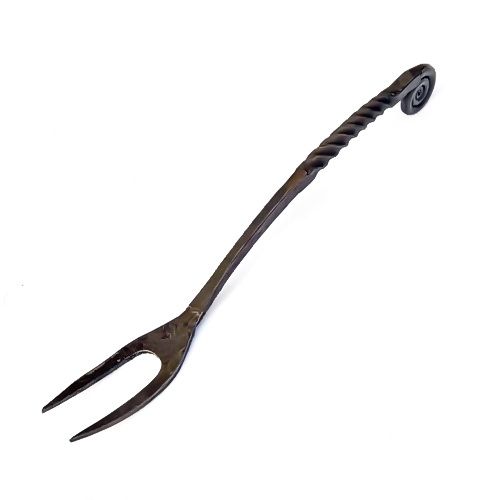
The fork as a kitchen and dining utensil is generally believed to have originated in the Roman Empire, as proved by archaeological evidences. In the Roman Empire bronze and silver forks were used, indeed many examples are displayed in museums around Europe. The use varied according to local customs, social class and the nature of food, but forks of the earlier periods were mostly used as cooking and serving utensils.
![]() |
| Ancient Roman serving fork |
The personal table fork was most likely invented in the Eastern Roman (Byzantine) Empire, where they were in common use by the 4th century (its origin may even go back to Ancient Greece, before the Roman period). Records show that by the 9th century a similar utensil known as a barjyn was in limited use in Persia within some elite circles. By the 10th century, the table fork was in common use throughout the Middle East.
![]() |
| Ancient Roman table fork |
![]() |
| Theophano S |
![]() |
| Byzantine fork |

By the 11th century, the table fork had become increasingly prevalent in the Italian peninsula. It gained a following in Italy before any other Western European region because of historical ties with Byzantium, and continued to gain popularity due to the increasing presence of pasta in the Italian diet. At first, pasta was consumed using a long wooden spike, but this eventually evolved into three spikes, a design better suited to gathering the noodles. In Italy, it became commonplace by the 14th century and was almost universally used by the merchant and upper classes by 1600. It was proper for a guest to arrive with his own fork and spoon enclosed in a box called a cadena; this usage was introduced to the French court with Catherine de Medicis entourage.
![]() |
| cutlery with Medici coat of arms |
![]() |
| Catherine de Medici |
![]() |
| French cutlery |

In the 1500s the Europeans began to use a fork instead of the wooden spoons or the fingers. People at court in England had small fine boxes with their personal cutlery, but according to a British food columnist Bee Wilson (consider the fork - a history of invention in the kitchen there is a French satirically sketch from 1604 which show people who use a fork as sexual misfits). Wilson also has an interesting consideration that the use of knife and fork had an influence on the dentition. Before the use of fork people bit chunks of meat off with their teeth but with the fork they could eat the meat in small bites. This trained the muscles in the jaw in a various way - and during the 1600s the Italian nobility began using the fork and then France and Britain gave up to the fork while the Scandinavian waited until the beginning of the 1700s.
![]() |
| Medieval fork |
![]() |
| cutlery 1700s. |
![]() |
| Edward 1. |
In Denmark there was no major spread until the time of Christian IV,
one of the reasons of this restraint was the hostile attitude of the
church which claimed that Christ had used his fingers when heate.
And a strange warning was found in one of Luther's writings: "God keep
you from a stab by a fork for it makes three holes!" A fortable
fork was a rare thing in Denmark 400 years ago. | Danish table 1700s, "Den Gamle By", Århus |
King Christian IV noted
in his diary that he had bought a knife and a fork of gold with
diamonds from two Frenchmen - a very unusual buy. Christian IV was
probably won for the new utensil during his travels in Europe where the
fork was taking hold The high ranks in Denmark followed him, but it
took still one hundred years before this modern table utensil was
accepted in the broader ranks. People still managed well in the old way
- the old five fingered fork and a pointed knife.
![]() |
| various forks |
Skalk Jan Koch, Danish archaeological magazine,1979, "Den skæve gaffel" Ellen Andersen, bordskik, 1971. Erik Kjersgaard: Mad og øl i Danmarks middelalder, 1978.
English Wikipedia, and wikipedia photos.
Thursday, August 18, 2016
Flax/ Linseed (DK: Hør/ Hørfrø)
![]() |
| Asian Flax/photo Høvblege, Møn:gb |
Linum usitatissimum
var. humile = linseed (oliehør)
var. vulgare = flax (textile flax)
![]() |
| Wild flax (wikipedia) |
History and Folkore about Flax/Linen in Denmark
(source: Brøndegaard, Folk og Flora, Dansk Etnobotanik)
![]() |
| linseeds (wikipedia) |
At the Danish island of Bornholm were in clay pots found prints of linseeds from Bronze Age. Finds of yarn and linen fabrics from the same period were probably imported wares. Linseed was probably cultivated at Bornholm in Bronze Age 800-400 BC as a nutrition. ( - eating the oilrich seeds evt. mixed with barley). From early Roman Iron Age are known several imprints of linseeds in claypots, mostly together with barley and burnt seeds.
![]() |
| Tollundman, Silkeborg Museum( photo SBN/GB) |
From the time before 1 BC are not known any finds of Danish cultivated flax. The textile flax must have arrived to Denmark from eastern Europe. Flax was in the 1200s used as a payment of medium of exchange. Already towards the end of the Middle Ages the cultivation had reached an extent. In 1312 taxes were paid from flax in Århus district. Not until ab. 1400 it seems that linen was of importance as a commercial product. The linen was in the Middle Ages used for towels, dishtowels, cloths, curtains, rugs (esp. a cover for horses), sacks and purses.
![]() |
| 14th century, depicting linen, wikipedia |
In 1506 the Jutland farmers objected to pay taxes of flax( flax was not corn) but the magistrate was against them. Provisions for the linseed production were found in many city laws. The linseed farm had to be securely fenced etc. Before and during the Absolutism the government tried with regulations to support and expand the breeding.
![]() |
| Flax, Open Air Museum in Brede, Zealand(wikipedia) |
The government urged from 1748 people
![]() |
| Linen laid out for bleaching in field,( J.Th. Lundbye). |
The farming of linseed had a big upturn during WWI an WWII.
Rules about sowing
![]() |
| The sower, van Gogh, Wikipedia |
The farmer had to sow linseed on the 100th day of the year = 10 april. Then the growth would succeed best and avoid frost damage - or he might sow on the 1. of May - or in the first half of May. The 16th of May was called "linseed day" or "Saras day". If the seeds were sown on a Saturday the wearer of the linen would get lice. The seeds had to be sown close to the farm so the seeds could hear the gate creak!
The sower had to creep while he was sowing the linseeds, women must not sow , they were only allowed to look - or the sower had to roll up his pants high, and he had to walk on his toes or swing his legs as high as he wished the linen to grow, and keep his head high and throw the rest of a handful of seeds over a horse's head.
Superstition
![]() |
| Medieval woodcut, wikipedia |
If a May branch was put in a flax field on Midsummer's day the trolls would stay away.
A flax field was a very pretty sight when it was blooming like a big light blue carpet and flax was almost considered a sacred plant because baby Jesus was swept in linen. Women had to curtsey respectfully when they passed the flax field
A swarm of bees must not be pursured in the flax field.
The evening before Walpurgis day linseed had to be strewn around the farm against witchcraft and trolls. To avoid sickness in cattle linseed and earth from the church yard had to be strewn in the stable and put in a cross over the back and head of the cow. Linseed upon the beams of the stable healed sick pigs.
The seeds were a part of the fodder for bewitched chickens .

People were protected against ghosts when they carried a bag with linseed, magistrantia and fly-rowan. This was effective against ghosts, spectres and other supernatural beings. Against nightmares people strew linseed upon the treshold and went backwards to bed
Linseeds in the coffin tied the dead to the grave, but if the seeds were put in the coffin before the body, they worked opposite.
Linseeds put in the pillow for newborn children made them bright and healthy.
![]() |
| Old Medicine, Viborg Museum, photo gb. |
The seeds crushed with salt heals snake bites. Crushed with incense in water and rubbed on watery eyes. Burnt seeds mixed with oil and butter on pillow against hair loss.
Henrik Smid 1546: Decoct of seeds with honey in water internally and the cooked seeds as a cover for intern diseases. Linseed oil rubbed on stomach against colics. Linseeds or the oil rubbed on burns.
Simon Paulli 1648: Crushed seeds cooked in milch or water upon swellings. Raw flax yarn cooked in lye as a cover, easing lower back pain caused by blatterstone.
The linseeds were written into the Pharmacopoeia in 1722
![]() |
| Medieval pharmacy, wikipedia |
Domestic animals.
Linseed and linseed oil were used for cattle, horse, dogs, sheep and chicken.
Source: Brøndegaard, Dansk Etnobotanik Folk og Flora
Photo: grethe bachmann
Photo Copy:wikipedia
______________________________________________________
For further info about flax/ linseed see English Wikipedia.
Sunday, August 14, 2016
The first morning on a holiday tour to the Thy district...
On a country road through Himmerland
On our way to Thy via Himmerland and Aggersund we passed a fine little Romanesque church, Stenild church, by the country road, built in pretty carved granite ashlars. The broad tower was in red bricks and ashlars.The earliest artifact in the church is a very large Romanesque granite baptismal font, a socalled lion font with impressive reliefs of lions. Between the lions are reliefs of human faces. The church has two bells, one from John Taylor and Co, England in 1959, and the other from Århus in 1651.
Aggersund Bridge, a connection between Himmerland and Thy.
The bridge at Aggersund is from 1942. It is a pretty arch bridge with a double link span in the middle, which is opened by the watchman, when ships pass Aggersund on their way to and fro the town of Aalborg. The bridge has a fine placement in the flat landscape in the western and narrowest part of the Limfjorden
A view to a Salt Marsh by Aggersund
A salt march is marked by the nearness of the sea. The air-contents of salt is high, and the marsh is often flooded by heavy winter storms. This causes a flora, dominated by species which can tolerate salt. The salt marshes are habitats for waders, ducks and seagulls. In the winter they are also a foraging area for some birds of prey.
The Danish salt marshes are protected nature types. They represent only 1% of the total area in Denmark. The increased interest for and the increased funding for landscaping has resulted in a positive development of the management of the Forest and Nature Agency's areas of the salt marshes. In several places are planned or carried through nature restoration of earlier salt marches.
After the Aggersund Bridge we have left the Himmerland district - and we are now in Thy, which among many other things has a National Park -and not at least the North Sea!
Coffee break at Aggersborg, a very special place with one of the Danish Viking Trelleborgs, Aggersborg. There is no castle or buildings left, only a large circular grassy site.
Aggersborg is the largest Viking fortress in Denmark with an inner diameter of 240 meter. The whole plan along the outer edge of the moat is 299 meter broad. The site is difficult to date since underneath is a village with houses from German Iron Age, but it was probably built approximately the same time as the other trelleborgs in Denmark, most likely around year 980, when Harald Bluetooth and/ or Svend Forkbeard ruled the country. The fortress was built during 1-2 years and was only used for about 5-20 years.The situation of Aggersborg was a protected one and yet accessible by ship. This should be considered in the light of that the Limfjorden at this time was open for ships in three directions: west, east like today, but also to the north through the access Sløjen. Besides this the Aggersborg was placed by one of the three passages of the ancient Hærvej across the Limfjorden. It is not known if Aggersborg was a power center for control of trade and internal feuds, or if it was a barrack/ training camp in connection to Svend Forkbeard's raids to England.
Here you can see a piece of the circle. On the photo of the Aggersborggård you can see the whole circle of Aggersborg from air.
Among many archaeological finds at Aggersborg was a fine and heavy gold bracelet. (now at the National Museum) A copy of the bracelet is at the Minimuseum at Aggersborg.
Aggersborggård is a Danish manor which history goes farthest back in time, to the year 1086. Aggersborg was a king's manor from 1086 till 1579. The present farm lies in the edge of the moat of the Viking fortress Aggersborg. 
Aggersborg kirke
North of the mighty Aggersborg site lies Aggersborg kirke, probably built in the 1100s. On the walls of the church are some runic inscriptions. The church is open daily.
Minimuseum by the church. There are no traces of the Viking longhouses on the site but north of Aggersborg by the church lies a small museum where it is shown how the fortress looked and how the longhouses were built.

photo August 2016 : grethe bachmann
gold bracelet and Aggersborggård: wikipedia.
Wednesday, June 29, 2016
34 Griffon vultures went on a Summer Holiday in Denmark
![]() |
| Griffon vulture (from wikipedia) |
34 griffon vultures arrived last week for some days to the North Jutland village of Volsted south of Aalborg. This is really a rare event. Only about six griffon vultures have been since in Denmark since 1858.
Usually there are no griffons in Denmark. They live in the Spanish mountains and in South Eastern Europe, but sometimes they might fly north with the summer heat. Flocks have been located in Holland .
The 34 griffons in North Jutland are probably young birds from last year - and they might fly south again when it gets cold in DK. They cannot find much food here, there are no carrions out in the Danish fields.
The griffon vulture is black, brown and white with a wingspan about 2,8 meter and a weight of ca. 11,3 kilo.
source: various articles in the Danish News.
Tuesday, June 28, 2016
Beekeeping and the Sweet Honey Bee
![]() |
| honey bee/apis |
![]() |
| beehives in France |
The type of honey can always be determined by examination of the pollen grains in the product.
![]() |
| bee carrying pollen |
flower honey ( mild with a fine characteristic scent)
forest honey (dark, neutrally sweet)
heather honey (dark and spicy)
herb-honey (each spice delivers a dark and very characteristic honey)
rape-honey (very mild, light with a quick crystallization)
clover-honey (mild, light and with a gentle taste).
![]() |
| Beekeeper |
Honey is used as a herbal medicine but mostly in German-speaking countries, where they have a long tradition to value the preventive effect on the health. It was known since antiquity that honey works antiseptic - and the Egyptians used honey for treating wounds.
The content of antioxidants enzymes, vitamins and minerals make honey a more healthy product than pure sugar.
![]() |
| a jar of honey |
Before humans made sugar from sugar cane, honey was a very important and sought for sweetener, and often the only one known. Today honey is used as a laying on and as a sweetener which brings a characteristic mild taste to dishes, desserts, cakes, candy and drinks.
Globally are more than 20.000 species of wild bees.
Harvesting honey from wild bees is one of the earliest human activities and is still being practized in some native societies i Africa, Australia and South America. Beekeeping was known by humans for thousands of years. At some point humans began to attempt to domesticate wild bees in artificial hives made from hollow logs, wooden boxes, pottery vessels, and woven straw baskets or "skeps". Traces of beeswax are found in pot sherds throughout the Middle East beginning about 7000 BCE.
According to legend the Irish Saint Modomnoc introduced the beekeeping in Ireland in the 500s.
![]() |
| cave painting, 15.000 years ago |
![]() |
| stele, Mesopotamia 760 BCE |
In ancient Greece the god Aristaios was the shepherd god for beehives. Beekeeping was also very specifically addressed by the Roman writers of antiquitiy like Virgil, and the life of the bees were described by Aristoteles.
In prehistoric Greece (Crete and Mycenae), there existed a system of high-status apiculture, as can be concluded from the finds of hives, smoking pots, honey extractors and other beekeeping paraphernalia in Knossos. Beekeeping was considered a highly valued industry controlled by beekeeping overseers—owners of gold rings depicting apiculture scenes.
Archaeological finds relating to beekeeping have been discovered at Bronze and Iron Age archaeological sites in Israel in the ruins of a city dating from about 900 BCE. Beekeeping has also been practiced in ancient China since antiquity. In the book "Golden Rules of Business Success" written by Fan Li (or Tao Zhu Gong) there are sections describing the art of beekeeping, stressing the importance of the quality of the wooden box used and how this can affect the quality of the honey.
![]() |
| P. Bruegel 1568: Beekeepers. |
![]() |
| Beekeeping, 14th century |
It wasn't until the 18th century that European understanding of the colonies and biology of bees allowed the construction of the moveable comb hive so that honey could be harvested without destroying the entire colony.
Labels:
archaeology,
bee,
beehive,
beekeeping,
history,
honey,
honey bee,
literature
Subscribe to:
Posts (Atom)