A lovely nature area along the northern coast of Horsens fjord was preserved since the 1970s. Here is a varied landscape with a rich flora and fauna . The meadows, the heath and the pastures have all a high landscape-value, they create a comprehensive variation, and they are the home of a richness of plants and animals, who prefer the uncultivated open land. Earlier were the areas grazed, and it is necessary still to nourish them to keep the nature areas open.
The hilly area in Uldrup and Sondrup is one of the prettiest hillsides in Jutland. The coast along the fjord is low-watered , especially outside the island Vorsø. The flat meadows are raised sea bed from the Stone Age Sea. By the coast of Uldrup hills and Sondrup beach are high cliffs close to the coast.
The flora is varied, about 450 species were recently registered, which is 1/4 of all species in Denmark. In the forests are beech, oak, ash, conifer, and in the Brigsted area large orchards. Along the ditches by the manor Åkær are in springtime broad belts of red butterbur with their large rhubarb-like leaves. This dock is called
Pestilensurt and was used to cure wounds in the Middle Ages. In the beach meadows along the coasts is a pink sheen from thousands of sea pink, and in high summer along the fields and roads is the yellow bedstraw, the white yarrow and the fine butter-yellow toadflax. On the hills at Uldrup is the pretty purple pasqueflower. near old houses are soap-wort and hops. The hop often climbs the trees. It was earlier used for brewing beer.
The bird life is rich; lapwing, redshank and yellow wagtail are breeding here, the kestrel is hovering above the beach meadow, where avocet and common snipe breed. In the alder-thicket along the water streams is the nightingale and the song thrush. On the preserved island Vorsø is a large colony of cormorants, and this special black bird is often seen by the fjord. In the hills are green woodpecker, Honey buzzard, common buzzard and oriole. In the migration period arrive the eider, the greylag goose and the brentgoose to the coasts of Horsens fjord.
In the hills near Søvind are old marl pits, they are now ponds and the habitat of rare amphibians.

The Highlanders, curious or astonished? Probably the last, seeing this strange person climbing the slope to point at them with some black thing and saying something. "Hello, how are you?"
But where are the geese? They were here last year.........

- oh, they are now grazing a large field by a small pond. The gander looks like the same gander from last year, so his life did not end last November, but it's soon Morten's evening....

The sheep kept the geese company without difficulties, it seemed. They were almost dressed in autumn colours, their wool looks fine, maybe useful for the costy knitting yarn.

The narrow country road continued. There were no possibilities of getting into the beautiful forest in the hills today, it was closed for the public; it's a hunting day all over the country. The hunters are all over the forest. I'm a hunter with camera, but this doesn't count, and I won't go into the wood and get shot by some other sort of hunter.............

And then this big venerable oak stood there on a hill by the road drawing attention.


A break at a beautiful place near Søvind. There were some ponies, one of them had a sweet fole. They were very sleepy, both mother and kid. Did not worry about intruders. The place was charming with little soft rises in the terrain, and with a row of pollarded willow trees. There was a sun haze in the background - we're on the edge of October and on our way into November - and we'll now change the clock to winter time.

Peacefully walking the road, unaware that someone is printing them on nature's canvas.

And now we're at the Brigsted area, close to the meadows by the coast, and here is some butterfat cattle grazing the salty grass - they look so healthy.

There was a bull and he looked a little cross. He'll have to take care of the whole field of course.

But he decided there was no danger....

- and continued the grazing with all his wives. What a sheik!
I don't know what kind of cattle this is. I guess it's some valuable meat cattle.
I'll try to google.

There are many fruit orchards in this nature reserve. Here's apples. lots of apples.

The hunters were also here at Brigsted. Maybe going for ducks or pheasants. Hurry away birds! Hurry!


The stone heaps mark the wading path to the island Vorsø. To the right traces of a car on the driving route.
The preserved island Vorsø is about 62 ha. It has an edge of low beach meadows and a low-watered coast. The island belongs to the Miljøministeriet. The preservation-history and the island's status as a living biological laboratory makes it interesting beyond the borders of the country.
There is a large cormorant-colony at the island. The cormorant was totally listed in Denmark since 1979. Flora and fauna live without human interference. There are rare plants and animals. The development is followed and registered by nature supervisor Jens Gregersen, who lives with his family on the island as the only inhabitants. In the middle of the island is a field station and a habitation.
Jens Gregersen is a fine artist (bird and nature)with several exhibitions and books about birds.
Vorsø

There's much water in the beach meadows.

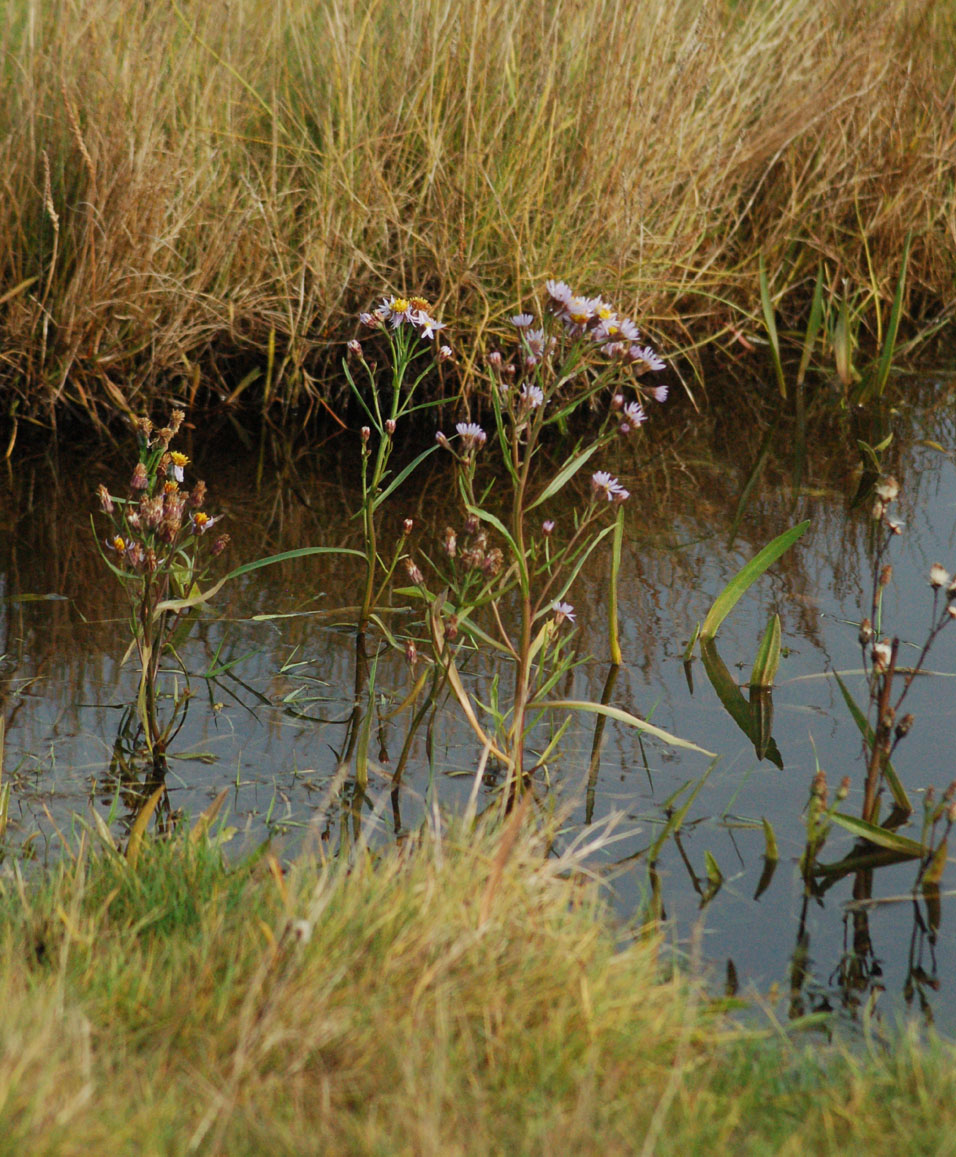
One strandasters (Aster trifolium) was still blooming.

It's always exciting to see what's on the beach . The Stone Age people have probably eaten lots of mussels. There are many kitchen middens along the coast with rests of their food habits.

The sun stands low at this time of the year, giving a golden light, which is so magnificent. This day has been so beautiful that I shall not complain and quarrel about my longing for spring! Not today!

And then I saw them, the poplars. This is Monet! He would have loved them!
 Poplars, Epte near Giverny
Claude Monet
Have a nice day, have a nice Halloween!
Poplars, Epte near Giverny
Claude Monet
Have a nice day, have a nice Halloween!
 photo 30 October 2010: grethe bachmann

 Once again a visit to the small island Alrø in Horsens fjord, the latest couple of visits for the same reason, to see the white tailed eagle, who's always in another place anyway, when we're there - probably sitting on the island of Vorsø, which has got public access for birds only. But it's good to be out in the countryside to get some fresh air instead of the black city air, and the narrow country roads are not very traffic. Although it's a part of our neighbourhood close to Århus then there are still places, we haven't seen yet. In the winter season we take relative short trips. As you can see the day is dark, and the day is short too . The light is quickly disappearing in the afternoon, and it is cold to be out for long.
 Two horses in a field often walk together. I think they like company. I feel pity with a horse who's quite alone. Maybe I'm wrong? Well, two friends, those two horses. The landscape shows that the snow is still here. We've got rid of it in town, this happens quickly, already while it is snowing - and often in the middle of the night. I can hear the snowmen driving through the streets and in front of our building to remove the snow. They really have to get up early. In the country the snow stays put except on the traffic roads. I wouldn't be able to live in a house in the country. Furthermore there are no shops.
 But in this district there is one little village after another, and I took some photos along the way of farms and houses - it was funny, because there were so many halftimbered houses in black and white. Maybe they copy each other. The big halftimbered black and white house is a vicarage. Many priests live in a pretty vicarage, but it's not sunny days always to be a priest. They've got many obligations. A priest is dependent on the parish council and what they decide. If the council don't like their new vicar they can make life difficult for him. I can imagine it's not an easy job to be a priest, and his wife has to be an outgoing and social person. No, the pretty vicarage might be dearly bought!


 woolen under-fur, which isolates against both cold and heat. The cover-hair is water-repellent. The original Scottish Galloway is lesser than the Amercian. The Scottish bull weighs about 700-800 kilos. The Galloways are peaceful and easy to deal with, but if the flock is threatened, they stick together and form a united front against the enemy.


 season. If an animal is run over by a car, it won't last long before it has disappeared, if there's a predator in the neighbourhood. The birds of prey are among Nature's garbage men.


 Some of the ice on the fjord had been pushed into frozen waves and looked like whipped cream. There was not a bird to see anywhere, not even geese and
  swans on the fields. There was nothing to eat. The grass was frozen too. Only one car when we came out to the only parking place in the southern end of the island. A young couple tried to take a little walk. The wind made it colder and they gave up after five minutes. I gave up after almost the same and sat in the car drinking thermo-coffee and eating the traditional Wiener-Pecan-cake. Many birds gathered along an opening in the ice far out. The white-tailed eagle was probably on the next island, also too far away.