Showing posts with label bird. Show all posts

Wednesday, November 28, 2012

The Days are short when you reach November.......

yes, the lyrics of the "September Song" can be changed like the weather.........

the fog has almost gone


What shall I take care of this winter in order to stay healthy? There are always so many warnings everywhere and it is so difficult to remember it all, isn't it?
.
"Winter can have a pretty big impact on our physical health and emotional health,” said Dr. Conrad Iber, director of the Fairview sleep program at the University of Minnesota Medical Center.

a low gravehill with trees.
farm in November sun


"Remember to drink lots of water, eat more whole grains and more vegetables and be physically active, your bedroom has to be cold, you'll become more grumpy, because there's less sunlight, it might be a good idea to get a sunlight lamp, do some exercise, socialize, eat plenty of fruits and vegetables, rich in D- vitamin,  it's prime time for colds and flu, again remember a balanced diet, exercise, fresh air and adequate sleep. Get a flu shot. And then here's something I wasn't aware of:  your body adapts to the cold by shifting more blood flow to interior organs and away from your hands, feet and face. So that's what happens!.... again remember exercise and a good diet, wear layers, cover your wrists, ankels and head, when you're outside on cold days".

I promise I'll try to remember everything.
Btw: I have got a flu shot ...........

cattle enjoying still being out...


 oak with  leaves down to the ground, (enlarge).


When all this has been said I went out Saturday to see what was happening outside on a cold day in November. It was not very cold . The cold of winter will arrive on the last day of November, on Friday the 30. "Make no sorrow in advance" is an old saying. The weather people might be wrong. I'm not ready for snow.


well-dressed hunters
old kloster church, Tvilum


It was very foggy that morning, at least here in Århus and East Jutland. There was no sign of a blue heaven and I couldn't imagine it might be any better. It's actually a great help that we can look at the satelite on the net and see where to go. "There are no clouds to the north!"  So we took the north-road hoping for a little sunlight on this short afternoon. It took almost an hour before we were out of the fog, and the sun came through the haze and threw a golden light upon the landscape.


flowing lines


Gudenaa River Valley, at Sminge


landscape with windmills, Tvilum


I always take some photos while we're driving, which probably is obvious but I use them anyway because they can tell a little about my country. All seasons have their charm. November is reflective, now the year has almost passed, and we are going into a long winter, summer feels far away now, and we'll have to wait almost half a year before we'll see it again. Although the days grow shorter, there is a special light in the day hours when the sun is low. It's this golden light we can see in summer on a late afternoon. I love that golden light. Hours like this makes me wish that I lived in a cosy house out in the country, where I could meet the nature from morning til noon. But I'm a city girl. The countryside is not always so romantic, muddy roads and smell from the swine farms ..........
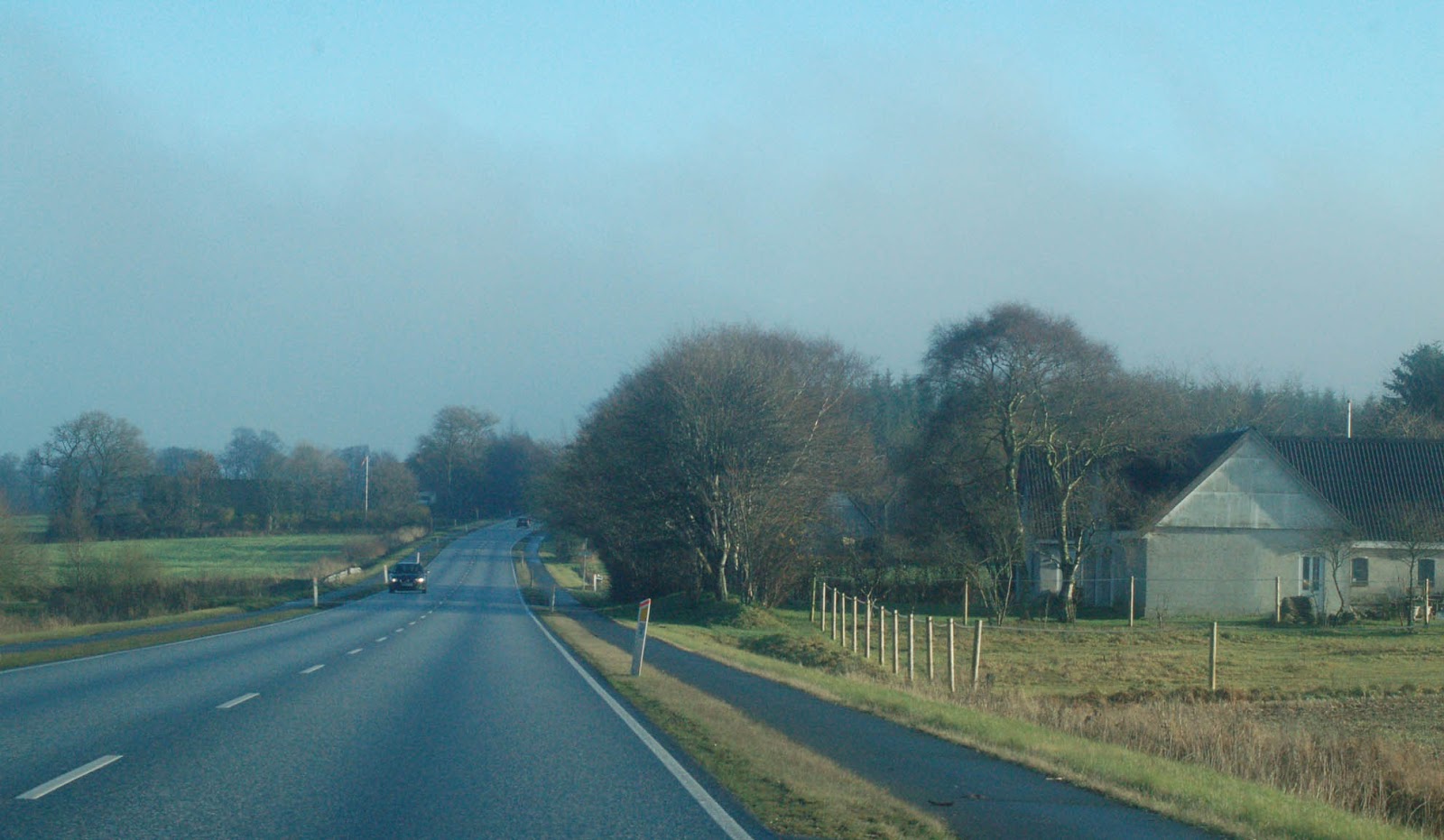
now we're going back home....


 - but we were surprised by a strange change of weather, suddenly dark clouds came close to the ground and surrounded everything with a mysterious dark haze. We could see the lake, but it looked like something from the Arthurian saga, we'll go down and await the boat from Avalon.....


Well, let's go back to reality. What stuff are dreams made of anyway? 

Before reaching home we took a side-trip to a lake close by my home, where a rare bird has visited Denmark for some weeks. This bird has been in Denmark twice and in Europe five times, it comes from far away, from Asia. It's the Brown Shrike - and I'm sure this is now the most photographed "person" in Denmark beside Crownprincess Mary. The birdwatchers come from abroad too. I haven't got a photo yet. I've been promised one and I'll bring it on the blog for those who are interested. But I did see this little fine bird - eventually. First I was staring at a pole with a spot in the top. This was not the right pole, but then I saw the little famous star just before it jumped down into the grass.

See you see soon again. I've been on Amled's Heath with Prince Hamlet's grave. I'll show you later.  


Looking for the Brown Shrike.

the bird is here - somewhere........

photo 24.November 2012: grethe bachmann 


Tuesday, October 26, 2010

The Quill / The Goose Pen


The number of geese in Denmark was in 1800 estimated to ab. 123.00, but in the first livestock-counting in 1888 was registered 213.530 geese. The largest part of geese was driven down through the Jutland peninsula for sale in Sønderjylland and at Funen. The slowly walking geese could at most walk ab. 14-15 km a day and if a geese became too tired, it had to be carried!

The geese were kept for delivering food for the table, but also in order to provide feather and down for pillows and duvets. 200 geese were necessary to deliver feathers and downs for a one bed-clothes. But the feathers were used for other things too, as toothpicks, pipe cleaners and as a paint brush for oil-brushing the breads before baking. The long stiff flight feathers were fine in a duster, and the ribbed feathers could be tied in bundles as scrubbing brush for pots and pans.

The Quill

The large flight feathers were through many centuries used as writing materials. With a special pen-knife the end of the feather was cut off slantwise. The tip was not slit; if the line had to be thicker, then this did not happen by pressing harder, but by giving the feather a turn, so the ink could float out broader.

In several districts the farmers had a duty to deliver suitable goose feathers for the parish school. The school pens were cut by the teacher - but the tip soon lost its elasticity and had to be cut again. The pen feathers were an export article.

The quill was an excellent writing tool. The old documents with their tortuous initials with elegant sweeps show this clearly. The history of the goose-pen can be traced back to the 400s, where they replaced the thin metal-pens in copper or bronze, which were known by the Romans. From the Mediterranean the quill spread across Europe and arrived in the North together with the Latin script and the parchment.

The steel-pen with a slit was invented in the late 1700s, but not mass-produced until ab. 1830. This happened in Birminghan and developed into a good business for the enterprising manufacturer. The feather pen was during a few decades almost out-competed, and in 1880 the production had grown to 15 million steel-pens a week.

In linguistic history we still write with the goose-pen, since the word pen origins from Latin, "penna" meaning feather.

Source: Skalk, archaeological magazine, nr. 5, 1989, V.J.Brøndegaard.


photo: grethe bachmann

Friday, December 25, 2009

Yellow Wagtail/Gul Vipstjert

Motacilla flava


The Yellow Wagtail is a small passerine in the wagtail family Motacillidae, which also includes the pipits and longclaws.This species breeds in much of temperate Europe and Asia and has a foothold in North America in Alaska. It is resident in the milder parts of its range, such as western Europe, but northern and eastern populations migrate to Africa and southern Asia.
Yellow wagtail is like the other wagtails characterized byt its long tail, which gave the bird its name. There are various species with very varied looks, but what is shared is the male bird's yellow belly and olive back, the belly of the female birds is light yellow. The head pattern of the male is various in various species. The most common wagtail in Denmark is yellow wagtail (M.flava) with a blue-grey head with a clear white eye and beard-stripe. The male of northern yellow wagtail (M.thunbergi) which is a common migrating bird in Denmark, lacks the white eyestripe, and the head is darker than the common yellow wagtail. The male of yellow-headed yellow wagtail (M. flavissima) which is sporadicly seen in West Jutland, has an olive head with a yellow eye stripe. Neighbouring wagtails differ most, maybe because the female bird prefers the male of their own species with the clearest features - pairs of the same species have a better breeding succes than mixed pairs.
In Denmark the wagtail mostly breeds in meadows with a low grass growth, mainly along the coast and at fjorde with beach meadows. It also breeds in inland moors. The largest population in Denmark is at the birds' sanctuaries Vejlerne and Tipperne in North Jutland and at coast areas near Copenhagen and along the bay of Køge. The Danish breeding birds mainly belong to common Yellow Wagtail.
In migrations time the northern Yellow Wagtail is a common guest in Denmark. It is seen at the migration areas or resting at meadows and large grass areas, i.e. golf courses all over the country. The European wagtails overwinter in tropical Africa, while the East Asian wagtails overwinter i India and South East Asia.
The yellow wagtail's food is insects which it catches upon the ground or in the air. Lesser flocks can hunt mosquitoes in the morning- and evening hours above waters, while they in the day hours separately hunt manure flies which gets easily started from cow pats. The long tail supports the balance when the bird catches insects in the air or while running on the ground.
The yellow wagtail has declined as a breeding bird in Denmark during the last decades. This is due to that its preferred habitat, grazed moist areas have decreased either by draining, cultivating or overgrowth.
Dansk Ornitologisk Forening

Photo ⓒ Margrethekog, Vadehavet : grethe bachmann

Friday, December 18, 2009

Great Spotted Woodpecker/Stor Flagspætte


Great-spotted woodpecker/Stor Flagspætte

Dendrocopos major

The great-spotted woodpecker is a striking black and white bird with bright red under the tail. Males have a distinctive red patch on top of the head and young birds have a red crown. This bird is distributed over an immense range covering almost the entire Palearctic from Britain in the west to Japan in the east and reaching North Africa and the Canary Islands in the south-west. In recent times the great spotted has become the most familiar woodpecker due to regularly visiting bird tables in observer's gardens. The Great spotted woodpecker is an exciting garden visitor, and during the summer adult woodpeckers may be accompanied by their youngsters learning about the food available and how to obtain it.


In summer the great woodpecker live mainly of insects, especially caterpillars , in winter mostly of cones. A cone is harvested by the woodpecker holding it with one foot while attacking the stalk until it breaks. After wedging the cone in the anvil it is worked by rotation at regular intervals in order to obtain the seeds from all sides. An ornithologist recorded a single woodpecker which used two adjacent anvil trees and dealt with some 2000 cones in a single winter.

When hidden by the foliage, its presence is often advertised by the mechanical drumming, a vibrating rattle, produced by the rapidly repeated blows of strong bill upon a trunk or branch. This is not merely a mating call or challenge, but a signal of either sex. It is audible from a great distance, depending on the wind and the condition of the wood, a hollow bough naturally producing a louder note than living wood. The call is a sharp quet, quet.

Great woodpecker has like other woodpeckers some adjustments for its special habits. A unique cranium-construction does that the bird gets no concussion from drumming. This work combined with opening the cones in winter wear out the horn of the beak - and three beak-lengths are worn out during one year.

Great Woodpecker/Dansk Ornitologisk Forening

photo ⓒ 2007: grethe bachmann