Showing posts with label film. Show all posts

Tuesday, January 21, 2014

The Cheshire Cat


from 1866 publication Alice in Wonderland (wiki) 
The Cheshire Cat is one of many iconic characters depicted in Alice's Adventures in Wonderland that have become enmeshed in popular culture, appearing in various forms of media, from political cartoons to television. One of its distinguishing features is that from time to time it disappears, the last thing to be seen being its grin.

I love the Cheshire cat, a great invention by Lewis Caroll. Its behaviour by disappearing, only leaving its grin, is a very catty behaviour. But I wanted to know a little more about this famous cat and found that it is amazing how much the Cheshire Cat is involved in: Literature, Film, TV, Games, Amima, Manga, Businesses, Art, Comics. Lewis Caroll really did hit bull's eye with that cat.


 CARVINGS

carving, St.Nicolas Church, (wiki)

Where did Lewis Caroll catch
carving, St.Wilfried's Church, Cheshire (wiki)
that great idea? Many have guessed that it came from sandstone carvings on old churches. There is a carving of a cat on the tower of St Wilfried's church in Grappenhall, a neighbourhood of his birth place in Daresbury Cheshire, but some historians believe that his Cheshire cat was inspired by a carving in Croft church. In 1992 the Lewis Caroll Society wondered if a gargoyle on a pillar in St Nicolas church in Cranleigh, where Caroll used to travel when he lived in Guildford - or if a church in the village of Croft on Tees in the north east of England where his father had been rector - had inspired him. But seemingly it could not be the church in Cranleigh, since he moved to Guildford about three years after Alice in Wonderfland was published. The cat in Cranleigh is very similar to a very grinning Cheshire cat though. He might have been there anyway. He cannot tell us now. And according to someone, whom nobody knows, he had visited St Christopher's Church in Pott Shrigley, Cheshire, which has a stone sculpture most closely resembling the picturial cat in the book. There are many theories.


English Stone Masons in Jutland.
with a grin, Hedensted Church (grethe b)
without a grin, Hedensted church (grethe b)
Maybe the Cheshire Cat visited Denmark?. When all the stone churches were built in a relatively short period, there was a need of both men of the church and craftsmen, and the king sent for bishops and stone masons from England. Many Danish churches have got some fine carvings, some were made by English stone masons - and I have found two cats in a church in Hedensted in East Jutland. A cat with a grin and a cat without a grin. Maybe the stone mason came from Cheshire? What do you say about that? 


1898 edition (wiki)
Alice in Wonderland
Alice first encounters the Cheshire Cat at the Duchess' house in her kitchen, and then later outside on the branches of a tree, where it appears and disappears at will, engaging Alice in amusing but sometimes vexing conversation. The cat sometimes raises philosophical points that annoy or baffle Alice. It does, however, appear to cheer her up when it turns up suddenly at the Queen of Heart's croquet field, and when sentenced to death baffles everyone by having made its head appear without its body, sparking a massive argument between the executioner and the King and Queen of Hearts about whether something that does not have a body can indeed be beheaded. At one point, the cat disappears gradually until nothing is left but its grin, prompting Alice to remark that she has often seen a cat without a grin but never a grin without a cat


Adaptations
In the 1951 Disney animated film, Alice in Wonderland, the Cheshire Cat is depicted as an intelligent yet mischievous character that sometimes helps Alice and sometimes gets her into trouble. He frequently sings the first verse of the Jabberwocky poem.
Cheshire Cat made non-speaking cameos in House of Mouse.
Cheshire Cat has made multiple appearances in the video game series Kingdom hearts.
1999 TV film: In the 1999 television adaptation of the books, the Cheshire Cat is portrayed by Whoopi Goldberg. She fully acts as an ally and friend to Alice, the latter defending the cat when she is threatened with execution.
2010 film: The Cheshire Cat appears in Walt Disney's 2010 Alice in Wonderland, directed by Tim Burton. In the movie, Cheshire (as he is referred to by other Wonderland characters) first appears to Alice as she is walking alone in the forest. He helps her by binding the wound she suffered earlier by the Bandersnatch and taking her to the Hatter and the March Hare. He is later blamed by the Hatter for betraying him during the Red Queen's attack where the White Queen's throne was usurped. However, as the plot moves along, he redeems himself by changing his form to resemble the Hatter during his execution and then evaporates as the axe is about to make contact, thus fooling everyone as the Hatter's hat floats up to the Queen's seat and Cheshire appears and winks. In the video game adaptation of the movie, Cheshire is a playable character who can not only turn himself invisible, but other objects around him as well. The character was voiced by Stephen Fry.


Other references:
Prior to the release of the 1951 Walt Disney animated adaptation of the story, scholars observed few specific allusions to this character. Martin Gardner, author of The Annotated Alice, wondered if T.S.Eliot had the Cheshire Cat in mind when writing Morning at the Window but notes no other significant allusions in the pre-war period. Images of and references to the Cheshire Cat cropped up more frequently in the 1960s and 1970s, along with more frequent references to Carroll's works in general. (See generally the lyrics to White Rabbit by the rock group Jefferson Airplane. The Cheshire Cat appeared on LSD blotters as well as in song lyrics and popular fiction.

TELEVISION: The Cheshire Cat appears in Once upon a Time in Wonderland (a spin-off of Once Upon a Time) voiced by  Keith David. While looking for the Mad Hatter's house from the trees, Alice encounters the Cheshire Cat in giant form where the Red Queen had promised him that Alice would be good food for him. Both of them ended up engaging each other in combat until the Knave of Hearts arrived and threw a piece of one mushroom side into his mouth which shrank him back to normal size as the Cheshire Cat leaves.

 
ANIME and MANGA: In CLAMP's Miyuki-Chan in Wonderland, the Cheshire Cat appears as a sexy catgirl. In the Alice in the Country of Hearts or Heart no Kuni no Alice series of manga and anime the Cheshire Cat appears as a catboy punk called Boris Airay. He has tatoos and body piercings, wears exposing outfits, a collar and a chain and a boa. He also has a fetish with weapons, especially guns. In the series, like many of the other characters, he falls in love with Alice.
The villain Schrödinger in the manga Hellsing is described by his commanding officer the major as "the smiling cat of Wonderland".
In the anime and manga Pandora Hearts one of the main characters Alice had a pet cat that died, but returns 100 years later as a chain in a realm created by one of Alice's memories. He came to call himself the Cheshire Cat, and had a more human-like appearance or a catboy look.
 In the sixth episode of Serial Experiments Lain,  Lain refers to a Wired user with an avatar consisting of disembodied, wide-grinning lips as Cheshire Cat. Lain's friend, Alice, was named after the book's protagonist.
The Pokémon character Gengar has the Cheshire Cat's mischievous smile.
In the episode 'Haruhi in Wonderland' of the popular anime/manga Ouran High School Host Club, the twins Hikaru and Kaoru Hitachiin each dress up as the Cheshire Cat, allowing them to 'teleport' from one place to another. They keep up this charade until Haruhi tells them to come out. She cannot concentrate as they are making her dizzy.

ART: An exhibit called The Cheshire Cat at the Exploriatum in San Francisco, created by Bob Miller in 1978, features a mirrored eyepiece that allows visitors to look at a picture of the Cheshire Cat's face with one eye, while the other eye sees a reflection of a white screen to the side-
stuffed toy, Museum Indianapolis(wiki)

BUSINESSES:The Cheshire Cat lends its name to two public houses in the county of Cheshire; one near stockport and another on the a41 south of Chester.

COMICS: In DC Comics, the New Goddess Malice Vundabar, niece of the villain Virman Vundabar, resembles Alice and controls a carnivorous creature called Chessure, that looks like nothing more than a grinning face. Cheshire is also the codename of the human assassin Jade Nguyen, who has a daughter with the heroic archer Roy "Speedy" Harper.
In Marvel Comics, Cheshire Cat is a foe of Luke Cage. An ally of fellow Cage enemy Big Brother, Cheshire Cat is able to make himself invisible and teleport. His physical appearance and manner of speaking are both evocative of a classic hep cat., despite debuting in 1976.

Jabberwock (wiki)
FILM: "le fond de l'air est rouge" (1977), the English title Grin Without a Cat. Like the original, it signifies that revolution was in the air but failed to take root. In the film, it is also stated: a spearhead without a spear, a grin without a cat.
The late filmmaker Chris Marker gave his monumental documentary on the New Left Movement of 1967–1977,
The Disney version of the character can also be spotted during the final scene of the film Who framed Roger Rabbit (1988). The Cheshire Cat is heard singing the poem Jabberwocky before he materialises in front of Alice.

GAMES: The character Luka in video game Bayonetta is nicknamed "Cheshire" by the titular character, which is exhibited through his ability to appear or disappear at many locations throughout the game by use of a grappling hook.
American McGee (wiki)
In the video games American McGee's Alice (2000); and the sequel Alice: Madness Returns (2011), the Cheshire Cat is portrayed as an enigmatic, yet wise guide for Alice in the corrupted Wonderland. In keeping with the twisted tone of the game, the Cheshire Cat is mangy and emaciated in appearance. His voice was provided by Roger L. Jackson, who also voiced the Mad Hatter and the Jabberwocky in the game.
In the Disney/Square Enix video game series Kingdom Hearts, loosely based on the Alice books as a subsequent adventure, the Cheshire Cat offers Sora, Donald and Goofy clues to prove that the Heartless attempted to steal the Queen of Hearts' heart and not Alice, along with the blizzard spell.

MUSIC:Pop punk band Blink-182's debut studio album is called Cheshire Cat(1994).
Hypnogaja's  song "Looking glass" states that "There's a cat that smiles like the crescent moon".
Blood on the Dance Floor's "Where's My Wonderland" song makes a reference to the Cheshire Cat's smile.
The Cheshire Cat is part of the chorus of victim effect's "Alice Alice".
French singer Nolwenn Leroy produced the album Le Cheshire Cat et moi in (2009)
Radiohead's "Jigsaw Falling Into Place" contains the lyric "You've got a Cheshire cat grin".
Though never mentioned by name, the Cheshire Cat is a central character in vixy's "The Girl Who's Never Been".
The Cheshire Cat is in the Mad T Party at Disney's California Adventure park. He is portrayed after Chessur and is found onstage playing the drums.

 
PRINT: Cheshire cats is the name given to the widespread genetically engineered cats appearing in Paolo Bacigalupi's biopunk novel The Windup Girl (2009).
In Frank Beddor's The Looking Glass Wars series of novels, the Cat is Redd's top assassin. The Cat has butcher knife claws and can change from his true form to the form of a small black kitten. He initially has nine lives, but loses all but one by the end of the book.
In the  Thursday Next series by Jasper Fforde, the Cheshire Cat is an overseer in the Great Library, a library within the "book-world" which contains copies of every book ever written. However, due to "boundary changes", the Cat is renamed the "Unitary Authority of Warrington Cat".


Don't despair, take it easy, we're all mad here!


Source: wikipedia
photo Hedensted church, grethe bachmann
photocopies; wikipedia

Friday, October 05, 2012

Since 1962: My Name is Bond - James Bond ........


Sean Connery and the Aston Martin


Roger Moore and the Lotus Esprit


It seems I have ended up in a little corner of entertainment. Today it is 50 years since we saw the first James Bond-movie! 50 Years! Danish TV has been celebrating Bond a little this morning. While watching TV I had my porridge with blueberries and strong black coffee without sugar. Not Dry Martini with olives - shaked not stirred! No, not in the morning anyway.

Well, they had brought three fabulous Bond cars out in the open in front of the railway-station in Copenhagen: What a sight. I know that those cars are not good for the environment. But they are beautiful. What a design! The present owners of the cars represented them and told a little about them.

1) The owner of the Aston Martin  had bought the car 27 years ago, and he had paid about 72.000 kroner'
( that's about 10.000 dollars for it then). Now it's much more worth. He had just been on a holiday in England where he was driving it through the countryside and people recognized it. The Aston Martin was the first Bond-car, used in Goldfinger with Sean Connery. The Aston Martin was also in fx Goldeneye, Casino Royale etc.

 2) The Lotus Esprit was used in The Spy who Loved me  (1977) with the elegant Roger Moore. The Lotus Esprit was designed by Giorgetto Giugiaro and was featured in a long chase sequence converting into a submarine.The Lotus Esprit was also in For Your Eyes only.
Pierce Brosnan and the BMW

 3) The BMW from films like Tomorrow Never Dies with Pierce Brosnan, also in The World is not Enough etc.  .


We always see pretty models in bikinis sitting on the cars, but I think you should see three handsome guys instead - leaning up three beautiful cars. 


Congratulations James Bond - here's your Dry Martini!


Since I have started this Bond-talk, you might as well have a list of the Bond-movies:

Official James Bond films
  1. Dr. No (1962-Sean Connery)
  2. From Russia With Love (1963-Sean Connery)
  3. Goldfinger (1964-Sean Connery)
  4. Thunderball (1965-Sean Connery)
  5. You Only Live Twice (1967-Sean Connery)
  6. On Her Majesty's Secret Service (1969-George Lazenby)
  7. Diamonds Are Forever (1971-Sean Connery)
  8. Live and Let Die (1973-Roger Moore)
  9. The Man with the Golden Gun (1974-Roger Moore)
  10. The Spy Who Loved Me (1977-Roger Moore)
  11. Moonraker (1979-Roger Moore)
  12. For Your Eyes Only (1981-Roger Moore)
  13. Octopussy (1983-Roger Moore)
  14. A View to a Kill (1985-Roger Moore)
  15. The Living Daylights (1987-Timothy Dalton)
  16. Licence to Kill (1989-Timothy Dalton)
  17. GoldenEye (1995-Pierce Brosnan)
  18. Tomorrow Never Dies (1997-Pierce Brosnan)
  19. The World is Not Enough (1999-Pierce Brosnan)
  20. Die Another Day (2002-Pierce Brosnan)
  21. Casino Royale (2006-Daniel Craig)
  22. Quantum of Solace (2008-Daniel Craig)
  23. Skyfall (November 2012-Daniel Craig)

Tuesday, August 23, 2011

Bunuel, Dali and Lorca


A Filmmaker, a Painter and a Poet...........
 
Bunuel
In the beginning of the 1980s came an autobiography from Luis Bunuel," Mon
"Belle de Jour" Catherine Deneuve
dernier soupir"  (My Last Sigh). He was one of the great filmmakers with films like "Belle de Jour" and "The Discreet Charm of the Bourgeoisie" and many other films from his French period. Later in his life he was instructing films in Mexico for many years. He made himself noticed in 1929 with "Un Chien Andalou" ,a scary shortfilm, which he made together with Dali. They both claimed to be the creator of this film later on. Bunuel was from his youth socializing with a group of young people, who later became famous writers and painters. He was good friends with Salvador Dali and Federico Garcia Lorca.


Calanda
Luis was born in Calanda in Aragon in 1900. His father was a rich man, the owner of large properties in Calanda. Luis tells that his father did not do a day's work, he read newspapers, smoke Havanna cigars, drank wine, eat caviar, he had aperitif-time, lunch, a nap after dinner, change of dress, club, bridge, tresillo (card-game), friends, evening meal , theater, opera or operetta together with Luis' mother. The family's house in Calanda was built after the "bad taste" of that period, represented in Spain by the Catalonian painter and architect Gaudi.  His parents went often to Paris and came home with lots of gifts to the children. Luis had 4 sisters and 2 brothers. His father died in 1923 and Luis was now the head of the family. He left for Paris in 1925.

When he was 8 years old, he was in a cinema for the first time; besides a pianist was an explicador, who commented the plot of the movie. When he was 12, he still believed that the babies came from Paris. He began playing violin when he was 13, and a house maid carried the violin for him. He had some terrible doubts about religion, doomsday was an unbelievable scene with all those billions of people, and why the purgatory?  He went to a Catholic school by the Jesuit monks. A school day was from 7.30 till late afternoon. The school rooms were never heated, and the children wore big scarves, however they had frozen ears, hands and toes. The disciplin was very strict. Each misconduct was followed by a penalty, they had to lie on their knees with a heavy book on each hand  -  all day were they watched over by lynx-eyed guardians, they were never alone. Go to the bathroom alone was also forbidden - there was no contact between the pupils, they sat in two rows with a one meter distance and folded arms, silence, religion, Catechism, Latin, and a final  challenge, which was a contest on the day's lesson. In spite of the strict discipline the boys were boys.  He went to a café and drank some snaps, his two friends pretended to drink, but Luis drank and became sick, he saw double and was swaying, he fell on his knees during mass at school and threw up on the holy stone floor -  he was threatened with suspension.

children at Kalø Castle ruin
One summer Luis and his siblings and cousins went without permission to the neighbouring town Foz, dressed in fine clothes;  they went about 5 kilometer to the family-estates; they visited all of them and had sherry and pancakes in every place. They became gradually a little fuddled. On their way home they went into the church yard, where Luis lay down upon the inquest table and asked to be cut up. His sister's head got stuck in a hole by a grave. They went to some rock caves, where they foolhardily climbed the rocks and went through the tunnels with only an altar candle. They got lost, they were scared of the bats and were hungry. Luis offered chivalrously to sacrifice himself to be eaten by the others, but his sister Conchita asked on her crying knees that they should eat her instead, for she was the youngest and the most tender and the most stupid. They were found at last and brought home on a cart. Luis was unconscious, he had a sunstroke - or was it the drunk or was it tactics? For two whole days the parents adressed the children in the third person, but Luis heard his father proudly telling his guests about their adventure and about Luis' heroism.

Luis went to Madrid University in 1917 after his high-school certificate. He wanted to be a composer, to get away from Spain to Paris, but his father said no. "Composers die from hunger". He studied agriculture, changed to industrial engineer, then natural history and changed to philosophy, so he could get abroad. Luis was anarchist. King Alfonso 13 and queen Victoria visited the university. Luis was overawed, adressed him Majesty and was embarrassed afterwards, but then he discovered he had kept his hat on, so his honor was saved.
Luis' friends and aquaintances included many, who later became famous personalities. His good friends were Dali and Lorca. Federico Garcia Lorca was born in Granada in Andalusia in 1899. He drew people to him with his superior talents, his charm and deliberate elegance, when he sat down by the piano playing Chopin.  He was like a flame. No one could resist his magnetic charisma. He was the son of a landowner from Granada. Luis Bunuel and Lorca were inseparable, The clumsy Aragon and the elegant Andalusian. Lorca was neither effeminate or affected, and he became angry by the accusation maricon ( gay). In another source outside Bunuels autobiography is said that Lorca was openly homosexual.


Salvador Dali was from Catalonia, born in 1904 in  Figueras the son of a notary; he was called the Czech painter, and he had exhibitions already in 1926-27 in Madrid. When he had an examen from the art academy he pronounced: "No one present is able to judge me! Goodbye and thank you!" He was expelled. Dali was once thrown out from the family house by his father because he had written degrading words upon a painting of his mother.

Gala, Paul Eluards' wife, lived together with Dali for many years. When he and Gala were in USA, they went to a carnival where Gala was dressed as Charles Lindbergh's kidnapped baby. The Americans were furious. 

Dali had a meeting with three Mexicans at a café, where he referred them to talk with Gala. She demanded 10.000 dollars for an interview. "Dali's steak costs 10.000 dollars today," she said. Dali was often seen with a leopard in a gold braid. Later source: Salvador Dalí frequently traveled with his pet ocelot Babou, even bringing it aboard the luxury ocean liner, SS France.
His only real relationship was with Gala. His relations to rich American women were odd. He asked them to undress , then he placed a fried egg upon their shoulder and asked them to go back home again.
Dali was the most clumsy person. He had to be accompanied across the street, and he couldn't manage to buy tickets. " How do you do it?" He wrote in his autobiography that Luis Bunuel was an anarchist, and Luis was fired from New York's Museum, where he was in that period. Luis scolded him, and Dali answered: " I wrote the book to glorify myself - not you."

Luis married Jeanne in 1925 and was married to her the rest of his life. They had two sons. Bunuel lived for many years in Mexico where he instructed 21 films. He died in 1983 in Mexico. Dali died in 1989,  Gala died in 1982. After Gala's death,  lost Dalí much of his will to live. Lorca was executed in 1936 by the fascist milits.It is not known where he is buried.

This is a little of what Luis Bunuel has told. It would be too much to write more. There are other informations elsewhere. Many were involved in the group around Luis and the others, both from his youth in Madrid and later from Paris - Pablo Picasso, Andre Breton, Pedro Garfias, Appollinaire, Tanguy, Ugarte etc. etc. -  and there are deviant sources and deviant informations to find outside the words of Luis Bunuel, but so it has to be when it is about an autobiography. Different opinions from various people. How would it be if we wrote an autobiography?


I don't think I have done anything for money which I did not want to do. People cannot buy me to say yes, no matter how much money they offer. What I deny to do for a dollar, I will not do for a million. 

Luis Bunuel.


If you'd like to read about Spain and about the period of the surrealists then I can recommend Bunuels' book.

Source: Mit sidste suk, Luis Bunuel , 1982

Monday, June 28, 2010

Elvira Madigan and Sixten Sparre

A Tragic Romance


Troense, where Elvira Madigan and Sixten Sparre stayed in a guest-house, until they ran out of money.

She was born Hedvig Antoinette Isabella Eleonore Jensen in Flensburg in Germany. Her mother was a Norwegian circus performer and her father a Danish stablemaster. Her mother later lived with the American circus manager John Madigan. Elvira had her debut at five and performed as a line dancer together with her stepsister Gisella as the "Sisters Madigan" in 1886, when she was nineteen. They had an enormous success, they travelled from one triumph to another - in Paris, London, Berlin, Bruxelles, Amsterdam and Odessa.


The graves of Elvira Madigan and her lover Sixten Sparre.

While she in 1887 was in Sweden with her stepfather's circus, she met a Swedish cavalry officer, Lieutenant Count Bengt Edvard Sixten Sparre (27 September 1854 – 20 July 1889). Sparre was the son of a landowner and was married to a rich lady of the nobility, but he fell madlessly in love with the beautiful circus princess. They exchanged love letters for a year and ran away together to Denmark in June 1889, where they spent about a month at the island Tåsinge south of Funen. At last they had no money and could see no way out. They brought with them a picnic basket and went out to a forest south of Valdemar Slot, where they had a last meal and committed suicide in July 1889 with Sixten Sparres service revolver. Elvira was 21 years old and he was 35.


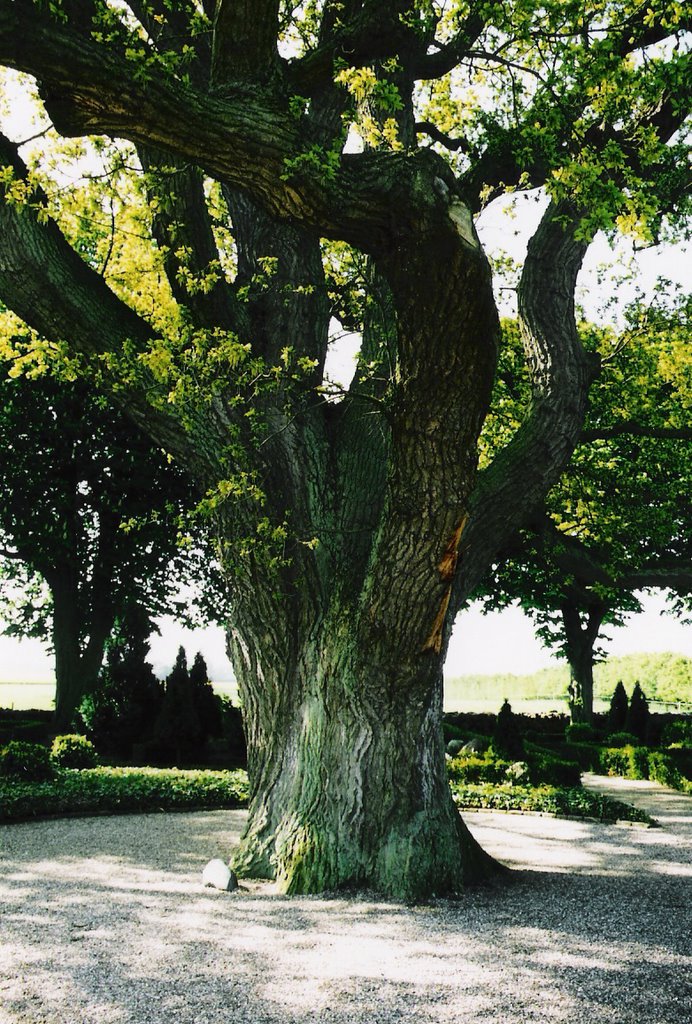
A shady 250 year old oak near the graves.

The graves of Elvira Madigan and Sixten Sparre grave are situated on Landet cemetary on the island Tåsinge and is still today visited by tourists from far and wide. Their tragic love story has some resemblance to the Austrian Mayerling drama, where Crown Prince Rudolph of Austria shot his mistress and himself in January 1889.

The romance, the suicide and the following scandal was both then and later hot stuff for journalists and writers. In 1967 Bo Widerberg revived the beautiful and sad story in his movie "Elvira Madigan", which is especially remembered for its music, the second movement of Mozarts piano concerto nr. 21, now often mentioned as "The Elvira Madigan".


photo Landet kirke, Tåsinge 1999:grethe bachmann