Showing posts with label jewelry. Show all posts

Saturday, February 17, 2018

Chatelaine - a keychain or a mistress of the house

Antique figure with chatelaine
chatelaine jewelry

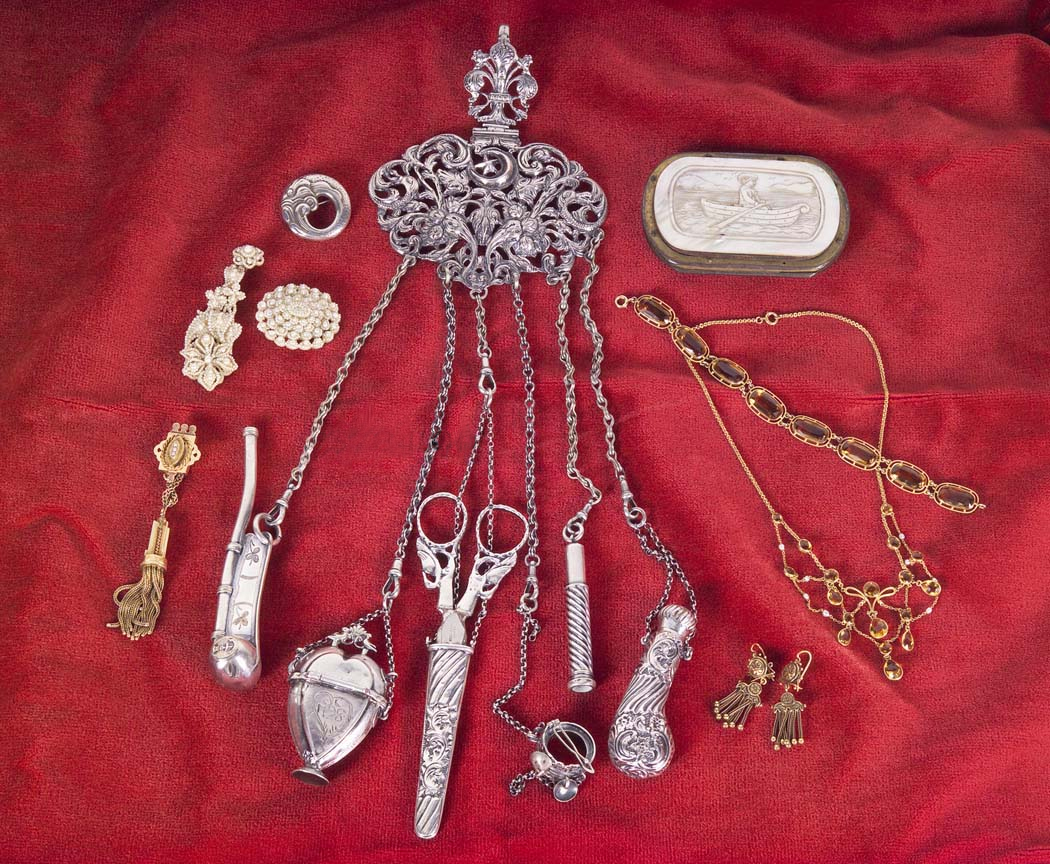
Named after the French word for "a lady who controls a great house," a chatelaine was the precursor to the keychain, the swiss army knife, the multitool, the tool belt etc. Attached to the waist of the dress, a chatelaine consisted of a series of chains from which hung keys, scissors, pen and paper, eyeglasses, whatever tools a lady thought necessary. They tended to be amazing pieces of jewelry.  Most major jewelers made or sold chatelaines, including Tiffany, Liberty,  Boucheron, Faberge and Lalique.

Chatelaines were quickly adopted by nurses and professional seamstresses who needed their tools handy. Purses were tiny and most dresses didn't have pockets. When pocket watches became all the rage, many chatelaines started out as watch chains with added accessories.


Each chain is mounted with useful household appendages such as scissors, thimbles, watches, keys, vinaigrette and household seals.The chatelaine was also used as a woman's keychain in the 19th century to show the status of women in a household. Similar jewelry was worn by Anglo-Saxon women, as seen from the
medieval chatelaine
burial record, but their function is uncertain. Chatelaines were worn by many housekeepers in the 19th century and in the 16th century Dutch Republic where they were typically used as watch chains for the most wealthy.  Ancient Roman women wore chatelaines with ear scoops, nail cleaners, and tweezers. Women in Roman Britain wore 'chatelaine brooches' from which toilet sets were suspended.


chatelaine Victorian.
The woman with the keys to everything important in the house was "the woman of the household". She was the one who would direct the servants, housemaids, cooks and delivery servicemen and would open or lock the access to the valuables of the house, having total authority over who had access to what. When a woman married a son and moved into his father's house, the son's mother would usually hold on to the keys.  But if the mother became a widow, the keys and their responsibilities and status were often passed to the oldest son's wife. In the case of the absence of a woman of the house, the controller of the keys was often a hired housekeeper.


Sunday, December 11, 2016

The Scandinavian Woman in Viking Age


Viking grave site, Lindholm Høje, photo:GB


The Viking Age is often displayed as a violent time, dominated by  men who conquered countries and built kingdoms, but the image has changed during the latest 20 years. Archaeological finds from Scandinavia and the Continent bear witness  about the Viking women's daily activities, their power and status from slave to queen.


The daily Life of a Viking woman.


Hjerl Hede, photo:GB
Silkeborg Bymuseum, photo:GB
Most people in  Viking Age were farmers -  or they lived in farms. The management was maintained by a household: the family, some slaves, farm workers and servants, although the knowledge about a Viking household like this is limited today. The economy of the farm was (in Dk) based upon livestock, agriculture and production of textiles and other things for own use. All members of the house took probably part in the daily doings - the archaeological finds show that the production of textiles and metal objects and timber work were gender based for respectively women and men.

Textiles, Silkeborg Bymuseum, photo:GB


textiles, photo:GB
Women could work as craftsmen in the cities, often with the production of textiles for trade, and  they might also take part in doing the trade on behalf of the family. It seems that some women were specialized textile workers since the production- techniques were complicated. The production and trade of textiles were an important part of the economy.


The daily life in the city and on the farm was lived both inside and outside the house. Women took care of the children and of the elderly, they made food and conserved food, like dairy-products and other processing of raw products. The textile production included also processing of wool, spinning and weaving. Unfortunately the textiles from Viking Age are rarely preserved up till today, but some small fragments are found and they show a wide width in the techniques they used and in the quality of the textiles.


The gender roles via the burials of the Vikings tells something. Men and women were often buried in
Højstrup viking graves, photo: GB
their prettiest clothes with grave goods and eventually with sacrificed animals. During the 9th century and in the first half of the 10th century wealthy women wore a dress held together with two oval clamps on the shoulders and with more grave goods  like broches and pearl necklaces and spindle-things - often also with small chests containing textile equipment. Keys are also a common thing in women-graves - maybe marking the status of a house wife. But rich women-graves and rich men- graves were in general rather few. The rich graves seem reserved to the highest class in the social hierarchy. Common people were buried with one or two objects or nothing.


Silkeborg Bymuseum, photo:GB
The ideal Viking woman was a woman between 16-40 years of age. At 16 she was ready to marry and have children and she could take part in the physical hard life on the farm.She enjoyed to some extent more freedom than women in other parts of the medieval contemporary Europe. Written sources represent the Scandinavian woman of Viking age as independent and with rights. Runic inscriptions, especially from Mid Sweden, bear witness about the woman's right to dispose over her property and her rights to inherit. The married couple was jointly responsible for the household and had to trust the partner's willingness to cooperate. An apparently good relation was between a Swedish couple, Holmgaut and Odendisa, since Holmgaut let carve runes in a memorial after his wife "no better housewife will come to Hassmyra to look after the farm" This inscription describes the woman's role in the management of the farm, the organisation of the household and maybe the control of people, animals and ressources. If the husband was out on a Viking expedition the responsibility of everything at home fell to the woman.

Wednesday, March 10, 2010

Lindholm Høje, Vendsyssel, North Jutland


I saw a woman standing on top of the hill at Lindholm Høje, a timeless figure; she could be a Viking woman looking for her husband's grave.


All these people that lived here once, unknown names, unknown faces. Although archaeology has special technological methods today and discovers more and more from our past, we will probably never be able to know much more than we already know about the people who lived here at Lindholm Høje.


North of Limfjorden, upon Lindholm Høje, a little west of the town Nørre Sundby, was in the 1950s examinated a burial site from Germanic Iron Age and Viking Period. The contemporary buildings were originally situated a little north of the burials, but the place was exposed to sand drift and gradually, as the burial site was covered under layers of drifting sand, the town grew over the burials. Around 1100s A.C. the inhabitants gave up the fight against the sand and moved down to the coast, where the present town Nørre Sundby is.

South of Limfjorden at Bejsebakken by the town Aalborg are traces of settlements from the same period as Lindholm Høje. Probably both Bejsebakken and Lindholm Høje were important trade-places in the late part of Iron Age, but they might also have been wealthy villages, where the inhabitants lived from farming and fishing only. The strategic placements seem to indicate that they were places of more than a common significance.


The land north of Limfjorden, Vendsyssel, was connected to Jutland via the narrowest place at Limfjorden; (Aalborg-Nørresundby) the north-south land-traffic crossed the east-west sea route, and this was of great significance for the trading. In the beginning of the Viking Period the trading route went south, crossing the foot of Jutland at the Eider-river with the town Hedeby (Haithabu) as the dominating trading center. It is not known if Bejsebakken and Lindholm Høje were integrated in this trading net with international contacts or if they were just internal markets for goods to and from Vendsyssel.

Several things were found at Lindholm Høje and Bejsebakken. Upon the museum at Lindholm Høje are exhibitions. Upon Bejsebakken was found a little bronze-buckle with animal ornaments, the first hesitant beginnings of one of the styles which later was dominating in the Mälarn-area. Although it is on a slight basis, this finding indicates that the two Limfjords-villages had more than local and craftsmanlike contacts with the other part of Scandinavia.


The sand drift was a catastrophe for the inhabitants, but it has preserved the graves in a unique way. Up to four meter thick layer of drifting sand has protected the burial-site and its original surface so the graves look like they did in ancient times. In almost each case the dead person was burnt and burnt together with various things, like bronze-jewelry, glass pearls, little tools like iron knives, spindle whorls, gaming pieces and often a dog. Around the funeral pyre was raised a stone circle and a very thin layer of soil was spread over the dying fire. A short time after the drifting sand arrived and covered the rest, which the western wind had not yet removed.


At Helgö, Birka, Hedeby and other of the oldest villages were established large common burial sites. In Denmark is Lindholm Høje the only known example up till now and one of the prettiest Danish ancient memories. It is the largest burial site from Germanic iron age with not less than 600 preserved graves which covers the time from the 500s up till year 1000. The graves are marked with stone structures and were established in year 400-1000 AC.

The preservation-conditions have been good caused the shifting sand which has covered and protected the place since the 1100s. Findings from the graves are exhibited at the Museum at Lindholm Høje. From the top of the hill is a remarkable view across Limfjorden which already in ancient times was of great importance. In the excavations of the 1950s were also parts of a village and a new-ploughed field from the Viking Period excavated.


Jewelry , Urness -style, found at Lindholm Høje

Lindholm Høje Museum has two various archaeologial exhibitions. One tells the story about how they lived and died in Iron Age and Viking Period at Lindholm Høje. The other is about "Oldtiden i Limfjordslandet" (Ancient times around Limfjorden). Both exhibitions are passed on in an untraditional way, where reconstructions, panoramas, pictures and sound are combined with archeaeological findings. There is a rich opportunity to meet man from ancient times through experience and objective absorption. In the museum is a café.

Source: Politikens Danmarkshistorie, bd. 2, Danernes Land, 200 B.C.- ab. 700 A.C., Lotte Hedager, 1992.


photo Lindholm Høje August 2008: grethe bachmann