Showing posts with label superstition. Show all posts

Friday, November 23, 2018

December Traditions built upon Superstition and Omens.....

December
Christ's Month/KristmånedSuperstitions and Omens


Now we are soon in the tvelwth and last month of the year, but in ancient times while the Julian calendar ruled it was the tenth month of the year. Decem means ten in Latin. The medieval Danish name was Kristmåned (Christ's Month), the month where you celebrate the birth of Christ.


Ploughed field, Fulden.

The farmer had to finish his ploughing in the first days of December. After this he brought liquid manure to the winter rye and fetched thorn and staves for building and repairing the fences. If the meadows and the moors were frozen, he cut willow twigs for his furlong fences -and if he had no longstraw for his roof repair, he fetched reed in the frozen meadows and marshes.
He also had to repair the watermills and the sluices. Indoor the farmer family was concentrated around the Christmas preparations, but the whole family helped each other to repair tools and make twine and ropes. There was no time for laziness in the farmer's family.

Weather omens were serious matters then, not just something to make fun about. If an omen said that a cold and snowy December promised a fertile year and a good summer, then the farmer wanted cold and snow. A mild month with rain and fog made him worried. But else the weather omens were few in December, although three unlucky days kept people inside the house - the 6th, 11th and 18th of December. The 6th of December was Sct. Nicolai's Day, and if the weather was good it would be good the rest of the month. If the 8th of December (Sct. Anna's Day) came with thaw the whole winter would be mild.

The night between 12th and 13th December (Sct. Lucia) was a dangerous night. Before people went inside in the evening the whole year's work had to be finished and all crops be under cover, or else they would be destroyed by de underjordiske/the underground people (trolls, pixies etc.) It was an exciting night for the young girls on the farm. It was possible for the girl to see her future fiancé, if she held a lit candle in each hand and looked into a mirror while she spoke a verse:

Luci du blide
skal lade mig vide:
hvis dug jeg skal brede,
hvis seng jeg skal rede,
hvis kærest' jeg skal være,
hvis barn jeg skal bære,
i hvis arm jeg skal sove.

Luci you gentle one,
let me know,
whose table cloth I shall spread,
whose bed I shall make,
whose sweetheart I shall be,
whose child I shall bear,
in whose arm I shall sleep.


The night before Christmas the stables were cleaned extra thoroughly and the livestock had plenty of clean bedding and extra fodder. The superstition said that the animals found their tongue on Christmas Eve, and if everything wasn't quite allright then they would speak evil about their master and his house.

The family also had to consider "the underground people", and it was necessary to do a lot of preparations in order to prevent their destructive power. The farmer had to put steel above the stable door, and the teeth of the cattle had to be rubbed in salt and soot, (poor cattle!) to prevent the underground people from harming the animals. Plough, harrow and other tools had to be indoor, when Jerusalems shoemaker - the Wandering Jew - was out walking that night. If he rested upon a forgotten implement, then nothing was able to grow in that field the following year.

All things made of iron had a great power, and besides the steel above the stable door the farmer had to put a solid scythe into the corn pile, an axe into the dunghill and a big knife into the eaves.
Overall were dangerous creatures at work, numerous tales were told about helhesten(a ghost horse with three legs), trolls, witches, evil minded pixies, vætter (elves) and other dangerous underground people, who were the cause of misfortune to people who did not take precautions against them.


The farmer's wife and the farm girls had to see to that all clothes had been washed and dried before Christmas Eve - all clothes had to be indoor. The saying was: Den der klæder gærder i julen skal klæde lig inden året er omme. /He who dresses the fence in clothes during Christmas must dress a dead body before the end of the year.

The Christmas dinner went on and on - and on. Many believed that he who first stopped eating would die before the end of the coming year. This must really have been a hard nut to crack. They had to stop eating at the same time!

Often people put an extra, lit candle in the window. It had to show all wayfarers where the farm was , but it also had to lead the departed of the family, when they visited their home this night. Some put an extra setting on the Christmas table.

Many of our Christmas dishes come from the pagan solstitial celebrations. The special tradition where the farmer puts porridge upon the loft for the Christmas pixy is probably even older than this - probably from bondestenalderen (4000 bc) . In this period porridge was offered to friendly gods who lived by the settlement.

The Christmas pork roast is an old tradition too, way back to the pagan sacrificial celebrations before Christ, when the biggest hog (gilded orne) was sacrificed to the fertility god Frej, (Frodi) so that he would bring "year and peace" to the farm.


Christmas Day was a very important time. The farmer was dependent on the weather like the farmer has always been and still is. He had to imagine the weather in the year to come. In the morning the farmer cut twelve grooves (for the twelve days of Christmas) in a beam in the ceiling, and around every groove he made a chalk circle. Every day he wrote signs in a circle - if it was raining he wrote dots, if it was storming he wrote stripes and so on. He marked every circle with a sign which he himself knew the meaning of and which he had learned from his father. When Christmas was over he could easily see how the weather would be in the next twelve months. Actually a long-term forecast of that time. Today our long-term forecasts on TV are somewhat more advanced, but this doesn't mean they are more reliable. When I remember my umbrella the sun starts to shine and when I forget my umbrella it rains cats and dogs.

On this first day of Christmas it was not allowed to walk about in the farm. Fodder for the livestock were ready for several days. The farmer had to keep away from the grindstone, his wife had to keep away from the spinning wheel. Sewing and knitting were also forbidden, both this day and the rest of the Christmas days. If people crossed this line they were almost sure to get swellen fingers the next year. On every one of the twelve Christmas days it was widely forbidden to make practical and useful things, except when it was necessary to supply the fodder for the livestock and other necessary things.


Most omens were taken the night before the festival and the farmer was very interested in the weather on the last day of the year. If it was raining on exactly this day (Sylvesterdag) the harvest would be a difficult one. Furthermore he took a slice of bred on New Year's Eve, smeared lard on and cut it in four. Those four pieces were put on the floor. The chained dog was brought into the room and held back while the farmer pointed at the bread slices one by one and told the dog: "This is my rye, this is my oat, this is my wheat and this is my barley". The dog was loosened and the bread slice he eat first told the farmer which kind of corn would bring the best yield in the following season. And the next slices the dog eat were also put in order in the farmer's mind. So if the omen later showed to be wrong it wasn't his fault. Maybe he thought it was the dog's fault!

The young farm girls played fortunetellers. One girl went outside the room, and the girl who wanted to know about her future took four little bowls. The first one was placed over a tiny bunch of soil , the other above a ring, the third above a comb and the fourth above nothing. Then the girl outside was called upon and she pointed on one of the four bowls. The soil meant death, the ring meant early betrothal, the comb was marriage - and the empty bowl meant that nothing would change in the coming year.


Shortly before twelve according to the custom people started making a terrible noise with pots and pans in order to chase away evil spirits, but at twelve there was silence for a short moment, and then everyone wished one another a Happy New Year. We still make some noise but we don't believe in evil spirits - do we? We still wish each other a Happy New Year, and I wonder how old that tradition is.

Some people back then even believed that if they on New year's night at twelve stood in the middle of a crossroad and called out three times for a dear departed, then he or she would show and answer three questions.

Whatever! A new year began, and people way back then were dependent on so many things and afraid of so many things that it is impossible to imagine for us today. But if you have ever been out in the country on a completely dark night then you might catch an ancient feeling of fear. No moon, no stars, no street lights. You cannot even see your own hand. On a Christmas holiday by my grandmother, when I was about ten years, I had to fetch milk for her on a farm nearby on such a dark night. I was terribly scared and couldn't find my way in some critical moments. And in the old days, in the Middle Ages and long before, way back in time people really believed that out in the dark were evil spirits, the ghost horse, trolls, witches, pixies, elves and many more dangerous creatures.

Source: Ruth Gunnarsen: Familiens Højtider i gamle dage.
photo/mostly from Hjerl Hede Open Air Museum, Jutland: grethe bachmann

Tuesday, January 02, 2018

Common Purslane / Sommer Portulak


Portulaca oleracea


Common Purslane
Common purslane, also known as verdolaga, little hogweed, red root, or pursley and khorfe is an annual succulent in the family portulacaceae, which may reach 40 centimetres (16 in) in height. Approximately forty cultivars are currently grown. The plant was cultivated as a kitchen herb since antiquity. Purslane is very rich in C-vitamin and the important omega 3 fatty acids, which strengthen the immune Systeme. The plant is also diuretic. 

It has an extensive distribution throughout the Old World extending from North Africa and Southern Europe through the Middle East and the Iran, Indian Subcontinent to Malesia and Australasia. Scientists suggested that the plant was already eaten by Native Americans who spread its seeds. How it reached the New World is currently unknown. It is naturalised elsewhere, and in some regions is considered an introduced weed

Mostly prostrate stems and alternate leaves clustered at stem joints and ends. The yellow flowers have five regular parts and are up to 6 millimetres wide. Depending upon rainfall, the flowers appear at any time during the year. The flowers open singly at the center of the leaf cluster for only a few hours on sunny mornings. Seeds are formed in a tiny pod, which opens when the seeds are mature. Purslane has a taproot with fibrous secondary roots and is able to tolerate poor compacted soils and drought.

A common plant in parts of India, purslane is known as sanhti, punarva, paruppu keerai (Tamil), gangavalli(Telugu) or kulfa (Hindi) 

Australian aborigines use the seeds of purslane to make seedcakes.

Greeks, who call it andrakla or glystrida  use the leaves and the stems with feta cheese, tomato, onion, garlic, oregano and olive oil. They add it in salads, boil it, or add it to casseroled chicken.

In Turkey, besides being used in salads and in baked pastries, it is cooked as a vegetable similar to spinach, or is mixed with yogurt to form a tsatsiki variant.

Similarly, in Egypt, it is known as reglah  and cooked as a vegetable stew.

Called Bakleh in Syria and Lebanon, is eaten raw in a famous salad called fattoush, and cooked as a garniture in fatayeh (triangular salted pastries).

In Albania, known as burdullak, it also is used as a vegetable similar to spinach, mostly simmered and served in olive oil dressing, or mixed with other ingredients as a filling for dough layers of byrek.

In the south of Portugal (Alentejo), baldroegas are used as a soup ingredient.

In Pakistan, it is known as qulfa and is cooked as in stews along with lentils, similarly to spinach, or in a mixed green stew.

Known as Ma Chi Xian (pinyin: translates as "horse tooth amaranth") in traditional Chinese medicine Its leaves are used for insect or snake bites on the skin, boils, sores, pain from bee stings, bacillary dysentery, diarrhea, hemorrhoids, postpartum bleeding, and intestinal bleeding.

Use is contraindicated during pregnancy and for those with cold and weak digestion

Nutrition and chemicals of the plant read wikipedia


Denmark:
Common Purslane/ Sommer Portulak is an old kitchen herb which was known back from the 1500s. The fresh shots can be eaten raw in salads etc. The taste reminds about mangetout peas, but with a sour touch. In old garden books it was often classified as a spice herb. Both leaves and stalks can be cooked and be mixed into mashed potatoes, in soups and sauces. The leaves act as a smotthing. The plant is suitable for vinegar pickling and it  can also be caramelized when fried in an oven.


Folk Medicine:

Harpestræng ab. 1300s: the juice from the herb to drink or the herb to crush and put upon the stomach against fever; the crushed herb upon an aching tooth or sick eyes; the plant to take with salt and wine against indigestion; purslane was the part of an ointment for abscesses and wounds.

Henrik Smid 1546: the juice from the seeds and destilled water from the plant against stomach-, liver- and kindey diseases. The plant and the juice against cough, shortness of breath and gonorrhea.
Purslane attenuates the superfluous unchastity.
Herb or seeds crushed and mixed with barley flour upon forehead and temples against headache.
Juice or destilled water from the plant with rose oil rubbed upon the forehead give a restful sleep. 

Simon Paulli 1648: put the plant on left side of body against pains from malaria. 

1700s: at the pharmacy was sold a sirup from purslane seeds for childrens' stomach pain.

The seeds were written into the pharmacopoeia in 1772.

Kitchen:
In 1648 purslane /portulak grew in the Danish gardens, and the chefs used it in a salad. 
In 1800 purslane was used in soups, the chopped parts in kale soup.
The stalks were sugar candied like pumpkins, and vinegar pickled and used in a sharp sauce. 

 Superstition:
Purslane counteracts drunkenness.
If the plant hangs above the bed peope don't get bad dreams.


Livestock:
Purslane in the fodder provides greater milch production in cows.


Source of the Denmark-text: 
V.J.Brøndegaard: Dansk Etnobotanik 1978-80, Folk og Flora, Portulak/ Portulaca oleracea 


photo and image: wikipedia.


Friday, December 22, 2017

The Story about the Church Bell begins a long, long time ago.......

Oudrup kirke, Himmerland/gb


The first Christian churches had no church bells, and since Christianity was considered an enemy of the state, services were performed in private homes or in secret. When Christianity was acknowledged in the year 313, churches were built everywhere, but without bells, since the bell ringing was considered a heathen custom. Paulinus (+431), a bishop in Nola in Campania was said to be the first to ring bells, shaped as bellflowers to call people to prayers. According to legend he was inspired to this because he fell asleep in a meadow where he was awakened by small ringing bells carried by angels. It was also said that Pope Sabinianus (+ 606) introduced bell ringing to call together for communion .

Hedeby klokken
The oldest preserved church bell in Denmark is the Haithabu bell (Hedebyklokken) from the 900s. Haithabu became bishopric already in 948. The bell was discovered in an archaeological excavation in 1978 in the water outside Hedeby where the harbour was situated in the Viking period. The well-preserved bell is today a part of the exhibition in the Haithabu/Hedeby museum. A copy is at the Klokke museum in Jels, Jutland. The Hedeby bell was not the first church bell in Hedeby, already in 854 Haarik 2. gave the inhabitants permission to ring a church bell. The rests of this bell formed in 1998 the base of a reconstruction of the socalled Ansgar-klokke. In 829 Haarik 1. had given permission to build Denmark's first church at Hedeby. The churches were at that time of wood and the church bells were placed in a wooden tower by the church. The wooden church itself could not carry such a heavy bell.(see also next chapter about Scandinavia)


I in 1526 the Danish king Frederic 1. ordered that if a church owned two bells the biggest one had to be delivered for making canons - if the church had three bells the biggest and the smallest had to be delivered. In the whole country were gathered 1.180 church bells with a collected weight of 375 tons.


Superstition:
In folklore the church bells' booming sound could drive away all evil from the parish. A little scraped rust from the church bell was considered a help in many diseases. It was said that when Thomas Beckett was murdered, the bells of the Canterbury cathedral began ringing by themselves. In France the bells are not ringing on Good Friday. The story goes that the bells flew to the Vatican. On Easter morning the children run out into the garden to look for the the bells coming flying home from Rome.


Scandinavia:There are 2 written sources and 2 archaeological finds about the very first church bells in the North.

1) From the bell-producing Fulda kloster (built 744) the abbot Hrabanus Maurus writes to bishop Gauthbert in Birka that he very soon will send"unnam gloggam et unnum tintinnabulum". This happens around year 831.
Sct Patrick's bell
2) At Ansgar's visit by the Danish king Haarik in 855/856: "He (Haarik II king 854-870) even allowed that a bell must ring by the church, a custom which the heathens (Vikings) considered illegal". (from Vita Ansgarii chapter 32 by Rimbert who became Ansgar's successor as archbisop in Hamburg- Bremen archbishopric).


1) One of the archaeological finds is the rest of a bell from excavations at Hedeby (Haithabu), an excavation which was led by dr. Hans Dresche, a famous bell-expert and earlier leader of the Helms-Museum in Hamburg/Harburg. The find is a melted bell -bronze which has flowed out upon a piece of charred oak from which is also a piece of a Carolingian profile. The reconstructed bell's diameter is 23,5 cm, a height of 21,5 cm and wall-thickness 4 mm. Inclusive the trifora the height is 28 cm. The metal alloy contains much lead, which gives the bell a very dumb and short after sound.

It is on exhibition in the foyer of Norddeutsche Kirkenamt.

(Deutsche Glockspielvereinigung, Mitteilung 38. The bell has the name " Ansgar's Bell."


2) The other find is the famous bell-find from the former Hedeby (Haithabu) at Slien, which was the most important Nordic trading town and transit harbour between east and west in the Viking Age. The find was a complete and almost unused bell with armatur that lay by a row of harbour poles. Hedeby was known for its until 60 meter long wharfs. It seems that the bell simply was lost down into the muddy water when it was being transferred to ship-transport. The profile of the bell belongs to the style from ab. year 950 - and it was supposedly a precursor for the later, but still very old "beehive- bell". The bell is on exhibition at the Viking Museum in Hedeby.


Missions


The first very early missions in the North (Scandinavia) were done by Irish and English monks who  landed with their small skin-boats (curraghs) at the west coast of Jutland and also often went out to all corners of the world on a dangerous journey. The monks were travelling in small groups and one monk probably carried a tintinnabulum. These early travels in the 600s were missions or exile/pilgrim-journeys with the mission as a byproduct if they met other people.


The pilgrim-journeys arose in order to replace the earlier socalled bloody "red" martyrdom with the "white" martyrdom . The "white" martyrdom was an idea about the voluntary excile being the highest Ascetism. In England and Ireland were already at that time thriving culture centres. Christianity had appeared to be quickly absorbed in the society by the druids, and their strong connection to the clans gave the hermit-monks the possibility to go on their pilgrim journeys.

The population was estimated to only 1-2 millions in Scandinavia in the 600s, most of them lived in easy available areas like Denmark, Scania (Skaane), Viken (Oslofjord). Additionally lived people on the Baltic islands like Bornholm, Øland and Gotland and in the area around Mälaren (near present Stockholm). The rest of the North was probably almost no man's land, only inhabited by skridfinner
( named like this because they transported themselves by the help of skis.


There were no inhabitants at Iceland when the Irish/English monks arrived there. When the first Vikings later came to Iceland they called the monks papar, the Greek-Roman word for priest ( ref. to the Icelandic island, papay, where they probably lived. The biggest city at that time was Byzans with 500.000 inhabitants, and the concept priest was not an unknown territory to the Vikings who were familiar with travels across the great rivers to the East.


The meeting between monks and Vikings were probably often fatal to the monks, and a procedure was made in order to make the meeting safer. If a king or a chief ( who was already a Christian) wished to establish a mission in a socalled heathen country, a delegation was appointed where the leader was a high level cleric, mostly a bishop. It was important that the leader of a mission-delegation had a high title, if the title was low it would seem insulting and not give any protection.


Willibrord
The mission-delegation with a leading bishop seeked at first the chief or regent of the country in order to win his interest and get protection and accomodations. A country was considered Christian if the regent was baptized. Thereafter the monks went back to their klosters with local boys who were educated to go on mission back in their homeland. Another method was that the monks simply destroyed the heathen shrines, which usually were placed outdoors in a grove or a moor, but this method was very riscy. Deviant religious imaginations were traditionally accepted in the North, but not desecration or disrespect to the old sacred places of society. In ab. year 710 the English missionary brother Willibrord was on a northern mission to the Frisian king Radbord in "the land of the wild Danes" and to the island Helgoland (Forsiteland). He was welcomed very friendly in Frisland and with honour by the king of the Danes Angantyr (Ongendus), but he had no luck in converting anyone. However Angantyr gave him 30 boys to be educated for the mission. On their way home the entourage stranded at Helgoland, where they slaugthered the holy cows and desecrated a sacred spring. For this offense some of them suffered a horrible death. Willibrord and many other monks had the custom to practise vandalism on the shrines of the heathens whereever they met them.


Maybe there is a clue of some form of retribution for these monks' desecrations of Scandinavian shrines, when the Vikings then started the violent attacks and destructions of klosters and the sale of Christian slaves during the next 200 years' lootings and ravaging. The monastery at the tidal island Lindisfarne in the northeastern England was one of the first klosters exposed to a Viking attack on the 6th of June 793. Several other Irish and English klosters were also exposed to attacks and ravage in the following period. The year 793 is traditionally specified as the beginning of the Viking Age.


The monkary, which came a little later, was reigned more directly from the papacy - and they were
Ansgar preaching at Harald Klak's yard
competing with the Irish/English monks. One of these from the new monkary was archbishop Ebo of Reims. He was in the summer 823 on a mission in the land of the Danes together with bishop Halitgar of Cambrai and Willerich of Bremen. According to their own reports they succeeded in baptizing many people during the long summer stay in 824-827. Ebo did however not succeed in converting any Danish magnate or any Danish king. The monk Ansgar was more lucky a few years later. He was named "the Apostel of the North" and he took over Ebo's missionary work. The first Danish king, who was baptized was Harald Klak. In 826 he was driven out of the land of the Danes by the Godfred-sons - and he arrived with his wife and a large entourage of 400 men, and they were all baptized. This happened at the castle Ingelheim at Mainz. The baptism abroad was a political action from Harald Klak to secure the help of the emperor Ludwig the Pious. In return Ludwig demanded Harald's son Godfred to stay as a hostage and a guarantee. Ansgar had to go with Harald Klak to Denmark. He was accompanied by his friend, the monk Authbert. They brought both church things and maybe a tintinnabulum in their luggage. 
In 827 Harald Klak had to escape southwards to his vasalry in Rüstringen in east Frisland between the rivers Ems and Weber, a county which was given to HK as a christening gift from the emperor. Ansgar and Authbert had to stay with Harald Klak and to follow him back to the Christian region. Here they bought children and established a Christian school for the boys, but only outside the land of the Danes. Brother Authbert got sick in 827, he went back to the kloster and died. In the same years delegates came from Svitjod (Sweden) to the emperor at the Reichstag in Worms. The delegates mentioned people in the northern part of Scandinavia who longed for a Christian worship.

Ansgar agreed to go to Sweden and was followed by a priest named Vitmar, while Harald Klak now had a priest called Gislemar. In 830 the travel began up to Birka in Sweden, but not on the usual and quick transit road west-east across Slesvig to Hedeby. This route was on the river Eider (called Fifeldor, later Egifor, Ægirs door, the sea god= the port of the sea) and up the side river Treene to Hollingsted with a reload to waggons and then a drive of 2 Danish miles (14 km) across land to the bottom of the Slien, in Hedeby was reloaded to ships and the sea travel to the east.


The Danish king Haarik I was Harald Klak's enemy, therefore Ansgar was not at all welcome to use the transit route across Slesvig to Hedeby. The ship had to sail around Jutland where it was attacked by Vikings on the halfway near the present Gøteborg. Ansgar and several others survived, they jumped overboard and swam to the coast. 40 books , all the luggage with the church things and the emperor's gifts were lost. If they had brought a bell and a tintinnabulum too they disappeared into the sea. Some of the merchants went back home, since they had lost their stocks, but Ansgar and Vitmar continued on foot through the land of the Goths, off and on taken onboard boats - in this way they crossed the big Swedish lakes. Finally they came to Birka where they were welcomed in a friendly way by king Björn. Birka was situated to the east on the birchtree-island Björkö. The trading town was at that time half the size of Hedeby. The king gave permission to the monks to preach and the king's friend and advisor, Herigar - who was the chief of Birka - was baptized and built a small wooden church by his farm.


Birka /museum)
Ansgar and Vitmar got in contact with several Christian prisoners who wanted to hear the evangelium. The prisoners were probably slaves from the southern regions since Birka was not at war with anyone, but the Vikings made a good profit by taking slaves on their lootings and transmit them to fx Byzans . Hedeby functioned as a transit harbour for this affair. Sweden or Svitjod meant at that time the region around Mälaren (near the later Stockholm). Ansgar and Vitmar stayed at Birka for 12 years and went back in the end of 831 with a runic letter, a message carved in a wooden stick from king Björn as a proof that they had accomplished something.

Ansgar was devoted to archbishop of the North in 831 with residence in Hamburg/ Hammaburg. He also got a kloster Turholt in Flandern as a refuge since Hedeby was dangerous place. At Turholt he established a boys' school for Normannic boys from the slave markets.There were peaceful times for a couple of years in Hamburg, but then a Danish fleet arrived to Frisland where they ravaged and looted the area and the town Dorestad each year. Haarik I Godfredsen (814-854) was king in Denmark, and he was not at all amused by the situation, so he was busy in sending messages to the emperor,ensuring him that he had nothing to do with these attacks. The exiled Harald Klak was - although christened - active in these loottings, and some of them probably came from the vasalry he had in east Frisland.


After the emperor's death in 840 the kingdom was divided in three parts, and the situation grew worse for Ansgar. His bishopric was by Ludwig the Pious' death now under king Ludwig the German as a part of east Franken. Ansgar's Turholt was now under Charles the Bald. Charles tried to befriend the very looting-active Regner Lodbrog (Reginar)by giving him Turholt. So Ansgar lost Turholt - and Reginar, who was not a friend of the Christians, closed the boy school and sent the boys out on field work. Ansgar's assisting monks left him and went home to old Corbien. Later Charles the Bald got angry with the uncontrollable Reginar and took back Turholt.
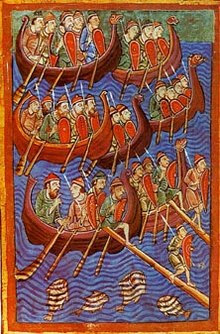


Emperor Lothar gave in 841 Harald Klak more land: Dorestad, the island Walkeren and the rest of Frisland as an attempt to stop the lootings which Harald did together with the Danish Vikings. In those years were many lootings - many klosters and churches were destroyed or exposed to ravage and many Christians were taken prisoners and sold as slaves.Ludwig the German went up to the other side of the Elben by the Abodrites to incorporate their country into his empire and to make them his taxpayers. This was too much for the Danish king Haarik I who considered both the Frisian and the Abodrites his taxpayers. He rearmed with 600 ships and sailed up the Elb to Hamburg which was plundered in 845. Ansgar's archbisopric was burnt down with the large "handwriting " library which Ludwig the Pious gave him. The Danes drove out Ansgar from the town, but a pious lady gave him the farm Ramsola ( about 30 km from Hamburg). In 847 Ansgar got instead the archbishopric Bremen which was put together with the rest of the archbishopric in Hamburg. After this Bremen- Hamburg was archbishopric in the North until 1104.

Regnar Lodbrog
One of the main persons behind the lootings was Regner Lodbrog. Historically speaking he returned home to king Haarik I's residence bragging with all the silver and gold he brought. Hearing this bragging were also Frankisch diplomats . The mightiest man in Saxony was their spoaksman. The presence of Franks by king Haarik indicated that they together with Haarik were clearing the outstandings with the Abodrites' tax and the burning of Hamburg. It seems however that the Viking, Regner Lodbrog was infected with a disease, many members from the expedition were also sick. According to the Franks Regner Lodbrog got a very unpleasant, but well-deserved death. King Haarik considered this a bad omen and took the opportunity to execute the Vikings who were not already dead from the disease. He released their Christian prisoners.

As the road was now cleared king Haarik sent for Ansgar and allowed him to build Denmark's first church and a house for the priest in Hedeby in 849. It was the first time in Denmark that Christianity was allowed in this way. There was however no permission for bell-ringing. In Hedeby was an active heathen opposition against Christianity, but Ansgar's church was built, and it was tolerated that the priests did missionary work, but Jarl Howi in the lead of the leading circles of the town forbid bell-ringing. Haarik shared in 830 the power with 2 nephews, but the Viking lootings went on. Ansgar visited often king Haarik in the king's last years.


replica, Viking church, Moesgaard, Aarhus/gb
In 854 came an army to Denmark led by Guttorm, possibly a nephew of Haarik. Almost the whole royal family and the nobility were killed in the 3 days long battle which followed. King Haarik I and Guttorm were killed - and a little boy was now king Haarik II. Jarl Howi and the leading circles in Hedeby took the opportunity and closed the church in Hedeby and drove out the priest. Denmark's first church was closed 5 years after the building. 

A messenger came in 855 from the new king Haarik II to Ansgar. Jarl Howi was thrown out of town. Ansgar went back to Hedeby ca. 856 and was welcomed by king Haarik. Christianity was again allowed, the church opened and the priest came back. Haarik gave permission to ring one bell in Hedeby. Ansgar got a piece of land in Ribe for the building of a new church and a house for a priest. The priest was allowed to do missionary work, but there was no permission for bell-ringing.

Ribe was founded between 704 and 710.


In general the mission tried to achieve allowance to build a church at places where Christian
Viking town/museum
merchants were, like in Hedeby and Birka. Hedeby was mentioned for the first time in 810; it was established as an international trading center. Hedeby and Birka were the largest cities in the Viking period and the most interesting areas for the mission. Birka was a fortified international trading center with own rights. It was situated inside Skærgården inside Mälaren, the fjord outside the present Stockholm and east of Björkö.

Ansgar sailed to Birka in 828 and went back to Saxony in 831. After Ansgar and Vitmar left Birka in 831, bishop Ebo sent a sister's son, bishop Gauthbert to Sweden together with the priest Nithard. Gauthbert was by Ebo equipped with everything for his important office, and there might have been bells in the luggage, according to information from the Fulda kloster.


In Sweden bishop Gauthbert was driven out of Birka by an exited crowd of people ab. 837-842. He might have bothered or purged the great heathen temple in Uppsala. His priest Nithard was killed. The expulsion of Gauthbert took place at the same time as king Haarik I's dissatisfaction with Ludwig the German's tax prints from the Abrodites and the retributive actions against Hamburg and its bishopric. Gauthbert became bishop in Osnabrück and did not go back to Sweden again. During the years 845-851 there was no priest in Sweden. After this pause of 7 years Ansgar sent in 851 a hermit Ardgar( or Hardegar) to Birka as a priest and to assist Heringar. When Heringar died in 851 the hermit went back home.

Ansgar went to Sweden in 852 together with the priest Frimbert (Erimebert), a nephew of Gauthbert and brother of the killed priest Nithard. They went together with a priest of Danish descent, Anfrid. Bishop Gauthbert was still missionary bishop in Sweden, a title he got from Ebo. This time the travel went via the transit route Hedeby and took only 20 days. The new Swedish king Olaf welcomed Ansgar in a friendly way; the king was baptized, and church and priest were allowed again. Ansgar went back home. Gauthbert's two delegates went back from Sweden 3-4 years later. Gauthbert died in 860. The next to be sent to Sweden by Ansgar was Ragebert, but he was attacked by Danish Viking pirates and died. A priest Rimbert of Danish descent was then sent to Sweden

In the northernest mission of Sweden - which probably was not a popular place of deployment - the mission died out with archbishop Unnes 17 september 936, and the land became heathen again. There was a pause of at least 100 years - and thereafter came the other competing Christian mission, the English missionaries and resumed the work. First of all Sct. Sigfrid who became bishop of Växjö.


The largest church bell in the world is the Zar bell, cast in 1733-35 in Moscow. It is now on exhinition at the Ivan Velikij bell tower in Kreml.It weighs 200 tons, is 14,6 m tall and with a biggest diameter of 6,6 m.


photo wikipedia
photo + text: grethe bachmann

Thursday, September 14, 2017

European Birthwort/ Hjertebladet Slangerod

Aristolochia clematitis


European Birthwort 1885/ wikipedia
The (European) birthwort, (DK: Hjertebladet Slangerod)  is a twining herbaceous plant in the Aristolochiae family, which is native to Europe. The leaves are heart-shaped and the (carrion smelling) pale yellow flowers are tubular in form. The plant seeks light by ascending the stems of surrounding plants. It is connected to light-open habitats with dry and warm soil which has a high contents of nutrients and calcium. In Denmark it is cultivated in gardens and parks and is sometimes seen growing wild, especially at kloster sites and castle ruins. Autumn colour yellow-brown.


European birthwort/wikipedia
The name Aristolochia comes from the Greek word aristos which means best and lochia which means birth. The plant was known in the classical antiquity to start births . The Danish name slangerod refers to its use against snake bites.

Folk Medicine 
Birthwort was used in a decoct which was drunk as a sweat- and diuretic means; a decoct was also drunk against against jaundice and leaves and roots for healing wounds. The plant contains a substance which activated the white blood cells.  The root was stuck in the abdomen to promote birth.


Because of similarity to slangeurt (Polygonum bistorta) and corydalis (lærkespore) it is in early literature difficult to identify the botanic species.


Kloster garden(/ photo: GB
Harpestræng ab. 1300:
The physicians often distinguished between the drugs Aristolochia longa (DK: lang hulurt) and Aristolochia rotunda ( DK: rund hulurt) and Aristolochia clematitis (European birthwort/hjertebladet slangerod.)
A. rotunda: to drink with wine after poisonous bite; it drives out the afterbirth; to drink with water for cough; crushed as a cover on gouts; mixed with honey as a wound healing cover; to drink for fever; used as a smoking against insanity.

Christiern Pedersen 1533:
crushed plant to drink with wine or beer for breast pain; vinegar decoct as a cover for stomach pain; crushed root with wine or beer against malaria , to drink with wine after snake bite.
Henrik Smid 1546:
cooked with myrrha and pepper in wine for drink to drive out the afterbirth and all filthiness; wine decoct cleans and heals all internal wounds and broken lungs, liver and uterus; fresh crushed root used as cover drives out thorns, arrows etc. from wounds and heals it. A. rotunda to drink with wine against the plague, drives out sweat and urine and counteracts jaundice; crushed seeds with a drink against diarrhea.  Barbers used the root to heal and dry all runny wounds.
Simon Paulli 1648:
root to make the flesh grow after abscesses; the root is good for itching and scabies; decoct of leaves and roots for bathing mange and wounds on hands and feet. Some say the leaves should be smoked under newborn babies if they looked fragile and sick.

The rootstock of Aristolochia longa and Aristolochia rotunda were written into the Pharmacopoeia in 1772. 

Livestock: the plant was also used in diseases of the livestock: cattle, horse, swine, sheep and poultry.

Superstition 
The plant was revered by ancient healing book- authors who recommended it against snake bites.  Having a root in the pocket as an amulet against toothache.


European Birthwort/ wikipedia
Poisonous Plant:
It was formerly used as a medicinal plant, though it is poisonous , and is now occasionally found established outside of its native range as a relic of cultivation. It is now thought to be the cause of thousands of kidney failures in Romania, Bulgaria, Serbia, Bosnia and Herzegovina and Croatia where the plant is thought to be unintentionally consumed through contaminated flour. Urinary tract malignacies among those who have consumed the plant are also reported. The link between renal failure and aristolochid acid, which the plant contains, was discovered after a clinic for obesity in Belgium, some of the patients experienced kidney failure.


NB:
Because of its toxicity it must be warned to use the plant or parts of it as a natural medicine.

All parts of the plant are considered carcinogenic (kræftfremkaldende) and kidney damaging. 


Source:
Danske Klosterurter, Anemette Olesen, Aschehoug 2001. 
Brøndegaard, Dansk Etnobotanik, Folk og flora, bd. 3, 1978-80.


Thursday, September 07, 2017

Common Rue; Herb-of-Grace/ Almindelig Rude


Ruta graveolens


Common Rue(Almindelig Rude) 
Ruta graveolens, commonly known as rue, common rue or herb-of-grace, is a species of ruta grown as an ornamental plant or herb. It is an aromatic half shrub with a loose, bushy growth and with yellowish-green leaves and small yellow flowers. The yellow flowers arrive in June-August; the fruits are capsules with many seeds. The root system has many heavy and deep roots with few side roots. It is native to the Balkan Peninsula; it grows in dry regions and has adjusted the Mediterranean climate. 

The name ruta comes from the Greek word yte, which means window (Danish: rude) and graveolens means strong smell.


It is grown throughout the world in gardens, especially for its bluish leaves, and sometimes for its tolerance of hot and dry soil conditions. It is also cultivated as a medicinal herb, as a condiment, and to a lesser extent as an insect repellent. Common rue was always valuated because of its ability to repel pests (like cucumber beetles). The species was earlier used as a medical plant and as a spice herb but today mostly used as a drought tolerant, ornamental plant. Rue has a bitter and sharp taste and is not usable in the kitchen, but the plant is good in making some low small hedges in the herbal garden, since it can withstand cropping.

The common rue (Ruta graveolens) is commonly cultivated in Denmark. Today is is preferred in many homes and gardens because of its strong scent and its ability to repel  insects from some crops. Rue grows wild in a few places in Denmark, feral from earlier cultivation as a medical and spice herb.


History.


Fresh rue was used in magical rituals since antiquity, and it is one of the earliest garden plants, which was cultivated for its magic abilities. Several  ancient civilizations used rue and worshiped its powers. During the Middle Ages rue was a very used medical plant, used against various diseases. The whole plant is rich in etheric oils and has a strong unpleasant smell. The Romans  and Greeks used it in antiquity as a spice and as a medicine, and it was later famous for attenuating the lust of the flesh in monks and nuns. In the year 795 king Ludwig the Pious ordered that rue had to grow in all kloster gardens and that nuns and monks had to eat it each day to keep their chastity. Evil tongues claimed that the plant was in the gardens of the nunneries because it was used as an abortifacient.  

The Romans cultivated rue and brought it with them when they visited prisoners, because they believed the plant would avert "the Evil Eye". The Chinese used it to counteract negative thoughts or wishes. The Celtic wizards said that rue was a defense against magic and could be used to promote healing. Rue was sacred to the early Jews, Egyptians and Caledonians; they believed it was a gift from the Gods. In the old America rue was used by the Indian societies for spells, and they claimed that they could win the heart of their love forever by placing a branch under the light of the moon, before giving it to their love.

Rue is also a common ingredient in witchcraft and spell making. During the Middle Ages it was a symbol of recognition between witches. The Catholic Church also used a branch of rue to sprinkle holy water on its followers during this time known as the "herb of grace."

Tacuinum handbook
The Tacuinum Sanitatis, a medieval handbook on wellness, lists these properties of rue:
Nature: Warm and dry in the third degree.
Optimum: That which is grown near a fig tree.
Usefulness: It sharpens the eyesight and dissipates flatulence.
Dangers: It augments the sperm and dampens the desire for coitus.
Neutralization of the Dangers: With foods that multiply the sperm.
The refined oil of rue is an emmenagogue and was cited by the Roman historian Pliny the Elder and the gynecologist Soranus as a potent abortifacient (inducing abortion).


Folk Medicine

rue

Harpestræng ab. 1300s: eliminates the desire for women; the juice to take for abscesses in the body; fresh plant to eat for purblind eyes; juice of rue and fennel mixed with chicken bile and honey for an ointment  which gives clear eyes; if someone drank the juice of the plant or had eaten it raw they could not be harmed by poison.   

1400s: crushed green rue and laurel mixed with earthworms and vinegar upon face against headache; the seeds mixed with pigeon shit and seethed syrup of vinegar and honey for dropsy; wine decoct or the seeds mixed with deer- or goat's horn to take against rhinitis.  

Christiern Pedersen, 1533: leaves, walnut cernels and figs to eat as an antidote against the plague; crushed leaves of rue mixed with honey and put upon the navel expel worms; juice mixed with honey or morning dew and the juice from the wine clear the eyesight; crushed rue mixed with dog shit to put upon plague abscesses.

Henrik Smid 1546: the plant resists all venom and poisons; the juice mixed with alum, saltpeter and honey heals "the bulky and shabby head."  

1624: Klog mand (healer) (+1624) in southwest Jutland treated fresh wounds with rue, plucked on Midsummer's Night and put into Rhine wine and mixed with horse manure.  

1693: in times of the plague has to be smoked with green rue and five other plants and chips from the billy goat's horn; rue and lovage mixed with honey for a patch upon snake bites.

1799: pulverized rue, feverfew and St. John's wort-oil used for an ointment upon the wrist-artery for stroke.   

Herb and seed were written into the Pharmacopoeia in 1772. 

 Livestock: Rue was used for various diseases in cattle, horse and swine.  

Superstition: 1300s: The weasel eats rue before fighting a snake, then it will not be hurt by the poison. 1774: Rue was plant close to Sage in order to prevent poisonous animals to be there. Some people believed that the smell from rue dispels the toad.  


Culinary use 

rue foliage

In Denmark it is advised not to use rue as a spice or culinary herb, since it has given liver damage on laboratory rats. It is also advised to avoid sun light and to  wash the skin thoroughly with soap water if the juice from the plant has touched the skin. 

Rue has a culinary use, but since it is bitter and gastric discomfort may be experienced by some individuals, it is used sparingly. Although used more extensively in former times, it is not an herb that is typically found in modern cuisine. Today it is largely unknown to the general public and most chefs, and unavailable in grocery stores. It is a component of berbere, the characteristic Ethiopian spice mixture, and as such is encountered in Ethiopian cuisine.


It has a variety of other culinary uses:
It was used extensively in ancient Near Eastern and Roman cuisine (according to Ibn Savyar-al-Warraq and Apicius).
Rue is used as a traditional flavouring in Greece and other Mediterranean countries.
In Istria (a region in Croatia), and in Northern Italy, it is used to give a special flavour to Grappa/Raki and most of the time a little branch of the plant can be found in the bottle. This is called grappa alla ruta.
Seeds can be used for porridge.
The bitter leaf can be added to eggs, cheese, fish, or mixed with damson plums and wine to produce a meat sauce.
In Italy in Friuli Venezia-Giulia, the young branches of the plant are dipped in a batter, deep-fried in oil, and consumed with salt or sugar. They are also used on their own to aromatise a specific type of omelette.
Used in world beers as flavouring ingredient. 

Other
Rue is also grown as an ornamental, both as a low hedge and so the leaves can be used in nosegays.
Most cats dislike the smell of it, and it can, therefore, be used as a deterrent to them. Caterpillars of some subspecies of the butterfly Papilio Machaon feed on rue, as well as other plants. The caterpillars of Papilio xuthus also feed readily on it.
In South India, rue is recommended for home gardens to repel snakes (however the effectiveness is unknown).

Toxicity


burnt skin from rue.

Rue extracts are mutagenic and hepatotoxic. Large doses can cause violent gastric pain, vomiting, systemic complications, and death. Exposure to common rue, or herbal preparations derived from it, can cause severe phytophotodermatitis which results in burn-like blisters on the skin.


The bitter taste of its leaves led to rue being associated with the (etymologically unrelated) verb rue "to regret". Rue is well known for its symbolic meaning of regret and it has sometimes been called "herb-of-grace" in literary works. It is one of the flowers distributed by the mad Ophelia in William Shakespeare's  Hamlet (IV.5):
"There's fennel for you, and columbines:
there's rue for you; and here's some for me:
we may call it herb-grace o' Sundays:
Millais: Ophelia
O you must wear your rue with a difference..."
It was planted by the gardener in Richard II to mark the spot where the Queen wept upon hearing news of Richard's capture (III.4.104–105):
"Here did she fall a tear, here in this place
I'll set a bank of rue, sour herb of grace."
It is also given by the rusticated Perdita to her disguised royal father-in-law on the occasion of a sheep-shearing (Winter's Tale, IV.4):
"For you there's rosemary and rue; these keep
Seeming and savour all the winter long."
It is used by Michael in Milton's paradise lost to give Adam clear sight (11.414):
"Then purg'd with euphrasy and rue
The visual nerve, for he had much to see."
Rue is used by Gulliver in "Gulliver's Travels" (by Jonathan Swift) when he returns to England after living among the "Houyhnhnms". Gulliver can no longer stand the smell of the English Yahoos (people), so he stuffs rue or tobacco in his nose to block out the smell. "I was at last bold enough to walk the street in his (Don Pedro's) company, but kept my nose well with rue, or sometimes with tobacco".
Rue is mentioned in the Bible, Luke 11.42: "But woe unto you, Pharisees! For ye the mint and rue and all manner of herbs".
In mythology, the basilisk, whose breath could cause plants to wilt and stones to crack, had no effect on rue. Weasels who were bitten by the basilisk would retreat and eat rue in order to recover and return to fight.
Rue is considered a national herb of Lithuania and it is the most frequently referred herb in Lithuanian folk songs, as an attribute of young girls, associated with virginity and maidenhood. It was common in traditional Lithuanian weddings for only virgins to wear a rue (ruta) at their wedding, a symbol to show their purity.
Likewise, rue is prominent in the Ukrainian folklore, songs and culture. In the Ukrainian folk song "Oi poli ruta, ruta" (O, rue, rue in the field), the girl regrets losing her virginity, reproaching the lover for "breaking the green hazel tree". "Una Matica de Ruda" is a traditional Sephardic wedding song.
Chervona Ruta—a song, written by Volodymyr Ivasyuk, a popular Ukrainian poet and composer. Pop singer Sofia Rotaru performed the song in 1971. More recently Rotaru performed in a rap arrangement.


Banner of Saxony with rue./wikipedia


source:  
Brøndegaard, Dansk Etnobotanik, Folk og Flora ,bd. 2
Anemette Olesen, Danske Klosterurter, Aschehoug 2001,
Wikipedia, dansk og engelsk, 2017.


photo from wikipedia