Friday, March 27, 2015

Burgundy Snail / Vinbjergsnegl - Escargot

Burgundy snail by castle ruin Fussingø, photo gb.

Helix pomatia


The Burgundy snail or the Roman snail is an edible snailn  -  named  Escargot in the cuisine. It is a speciea of large edible air-breathing snails,  a terrestrisl pulmonate gastropod mollusk in the family Helicidae. It is the largest shell-snail in Europe. As adult it has a height of ab. 4,5 cm and a broadth of 4 cm. It is considered a fine delicacy, especially in southern Europe.

Denmark
As for its spread in Denmark it was important that it was edible. In the Middle Ages snails were not considered to be meat and therefore allowed as a meal during Lent. Both klosters and manors farmed these big snails. Today the snails are often seen around old manors and klosters  - and by the kloster ruins. 


by old  church dike, Skarresø, photo gb
The Burgundy snail / Vinbjergsneglen is protected in Denmark.to the extent that commercial gathering of the snail is not allowed. It is allowed to gather the snail for private use, but it is encouraged to spread this gathering in order to avoid excessive interference in the various  habitats

The snail achieves the age of 6-8 years in the wild, but it s not unusual to see older specimens.

The Burgundy snail/Vinbjergsnegl and the common Garden snail come out in big numbers after heavy rain in spring. The mating takes place in May or June. The snail is hermaphrodite. After the mating the snail buries itself into the ground and lays about 60 eggs.

The natural habitat in Denmark is upon large and smaller hills and in open thickets, but seldom in people's gardens. The snail's food is mostly decomposing plants and dead animals. Since there are foxes and badgers in the habitats they are considered natural enemies of the snail, 

In the middle of November the snail closes its house with a sealing of chalk in order to hibernate.


in Bjerre forest, near Boller castle , photo gb

Europe
It is called by the French name Escargot when used in cooking. Although this species is highly prized as a food it is difficult to cultivate and rarely farmed commercially.

The shell is creamy white to light brownish, often with indistinct brown colour bands. The shell has five to six whorls. The aperture is large.The apertural margin is white and slightly reflected in adult snails. The umbilicus is narrow and partly covered by the reflected columellar margin.


In southeastern Europe, H. pomatia lives in forests and open habitats, gardens, vineyards, especially along rivers, confined to calcareous substrate. In central Europe, it occurs in open forests and shrubland on calcareous substrate] It prefers high humidity and lower temperatures, and needs loose soil for burrowing to hibernate and lay its eggs. It lives up to 2100 m above sea level in the Alps, but usually below 2000 m. In the south of England, it is restricted to undisturbed grassy or bushy wastelands, usually not in gardens; it has a low reproduction rate and low powers of dispersal.
Average distance of migration reaches 3.5–6.0 m.]


Lolland, near Aalholm castle. photo gb.

Protection
Great Britain: In the west and south of England in southern areas on chalk soils. Its common name in the UK is "Roman snail" because it was introduced to the island by the Romans during the roman period (AD 43–410). In England only (not the rest of the UK), the Roman snail is a protected species under the Wildlife and Countryside Act 1981 making it illegal to kill, injure, collect or sell these snails


In central and southern parts of Sweden, Norway and Finland, isolated and relatively small populations occur. It is not native to these countries, but is likely to have been imported by monks from Southern Europe during medieval times.


Germany – Listed as a specially protected species in Annex 1 of the Bundesartenschutzverordnung.

Czech Republic - least concern species (LC) its conservation status in 2004-2006 is favourable in the report for the European Commission in accordance with the Habitats Directive.


Conservation
This species is listed in IUCN Red List, and in European Red List of Non-marine Molluscs as Least Concern. Helix pomatia is threatened by continuous habitat destructions and drainage, usually less threatened by commercial collections. Many unsuccessful attempts have been made to establish the species in various parts of England, Scotland and Ireland; it only survived in natural habitats in southern England, and is threatened by intensive farming and habitat destruction. It is of lower concern in Switzerland and Austria, but many regions restrict commercial collecting


Escargot, photo wikipedia.
Escargot  is a dish of cooked land snails, usually served as an appetizer in Spain and in France.  The word escargot is also sometimes applied to the living snails of those species which are commonly eaten in this way. Not all species of land snail are edible, and many are too small to make it worthwhile to prepare and cook them. Even among the edible species, the palatability of the flesh varies from species to species. In France, the species Helix pomatia is most often eaten.

Heliciculture  snail shells have been found in archeological excavations, indicating snails have been eaten since prehistoric times. A number of archaeological sites around the Mediterranean  have been excavated yielding physical evidence of culinary use of several species of snails used as escargot. The Romans, in particular, are known to have considered escargot an elite food, as noted in the writings of  Pliny. ]

Like most molluscs, escargot is high in protein and low in fat content (if cooked without butter). Escargot is estimated to contain 15% protein, 2.4% fat and about 80% water.


Source. Danish and English wikipedia, Naturstyeelsen, Danmark om Vinbjergsneglen.

Sunday, March 15, 2015

The Vikings - Legal System - Survival of the Fittest.


viking house, Fyrkat/photo gb


Denmark 
Denmark was in the Viking period divided in about two hundred districts, the socalled "herreds", which each had a ting (thing). The thing was the counsil of free swordsmen coming together to manage the law, to issue rulings, and to discuss matters of a more common character..

The law was a complex of customs, something which was remembered from generation to generation. Therefore the thing-assembly was often a case of old men - with support from the old rhyme-formulas (stavrim)  - to remember and claim the law..

The punish provisions towards acts of violence or murder - among free men - were built  upon mandeboden (man's fine) and its various degrees: full mandebod for a killing or cutting off the nose; half mandebod for an eye, quart  mandebod for an ear etc. The warrant was made by the thing-men themselves,  and the law was no doubt not rarely bent to the power, since the enforcement  of the court decision had no special protection. If a member of a strong family during the eternal feuds among the families had insulted or violated a man from a weaker family and had been sentenced a mandebod on the thing, then the weaker part  had to recover the mandebod (the man's fine) himself, which might be difficult or even impossible.This was a shortage of the legal system.
.
law document Sweden wikipedia
The word herred is interpreted as hærfølge = (army escort ). Maybe this points back to a military system where each district (herred)  was obliged to make men or ships available during war. Or else the really big decisions - like election of a king, war and peace or alike - or a court decision of a special complicated or questionable case - were assigned to the big landsting, which in Jutland was held in Viborg, at Zealand in Ringsted and in Skåne (Scania) in Lund. Such difficult cases could be decided by holmgang (duel) following special rules or by  jernbyrd  (ordeal by fire) where they in reality pushed the case respectively to the right of the stronger or the judgment of the gods.

Theft was a dangerous thing to be engaged in, the punishment was simply hanging  which was not  from moral principles, but contrarily with a base in the very realistic view that the thief was a poor man (that was why he stole) and a poor man had only one thing to lose: his life.


Germanic assembly, wikipedia


Like in all other human societies the society of the Vikings was also built on relations and Community. The worst punishment was social exclusion : he who denied to bend to the decision of the herreds-ting and therefore had his case brought to the landsting exposed himself to exclusion The landsting had the power to declare outlaw inside its area. In the length to live his life in isolation, without legal rights, being hunted, excluded from the circle of his fellowmen:  this was impossible, the only ways out were exile or death. But for the man who respected the Viking society's unwritten customs and the rooted view of the law  from the time immemorial, this man could live a flourishing life in prosperity, if he was versatile and had "god  lykke". (good fortune.)


Viking house, Fyrkat, photo gb
A magnate from the grade of the earls had enough to organize, he might lead his own Viking expedition in the summertime, either alone or together with other chiefs and come back for winter with a good prey. He might also be a merchant and lead his own trade business and he had to take care of his own farming. Finally he had to take care of secular and clerical public offices : to judge at the thing and to see to that he - as the gode (Gothi)  of his hov (court) took into account the demand of the gods when it came to cultivating the land and taking care of the law.

Uffe hin Spage, Lorenz Frölich, wikipedia


A means to decide disputes between persons  - or through them between families -  was the holmgang (the duel) The oldest description in a written law fragment from Sweden is about a holmgang-  and it reflects in a realistic way both the sensitive honour which was so vulnerable:  to insult with words and the brutality of the law of the strongest man. The fragment says: " if you say insulting words like: You are not equal to men or: You are not a real man " -  then the two men will have to meet where three roads cross. If he who said the word comes,  and if he who was told the word does not come,  then he'll have to stay as he was named, and then he is not able to give oath or to be a witness - neither in a man's or in a woman's case. If he comes who was told the word , but not he who said the word, then he'll cry three times: "Nidding"  and make a mark in the field. And  he who said the word will then be an inferior man since he dare not stand by what he said.

Now they'll both meet fully armed: if he falls who said the word: a word-crime is the worst - the tongue is the first killer:  he lies on the ground upon his deeds.


Sweden
A similar picture of the legal system in the Viking period is seen in Sweden. Here is also a family society, a life built upon the land-properties of the family and the inner solidarity,  with orally handed-down laws and rules of law, which were put into power by warrants at the thing-assembly of the herred (Swedish: de hundradets). Here is undoubtedly also a system of a common war oganization. And here is also a limited royal power. In the Ansgar- biography is said about Birka, that it was a usual custom to let common cases decide by the agreement of the people rather than on the king's demand. Two concepts were in front of life of the Nordic Viking: den gode lykke = the good fortune - the prosperity of the fortunate man - and æren (the honour) which had to be protected and must not be breached.

Norway
Hakon the Good, P.N.Arboe, wikipedia.
The same schedule is found in Norway as to the secular building of society. The indivual bygder (settlements) had their local thing-assemblies, and the large districts had their own more comprehensive things, where chiefs and old experienced men were judges and interpretors of the law. In Norway is also the family society with the single man, the private person, who seeks his right supported by his family via mandebod for a revenge-killing.
Like in Denmark and Sweden the problem is the same in Norway. Direct primary sources to a knowledge about the legal system of the Viking period are missing,  it is only possible to refer to the medieval laws, the * Frostatingloven  and the *Gulatingloven  (both laws are Norwegian laws, which acccording to the sagas were ordained by Hakon the Good for respectively Trøndelagen and Vestlandet). Like in Denmark there is reason to believe that there was a military system too in Norway ( a leding) where each district  was obliged to deliver ships and warriors to a common defense. And like in Denmark and Sweden it is also the same for Norway:  that the royal power was limited by the thing-assemblies and  folkets vilje ( will of the people). Anyway the king's power must not be too much reduced, for the king had his team of housecarls , his hird, which from an original private organization grew up to a half public factor  - a very active means of power which became the core of a larger army 


Iceland.
A Gothi /priest) Lund, wikipedia.
Iceland had no king. The legal system was established after west-Norwegian design and after the rules in the later Gulatinglov. This thing-constitution became common to the whole island from year 930. The common thing was held each summer( named altinget), with the lovsigemand (the man who  recited the law rules) and with the heathen priests (the Gothis) as the real rulers. The island was later divided into four quarters each with 3 (one with 4) herredsting. Since the magnates were goder (Gothis) it must be said about the Icelandic free state that it was a regular chief-union without a king. An oligarchy in a classical saying.


Source: Johannes Brøndsted: Vikingerne;. Vikingen hjemme, Samfund.  Ggyldendal 1960


Monday, March 09, 2015

Cat Quote


After scolding ones cat one looks into its face and is seized by the ugly suspicion that it understood every word .
And has filed it for reference

Charlotte Gray.


Friday, March 06, 2015

A Foggy Day in the Countryside...............


It's easy to see from the landscape ahead of the country road that the it's foggy today . The sun will hide until tomorrow afternoon. A foggy day has its own charm, the shades and colours are soft and  pretty, and there is something magic in the landscape -  as if the fairies might suddenly peep out...


A lake swept in fog is also a magic landscape - it is hiding something from the past, a forgotten world. Looking across the silent lake it is like wating for the barge from avalon coming out from the mist. The mystic in the air expands ones imagination - while a sunny day holds no mysteries.


The cattle is grazing in a frosty field, it seems they don't mind. Much cattle of today are used to stay out in the winter season. They have got enough wool to keep them warm. I'm not sure they would like to lie down in the grass however!


“One day many years ago a man walked along and stood in the sound of the ocean on a cold sunless shore and said, "We need a voice to call across the water, to warn ships; I'll make one. I'll make a voice like all of time and all of the fog that ever was; I'll make a voice that is like an empty bed beside you all night long, and like an empty house when you open the door, and like trees in autumn with no leaves. A sound like the birds flying south, crying, and a sound like November wind and the sea on the hard, cold shore. I'll make a sound that's so alone that no one can miss it, that whoever hears it will weep in their souls, and hearths will seem warmer, and being inside will seem better to all who hear it in the distant towns. I'll make me a sound and an apparatus and they'll call it a Fog Horn and whoever hears it will know the sadness of eternity and the briefness of life."
" The Fog Horn blew.”


Ray Bradbury, The Fog Horn 


photo February 2015 Mid Jutland : grethe bachmann

Monday, February 02, 2015

The Trundholm Sun Chariot/ Solvognen - Bronze Age


front side with gilding
The sun chariot (the Trundholm Sun Chariot)  is a Danish national treasure and a uniqe find from Bronze Age made in bronze and gold. The sun chariot is a horse drawing a sun disk. The horse and the disk stand upon the rests of six wheels  - and both horse and disk have eyelets in order to fasten the strings. The sun disk is coated with gold in fine patterns and circular motifs.
landmark/Odsherred municipality

The sculpture was found on 7th September 1902 in Trundholm Mose (a peat bog) in the northwestern part of Zealand in the region Odsherred in connection to the first ploughing of the moor. The finder Frederik Willumsen brought his discovery back home and let his son play with the horse, he thought  it was just an old piece of toy. The sun chariot had however already been damaged once in Bronze Age when it was placed in the moor as a sacrifice to the gods. A metal detector revealed in 1998 new fragments of the six wheels in the same spot. The sculpture is dated by the Nationalmuseet to about 1800 to 1600 BCE though other dates have been suggested. Unfortunately the chariot was found before pollen-dating was developed, which would have enabled a more confident dating. The sun chariot is now in the collection of the National Museum of Denmark in Copenhagen. 


backside with no gilding
The disk has a diameter of approximately 25 cm (9.8 inches). It is gilded on one side only, the right-hand side (when looking in the direction of the horse). It consists of two bronze disks that are joined by an outer bronze ring, with a thin sheet of gold applied to one face. The disks were then decorated with punches and gravers with zones of motifs of concentric circles, with bands of zig-zag decoration between borders. The gold side has an extra outer zone which may represent rays, and also a zone with concentric circles linked by looping bands that "instead of flowing in one direction, progress like the steps of the dance, twice forward and once back". The main features of the horse are also highly decorated

The gilded sun disk is placed upon the sun chariot and the chariot noves from left to right towards the sun during the day The opposite side of the chariot lacks the gilding on the sun disk -  this is the darkened sun at night on its way back from right to left to its starting point at sun rise, so the sun chariot illustrates with the two different sides the movement of the sun during day and night.


A Sun Horse in Mindeparken in Aarhus /photo gb.
People in Bronze Age did not believe in human gods as is known from the Viking period. They worshipped powers which preserved nature, powers which arranged for the rebirth of the day each morning and the rebirth of the planets each spring. They worshipped the sun as a divine power. The sun gave life and light at day, made the plants grow and the corn ripen in the summertime. It was necessary that the sun's travel across the sky continued day after day and year after year. The sun chariot was an image of this travel -  and it is possible that the priests of Bronze Age used it in religious feasts to show how the horse was drawing the sun across the sky.

The sun chariot is a witness of the religion of Bronze Age. The sun was center of the religion. People  in Bronze Age imagined that the sun was being drawn across the sky in the daytime. In the morning a fish brought the sun to a ship which carried the sun until noon. The sun horse took over and brought the sun to the afternoon ship. At evening a snake brought the sun back to the underworld which lay below the flat earth. Down here the sun was dark and it was by night ships brought back to the starting point in the morning where the fish once again took over. Thus the cycle of the day was kept for all eternity by the helpers of the sun - the fish, the horse the snake and the ships.

petroglyphs/ Grevinge
The conceptual world of the sun chariot is supported by several petroglyphs and decorations upon razors, upon jewelry, weapon and tools.Both in the petroglyphs and on the razors the horse is drawing the sun in a string, the wheels on the Danish sun chariot do actually not belong to the story. The wheels were added so the sun disk and the horse in ritual ceremonies could be drawn forth and back to make an image of the solar motion. By examining over 400 bronze artifacts the Danish archaeologist Flemming Kaul found out that the figures show the Bronze Age man's experience of the eternal travel of the sun.  All these figures and creatures were not only found in the Danish Bronze Age but were also a part of the religion of Egypt and large parts of Europe at that time. In Denmark the Bronze Age people had contacts to people far away -  they exchanged wares and got the popular bronze in return for amber and fur.


Sól and Mani, drawing by Lorenz Frølich 1895
Norse mythology. 


Despite the enormous gap in time, between varying sources, particularly Norse mythology, known from 13th AD century sources, the distinct reference of the sun being drawn by chariot is found in Norse mythology. Many attest that the Norse myths were preserved orally for an unverifiable time period before being written down, similar to the Vedic texts. In Norse mythology, Sól is the personified goddess of the Sun, the corresponding Old English name is Siȝel, continuing reconstructed Proto-Germanic Sôwilô or Saewelô. The Old High German Sun goddess is Sunna.. Every day, Sól rode through the sky on her chariot, pulled by the two horses Arvak and Alsvid. The sun chariot has been interpreted as representing a Bronze Age predecessor to the goddess. The chariot has also been interpreted as a possible Bronze Age predecessor to Skinfaxi,   the horse that pulled Dagr, the personification of day, across the sky.


Source,   Gyldendals og Politikens Danmarkshistorie, bd. 1, "I Begyndelsen";
samt Wikipedia dansk og engelsk og Nationalmuseet, København.     


photo fra Wikipedia, Wikimedia,
photo Solhesten, Mindeparken, Aarhus: grethe bachmann          


Sunday, January 18, 2015

Orpine stonecrop/ Sankthansurt


Hylotelephium telephium 


Flora and Fauna
Viborg the Latin Garden, photo GB

photo:wikipedia


Orpine stonecrop is a 20-50 cm tall plant with oval fleshy leaves and numerous yellow-green, yellow-white or purple flowers in umbel-like flat tops in August-September. It is a succulent perennial groundcover of the family Crassulaceae (same family as goldmoss stonecrop)  and native to Eurasia. It is widespread in Caucasus, Centralasia, East Asia , Sibiria and Europe

A number of cultivars, often with purplish leaves, are grown in gardens as well as hybrids between this species and the related Hylotelephium spectabile (Iceplant) , especially the popular Sedum 'Herbstfreude' ('Autumn Joy'). Occasionally garden plants may escape and naturalise as has happened in parts of North America as wildflowers.

 
photo:wikipedia
There are several subspecies including:
  • H. telephium ssp. fabaria - West & Central Europe
  • H. telephium ssp. maximum - Europe
  • H. telephium ssp. ruprechtii - North-east Europe
  • H. telephium ssp. telephium - Central & East Europe

This species (and some of its close relatives) are sometimes still placed in the genus Sedum.


Orpine stonecrop or simply orpine has various names like : frog's stomach - harping Johnny - life-everlasting - live forever - Midsommermen - Orphan John - Witch's Moneybags.


The orpine stonecrop grows in  stone fences, thickets, slopes, beach-fields, pastures  and old thatched roofs.

The common orpine (H. ss. maximum) with yellowgreen flowers is common in Denmark in oak thicket, stone dikes, dry slopes , pastures and beach banks. The red orpine H. subspecies telephium with purple flowers are found as feral here and there in Denmark.

The butterfly Copper (Ildfugl) and various other butterflies and insects feed on the nectare from the flowers in August-September.


Purple orpine, Dragstrup church, N.Jutland /gb


Folk Medicine
Orpine stonecrop is not used anymore in medicine. Earlier a decoction from the leaves were used against painful urination. As a folk remedy the fresh crushed leaves were put upon burns, corns etc. And the plant was put upon the shoulder until it withered as a means against haemorroids!


Orpine was sold from pharmacies as an ointment which stopped blood and pains in the genitals. The crushed plant was used as a wound-healing cover. In order to cure nosebleed the leaves were put on the forehead and the juice in the nostrils. The plant was part of a vinegar decoction used as an ointment upon lumps and to reduce swellings.


                                                                   Superstition: 

Edward Robert Hughes:Midsummer Eve 1908: wikipedia.
On Midsummer Evening people went out to pluck the orpine. (a Danish custom) They hung stalks up under a beam in the house with names for each member of the household - and omens were taken for every stalk and each name, mostly about who would die and when. The stalk which withered first told that this person would die as the first and he or she might even die before the end of the year. A bad divination!


But stalks were also hung up by the young girls in order to see "Who will be my sweetheart?" and "From where will he come?" This depended on in which direction the branch grew.

Two plants were hung up for the newly wed to see how their marriage would be. Would they get divorced or live happily -. depending if the plant grew to or from each other. Sideshoots meant how many children they would get.

The father of the house took omens about his children's future and development.

But the orpine could also protect against witchcraft and no witch could get into the house where an orpine was hung by the door. 


Purple orpine at Dragstrup church, N.Jutland/gb

Livestock:
A sick cow which might have been exposed to magic should have orpine with buttermilk, and if a cow gave bloody milk it was given orpine cooked in cream milk
A horse with lice was rubbed with juice from orpine mixed with quick lime - and against witchcraft some steel and a piece of the root were placed in the horse grime or between the ears. .


Other use:
To plant the orpine upon the mønning(roof ridge) was a custom which kept the roof ridge whole and strong.

Dyeing
The plant dyes yellow with alum.


Garden.
Especially the purple orpine is a very popular garden plant. New plants can be made from the leaves.


Source:
Brøndegaard, Dansk etnobotanik, Folk og flora, bd. 3,  Sankthansurt.
Wikipedia; Danish: Sankthansurt English: Orpine.. 


photo: grethe bachmann 2007
wikipedia. 


Thursday, January 15, 2015

Goldmoss Stonecrop/ Bidende Stenurt


Sedum acre


Goldmoss stonecrop, church dike: photo gb
Flora and Fauna


Goldmoss stonecrop (wikipedia)

Goldmoss stonecrop (Bidende stenurt) is a low-growing perrenial plant of the family Crassulaceae or Stonecrop.  Common names besides goldmoss stonecrop are mossy stonecrop, biting stonecrop and wallpepper. The plant forms mat-like stands. It stores water in the fleshy leaves and is called a succulent.

Stonecrop has starry yellow flowers which form a three to six flowered cyme and the fruit is five-united with many seeded follicles. The leaves can be reddish brown in the autumn.
 
Goldmoss stonecrop is native to Europe but also naturalized in North America and New Zealand. It is common n Denmark except in West Jutland. It grows in thin dry soils on shingle beaches, dry stone walls, dry banks, seashore rocks, roadside verge,  wasteland and sandy meadows near the sea.

Garden.
Goldmoss stonecrop, church dike, Himmerland /gb.
Goldmoss stonecrop is a popular plant in rockeries as an ornamental.  It grows well in poor soils, sand, rock gardens, and rich garden soil, under a variety of light levels. However, it does not thrive in dense shade with limited water. The spread of seed can easly make the plant weed-like on dry and warm soil.


Caution:
The leaves and the stalks have a bitter taste due to alkaloids. The leaves contain an acid fluid that can cause skin rashes. If people eat of the plant it might cause damage in skin and mucious membranes.Goldmoss stonecrop is not recomended in medicine today

Folk Medicine
1546: Acc. to Henrik Smid the Goldmoss stonecrop has the same healing powers as houseleek, the juice made people vomit and "peasants and simple folks" used stonecrop as an emetic.
Stonecrop was used as a dissolving cover upon nails.  A decoction mixed with alum and honey was used as a drink against scurvy and as a mouthwash for bad gums and loose teeth.
Dried and crushed goldmoss stonecrop against epilepsy. The juice or crushed leaves were put upon 
hard nodules or swollen glands.

Urglaawe (FOLKLORE) Biting stonecrop is known as Graddliche-Meed-un-Buwe, Eisegraut, Mauermoos, and Quekarmeedel in Deitsch. In Urglaawe it is considered to be a sacred plant due to its association with the Teutonic god Dunner. ( see the god Thor) 


White stonecrop/ Hvid stenurt /Sedum album 
white stonecrop, photo wikipedia


 The plant on the left is relatively drought stressed and the one on the right is well watered
 (photo: wikipedia)

White stonecrop has white flowers, redspotted leaves and dark red anthers. It favours alkaline calciferous soil and grows here and there in Denmak and is feral on stone dikes
It is found in the northern temperate regions of the world, often growing in crevices or free-draining rocky soil. As a long-day plant it grows vegetatively for most of the year and flowers in June and July. 

Garden:
White stonecrop is popular in garden rockeries. It thrives on a very thin soil that would not be enough for other plants. The fleshy water storing leaves help the plant to survive long periods of drought.
White stonecrop was used as a medical cover upon haemorroids and against cancer.


Food:
Both white stonecrop and rocky stonecrop were cultivated and eaten as a salad in some places in Denmark.

Superstition 
If people had a stonecrop which a raven was fetching to save its young bird it maade the carrier invisible 


Rocky stonecrop /Bjergstenurt/ Sedum rupestre/Sedum releflexum   with yellow flowers, also known as reflexed stonecrop, Jenny's stonecrop and prick-madam. It is native to northern, central and southwestern Europe. The rocky stonecrop grows in the same habitats as white stonecrop.  Like white stonecrop it is a popular ornamental plant in the garden. There are named cultivars with variegated leaves.


source: 
Brøndegaard, Dansk etnobotanik,Folk og flora bd 3. . 
wikipedia : Dansk og engelsk Sedum/ Stenurt.

Tuesday, January 13, 2015

Green Fields in Winter

A Taste of Denmark


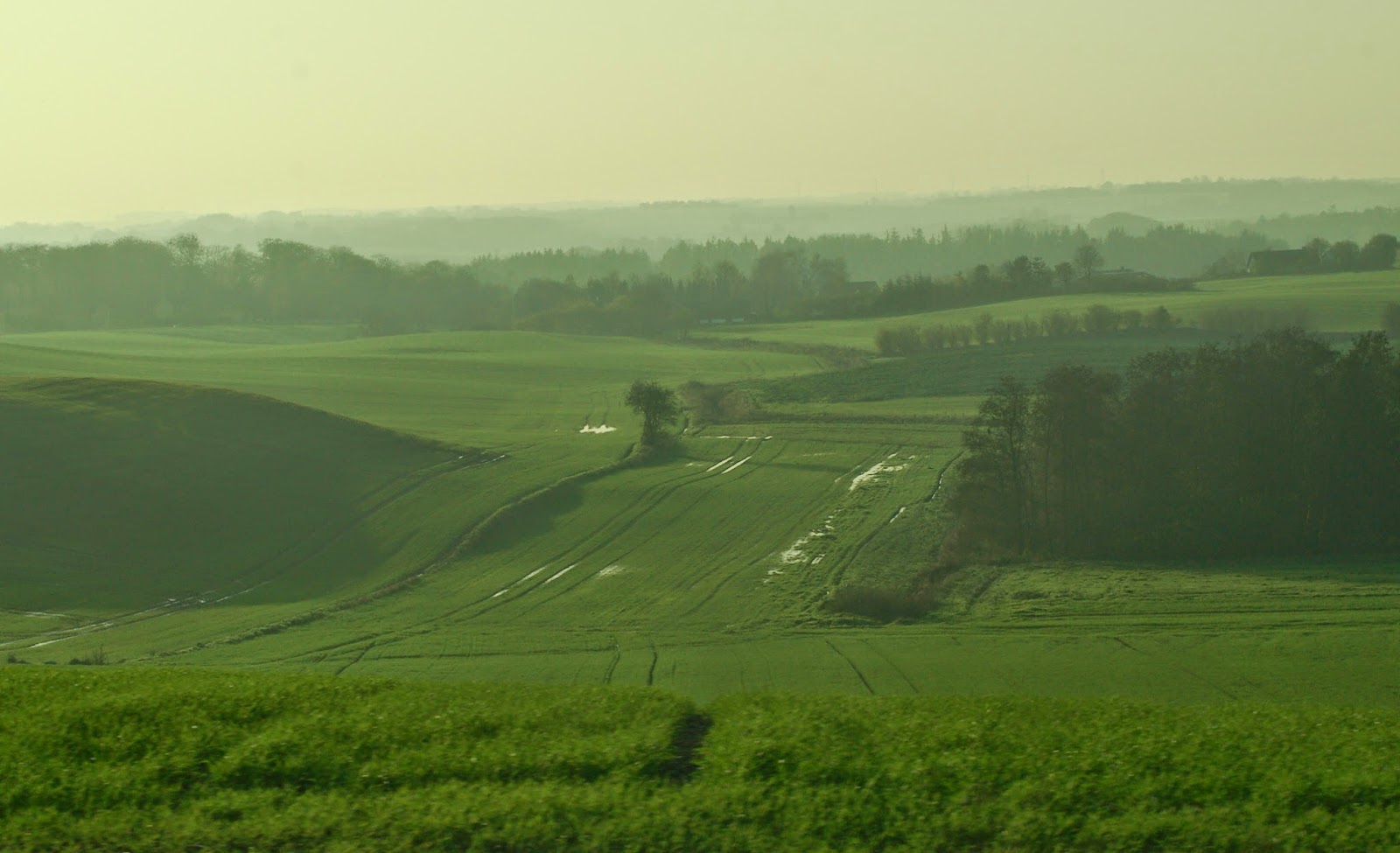
The winterseed creates lovely green fields during the winter season. On a  mild day in December the sun was shining through a haze across the winter-green fields.

The green fields are also good for geese and whooper swans who do some grazing up here North in winter.


You might almost believe that this is a spring morning and the church bell is ringing for service, but it is in the afternoon and the sun is already slowly on its way down.


If the winter is hard it can be a very costy business for the farmer. The extra expenses can be enormous if the seed is damaged. The winter is mild until now, sometimes with plus 10 Celsius which is a very high temperature in December.  But you can never tell. January and February can be a tough period for the winter seed.


A cosy little village lies surrounded by green fields.

A centralization in the 1960s meant that many shops, manufacturing business and schools have disappeared from the villages. But the increasing interest for the local community, environment and nature has caused that many villages have become attractive for people who are commuting to their job or go shopping in the big cities.

In some regions called udkantsDanmark  ( outskirtsDenmark) are problems because the necessary  jobs are only to find in the big cities. One of the results are many empty houses in the villages and no shops at all. A sad development.


It looks so peaceful and beautiful. This might be a scene from a Jane Austen film with d'Arcy and Elizabeth coming in from the right.............


Now it's later in the afternoon and the green fields are darker green.  Today's painters do not (usually) create their paintings outdoors. ( Maybe when they do watercolours). But when it was common to work on a painting outdoors they had to work fast in order to catch the light and the shades which many French impressionists have described. .


The last landscape from this day in December. The light is quickly fading. See you next time!


 photo East Jutland December 2014: grethe bachmann