Showing posts with label Sweden. Show all posts

Friday, December 08, 2017

Santa Lucia in Scandinavia (13.December)


The Scandinavion tradition with Lucia processions is relatively new and origins from 1928, where a Swedish newspaper graded "Stockholm's Lucia". Today each Swedish town has its own Lucia, who each year is graded Lucia long before 13 December. All the Lucias take part in a competition as "Swedens Lucia", a title which don't just mean to drive in a cortege to Skansen in Stockholm, but that the lucky girl gets a pr-tour to Italy and Syracusa where Lucia came from.


The Swedes have actually celebrated the Lucia night  ("lussenat") since the 1600-1700s, especially in the western part of the country, where tradition says that the young girls in the farm wake everyone with coffee and bread in the dark early morning. In Sweden the tradition has been cultivated with the special Lucia "lussebröd", a bun,  which is shaped like a wreath with four loops and spiced with saffron.


The Santa Lucia celebration song is a Sicilian folksong in the honour of Lucia, but the Scandinavian text is not so much about the historic Lucia, rather about the Swedish tradition where the Lucia Bride carries a tray with food to "those in need". Maybe this comes from the old legend, where Lucia brought food to the Christians in the catacombs during the persecutions. Lucia has nothing to do with Christmas which is seen in the Lucia songs. Sweden has lots of Lucia songs while the Danes only know a single one ( about the locality Lucia south of Napoli.) The first Lucia procession in Denmark was during the German occupation in WWII, and since then it has become a permanent part in Danish schools, but the Lucia feast in Denmark has never reached the same importance as in Sweden.


The story about Lucia begins in 283 at Sicily in the town Syracusa. Her family was well off and her  prospects were good, but at a young age Lucia conversed from the Roman religion and was baptized, which later cost her life. Sicily was a part of the Roman Empire -  and in order to maintain peace the inhabitants had to sacrifice to the emperor. The Christians denied to bring these sacrifices.

The Romans considered Christianity a dangerous religion and an enemy of the Roman empire, and the Christians were tortured and executed in the most brutal way. Many Christians lived a secret life where they either hid their faith or lived underground in the catacombs. Lucia helped her fellowmen. At night she brought food to the Christians in the catacombs -  and in order to find way in the dark she wore a wreath upon her head with lit candles.

According to customs she was promised to a man, who was a Roman from a reputable family, but she rejected the husband and the marriage. Her faith and her vow to God were incompatible with marriage, but in the eyes of the Roman her reasons were not just ridiculous, but also dangerous, and he indicated her to the authorities. Lucia would not sacrifice to the emperor and she was convicted guilty. At first she was sent to a brothel, but by divine intervention she was being protected. She was  then exposed to torture and sentenced to die at the stake, but once again God intervened. At last the judge took his sword and stuck her, and she died on 13. December year 304. 
Lucia was buried in her hometown Syracusa and as early as in the 400s she is mentioned in written sources. In the 600s where Christianity now was a state religion in the Roman kingdom she was a part of the Catholic liturgy. Her celebration day is the day of her death on 13. December, which is celebrated as a light feast in Scandinavia, especially in Sweden and Denmark. According to tradition the Lucia Bride walks in front of the light procession wearing a crown with candles upon her head. This is the virgin crown as a memory about Santa Lucia who gave her life to God as the bride of Christ .

Santa Lucia is connected to more than light and joy. She has become the patron saint for blind people and people with eye diseases. She is often displayed with a small bowl containing two eyes.


humorous drawing from 1848 by Fritz von Dardel


Sunday, March 15, 2015

The Vikings - Legal System - Survival of the Fittest.


viking house, Fyrkat/photo gb


Denmark 
Denmark was in the Viking period divided in about two hundred districts, the socalled "herreds", which each had a ting (thing). The thing was the counsil of free swordsmen coming together to manage the law, to issue rulings, and to discuss matters of a more common character..

The law was a complex of customs, something which was remembered from generation to generation. Therefore the thing-assembly was often a case of old men - with support from the old rhyme-formulas (stavrim)  - to remember and claim the law..

The punish provisions towards acts of violence or murder - among free men - were built  upon mandeboden (man's fine) and its various degrees: full mandebod for a killing or cutting off the nose; half mandebod for an eye, quart  mandebod for an ear etc. The warrant was made by the thing-men themselves,  and the law was no doubt not rarely bent to the power, since the enforcement  of the court decision had no special protection. If a member of a strong family during the eternal feuds among the families had insulted or violated a man from a weaker family and had been sentenced a mandebod on the thing, then the weaker part  had to recover the mandebod (the man's fine) himself, which might be difficult or even impossible.This was a shortage of the legal system.
.
law document Sweden wikipedia
The word herred is interpreted as hærfølge = (army escort ). Maybe this points back to a military system where each district (herred)  was obliged to make men or ships available during war. Or else the really big decisions - like election of a king, war and peace or alike - or a court decision of a special complicated or questionable case - were assigned to the big landsting, which in Jutland was held in Viborg, at Zealand in Ringsted and in Skåne (Scania) in Lund. Such difficult cases could be decided by holmgang (duel) following special rules or by  jernbyrd  (ordeal by fire) where they in reality pushed the case respectively to the right of the stronger or the judgment of the gods.

Theft was a dangerous thing to be engaged in, the punishment was simply hanging  which was not  from moral principles, but contrarily with a base in the very realistic view that the thief was a poor man (that was why he stole) and a poor man had only one thing to lose: his life.


Germanic assembly, wikipedia


Like in all other human societies the society of the Vikings was also built on relations and Community. The worst punishment was social exclusion : he who denied to bend to the decision of the herreds-ting and therefore had his case brought to the landsting exposed himself to exclusion The landsting had the power to declare outlaw inside its area. In the length to live his life in isolation, without legal rights, being hunted, excluded from the circle of his fellowmen:  this was impossible, the only ways out were exile or death. But for the man who respected the Viking society's unwritten customs and the rooted view of the law  from the time immemorial, this man could live a flourishing life in prosperity, if he was versatile and had "god  lykke". (good fortune.)


Viking house, Fyrkat, photo gb
A magnate from the grade of the earls had enough to organize, he might lead his own Viking expedition in the summertime, either alone or together with other chiefs and come back for winter with a good prey. He might also be a merchant and lead his own trade business and he had to take care of his own farming. Finally he had to take care of secular and clerical public offices : to judge at the thing and to see to that he - as the gode (Gothi)  of his hov (court) took into account the demand of the gods when it came to cultivating the land and taking care of the law.

Uffe hin Spage, Lorenz Frölich, wikipedia


A means to decide disputes between persons  - or through them between families -  was the holmgang (the duel) The oldest description in a written law fragment from Sweden is about a holmgang-  and it reflects in a realistic way both the sensitive honour which was so vulnerable:  to insult with words and the brutality of the law of the strongest man. The fragment says: " if you say insulting words like: You are not equal to men or: You are not a real man " -  then the two men will have to meet where three roads cross. If he who said the word comes,  and if he who was told the word does not come,  then he'll have to stay as he was named, and then he is not able to give oath or to be a witness - neither in a man's or in a woman's case. If he comes who was told the word , but not he who said the word, then he'll cry three times: "Nidding"  and make a mark in the field. And  he who said the word will then be an inferior man since he dare not stand by what he said.

Now they'll both meet fully armed: if he falls who said the word: a word-crime is the worst - the tongue is the first killer:  he lies on the ground upon his deeds.


Sweden
A similar picture of the legal system in the Viking period is seen in Sweden. Here is also a family society, a life built upon the land-properties of the family and the inner solidarity,  with orally handed-down laws and rules of law, which were put into power by warrants at the thing-assembly of the herred (Swedish: de hundradets). Here is undoubtedly also a system of a common war oganization. And here is also a limited royal power. In the Ansgar- biography is said about Birka, that it was a usual custom to let common cases decide by the agreement of the people rather than on the king's demand. Two concepts were in front of life of the Nordic Viking: den gode lykke = the good fortune - the prosperity of the fortunate man - and æren (the honour) which had to be protected and must not be breached.

Norway
Hakon the Good, P.N.Arboe, wikipedia.
The same schedule is found in Norway as to the secular building of society. The indivual bygder (settlements) had their local thing-assemblies, and the large districts had their own more comprehensive things, where chiefs and old experienced men were judges and interpretors of the law. In Norway is also the family society with the single man, the private person, who seeks his right supported by his family via mandebod for a revenge-killing.
Like in Denmark and Sweden the problem is the same in Norway. Direct primary sources to a knowledge about the legal system of the Viking period are missing,  it is only possible to refer to the medieval laws, the * Frostatingloven  and the *Gulatingloven  (both laws are Norwegian laws, which acccording to the sagas were ordained by Hakon the Good for respectively Trøndelagen and Vestlandet). Like in Denmark there is reason to believe that there was a military system too in Norway ( a leding) where each district  was obliged to deliver ships and warriors to a common defense. And like in Denmark and Sweden it is also the same for Norway:  that the royal power was limited by the thing-assemblies and  folkets vilje ( will of the people). Anyway the king's power must not be too much reduced, for the king had his team of housecarls , his hird, which from an original private organization grew up to a half public factor  - a very active means of power which became the core of a larger army 


Iceland.
A Gothi /priest) Lund, wikipedia.
Iceland had no king. The legal system was established after west-Norwegian design and after the rules in the later Gulatinglov. This thing-constitution became common to the whole island from year 930. The common thing was held each summer( named altinget), with the lovsigemand (the man who  recited the law rules) and with the heathen priests (the Gothis) as the real rulers. The island was later divided into four quarters each with 3 (one with 4) herredsting. Since the magnates were goder (Gothis) it must be said about the Icelandic free state that it was a regular chief-union without a king. An oligarchy in a classical saying.


Source: Johannes Brøndsted: Vikingerne;. Vikingen hjemme, Samfund.  Ggyldendal 1960


Tuesday, April 24, 2012

The Viking - his Pride and Joy , the Sword and the Axe.


1. Viking picture stone, Gotland


A Nordic Viking's full weaponry were sword, axe, spear, bow and arrow. The noblest weapons among these were the sword and the axe. A Viking with esteem for himself wore them permanently. A real Viking loved luxury, colours and riches in his weaponry, his riding equipment and his clothes.

The Sword
2. Danish sword
The sword is known from several finds in Scandinavia, mostly from burials, but after Christianity arrived it was forbidden to put weapons or other things with the dead Viking. In a Viking warrior's grave were usually only one or two weapons, sword or sword and axe. In return there might in some graves be more than one of each. The long sword seems to occupy the first place among the attack weapons.The new feature about the new Viking sword is the Hialte, the crossbar between the blade and the handle, which meant to protect the warrior's hand. The Hialte did however not give a real protection to the hand, and it is unlikely if the sword was often used as a stabbing weapon.


The Viking's main weapon was probably the sword. The single-edged sword from before the Viking-period was replaced by the long, often broad, double-edged sword with a four-divided hilt.The blade might be Damascened and inlaid, and the hilt was often richly decorated with chase and gilt and with inlaids of gold, copper, silver or niello (a mixture), making the sword into a splendid weapon. The scabbard of the sword is usually not kept or found, but the bronze-"shoe", which forms the finish of the scabbard was sometimes found. It is triangular and often shows animals ornaments in openwork.

3. Swedish swords
Nordic archaeologists have divided the sword material into 20 mutually various groups , Norwegian, Swedish, Danish and common, older and younger. Several Viking swords were found in the interest-sphere in England, Ireland, France, Russia etc. The swords were probably made both in the North and abroad, some swords produced in the Viking's homeland and others imported.

4. Frankish sword, Hedeby


A sword is a complicated thing to create, and the whole working process is not made by the same man. The blade is made by one, the hilt by another, the joining by a third. A hilt might be decorated in a special Nordic ornamentation with a "gripping beast" or in the Jelling style. A sword like that was produced in the North. A blade with a signature like Ulfberth was undoubtedly welded abroad, probably in France. Usually there was enough technical skill in the North to produce a sword. The finds of iron and blacksmith-tools in the Scandinavian Viking finds are a witness of the important role of the Viking-blacksmith. There was a question. Who made the best swords? The answer: Undoubtedly the Franks. This is known from literary sources. And the Franks forbid export of their valuable swords. Charlemagne forbid, Charles the Bald forbid, the last even forbid on penalty of death. Charlemagne's embargo was aimed both to the East and to the North, the clerics were especially impressed to conform to this. This indicates that weapons were often processed in the closter-smithy. The embargo of Charles the Bald was firstly aimed to the Nordic Viking-emporium. He did not wish to equip the bloodthirsty Vikings from the North with the best weapons in the world. And the Frankish swords were considered the best in the world.


5. Charlemagne, A Dürer.
It seems that the Rhine district and especially Cologne was an important center of weapon fabrication. Another sign of the brilliance of the Frankish swords was told in a story in the Gesta Caroli Magni (Story of Charlemagne) about Louis le Gros, who, sitting upon his throne, received swords as gifts from the Norman kings, also Nordic swords, which quality he wanted to test. He tested each sword. The result was that only one sword passed the examination. It might be a fictional anecdote, but it shows the tendency however, the emphasis that the Nordic swords were inferior to the Frankish swords.

A Viking period-find by Swedish archaeologists from Øland in the Baltic sea were five Damascene sword blades with fabrication-signature, probably Ulfberth-blades from the Franks, imported to Sweden to have  bronze-hilts attached. The Nordic craftsmen were from tradition masters in producing the bronze hilts with inlaids and chase. But the blades had to be Frankish.


Legendary Swords
There are many named swords in the legendary literature, and although there might be no reality behind the stories they reflect anyway the importance of the swords - both symbolic and practical. The legendary hero Roland's sword Durendal, king Arthur's Excalibur and Sigurd Fafnersbane's sword Gram are wellknown examples.

Uffe and the Sword Skræp (Offa of Angel)
6. Uffe hin Spage,  Lorenz Frölich
The legend about king Vermund and Uffe belongs to Saxo's Danmarkskrønike. The Saxon king had treacherously challenged the old king Vermund, whose mute son Uffe regained his voice and, unexpectedly to his father, proved to be a strong guy. So big and powerful that every chain mail broke when he got it on. At last he got his father's chain mail which was split up in the side, which was protected by the shield. But no sword was good enough for Uffe, they all skipped into pieces when he swung them, or they could only take one cut. The blind king Vermund then lead his people to a place in the meadow, where he secretly had buried the special sword Skræp, when he thought his son was unfit for anything. Skræp was unusually sharp and could split whatever it hit, nothing could withstand this sword.
The combat took place on an island in the river Eider, and the blind old king wished to sit upon a wharf close to the edge, so he could throw himself into the water if Uffe lost the combat. The sword looked brittle and rusty, but it passed the test. Vermund was blind, but not deaf. When Uffe first chopped one, then the other opponent, both in one single cut, his father recognized the sound of Skræp from the old days. His chair was pulled back from the edge, the king regained his love of life, and the Saxons had to go shameful away. In this way the kingdom of Saxon came in Danish hands, and this sword really deserved a special name.


Sigurd Fafnersbane and the Sword Gram 

7. Fafnerdrabet, Eskilstuna
8. sketch from the Fafnerdrab
A picture and a runic inscription are carved in a rock wall at Eskilstuna in Sweden. It illustrates the legend about Sigurd Fafnersbane. The blacksmith Regin incites Sigurd to kill the dragon Fafner, and he gives him the sword Gram ,which he has welded. Sigurd rides out on his horse Grane and kills the dragon, but when he roasts the dragon's heart on the fire, he is burned, and when he puts his finger in the mouth to ease the pain, he gets the dragon's blood on his tongue, and now he understands the voices of the birds. They tell him about Regin's treachery, and he kills the blacksmith. The whole story is told in one picture. Between Sigurd and the decapitated blacksmith, the tools are seen

Beowulf
The hero Beowulf can only get rid of the troll's mother by using a sword which hangs in the underwater cave where she lives. The Sagas make these swords supernatural, they were not of course, but it is obvious that a good and precious sword was treated with care. Famous swords were inherited through several generations. 


The Axe
9. Axe, Trelleborg
The sword was an international weapon in the Viking period, but the axe was a Nordic weapon. Through the millenias of the Nordic prehistory the axe is much older than the sword. The sword first arrived when man during his cultural development finds a material, which allows to prepare a product like a sword; the metal: first the bronze, then the iron. But the axe had existed in milleniums when the sword arrived. In the Viking period the war axe out in Europe was not out of use, but it was considered an outdated weapon. In the North the war axe had a Renaissance in the Viking period. The haunted western European populations knew their enemy when they saw the long-handled axe, the special sign of a Viking. Upon the Lindisfarne stone the Vikings carry two weapons above their heads, the axe and the sword. The Viking's war axe is  varied in design, but in two main types: an older called the skægøksen (beard axe), which edge is drawn down like a chin beard, and the broad axe with outswayed edge-corners which came around year 1000. Both axes might be decorated with exquisite silver inlaids. A very fine silver inlaid broad axe came up in the excavation of the Danish Viking fortification Trelleborg. 

The Cross in the Axe
10. cross in axe.
In the exhibition of Silkeborg Museum in Mid Jutland is a splendid war axe, a special example of the broad axe, also called The Danish Axe. With its unique decoration it is a bridge between two elements: the life of a warrior and the new faith. The axe is special in its unique design; the blade is openwork, and from the back of the edge-section is seen a little cross. The axe came from a private collection so nothing is known of where it was found. The magnate, who was once the owner of this axe, was surely a Christian. He might have had a connection to the first clerical circles in Denmark, eventually as a protector or a life guard. It is obvious that a Viking remained a Viking, no matter how much he had converted himself to Christianity.


The Spear
11. spearheads, arrows, axe
The spear was widely known and used in the Viking period, it was called the third main weapon of the Viking. The shaft was never found preserved, only the iron spearhead, which has a very elegant shape. A long slender blade with a sharp middle rib. Some spearheads have socalled wings. They are undoubtedly of Frankish origin. In late Viking period are often found a rich silver inlaid in exquisite geometric patterns, such spears were splendid weapons, which no doubt were brought back to their owners after combat- if it was possible!

Bow and Arrow
This ancient weapon was important to the Vikings. This is often told in the Sagas. The bows are gone(they were probably just simple longbows) and the arrow shafts also. But the iron arrowheads are often found in the graves, sometimes also in women's graves. They are heavy, dangerous arrowheads, and sent from a strong bow they must have had a significant impact. They have been found in graves, assembled in bunches or in a bundle of 40 pieces.They were carried in a round quiver.

The Knife.
The iron knife is also a weapon, both a weapon and a tool. The simple one-edged iron knife with a wooden or bone shaft was carried by men at their belt, and  by women in a chain on their breast. In women's graves from the Viking period it is common to find the blade of an iron knife at the woman's breast or at her belt.


The Protection
12. Gokstadship, sketch with shields

13. Viking helmet
The most important protection devices of the Viking were the wooden shield, the iron chain mail and the iron or leather helmet. All three parts are rare to find in excavations, but they are known from depictions and from literary references. The shield was round, flat and rather thin, often painted and with a central round iron boss. On the famous Norwegian Viking ship at Gokstad the shields hang in a row along the railing  The chain mail and the helmet were rare and distinguished protection weapons, carried by chiefs.  They are only known in rests from the finds, but sometimes from depictions or from statuettes, where the helmet is formed like a pointed Monkshood, probably in leather; this pointed hat was possibly a loan from Oriental equipment. Woven depictions from the Norwegian Oseberg ship show whitepainted chain mails, which cover the whole body and with a hood up over the head.


The Berserks. 
Hagar the Horrible

 In connection to the mention of the Viking weapons there existed a strange subspecies of the Viking warriors, called bersærker (berserks); they were raging, half insane brawlers, who were gripped by the intoxication of war, and when the rampage (bersærkergang) came upon them, they had terrible powers, but afterwards they fell into daze and helplessness. Snorre Sturlasson tells in his favorite Saga about those warriors "filled with Odin's rage". Odin could make his battle-enemies become blind, deaf or scared witless, and their weapons did not bite more than a stick. But his own men walked around without chain mail and were like mad dogs or wolves; they bit in their shields and were strong as bears or bulls. They knocked  down enemy warriors like they were flies, and neither fire or iron could fight them. These berserks are often mentioned in the Norse literature; a researcher is of the opinion that they should be considered a species psychopaths, elected for their special powers and brutality and actually organized in teams for kings and chiefs; they were during the battle able to inflame each other until the insanity.

Grethe Bachmann

Source: Johannes Brøndsted: Vikingerne, Materiel kultur, Våben, Gyldendal 1960; Skalk: Smeden, nr. 1, 1963; Skalk: Ole Shiørring, Korset i Øksen, nr. 6, 1978; Skalk: Christian Adamsen, De sagnomspundne, nr. 2, 2011.

 
Images:
1.  Viking picture stone, Gotland, Sweden,
2, 3, Danish sword; Swedish swords; Johannes Brøndsted, Vikingerne. 
4. Frankish sword, found in Hedeby(Haithabu) , Gyldendal og Politikens  Danmarkshistorie, 
bd.3.      
5. Charlemagne, painting by Albrecht Dürer, 1600, Buch: Kunsthistorisches Museunm, Wien.
6. Uffe hin Spage, drawing by Lorenz Frölich.  
7. picture and runes of the Fafnerdrabet upon at Ramsundsberget in Eskilstuna, Johs. Brøndsted, Vikingerne.
8. sketch of the Fafnerpicture, by J. Aarup Jensen, Skalk 1963.
9. Silver-inlaid war axe, found in the Viking fortification, Trelleborg, Sjælland ; Johs. Brøndsted, Vikingerne. 
10. Viking axe with cross, Silkeborg Museum, Jutland, Skalk 1978 .
11. Viking spearheads, arrows, axe, Johs. Brøndsted, Vikingerne.  
12. The Gokstadship (Norway) with shields, drawing from book by N. Nicolaysen about the Gokstad ship. 
13. Viking helmet, 7-9 century.
14: Hagar!


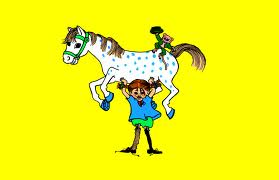
Pippi Longstocking's Horse


"Pippi-horse"
The other day I saw one of those horses we in Scandinavia call a Pippi Langstrømpe-hest. Pippi had this white horse with a lot of spots and she was able to lift it one-handed.  The books about Pippi are loved by every child in Sweden and the rest of Scandinavia.


I guess that most of you know Pippi (Peppi) Longstocking. Astrid Lindgrens books are translated into 64 languages. 

Astrid Lindgren's first three Pippi-books were published from 1945-48. Pippi was named by Astrid Lindgren's then nine-year-old daughter Karin. Pippi is unconventional and has superhuman strenght, she is able to lift her horse, she mocks and and dupes adults, but she reserves her worst behaviour for her most pompous and condescending of adults. Her anger is reserved for the most extreme cases, such as when a man ill-treats her horse, Like Peter Pan Pippi does not want to grow up.

Pippi claims her full name is Pippilotta Delicatessa Windowshade Mackrelmint Ephraim's Daughter Longstocking (Swedish: Pippilotta Viktualia Rullgardina Krusmynta Efraimsdotter Långstrump). Her fiery red hair is worn in pigtails, so tightly wound that they stick out sideways from her head.
Pippi lives in a small Swedish village, in an exciting house Villa Villekulla with her monkey hr. Nilsson and her horse, but no adults or relatives. She's got two friends Tommy and Annika, two children who live next door. Pippi's two main possessions are a suitcase full of gold coins (which she used to buy her horse) and a large chest of drawers containing various small treasures.
Pippi is the daughter of seafarer Ephraim Longstocking, captain of the sailing ship  Hoptoad (Hoppetossa in Swedish), from whom Pippi inherited her common sense and incredible strength. Captain Longstocking is the only person known who can match Pippi in physical ability. He originally bought Villa Villekulla to give his daughter a more stable home life than that onboard the ship, although Pippi loves the seafaring life and is a better sailor and helmsman than most of her father's crew.

Villa Villekulla
The story goes on and on with Pippi  and Tommy and Annnika, and Astrid Lindgren is one of the most loved authors of children books. She is the world's 18th most translated author and has sold roughly 145 million copies worldwide.The best-known books by Astrid Lindgren: The Pippi Longstocking series, Karlsson-on-the roof-series, Emil of Lönneberga, The Bill Bergson series, Madicken, Ronia the Robber's Daughter, Seacrow Island, The Six Bullerby Children, Mio, my Mio, The Brothers Lionheart.(some of the books are on film and TV).

Astrid Lindgreen died in 2002, 94 years of age.


Sunday, June 19, 2011

The Vikings /The Expeditions

Norsemen, Danes, Swedes


The Viking expeditions are grand. They include all of Europe, to the east along the large river-roads through Russia, to the Caspian Sea and the Black Sea, to the west along the Atlantic coasts down past Arab Spain through  the strait of Gibraltar and the Mediterranean. But they also include the wild unknown North Atlantic with the Faroe Islands, Iceland and Greenland, even America. 

The three Scandinavian countries had each their own geographic profile externally, and their own political interests. The names Sverige, Norge and Danmark show that each country had memories of old historic life. The name Sverige (Svearike) is the rige of the Swedes, a rige meant in that period a land where a king was the ruler  (= English: a kingdom). It is not a coincidence that the name of the land of the Swedes pointed to the authority and power of a king. The Swedish kingdom existed long before the Viking-period.

map from 1539 with Danevirke

Danmark means the mark (land/field) of the Danes. The old meaning of the name "marc"  = uninhabited borderland.The Mark must in this connection be the land at the south of Jutland's foot, the wild land south of Danevirke, which divided the Danes from the Saxons to the southwest and from the Slavic people to the southeast.The name Danernes mark = Danmark was gradually used in general already before year 900.   The Anglo-Saxon king Alfred the Great wrote Denemearcan in his foreword to Orosius' world history, and this is the first time the name Danmark is mentioned in the world literature.

The name Norge has an old root, but in a different way from the Danish and Swedish. Norge was also a collected kingdom under Harald Fairhair, but much later than what happened similarly in Denmark and Sweden. The name Norge has a commercial historical meaning. It means "den nordlige vej" (the northern road) or Nordvejen ( the Northroad), an appellation of commercial historical origin. This road was the trade route along the long, long coast of Norway, from south to north and back, a route which is described in the before mentioned king Alfred's document from the late 900s. It was a sea route from the trade center Skiringstal at the Oslofjord, via the seas of Kattegat, Skagerak and the North Sea up to the White Sea, where they fetched sealskin, polarbear skin and walrus-tooth. 

Sea Stallion model of Viking ship on its first voyage Denmark-Ireland.
The face of Norway turned west, towards the great oceans and their islands. It was mostly the Norsemen, who before and during the Viking period braved the immense, icegrey, stormy North Atlantic - and they started their voyage with no knowledge of, what they might meet or find. The Norwegian interest was split in two, the first one expeditons/raids to the southern, starting by a north-Scottish island, which was inhabited by Norsemen at the very first beginning of the Viking period; from here to the coast of Scotland, to Ireland, to the Isle of Man, to all Irish and English coasts around the Irish Sea - from here the Norse expeditions went deep into England from northwest, where they were fighting and competing with the Danes, but the Norse went still farther away, to the northern and southern France and into the Mediterranean - the French part of the expeditions is the same for Norsemen and Danes. The Norsemen's second interest, the northern expeditions went to the Faroe Islands, Iceland and Greenland. These expeditions were probably due to the pressure, which king Harald Fairhair put on the Norse earls and free farmers, when he roughly forced them to accept Norway under one Crown in the end of the 9th century. These later Norwegian expeditions across the Atlantic were not raids or piracy, they were more colonization of desolate areas.

Sweden looked to the east. The Swedish expansion had started already in the 8th century (across the Baltic Sea). The mighty Swedish trade developed and branched in a grand manner southwards through Russia to the southern states. The Baltic Sea was considered common area for Swedes and Danes.

Thousand years ago the Viking Ingvar Vidfarne went towards the east. In 2004 a Swedish expedition revived his tour from the Black Sea to the Caspian Sea, a a wearing tour across sea, mountains and along tortuous roads. The magazine Illustreret Videnskab  was onboard on the almost ten meter long Himingläva.

The Fyrkat house, copy of Viking stone (London stone)
And south of the Scandinavian peninsula was Denmark with lots of islands and the peninsula Jutland, the main land. Jutland had its foot upon the Central European continent, but this did not mean a connection between Denmark and the countries south of the border. On the contrary was Jutland and thereby Denmark  withdrawn from their southern neighbours, the German Saxons to the southwest and the Slavic Obodrits and Wends to the southeast. The Vikings preferred to use the water routes on the sea and the rivers. The Danish interest went therefore not directly to the south, but to the southwest along the Frisian and Frankish coast and towards west to England. To the east was the western part of the Baltic Sea. To the southwest were all the coasts and rivers of the northern France deep into the Danish field - but the Danes did not stop here -  they went farther away and came to the Mediterranean together with Norsemen and Swedes.


Sea Stallion Vikingship Museum Roskilde


Source: Johannes Brøndsted, Vikingerne,1960; Illustreret videnskab, 2004.


photo: grethe bachmann