Friday, November 23, 2018

December Traditions built upon Superstition and Omens.....

December
Christ's Month/KristmånedSuperstitions and Omens


Now we are soon in the tvelwth and last month of the year, but in ancient times while the Julian calendar ruled it was the tenth month of the year. Decem means ten in Latin. The medieval Danish name was Kristmåned (Christ's Month), the month where you celebrate the birth of Christ.


Ploughed field, Fulden.

The farmer had to finish his ploughing in the first days of December. After this he brought liquid manure to the winter rye and fetched thorn and staves for building and repairing the fences. If the meadows and the moors were frozen, he cut willow twigs for his furlong fences -and if he had no longstraw for his roof repair, he fetched reed in the frozen meadows and marshes.
He also had to repair the watermills and the sluices. Indoor the farmer family was concentrated around the Christmas preparations, but the whole family helped each other to repair tools and make twine and ropes. There was no time for laziness in the farmer's family.

Weather omens were serious matters then, not just something to make fun about. If an omen said that a cold and snowy December promised a fertile year and a good summer, then the farmer wanted cold and snow. A mild month with rain and fog made him worried. But else the weather omens were few in December, although three unlucky days kept people inside the house - the 6th, 11th and 18th of December. The 6th of December was Sct. Nicolai's Day, and if the weather was good it would be good the rest of the month. If the 8th of December (Sct. Anna's Day) came with thaw the whole winter would be mild.

The night between 12th and 13th December (Sct. Lucia) was a dangerous night. Before people went inside in the evening the whole year's work had to be finished and all crops be under cover, or else they would be destroyed by de underjordiske/the underground people (trolls, pixies etc.) It was an exciting night for the young girls on the farm. It was possible for the girl to see her future fiancé, if she held a lit candle in each hand and looked into a mirror while she spoke a verse:

Luci du blide
skal lade mig vide:
hvis dug jeg skal brede,
hvis seng jeg skal rede,
hvis kærest' jeg skal være,
hvis barn jeg skal bære,
i hvis arm jeg skal sove.

Luci you gentle one,
let me know,
whose table cloth I shall spread,
whose bed I shall make,
whose sweetheart I shall be,
whose child I shall bear,
in whose arm I shall sleep.


The night before Christmas the stables were cleaned extra thoroughly and the livestock had plenty of clean bedding and extra fodder. The superstition said that the animals found their tongue on Christmas Eve, and if everything wasn't quite allright then they would speak evil about their master and his house.

The family also had to consider "the underground people", and it was necessary to do a lot of preparations in order to prevent their destructive power. The farmer had to put steel above the stable door, and the teeth of the cattle had to be rubbed in salt and soot, (poor cattle!) to prevent the underground people from harming the animals. Plough, harrow and other tools had to be indoor, when Jerusalems shoemaker - the Wandering Jew - was out walking that night. If he rested upon a forgotten implement, then nothing was able to grow in that field the following year.

All things made of iron had a great power, and besides the steel above the stable door the farmer had to put a solid scythe into the corn pile, an axe into the dunghill and a big knife into the eaves.
Overall were dangerous creatures at work, numerous tales were told about helhesten(a ghost horse with three legs), trolls, witches, evil minded pixies, vætter (elves) and other dangerous underground people, who were the cause of misfortune to people who did not take precautions against them.


The farmer's wife and the farm girls had to see to that all clothes had been washed and dried before Christmas Eve - all clothes had to be indoor. The saying was: Den der klæder gærder i julen skal klæde lig inden året er omme. /He who dresses the fence in clothes during Christmas must dress a dead body before the end of the year.

The Christmas dinner went on and on - and on. Many believed that he who first stopped eating would die before the end of the coming year. This must really have been a hard nut to crack. They had to stop eating at the same time!

Often people put an extra, lit candle in the window. It had to show all wayfarers where the farm was , but it also had to lead the departed of the family, when they visited their home this night. Some put an extra setting on the Christmas table.

Many of our Christmas dishes come from the pagan solstitial celebrations. The special tradition where the farmer puts porridge upon the loft for the Christmas pixy is probably even older than this - probably from bondestenalderen (4000 bc) . In this period porridge was offered to friendly gods who lived by the settlement.

The Christmas pork roast is an old tradition too, way back to the pagan sacrificial celebrations before Christ, when the biggest hog (gilded orne) was sacrificed to the fertility god Frej, (Frodi) so that he would bring "year and peace" to the farm.


Christmas Day was a very important time. The farmer was dependent on the weather like the farmer has always been and still is. He had to imagine the weather in the year to come. In the morning the farmer cut twelve grooves (for the twelve days of Christmas) in a beam in the ceiling, and around every groove he made a chalk circle. Every day he wrote signs in a circle - if it was raining he wrote dots, if it was storming he wrote stripes and so on. He marked every circle with a sign which he himself knew the meaning of and which he had learned from his father. When Christmas was over he could easily see how the weather would be in the next twelve months. Actually a long-term forecast of that time. Today our long-term forecasts on TV are somewhat more advanced, but this doesn't mean they are more reliable. When I remember my umbrella the sun starts to shine and when I forget my umbrella it rains cats and dogs.

On this first day of Christmas it was not allowed to walk about in the farm. Fodder for the livestock were ready for several days. The farmer had to keep away from the grindstone, his wife had to keep away from the spinning wheel. Sewing and knitting were also forbidden, both this day and the rest of the Christmas days. If people crossed this line they were almost sure to get swellen fingers the next year. On every one of the twelve Christmas days it was widely forbidden to make practical and useful things, except when it was necessary to supply the fodder for the livestock and other necessary things.


Most omens were taken the night before the festival and the farmer was very interested in the weather on the last day of the year. If it was raining on exactly this day (Sylvesterdag) the harvest would be a difficult one. Furthermore he took a slice of bred on New Year's Eve, smeared lard on and cut it in four. Those four pieces were put on the floor. The chained dog was brought into the room and held back while the farmer pointed at the bread slices one by one and told the dog: "This is my rye, this is my oat, this is my wheat and this is my barley". The dog was loosened and the bread slice he eat first told the farmer which kind of corn would bring the best yield in the following season. And the next slices the dog eat were also put in order in the farmer's mind. So if the omen later showed to be wrong it wasn't his fault. Maybe he thought it was the dog's fault!

The young farm girls played fortunetellers. One girl went outside the room, and the girl who wanted to know about her future took four little bowls. The first one was placed over a tiny bunch of soil , the other above a ring, the third above a comb and the fourth above nothing. Then the girl outside was called upon and she pointed on one of the four bowls. The soil meant death, the ring meant early betrothal, the comb was marriage - and the empty bowl meant that nothing would change in the coming year.


Shortly before twelve according to the custom people started making a terrible noise with pots and pans in order to chase away evil spirits, but at twelve there was silence for a short moment, and then everyone wished one another a Happy New Year. We still make some noise but we don't believe in evil spirits - do we? We still wish each other a Happy New Year, and I wonder how old that tradition is.

Some people back then even believed that if they on New year's night at twelve stood in the middle of a crossroad and called out three times for a dear departed, then he or she would show and answer three questions.

Whatever! A new year began, and people way back then were dependent on so many things and afraid of so many things that it is impossible to imagine for us today. But if you have ever been out in the country on a completely dark night then you might catch an ancient feeling of fear. No moon, no stars, no street lights. You cannot even see your own hand. On a Christmas holiday by my grandmother, when I was about ten years, I had to fetch milk for her on a farm nearby on such a dark night. I was terribly scared and couldn't find my way in some critical moments. And in the old days, in the Middle Ages and long before, way back in time people really believed that out in the dark were evil spirits, the ghost horse, trolls, witches, pixies, elves and many more dangerous creatures.

Source: Ruth Gunnarsen: Familiens Højtider i gamle dage.
photo/mostly from Hjerl Hede Open Air Museum, Jutland: grethe bachmann

Tuesday, November 13, 2018

Viking Age - Denmark, Connections abroad.


fortification, Trelleborg, Zealand
By people in the Frankish kingdom and on the British Isles the Danes were first of all considered Vikings. Danish attackers, conquerors and colonists played an important role in the remake of western Europe, but they also had a strong influence in their own country.

Some Viking chiefs, who had won riches, power and glory came home to Denmark and tried to usurp royal power. King Horik and most of his family were killed in such a power feud in 854. The old branch of the royal family gained footfold , but other homecoming Viking chiefs - some from the east -  were more lucky in their fight about the throne. The fortification moats in Aarhus might have been built during that period.


The diplomatic connections between the Danish kings and the Frank and German rulers brought foreign influences to Denmark. King Harald was baptized in Mainz in 826, and he was not the only Dane, who experienced and was impressed by the court ceremoniel of the Franks. Maybe this infected the life in the Danish royal castle in the 800s, but as for the 900s the big Jelling stone and the cross-marked coins show that Harald Bluetooth fully understood the value of demonstrating his royal dignity. The Jelling church was probably bigger than many other Danish buildings, and its basic plan was inspired by the German churches.


The Franks and the Germans did not only affect their Danish neighbours - they also wanted to have power over them, but they did not succeed.  The Danes could retriet from Jutland to security on the Danish Isles and gather new strenght while the peninsula Jutland was attacked -  and the Saxon hertug Bruno and his army had to learn this in 880......the only Danish king who in the 800s had to acknowledge the supremacy of the Franks was Harald Klak,  and he was deposed and driven into exile .

The feud between the various throne pretenders weakened seriously the power of the Danish kings,  and in 934 the Danes could not resist an attack in southern Norway from the German army. The Danish supremacy broke down and Harald Fairhair was able to expand his Norwegian power while local rulers in the districts east of Storebælt (Danernes Mark) enjoyed a great independency.


Fyrkat , Jutland, photo:GB

Later the German king Henrik 1 forced the Danes to pay taxes, and two generations later the Germans ruled in Sønderjylland (South Jutland) for a short number of years (974-983). Nothing indicates that Harald Bluetooth ever acknowledged German rulers as his overlords - but after 983 and in the following century the Germans were too busy feuding their Slavic neighbours to care about Denmark. Undoubtly it was the German occupation of Sønderjylland which made  Harald build the complicated system of fortifications and roads which gave a clear expression of his power and talent of organisation. In order to build the fortifications Trelleborg , Nonnebakken; Fyrkat and Aggersborg and the great bridges - which were all built at the same time - the king had to exploit his right to recruit labor and demand other necessary services from the Danish population . Most probably these heavy burdens made him unpopular among the Danes and led to the rebellion  which drove him into exile and death. 


Runic inscriptions mention two earlier rulers at Funen, Roulv and Alle. The Glavendrupstone was raised in the memory of Alle by his widow Ragnhild and his sons. Ragnhild had the Danish rune-
master to carve the inscription upon the runestone in Tryggevælde at Zealand
Glavendrupstone
for the memory of her second husband, Gunulv, about whom it was said that "few are born better than he". It is not known which stone was raised first, but these men must have been contemporary to king Harald, and they might even have been local chiefs, who by acknowledging Harald as their king, took part in making it possible for him to announce that he had "won himself all Denmark. "

Harald's kingdom was exposed for disturbances from Viking fleets. As the leader of the expeditions to the west Sweyn Forkbeard saw to that his men were awarded like other men of the Viking chiefs. Torkel's fleet represented the biggest threat however. He was now in the service of the English king, but it was Sweyn who in 1013 seized the English throne and thereby got access to the rich sources in England.


The riches of Englands made Cnut the Great able to realise the Danish demand on the supremacy of a large part of Scandinavia, much more than his predecessors had ever been able to. Still before Cnut drove the Norse king Olav into exile he demanded to be king of the Norwegians -  and at the same time he declared he was king of a part of the Swedes. It is not known what he actually meant -  he might have thought of the West Goths, whose access to the sea went through Danish territory,  but it was more probable that he considered himself as the overlord of the Swedes who had been warriors in his army. As king of England Cnut advised one of the most advanced and effective Governments of Europe -  and it did not last long before this English influence was evident in Denmark. The attempts to establish a well-functioning coin was finally successfull and much was done to promote the development of cities which became metropols for the royal power. In some cities were established bishoprics -  and the bishops were fetched from England or at least educated there. Cnut's great kingdom sank into the gravel after his death but the changes he had started were continued by his successors and long after the separation of Denmark and England the English influence was noticed in the Danish church.


Merchants, wandering craftsmen, Christian missionaires, diplomats and the Vikings themselves were all  the cause  of influences from abroad in Denmark. The Danes connected more and more to the outside world during the Viking period than ever before and the consequences began to show in the beginning of the 1000s - cities were founded, bishoprics and a royal coinage were established. It is clear via archaeology that all parts of society were affected by the contact to the outside world.  In each archaeologically examined village from the Viking period are rests of mill stones from the Rhine district and soapstone-vessels and  grindstones from the northern Scandinavia. In Jutland are found western European ceramics - and Slavic clay ware or Danish copies are found in the eastern part of Denmark . More perishable goods like clothes and wine were probably also widespread. The imported goods were spread all over Denmark - but they were not for free. Wealthy Danes who lived in the 1000s were capable of paying their shopping  with coins and other silver -  but the import was through the whole period generally paid with Danish export products or with services and catering to the foreign merchants who visited the Danish harbours on their tour between the Baltics and Western Europe. Cattle was one of the most important export products
Highland cattle, foto:GB
. An early phase of this traffic is proved by the archaeological find of a large heap of cow dung which had accumulated in the town of Ribe. This indicates that cattle was gathered here,  probably in order to transport them by sea.


Ansgar
village and church, Hjerl hede, foto:GB
Except from Willibrord's visit in the beginning of the 700s the Christian mission began in 823 among the Danes when archbishop Ebbo baptized a great number of Danes. Ebbo's, Ansgar's and the preaching of their successors might have convinced many that the Christian God was a mighty God, but it was not until king Harald's conversion 150 years later that Christianity became the only legal religion. The Christian message was being preached by missionary bishops. In the beginning of the 1000s were established bishpoprics, and in the middle of the same century were churches built all over Denmark. In most regions of Denmark church services and new rituals were provided in a foreign  language by men who rarely had any education. Gradually the church seized several areas of daily life, also the marriage  - and eventually the top officials of the Danish church were incorporated in the elite of the Holy Church. Several rituals, like cremation and eating horsemeat were quickly submitted, while other rituals like some fertility rituals lived on in a Christian disguise.


During the reign of Sven Estridsen the church began receiving estates as gift or inheritance, which had great consequences gradually, when large areas were added to the church. The Christian doctrine brought a still more perceptible change, namely the abolition of the old custom to expose infants. The restriction in this form of child restraint reulted in an increase of population -  and new settlements occurred.


Hedeby trading center


Archaeological finds show that the Danes in the Viking period were relatively wealthy. The farmers in the wellknown settlement Vorbasse did generally not own their land, but they had much cattle, and their descendants in the 1000s had even more. The houses in Vorbasse were large and spacious. Houses of the Trelleborg-type which were built in the 1000s were larger and free inside .Another change was that the stables were now in separate buildings in an appropriate distance from the houses.
Trelleborg, house, foto:GB

Excavations in other places also indicate that the Danish farmers were really well in the Viking period - also the landlords who received various benefits from the farmers. The king was the greatest landlord - and when Harald Bluetooth won all Denmark he must have expanded the royal estate enormously. His son and grandson increased also the royal riches when they conquered England. The Crown Land also grew when farms were given to the king as a fine for manslaughter. Several farms which Cnut the Holy in 1085 gave to the cathedral in Lund were acquired by him or his predecessors in this way.


Detail, Ravning bridge, foto:GB

The realm of gravity up till Harald's rule was in Jutland - usually the king was able to keep the peace which gave the Danes and the visiting merchants a reasonable security both in Jutland and on the Isles. In the 800s and maybe before some Danish kings extended their power to the island east of Storebælt and up into the southern part of Norway. In these districts the king was probably the overlord of the local potentates while they in Jutland were directly regents. A supremacy like this had to be maintained by force or with the threat of the use of force and the power of a king depended on the fidelity and skill of his warriors (his lid).


Northern Empire, 1000s, wikipedia
The procedures of the government were also in the 1000s primitive and severe - as Cnut the Great did show, when he commanded his regent in England , Thorkel, to defure evildoers who else could not be prosecuted. Harald Bluetooth's rulership in the eastern part of Denmark probably had the same reprisals like Godfred had 150 years before, but Harald showed that he was able to mobilize many good forces at Zealand and Funen and in Jutland so he could build his big fortifications and roads and bridges. It might be Harald who initiated the conversion of the townships into administration units which made it easier to collect taxes and other benefits. .


Sweyn, wikipedia
Twice in the 900s it was clear how vulnerable Jutland was to German attacks, and Harald Bluetooth might have seen that the countries east of Storebælt provided the highest security against the threat from these mighty neighbours. It was not until the rule of Sweyn Forkbeard that the gravity of the kingdom moved east to the districts around Øresund. King Sweyn founded the towns Roskilde and Lund. The Danish king now wanted to be overlord of the whole country -   and "landefreden" ( the peace of the country) spread along the coasts of Øresund. Piracy was still a nuisance, but inspite of Adam of Bremen's assertion that both Storebælt and Øreasund were harrassed by pirates, the traffic through Øresund was probably not suffering from great hindrances, when the travelling merchants were on their way to the Baltic Sea.  They had been proned to follow the coast of Jutland in order to get the protection which the Danish king provided. Now they were guaranteed the same security if they chose the direct way through Øresund, which now became the gateway to the Baltic Sea  and the key to the power of the North.


The Danish royal power originated in its time in Jutland, and in the first centuries of the kingdom Jutland was kernelandet (the core country). When the scalds still celebrated Cnut the Great as Jótlands jøfurr (Jyllands høvding) it was a memory about that time. But by supplying their Jutland power with a firm grip of the regime of the Danish Isles and Scania - the large area, which until then were considered the outer districts of the kingdom ( danernes mark), the last great Viking kings, Harald, Sweyn and Cnut had created a strong and viable unit in Denmark with a future.


The big Jelling stone , photo:GB


Source: "Da Danmark blev Danmark" (700-1050) by Peter Sawyer, Gyldendal og Politikens Danmarkshistorie bd 3.  

photo: Grethe Bachmann
and photocopies:: wikipedia.

Sunday, November 04, 2018

Mortensaften /St. Martin's Evening


Mortensaften / St. Martin's Evening
Mortensaften 10. November is celebrated in memory of the bishop Martin of Tours, who really did not want to become a bishop and hid himself in a goose sty.  This meant death to the noisy geese!


Morten Bisp/ Martin of Tours:
Martin of Tours, fresco, Elmelunde church, Møn/foto:gb
Martin of Tours lived in the 300s in the Roman Empire where he was born ab. 336 by Roman parents. He joined the Roman army when he was fifteen and came to Gaul, where the legends about him soon began to flourish. He helped the poor, healed the sick and woke up the dead, he became famous and was considered a holy man. When Martin was twenty years old, he left the army and became a monk. He returned to Hungary to try to convert his countrymen, but the story tells that he only succeeded in converting his mother. He was persecuted and droven back to Gaul, where he settled down in a monastery at Poitiers. He lived a pious and quiet life and won the reputation of being a good and holy man.


geese/ foto:gb
He was so popular that the people of Tours wanted to elect him bishop, but Martin was not interested. When the inhabitants of the town came to elect him, he hid himself in a goose sty, but the geese did not like this visit. They were cackling and screaming and Martin was revealed and forced to assume office as bishop of Tours. He had now the power to arrange a revenge: All households had to  - once a year - to slaughter at least one goose and eat it on the day where he was revealed in the goose sty. He got his revenge on the big-mouthed geese.

Martin was also called the apostel of Gaul. He died in Candes in France 8 November 397 and was buried in Tours 11 November. A big church was built over his grave and he was later canonized. His death date became his Saint's day, which is still celebrated all over Europe.


The story about Martin of Tours and the geese was printed in Denmark for the first time in 1616, a long time after the reformation. The St. Martin survived the reformation with a new Danish name: Morten Bisp. The night of 10th november, now called Morten's Evening, was appropriate, because November was perfect for a party, since the slaughter period in November was one of few times, where people had fresh meat before winter. Else they had salted food for months.

Goose was food for rich people :
Medieval feast/ wikipedia
The traditional food on Morten's Evening was goose or duck in the old days. The goose was not an ordinary dish in Denmark, it was rich people's food - and common people started eating other poultry instead. The story about Martin of Tours and the geese is probably much earlier than the traditional November-goose. In Germany and France the wine harvest is celebrated in November, which also is a slaughter-month since the animals are fat after a long summer's good food. Martin became the Saint of the wine growers, and gradually the roast goose and the wine drinking were connected to the Martin's festivals  - and a good story like the story about Martin and the geese is not to be scorned.


Italian kitchen,Ferrara 1549, Runeberg

16th century: The goose is one of the earliest domestic animals and one of the most important slaughter animals, although it was always food for the rich. The ordinary farmer's family might breed geese, but they sold them in the next town after having taken wings and feathers (for brooms and quills) and the down ( for duvets and pillow stuffing). They also kept the head, neck and craw to themselves for a good portion of giblet soup. If they kept a whole goose, the breast meat was removed and smoked as a cold cut for guests.


But according to the advertizing from the supermarkets no one eats goose today. There are lots of Morten's Ducks in the cold counters, but no Morten's Goose.  So the popular roast Mortensand, which we enjoy on Mortensaften 10th of November, was once a Morten's Goose.


Velbekomme - Mortensand


copyright grethe bachmann


source: kristendom.dk; wikipedia.org.; Dagligt liv i Norden i det 16. århundrede, runeberg.org.; 2640 online portalens almanak og kalender.  

photo: grethe bachmann; 
photo copies from wikipedia
drawing: Italian kitchen Ferrara in 1549, Dagligt liv i Norden i det 16 århundrede, runeberg.org.

Thursday, March 15, 2018

Borage / Hjulkrone


Borago officinalis


Borago originates from Europe where it was cultivated by the Arabs in the south. It grows wild along roads and in fields.

Borago is in Denmark also known as agurkeurt = cucumberherb. The plant is 30-60 cm tall with elliptical leaves covered in rough hair, the flowers are wheelshaped with a fine skye blue colour all summer untill october. The plant smells of cucumber when it is chopped. Borago is actually not a spice herb. Today there is a warning against eating the rough leaves since the plant is related to comfrey, Symphtym officinale, which is forbidden to use for food. 

The borago keeps its germination for up till three years, and it is best to saw it in May. Make small grooves in the garden bed with 25 cm's distance between the rows and 7 cm between each seed and cover the seeds  The seeds have to be covered with soil since they need darkness . The plant throws many seeds, so it will germinate in many places the next year, especially since it is spread by ants.


The plant thrives well in all kinds of soil, but mostly in a nutrient rich and moist soil. If it grows in a sunny place it will flower long -  if the surroundings are too dry, the leaves will collapse and have to be watered. A poor soil must be given compost before seedling.

Borago can be plant in pots in window boxes or plant together with dill, fennel ananas-sage etc in jars on the terasse. It is loved by the bees and it has a rich flowering all summer. Borago is an annual self-seeding summer flower Only the flowers and seeds of borago is recommended in cooking.

Food: Vegetable use of borage is common in Germany, in the Spanish regions of Aragon and Navarre, in the Greek island of Crete and in the northern Italian region of Liguria. Although often used in soups, one of the better known German borage recipes is the Green sauce (Grüne Soße) made in Frankfurt. In Italian Liguria, borage is commonly used as a filling of the traditional pasta ravioli and pansoti. It is used to flavour pickled gherkins in Poland.


Drinks: 


Borage is traditionally used as a garnish in the Pimms Cup cocktail, but is nowadays often replaced by a long sliver of cucumber peel or by mint. It is also one of the key "Botanical" flavourings in Gilpin's Westmorland Extra Dry Gin.  

History: Pliny the Elder and Dioscorides say  that borage was the "Nepenthe" mentioned in Homer, which caused forgetfulness when mixed with wine. Francis Bacon thought that borage had "an excellent spirit to repress the fuliginous vapour of dusky melancholie." John Gerard's Herball mentions an old verse concerning the plant: "Ego Borago, Gaudia semper ago (I, Borage, bring always courage)". He states that "Those of our time do use the flowers in sallads to exhilerate and make the mind glad. There be also many things made of these used everywhere for the comfort of the heart, for the driving away of sorrow and increasing the joy of the minde. The leaves and floures of Borage put into wine make men and women glad and merry and drive away all sadnesse, dulnesse and melancholy, as Dioscorides and Pliny affirme. Syrup made of the floures of Borage comforteth the heart, purgeth melancholy and quieteth the phrenticke and lunaticke person. The leaves eaten raw ingender good bloud, especially in those that have been lately sicke."

Companion planting: Borage is used in companion planting. It is said to protect or nurse legumes, spinach , brassicas and even strawberries. It is also said to be a good companion plant to tomatoes because it confuses the mother moths of tomato hornworms or manduca looking for a place to lay their eggs. Claims that it improves tomato growth and makes them taste better remain unsubstantiated.

 Folk Medicine: Harpestræng 1300s: to drink together with wine makes the heart happy; a decoct with honey for diseases in lungs, heart and throat.  Christiern Pedersen 1533: against heartache and pain, eat leaves in salad; the flowes with wine; plant juice to mix with decoct of leaves and flowers in honey against jaundice  Henrik Smid 1546: a kale dish of the plant  and spinach is healthy for sick and fragile people; destilled water from flowers help against malaria; the ashes of the burnt herb mixed with honey for  mouth rinsing; the flowers pickled with sugar strengthens the heart. 

The herb was written into the pharmacopoeia in 1772


source: Brøndegaard Folk og Flora , Anemette Olesen Krydderurter i haven; Wikipedia: Borago officinalis

photos from wikipedia  


Monday, February 26, 2018

The Month of March - Daffodils and Birthstones

March is the first month of spring in the Northern Hemisphere (North America, Europe, Asia and part of Africa) and the first month of fall or autumn in the Southern Hemisphere (South America, part of Africa, and Oceania). Birthstones of March are Aquamarine and Bloodstone /Heliotrope.

Flower emblem of March is Daffodil.  

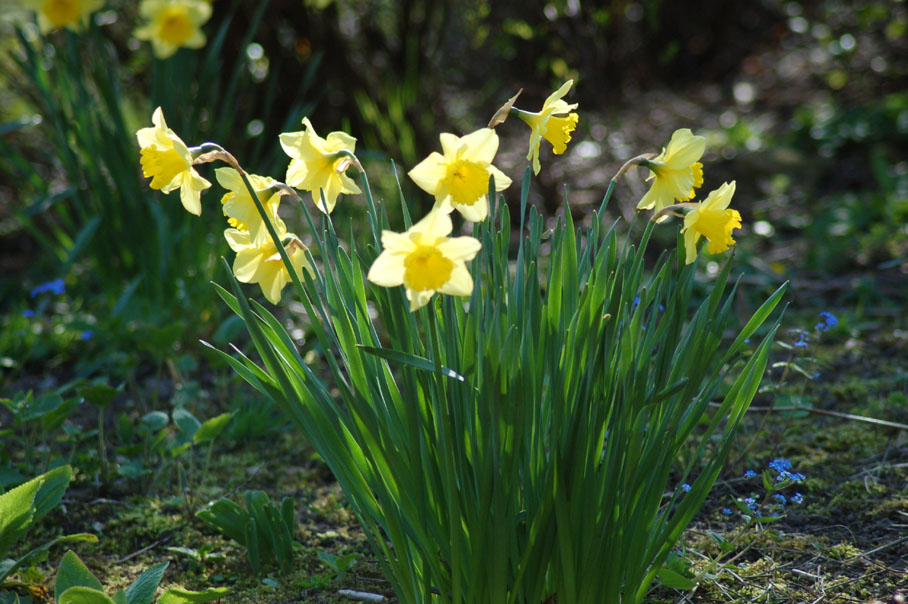
Daffodils, Mindepark, Aarhus/GB
The Danish name Paaskelilje refers directly to Easter, and it is impossible to imagine a Danish Easter without bundles of those pretty yellow flowers as a decoration in the house together with the Easter eggs and all the other traditional Easter decorations. The name Narcissus is mostly connected to the legend about the youth in Greek mythology who became so obsessed by his own reflection that he kneeled and gazed into a pool of water until he fell into the water and drowned. The legend says further that the Narcissus plant first sprang from where he died. Narcissus is the botanic name and there are many variations. The common English name Daffodil is sometimes used for all varieties. The Narcissus was listed as a medicinal herb in 'De Medicina' by the physician Aulus Cornelius Celsus, who said that 'it was powerful to disperse whatever has collected in any part of the body'.


Birthstones of March:

  • Aquamarine/Beryl
    Aquamarine (from Latin: aqua marina = water of the sea/ referring to its sparkling ocean colour. It is a blue or cyan variety of beryl. The gem-gravel placer deposits of Sri Lanka contain aquamarine. The deep blue version of aquamarine is called maxixe. Maxixe is commonly found in the country of Madagascar. Its color fades to white when exposed to sunlight or is subjected to heat treatment, though the color returns with irradiation. Aquamarine is in several localities in USA, Brasil and in Africa. The largest aquamarine of gemstone quality ever mined was found in Marambaia, Minas Gerais, Brazil, in 1910. It weighed over 110 kg (240 lb), and its dimensions were 48.5 cm (19 in) long and 42 cm (17 in) in diameter. The largest cut aquamarine gem is the Dom Pedro aquamarine, now housed in the Smithsonians institutions National Museum of National History.

    Facetted Aquamarine, wikipedia.
    Aquamarine evokes the purity of crystalline waters, and the exhilaration and relaxation of the sea. It is calming, soothing, and cleansing, and inspires truth, trust and letting go. In ancient lore, Aquamarine was believed to be the treasure of mermaids, and was used by sailors as a talisman of good luck, fearlessness and protection. It was also considered a stone of eternal youth and happiness. Today it protects all who travel by, over, or near water, and opens the channels of clear and heartfelt communication.

    Art Deco  Aquamarine ring,1920s (Pinterest)
    Ancient seer considered it to be under the influence of the moon, an orb exerting very great magnetic influence. Present day supporters of crystal-gazing suggest that when using an Aquamarine to view coming events, do so when the moon is increasing. The magnetism of the moon on the included iron oxides will strengthen the stone's forecasting ability.Aquamarine embodies all things connected to the sea, as well as those things relating to Heaven reflected on the surface of the water. It becomes a mirror, reflecting itself indefinitely, making it possible to discover hidden meanings of reality. As a stone of symmetries, it is conducive for meditation and revelation, a stone of prophets, shamans, healers, and mystics. It also allows us to explore the darkest depths of our souls, face to face with ourselves, and with other


    Aquamarine is the blue variety of Beryl, though the Beryl family forms in other colors used as gems, such as green Emerald, yellow Heliodor and Golden Beryl, pink Morganite, Red Beryl or Bixbite, and the colorless variety, Goshenite.


    bloodstone/wikipedia
    The mineral aggregate Heliotrope,  also known as Bloodstone , is a variety of jasper or chalcedony. The "classic" bloodstone is green jasper (chalcedony) with red inclusions of hematite. The red inclusions are supposed to resemble spots of blood; hence the name "bloodstone". The name "heliotrope" derives from various ancient notions about the manner in which the mineral reflects light. Heliotrope was called "stone of Babylon" by Albert the Great and he referred to several magical properties, which were attributed to it from Late Antiquity. Pliny the Elder (1st century) mentioned first that the magicians used it as a stone of invisibility. Damigeron (4th century) wrote about its property to make rain, solar eclipse and its special virtue in divination and preserving health and youth. Heliotrope features as an invisibility stone in one of Boccacio's stpries in the Decameron and as a healing magic item in a musical comedy derived from it. Heliotrope is sometimes used in carved signet rings and is the traditional birthstone for March.

    In the Middle Ages, bloodstones were associated with the crucifixion of Christ. According to the legend, when Christ was crucified, blood dripped onto the green ground, and this red-green stone was formed.  Greeks and Romans wore Bloodstones during athletic games to increase their strength and endurance. They are most commonly sourced from India, but can also be found in places like Brazil, China and Australia. Bloodstone is a good birthday gift for someone who would value a reminder of their strength.

Saturday, February 17, 2018

Chatelaine - a keychain or a mistress of the house

Antique figure with chatelaine
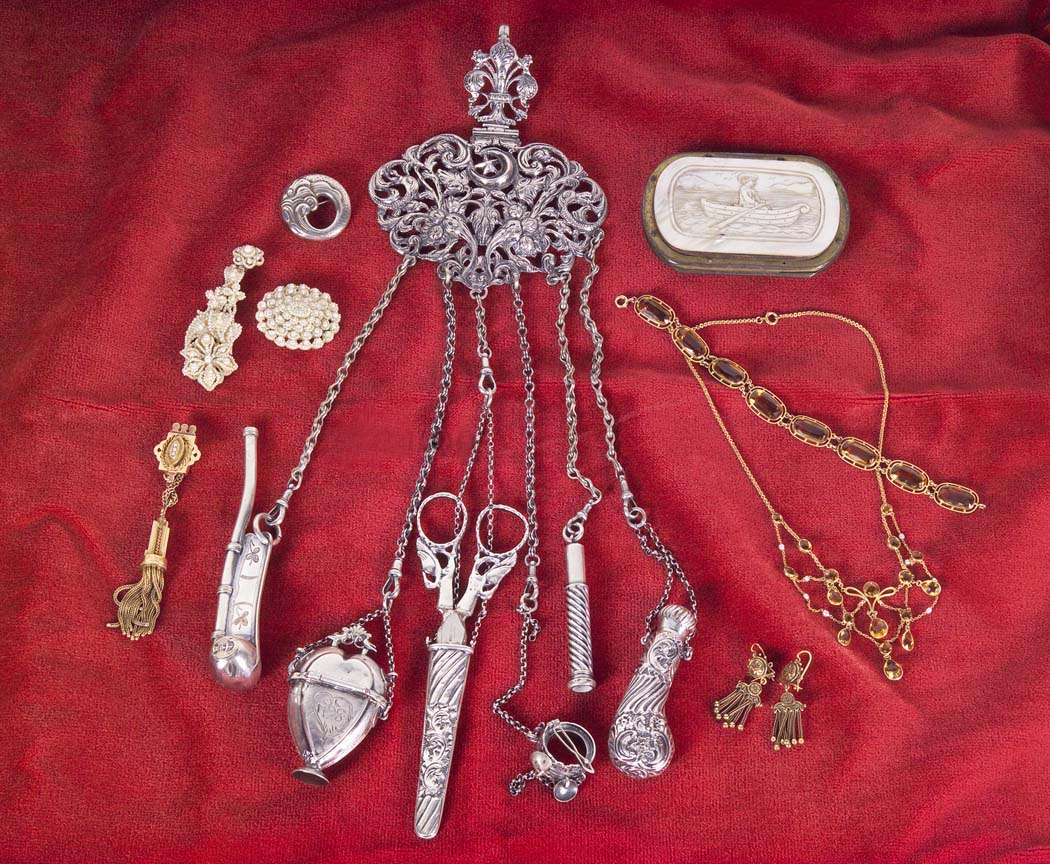
chatelaine jewelry

Named after the French word for "a lady who controls a great house," a chatelaine was the precursor to the keychain, the swiss army knife, the multitool, the tool belt etc. Attached to the waist of the dress, a chatelaine consisted of a series of chains from which hung keys, scissors, pen and paper, eyeglasses, whatever tools a lady thought necessary. They tended to be amazing pieces of jewelry.  Most major jewelers made or sold chatelaines, including Tiffany, Liberty,  Boucheron, Faberge and Lalique.

Chatelaines were quickly adopted by nurses and professional seamstresses who needed their tools handy. Purses were tiny and most dresses didn't have pockets. When pocket watches became all the rage, many chatelaines started out as watch chains with added accessories.


Each chain is mounted with useful household appendages such as scissors, thimbles, watches, keys, vinaigrette and household seals.The chatelaine was also used as a woman's keychain in the 19th century to show the status of women in a household. Similar jewelry was worn by Anglo-Saxon women, as seen from the
medieval chatelaine
burial record, but their function is uncertain. Chatelaines were worn by many housekeepers in the 19th century and in the 16th century Dutch Republic where they were typically used as watch chains for the most wealthy.  Ancient Roman women wore chatelaines with ear scoops, nail cleaners, and tweezers. Women in Roman Britain wore 'chatelaine brooches' from which toilet sets were suspended.


chatelaine Victorian.
The woman with the keys to everything important in the house was "the woman of the household". She was the one who would direct the servants, housemaids, cooks and delivery servicemen and would open or lock the access to the valuables of the house, having total authority over who had access to what. When a woman married a son and moved into his father's house, the son's mother would usually hold on to the keys.  But if the mother became a widow, the keys and their responsibilities and status were often passed to the oldest son's wife. In the case of the absence of a woman of the house, the controller of the keys was often a hired housekeeper.


Sunday, January 14, 2018

Eat Healthy Nuts each Day.

Almonds are especially known for having a slimming effect and a special beneficial effect upon the fat of the stomach. But almonds are also a fine source for E- vitamin, a strong antioxidant, which both strengthens the immune system and takes care of the aging proces of your cells, when they are threatened because of oxygenation. In addition, the almonds have a high content of dietary fibers, iron and magnesium. The dietary fibres are good for you because they at the same time saturate and benefit the digestion, while the magnesium plays a part of your Heart Health.
NUTRITIONAL PR. 100 G:  
Energy: 527 kcal.
Protein: 20,5 g
Fat: 39,1 g
Carbohydrate 29,5 g
dietary fibers: 9,2 g 


 Hazelnuts abound with E-vitamin which is a common term for a group of vitamins, which among others work as strong antioxidants. If you  eat 30 gram hazelnuts, the body's daily need of E- vitamin is covered. Besides this the hazelnuts have a fine content of the B-vitamin folic acid, which among others supposedly can prevent depression, blood clots and dementia.


NUTRITIONAL PR. 100 G:
Energy: 640 kcal.
Protein: 14,9 g
Fat: 54,4 g
Carbohydrate: 29,3 g
Dietary fibers: 8,2 g

Walnuts - if  you don't eat much fish it would be good for you to eat some walnuts, which have a fine content of the special omega-3 fatty acid ALA, which your body changes into the genuine and important fish oils EPA and DHA. Because of the fatty acids the walnuts attenuate inflammation in the body and lower the blood content of the dangerous LDL- cholesterol. Besides of the healthy fatty acids you'll also get lots of B6-vitamin, which is a part of a multitude of metabolic reactions - and which has an important function in the formation of the red blood cells.

NUTRITIONAL PR. 100 G: 
Energy: 678 kcal.
Protein: 14,3 g
Fat: 64,3 g
Carbohydrate: 16,2 g
Dietary fibers 5,6 g


Pecans have a very high content of the mineral zink, which plays an essential role in the metabolism of the body and is a part of many enzymes and hormones. At the same time zink is important for the skin. Pecans have a high content monounsaturated fat, which works beneficially upon the cholesterol level. Besides the pecans have a high concentration of E- vitamin, which keeps the cell membranes healthy by creating a protection against the free radicals.
NUTRITIONAL PR. 100 G:
Energy: 707 kcal.
Protein: 9,2 g
Fat: 72 g
Carbohydrate: 13,9 g
Dietary fibers: 9,6 g


Pistachios are stuffed with dietary fibers and proteins - and they are a very good solution, if you are a little hungry and need a saturating snack. They are a good choice if you wish to keep the slim line. Besides they give you a shot of potassium, which is important for the function of muscles and nerves. They also regulate the heart rhytm and the blood pressure. The nuts have a high content of E-vitamin and riboflavin, which is a B-vitamin with a big influence upon your skin, nails and hair. A bonus is the high content of the antioxidant lutein which protects your eyes against the ultraviolet rays from the sun.

NUTRITIONAL PR. 100 G: 
Energy: 566 kcal.
Protein: 20,6 g
Fat: 44,4 g
Carbohydrate: 28,0 g
Dietary fibers: 10,3 g


Cashew nuts have in general a high content of various minerals, like zink which is an important piece of the body's metabolism, but they also bring you magnesium, which is important for the nerve function, the metabolism and the muscles. The nuts also give you a fine supplement of iron, which is a part of the production of the red blood cells. Cashew nuts are rather caloric , but at the same time you'll get many heart-healthy fatty acids.


NUTRITIONAL PR. 100 G:
Energy: 597 kcal.
Protein: 15,3 g
Fat: 46,4 g
Carbohydrate: 32,7
Dietary fibers: 3,0 g


Peanuts are propped with niacin which both is a part of the metabolism of the body and plays an important role for the hormone production and the repair of the body's dna. In addition you'll get two strong antioxidants , E-vitamin and resveratrol (which is known from grapes). The experts have the opinion that resveratrol protects against aging and against cardiovascular diseases. Although all nuts in general are a fine source of protein, the peanuts have a high content which reminds about the protein content in meat, chicken and fish.

NUTRITIONAL PR. 100 G: 
Energy: 576 kcal.
Protein 24,9 g
Fat: 42,7 g
Carbohydrate: 28,4 g
Dietary fibers: 7,7 g


Brazil nuts  are especially known for the huge content of selen. This trace element is a strong antioxidant which among others can protect you against cardiovascular diseases - and on the whole protect the body cells against damage and destruction. Selen supports your immune system and is also an important piece in the formation of metabolic hormones . Brazil nuts also give you a  supplement of E-vitamin, which strengthens your immune system and of potassium which lowers your blood pressure. 


NUTRITIONAL PR. 100 G: 
Energy: 678 kcal.
Protein 15,0 g
Fat: 65 g
Carbohydrate: 13,8 g
Dietary fibers: 5,3


Photos from wikipedia
Source: Hjerteforeningen. dk, article in sundhed@soendag.dk /2015