Sunday, December 13, 2009

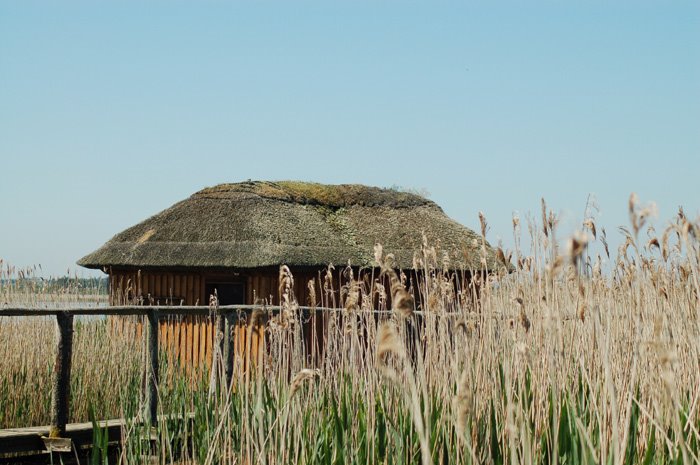
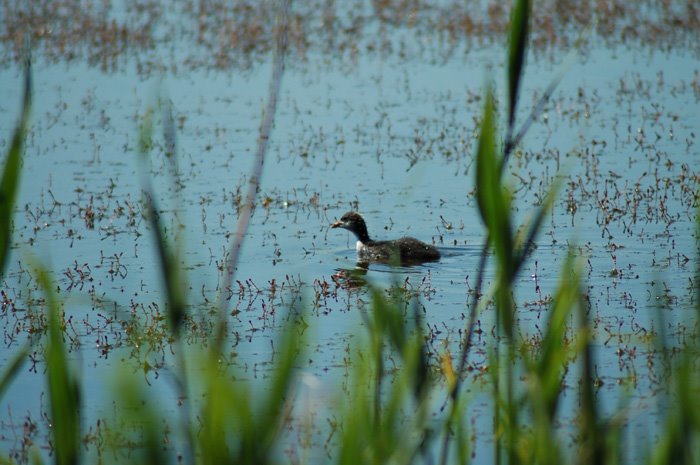
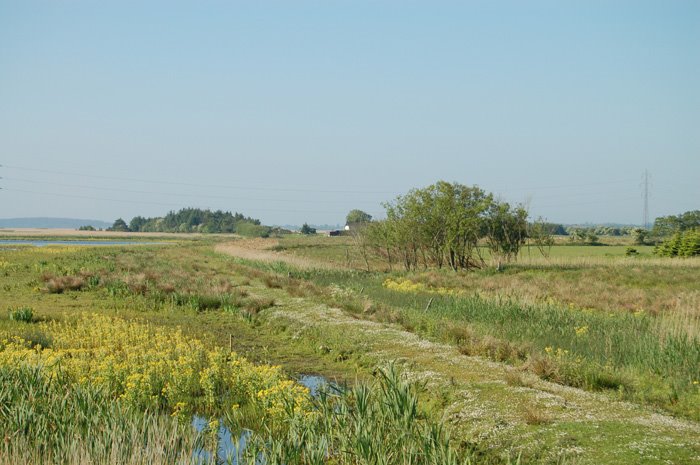
Vejlerne, North Jutland


Marsh harrier

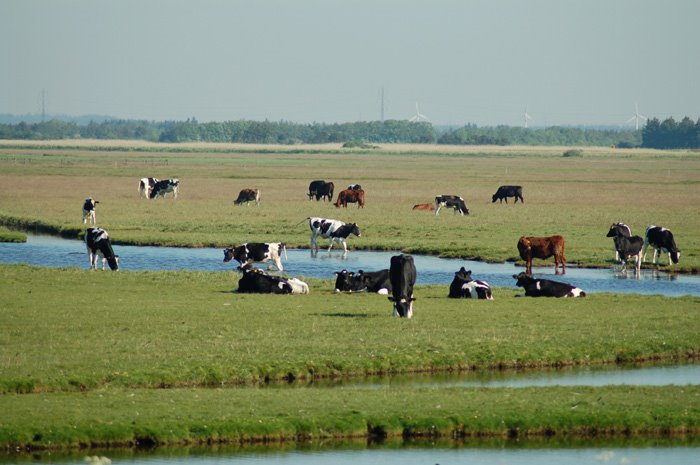
Vejlerne is a huge nature area situated between Lønnerup fjord to the west, Lund fjord to the north, Bygholm Vejle to the east and Limfjorden to the south. The area is about 6000 hectare, and it covers various nature types like meadow, reed wood, moor and fjord. The many fjords in the area were earlier connected to Limfjorden, and the areas with the byname Vejle (Bygholm Vejle, Arup Vejle, Krap Vejle etc) were a section of the waters close to the coasts of Limfjorden.

A drainage project had its beginning in 1866. Engineers, entrepreneurs, landowners tried with lesser succes during 40 years to drain the low waters of Limfjorden (Østerild fjord, Vesløs/Arup Vejle, Tømmerby fjord, Lund fjord and Bygholm Vejle), but they had to give up after having fought against weather, wind and the power of nature - and at last they had to admit that it was an almost impossible task to drain the earlier sea-bed.(with the technique from those days).


Krap Vejle

Krap Vejle, I heard but didn't see the Eurasian bittern


Krap Vejle, a young one

The area has since the stop of the drainage project been laid out as a protected nature reserve with national and international rules, and it is now assigned to the rules for EU-bird-protection-areas, Ramsar- areas and hunting-free areas. The varied nature in Vejlerne has a special chapter of Danish history, and many books have been written about the flora and fauna in this district. The area is now almost untouched, except the yearly cattle grazing and mowing in the largest meadow areas.

Vejlerne are visited all year by large bird populations. The amounts of ice and snow in winter decide how many birds are in the area. If the winter is mild there will be large flocks of pink-footed goose and whooper swan, various ducks and over wintering birds of prey, like blue harrier, white-tailed eagle and peregrine falcon. Upon meadows and fields are flocks of snow buntings and shore larks. If the winter is hard, Vejlerne might not be rich in birds.


Kærup Holme

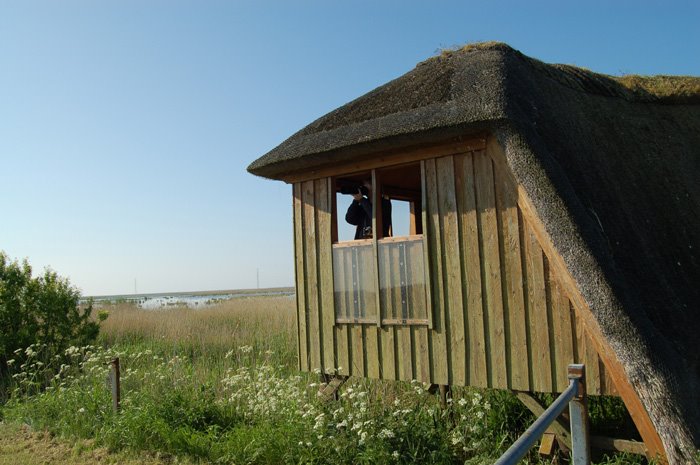
Kærup Holme, a view from the tower

Kærup Holme, a nice little family

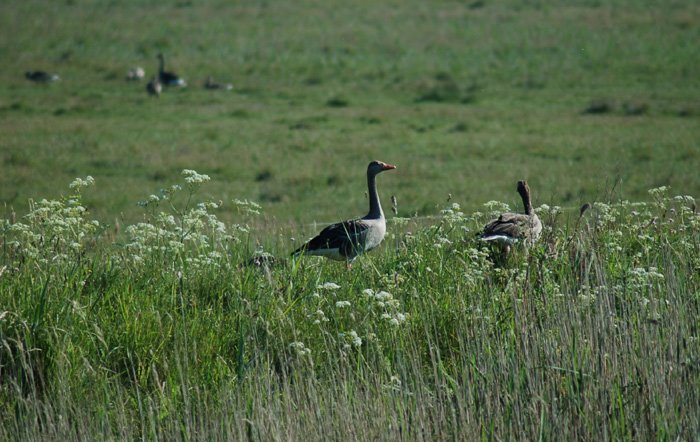
In spring come large populations of ducks if the waterlevels are ideal. Numerous are i.e. widgeon and teal. The pink-footed goose culminate in March, the same does the barnacle-goose. The spring migration guests arrive at the same time, Eurasian spoonbill, Common Crane, Black-tailed godwit and Pied Avocet. The wading birds' spring migration are dominated by various sandpipers, Eurasian golden plover, ruffs. Temminck's stint has one of the best localities in Vejlerne. As for breeding birds Vejlerne is unique, since the area has some of the most important populations of Eurasian bittern, greylag goose, spotted crake, common dunlin, black-tailed godwit, pied avocet, ruff, and black Tern. Little gull breeds occassionally.


Bygholm Vejle, a popular place for bird watching.


Bygholm Vejle, two towers connected


Bygholm Vejle, cattle-grazing


Bygholm Vejle, geese

Bygholm Vejle, Mute swan

During summer the birds are dominated by wading birds, common shelduck, and usually seen little egret, great egret, Caspian tern etc. At the same time the Eurasian spoonbills arrive from the breeding place in Nibe bredning and gather at the meadow in Bygholm Vejle with their young ones. More than 100 birds at the same time (200/ 162). Little gulls are often numerous in Kærup Holme area. Late summer come more and more cranes and they culminate usually in the end of September or start of October with up till 121 birds (in 2006). The cranes are easiest to see from the Kraptårnet, where they come flying across the Bygholm meadow for overnighting or fouraging in the fields east of Vejlerne. Autumn is like spring, but often the populations are much larger, i.e. up till 40.000 ducks, 13.000 greylag geese and 18.000 golden plovers. Peregrine falcon is seen regularly and up till nine have been seen at the same time on a September's day. In September and October are large numbers of bearded tits with their characteristic flying up and down.

Over 300 various bird species are seen in Vejlerne, the list of accidental guests is very long. American bittern, black-crowned night heron, purple heron, glossy ibis, red-breasted goose, blue-winged teal, Braillon's crake, Demoiselle crane, black-necked stilt, collared pratincole, black-winged pratincole, American golden plover, white-tailed lapwing, stilt sandpiper, lesser yellowleg, long-billed dowitcher, whiskered tern, snowy owl, red-rumped swallow, Blyth's pipit, citrine wagtail , Siberian stonechat, White's thrush, Pallas's warbler, lesser grey shrike, rosy starling, rustic bunting, little bunting - just to mention a few.

photo
Vejlerne: grethe bachmann

Saturday, December 12, 2009

Christmas Rose/Julerose


Christmas Rose/Julerose
Helleborus niger

Helleborus niger, commonly called Christmas rose or black hellebore, is an evergreen perennial flowering plant in the buttercup family, Ranunculaceae. It is poisonous.Although the flowers resemble wild roses, Christmas rose does not belong to the rose family.The name Christmas rose was given it in the Middle Ages because it flowered at Christmas time. The name niger is due to its black underground stalk.

The Helleborus niger has white, or occassionally pink flowers. In the wild, Helleborus niger grows in hilly terrain woodlands in middle and southern Europe. It is also found in the Alps and in the edge of the Appenines. The plant is a traditional cottage garden favourite, because it flowers in the depths of winter; large-flowered cultivars are available, as are pink-flowered and double-flowered selections. Helleborus niger contains ranunculin, which has an acid taste and can cause burning of the eyes, mouth and throat, oral ulceration, gastroenteritis and hematemesis.

Medicinal history: Its dried and grated root could make people sneeze, which supposedly cleared the brain, and the root was used in treating epilepsy, lack of balance and paralysis. the substance helleborin was used in heart diseases, weakness, melencholy, but caused by its poisonousness it is today only used in the homoeopathy or only obtained on prescription.

Superstition: In a French Catholic Christmas play from the Middle Ages are the three wise men/the three kings and a peasant girl Madelon. While the kings came with costy gifts for the Christ child, Madelon had none, and she cries, but an angel's wings touch the frozen ground, and a Christmas rose sprouts up . It was a Greek shepherd Melampos, who used the plant as a medicinal herb for the first time. He cured king Perseus' two daughters from their mental disturbances.The healing qualities could chase madness and evil spirits out from a human being; in the Middle Ages it was extended into general abilities of chasing evil spirits and sickness away. Also in the Middle Ages, people strewed the flowers on the floors of their homes to drive out evil influences. They blessed their animals with it and used it to ward off the power of witches. These same people believed, however, that witches employed the herb in their spells and that sorcerers tossed the powdered herb into the air around them to make themselves invisible. The Christmas rose was planted at the entrance of the house, and if an animal got sick, a piece of the plant was put into its ears.

A Maria-song: An old Christmas song from the 1500s, a Maria-song, was written when a monk was sent up to a prince in the mountains - and there in the prince's garden he was given a beautiful Christmas rose by a pretty young girl. The song is said to have been created on 24. December 1509, and the great church composer Michael Prætorius wrote the beautiful melody.(Dansk: En rose så jeg skyde)

photo Forsthaven 2009: grethe bachmann

Wednesday, December 02, 2009

Rowan Tree/Almindelig Røn


Rowan Tree/Almindelig Røn
Sorbus aucuparia


The rowan tree grows in forests, gardens and parks. Orange or red berries that grow in large clusters are hard, and they ripen between August and October. They hold three times as much C-vitamin as orange. The berries are edible, but very tart in flavour. Freezing causes the bittertart berries to turn sweeter, one may also put them in a freezer for 12 hours before processing them. NB: The berries contain a damaging substance which at worst can be harmful to the kidneys, - so it is advisable to heat-treat or freeze them before use.

Old Norse name: reynir, familiar to the name red, possibly to Samic raudna or rune = a secret magical sign, since rowan wood was used for runic sticks and the tree was put down to several
supernatural powers.


Use of wood, barch, leaves and fruits:
1)From the Ertebølle-culture (ab. 5000-3000 BC) was in Ordrup mose at Copenhagen found a small cup carved in rowan wood; 2) sticks of rowan stuck through the eyes of bronze vessels from Bronze Age; 3) rowan wood was a part of a bridle from the 1200s.

The 1800s: the wood of rowan was used for planks, wheel spokes, pipe stems and fuel, the barch and the young branches for tanning etc. After 1900s: the wood from rowan used by coach builders, joiners, turners and carvers, the Swedish Whitebeam was said to be the best for pins, balls, drawing-tools and rules, furthermore for hammer-handles and spirits-barrels.

Dyeing:
The barch dye red brown, and grey with vitriol.


Food and Spirits before and now:
Rowanberries were used for snaps; a small factory at Langeland produced in the beginning of the 1800s rowan aquavit. From the fruit were made vinegar. A rowan jelly was mostly served for venison at the manor houses, common people did not like the pungent taste. Some house wives put a cluster of rowan berry in the preserved cucumbers, a little cooked juice in stewed apples , the berries were during WWI gathered for marmalade and for export, some were sold at the pharmacies. The name Bornholmske rosiner (raisins from Bornholm) was a name for the fruits of Whitebeam and Swedish Whitebeam, known from 1688 when the farmers' wives used them in black puddings and Christmas cakes as a substitute for raisins. During WWII the berries were dried and cooked into raisins.

Today many like the rowanberry jelly or the berries preserved in sugar and vinegar - especially for venison, the dried berries can be used as a spice in venison-sauce and fruit-soup, the juice a fine spice in liqueurs and in preserved pumpkins, stewed fruit etc.The berries make an excellent jelly because of the high amount of pectin. Rowanberry jelly with cognac is the traditional accompaniment to venison and is also excellent with game and fowl. The berries can be used to make purés and juices, or they can be dehydrated and ground into powder to be mixed in porridges or bread doughs.


Decoration:
The bright red fruit clusters were a decoration for garlands and chandeliers at harvest feasts (in the 1800s) and for funeral garlands; berries and leaves were often used as a table decoration in festivities, i.e. hunting dinners.

Livestock:
Leaves, barch, young branches and fruits gave a good fodder for the livestock; dried berries softened in water for the chicken; turkeys could be fed up with rowan berry; dried rowan berry was a good winter fodder for birds. In the 1700s: when people planted rowan in their gardens it was mostly in order to lure kramsfugle (little birds) to the berries and catch them in snares. It was later forbidden by law.

Folk Medicine:
The juice of the berries were used against diarrhoea, stomach ache and dysentery. Wild Service Tree or Sorbus torminalis: the fruits were traditionally known as a herbal remedy for colic, the tree's Latin name, torminalis means 'good for colic'. The pulverized barch was used against malaria. Children with scrofula were rubbed with the berries; an extract from spirits was an ancient means against rheumatism; a special means against rheumatism was to eat raw rowan berries, one berry the first day, two the next until twenty, then counting down to one. The leaves, barch and berries were also used in various medicine for the farmer's livestock.

Against vermins and fire in corn:
A piece of rowan wood in the corn-heap drove vermins away. Between the corn layers were placed fresh rowan branches against rats and mice; the vermins could be driven away from the house in the same way. - At Lolland people put chips of rowan wood in the seed corn before it was sowed in order to prevent fire.


Acainst witchcraft and other superstition:
The rowan tree was probably already in ancient times ascribed to magical powers. The superstition especially paid attention to the "flying rowan", a small bush grown from seeds in wall cracks. In a Bronze Age grave from 1300-1100 BC in Maglehøj at Frederikssund was found a box with a rowan sprig. The cross of Christ was from this tree; therefore a tool from rowan cannot be bewitched, the tree is holy and prevents all evil. The flying rowan never touches the ground, and therefore witches had no power over it. If people used rowan wood as a fuel there would be unluck in the livestocks. If they found a flying rowan far from the city they had to plant it in their garden for luck. In Midsummer's Night let a twig hang under the ceiling, this brings luck to the house. Still in 1930 rowan was planted by the farm gate in order to secure happiness.

If people had a twig of flying rowan in their pocket it gave luck in trade, placed under the doorstep of the stable luck to the cattle, sticks of rowan carved on Midsummer's Night were sold by wise people as an amulet guarding against withcraft, a piece of rowan sewed into the shirt guarded against evil eyes. On Midsummer's Day people put rowan sprigs above all doors, gates, windows and upon tools and wagons against witches, who did not like the smell and thus were prevented from riding away on the farm horses. When the cows were driven home on the evening on the 1. of May they were decorated with rowan sprigs. Twigs were placed in the doorstep of the stable, and when repairing old houses twigs of flying rowan have often been found. In a legend from West Jutland two red calves are bound together with rowan twigs in order to prevent the merman from taking them with him to the North Sea; and when the cattle in summer were driven out on the fields, they were bound together two and two with rowan, and witches and trolls could not harm them.


The dead did not haunt the house, if the coffin was closed with rowan nails. Rowan twigs were used when exorcising ghosts in Himmerland; a wise woman sold, against haunting, bags with earth from the church yard. A cross of rowan above the bed prevented the sleeping from being murdered in the night. Wise people let patients with a disease, given them by witches, creep naked three times through a bend rowan branch or a garland of rowan branches. A tooth ache could be transferred to the tree. A twig, cut from a flying rowan on an evening in May, cured sores just stroking over the wound. Flying rowan in general had healing powers. But witches could also misuse the rowan, and that's why some people did not want a rowan tree on their ground. If people slept with a rowan twig in their bed, they were told a lucky lottery number; rowan crosses placed under the beehive in autumn bind the bees to the place. It was not advisable to graft apple upon rowan.

Omens:
Many rowan berries are a sign of a large rye harvest; if the rowan berry is red, the rye is good for bread; many rowan berries are a sign of a hard winter.

Proverb:
"They are sour sad the fox about the rowan berries, he couldn't reach them". This proverb is known in Denmark from 1682 and is a re-write from Æsop about the fox who could not reach the grapes.

Source: Folk og flora, Dansk Etnobotanik 3, V.J. Brøndegaard 1979.


Making snaps:
Use ripe rowanberries after frost. Put the berries in a glass or jar, 2/3 berries, fill up with alcohol. Drawing time ab. 6 weeks, now the essence has a fine red colour, after filtration the snaps is ready and can be thinned as you like but it grows better in storing.
Added honey and vanillla makes it a liqueur.

photo 2006/2008/2009: grethe bachmann

Friday, November 27, 2009

Climatic Changes in Scandinavia


Flowering rape field in November 2009

After October with night frost in several places November has been on the warm side of the freezing point in Denmark. Not one of DMI's meteorological stations has measured just one case of night frost in November and the frost will not appear in the first days to come. Statistically it is unlikely that November ends without frost, this has not happened in Danish weather-history which goes back to 1873. The mildest November until now was in 2000. But today is the 27th of November and still very mild - it seems that the record is about to be beaten.

There were many fields with yellow rape-flowers last Saturday, not as bright yellow as in May of course - and there are small cautious flowers in cherry and magnolia trees.

There is a large focus on the climatic changes and their negative influence on nature. The poles and archipelagos are in risc of being flooded, but the changes are also seen in several other places, i.e. in Scandinavia. The changes do not only strike single species or habitats in the North; the influence is broad on all levels, says a new report about climatic changes in the North, worked out by Nordisk Ministerråd. Their basis were 14 various species, which are indicators and meant to show the influence of the climatic change in various ecosystems. By following these indicators it is possible to follow more general tendencies instead of an indivual development progress. The earlier beginning of the pollen season, the changed distribution of the fish populations and changes in the behaviour pattern of the birds are just a few examples of that the climatic changes have already secured a foothold.

The report is in English and can be downloaded on:

www.norden.org/en/publications/publications/2009-551

Source: DMI, Danmark; Natur og Miljø, Danmarks Naturfredning, November 2009.

 photo Mols 21. November 2009: grethe bachmann

Monday, November 23, 2009

Soon Christmas Again!


The first Christmas sight is already in the first days of November, when you see the trees packed and ready....


...............for being transported - here on a small truck -to the market places where they sell lots of firs in November and December.
Now its time for creating a cosy Christmas home and time for baking Christmas cakes. The house has to be decorated with Christmas tree and candles and decorations and pixies and hearts and stars etc................. but from where origins Christmas - and who is Father Christmas?

Christmas was originally a midwinter-feast which was transferred to the Christian church and changed into a feast for the birth of Jesus Christ. The Old Norse Jul was celebrated in January and the southern feast for sol invictus (the invincible sun god) was on the 25. December; therefore the Christmas of Christianity was placed at the same time. According to German and Nordic customs the feast was the night before. Actually it was a vigilie (night of wake) from the Catholic period, where people together waited for midnight and the celebration of mess, which was held at the moment of the Nativity.
The earliest known evidence about Jule-feast in the north is from ab. 900. Here is mentioned the Norse king Harald Fairhair and his son Hakon the Good (the first Christian king i Norway) in connection to Christmas. Harald Fairhair was known as a king, who swore not to cut his hair and beard, until he was king of the whole country. Hakon the Good was known as the king, who ordered the Norwegians to celebrate Christmas "at the same time as Christian men", which indicates that the Jul before Christianity arrived was placed at another and earlier time. The character of the Old Norse Jule-feast appears from the expression "to drink jul". Through centuries the clerical understanding of Jul or Christmas fought against the secular or popular understanding. The development of Christmas was marked by modern ideas through the times and many old customs have become a part of Christmas.

Father Christmas or Santa Claus... who brings Christmas gifts to the children. Father Christmas origins from aCatholic idea that the patron saint of children Sankt Nicolaus( Santa Claus) upon his Saint's day 6. December brings gifts to well-behaved children, while the naughty children are being spanked by his companion (German: Knecht Ruprecht, French: Pére Fouettard). The custom and the date origins from the 1200s. But it was not Sankt Nicolaus, who gave the idea for his red-white dress. In frescoes Sankt Nicolaus is never seen in red and white. His red dress, his reindeer-sleigh, the winter-background and his house at the North Pole are modern additions from the environment of the middle-class´Christmas books and similar things for children. In the first American pictures from the representation Santa Claus wore a fur coat; later he got his present dress, but it is first in the 20th century his dress turned red and white.
Advent
...is the time from and with the 4th Sunday before Christmas until 24 December . From the 5th century celebrated as a preparation for Christmas. On the first Sunday of Advent the first of four candles is lit in the Adventskrans (garland), often a garland made of spruce and hung with red silken bands.

1. december
The Christmas calendar is popular with children. The first of 24 lids is being opened . The Christmas calendar has developed into a gift-calendar - sometimes in large proportions! The calendar candle is lit for the first time.

In December:
Many hangs a Christmas Star in the window. In gardens and on balconies are outdoors Christmas trees with lights the whole Christmas month and longer. Christmas decorations are made, i.e. a large candle encircled by spruce twigs , glass globes and other small Christmas things. And now it is the time for baking, especially the little cakes , i.e. vanila-cakes, brown cakes, small pepper biscuits, crullers etc. And it's time for the julegløgg. (mulled wine with raisina and almonds and various spices)

13. december. Lucia-Day
Lucia-procession where a so-called Lucia-brud (bride) in a long, white dress and with a garland of lit candles upon her hair, followed by white-dressed girls with a candle in their hand. This is a tradition which really brings joy to schools, kindergartens, old people's homes and at hospitals.

23. december. Lillejuleaften (Little Christmas Evening)
The Christmas tree is being decorated. - Many eat apple-cakes and drink gløgg.

24. december. Juleaften (Christmas Evening)
Many goes to church in the daytime. In the evening Christmas dinner, i.e. goose, duck or turkey - or roast pork or neck of pork. Dessert: mostly ris-á lá mande with cherry sauce and with an almond (he/she who gets the almond gets a gift).Dancing and singing around the Christmas tree. The only light in the house at that point are all the lit candles upon the tree and in the decorations. Handing out the gifts. The children are told that Father Christmas brought them!

25. december. Juledag (1. Christmas Day)
Holy Day. Family get-together. Det store kolde bord med små lune retter. (Cold dishes and small warm dishes) Drink: often the strong special Christmas beer. The start of the lunch is various herring with snaps.

26. december. Anden juledag (2. Christmas Day).
Holy Day. Family get-together. Again cold and warm dishes, but now at someone else's house!

Source: Jul i Dannevang 2009, Juleretter 1977, Mad og Bolig Dec. 1996.

Friday, November 20, 2009

Potpourri

Small Chinese jars with lid, decorated with golden dragons, red dragons or blue dragons and filled with potpourri create a lovely atmosphere in the winter season. The base in a potpourri is always dried rose-leaves, a large handful in a jar with a little salt in the bottom, then rose-leaves, again a little salt a.s.o. Put lid on and stir in it five times a day for five days. When you take off the lid a faint scent of roses is floating out into the room.

A stronger scent: Put some already salted rose leaves in a jar and pour a few drops geranium oil, some whole cloves, a little crushed nutmeg, some coriander seeds, a cut cinnamon stick and a little crushed violrod (Iris florentina at pharmacy). Stir and let it stand for a week, and it is ready to fill the room with a delicate scent when removing the lid in the daytime.

Fill little home-sewed sachets with dried rose leaves, dried thyme flowers and dried sweet gale leaves. Bind the sachets with silken bands. For your own use hang them on the hangers in the wardrobe or put them in draws or under your pillow. Or use them as a fine little gift for the hostess when you're out on Christmas visits in December.

Turkish Meringues: Common meringue paste , mix it with finely crushed dried rose leaves and bake the meringues as you use to. It looks delicate and give a lovely scent.

Source: Annemarta Borgen, Krydderurtehaven på Knatten, 1992.

photo Boller slot 2008: grethe bachmann

Thursday, November 19, 2009

Hollyhock/Almindelig Stokrose


Hollyhock/Garden Mallow/Almindelig Stokrose
Alcea rosea/Althaea rosea

Marsh Mallow/Læge-Stokrose
Althaea officinalis

Hollyhock comes from southern Europe and the East,where it grows wild in glades in the forests. The plant can be dated back to the English garden books from 1440 and seeds were brought to Europe from China. Remains of hollyhocks have been found in a Neanderthal burial site. Alcea is an old Greek plant name and rosea means rosy red. The Danish name Stokrose refers to the rose-like flowers which are placed upon a long stok. (stem)


Folk Medicine (Marsh Mallow/Læge-Stokrose/Althaea officinalis)
Both flowers, leaves and roots were used. The boiled roots were effective against coughing, but also an extract from flowers and leaves in alcohol or as a tea was good against coughing and inflammation of the oral cavity. The extract could also ease a tootache. The dark coloured flowers were said to be the best, and the red colour told that it was especially meant for diseases of the blood. Roots were chewed for digestive problems, and the green leaves were used in order to soothe the pain from burns. Extract from the leaves were used against scurvy.

Today:
The flowers can be cut and sprinkled in salads.

Superstition.
The red marsh-mallow was drunk in tea against blood-diseases. If you eat the seed you were protected against the bite from poisonous animals. In the old days people planted the marsh-mallow close to the house because they meant it prevented lightning.

Others:
Hollyhoc was used for plant dye, where the flowers can give a blue-black colour, the plant fibres were used for rope. Flowers were cooked in soups.

Source: Anemette Olesen,Danske klosterurter, 2001.

photo Stokrose 2007/2008: grethe bachmann

Wednesday, November 18, 2009

Nature in Trouble


Lapwing, Vilsted Sø


Skylark, Ertebølle

Many years ago, in 1986, a plan for pesticides was introduced in DK. The purpose was to lower the use of pesticides in order to keep the diversity of nature. Unfortunately it has developed in the wrong direction. I.e. has the population of lapwing, skylark, partridge and hare minimized severely, caused by the barren landscape. The waterworks state that more and more drillings contain rests of pesticides. The agriculture says that the use of pesticides is necessary caused by "hunger in the world", while *DN 's representative says "rubbish", cause 85% of the Danish corn-production is used for animal-fodder.

* Dansk Naturfredning


Partridge, Rugård

Hare, Oudrup Hede

Source: Natur og Miljø, Danmarks Naturfredningsforening, nr. 4, Nov. 2009.

photos 2007-2009: grethe bachmann

The Polar Bear is Growing Smaller


The polar bear grows grows smaller and smaller. Compared to its relatives from the beginning of the 1900s, the polar bear is 2-9 % smaller. The cause is connected to the increased pollution and the strong recduction of the ice cap caused by climatic changes. Cranes of the polar bear from various period have been compared. The discovery was made by scientists from Biologisk Institut and Danmark's Miljøundersøgelser (Environment Investigations).

Source: Natur og Miljø, Danmarks Naturfredningsforening, nr. 4, Nov. 2009.

photo Randers Kulturcenter 2009: grethe bachmann
The Polar Bear is Growing Smaller


The polar bear grows grows smaller and smaller. Compared to its relatives from the beginning of the 1900s, the polar bear is 2-9 % smaller. The cause is connected to the increased pollution and the strong recduction of the ice cap caused by climatic changes. Cranes of the polar bear from various period have been compared. The discovery was made by scientists from Biologisk Institut and Danmark's Miljøundersøgelser (Environment Investigations).

Source: Natur og Miljø, Danmarks Naturfredningsforening, nr. 4, Nov. 2009.

photo Randers Kulturcenter 2009: grethe bachmann

Friday, November 13, 2009

Viking Art

Lindholm Høje, here was the little Urnes-broche found.

The art in the Viking period is a name for the artistic styles in the North and the areas of northern Europe where the vikings settled. The preserved works of art include both carved wooden figures, jewelry , carved stones and in rare cases tapestry; it also includes literary works i.e. poems. The animal motives and the stylized figures are a direct continuation of the styles from earlier periods. In the Viking art is also found Celtic and Romanesque influence.

There are six main styles: Oseberg, Borre, Jelling, Mammen, Ringerike and Urnes Style. The Jelling style is named after the Danish royal grave in Jelling, East Jutland, and features prominent animal designs. The Ringerike style is characterized by elaborate foliage ornament and interlacing and is named after the district in Norway where it is represented in local sandstone. Detailed designs in carved doors of Urnes stave church in the Sognefjord, Norway gave its name to the final style. Urnes style is developed from Ringerikestilen and was used from ab. 1050 til ab. 1140. Large slender animals weaved with snakes and threads are characteristic.

Urnes Style. The fibula was found in Roskilde, a characteristic example of the large animal interlaced with threads and snakes. It is a combination of a dress-buckle or a pendant from the 1100s. The original jewelry is bronze and is exhibited at the National Museum. The copy is Sterling silver (55 mm) and is availbable at i.e. Moesgård Museumsbutikken (on-line).


Urnes Style. The little broche from Lindholm Høje is from ab. year 1000, a fine example of the late Viking period's animal style, the large animal fighting the snake, a symbol of the fight between good and evil. The original jewelry is exhibited at Aalborg Historiske Museum


photo : grethe bachmann

Tuesday, November 03, 2009

Coppicing/Stævningsskov


Coppicing is a traditional method of woodland management in which young tree stems are repeatedly cut down to near ground level. In subsequent growth years, many new shoots will emerge, and, after a number of years the coppiced tree, or stool, is ready to be harvested, and the cycle begins again.

Coppice management (Stævningsskov) was one of the earliest forms of woodland management in Denmark, traceable back to Stone Age. In the Middle Ages the lord of the manor had the right to the upper sections of the wood, while the peasant had to be content with the lower sections. The coppicing was a smart solution to the peasants, since this forest type never developed into tall trees; if it was cut regularly they could keep their right to use the wood. They used it for fences, fuel, posts, poles etc. To avoid the trees from growing up the wood has to be cut every 15-20 years.

Coppice management favours a range of wildlife, often of species adapted to open woodland. After cutting, the increased light allows existing woodland-floor vegetation such as bluebell, anemone and primrose to grow vigorously. Often brambles grow around the stools, encouraging insects, or various small mammals that can use the brambles as protection from larger predators. Woodpiles (if left in the coppice) encourage insects such as beetles to come into an area. The open area is then colonised by many animals such as nightingale, nightjar and fritillary butterflies. As the coup grows, the canopy closes and it becomes unsuitable for these animals again – but in an actively managed coppice there is always another recently cut coup nearby, and the populations therefore move around, following the coppice management.


Queen of Spain Fritillary/ Storplettet perlemorsommerfugl

photo 2. August 2008 and 31. October 2009: grethe bachmann

Monday, November 02, 2009

Autumn Forest


A day in the autumn forest just before a rough wind came blowing the next day sweeping the leaves like snowflakes to the ground. Although the sky was dark and grey the colours of autumn are shining through. A little rain deepens the shades of the foliage.

photo Fussingø forest 31. Oct. 2009: gb

Thursday, October 29, 2009

November


November comes
And November goes,
With the last red berries
And the first white snows.

With night coming early,
And dawn coming late,
And ice in the bucket
And frost by the gate.

The fires burn
And the kettles sing,
And earth sinks to rest
Until next spring.

- Clyde Watson.


photo Mossø: gb

photo Mossø: gb