Showing posts with label drink. Show all posts

Sunday, October 04, 2015

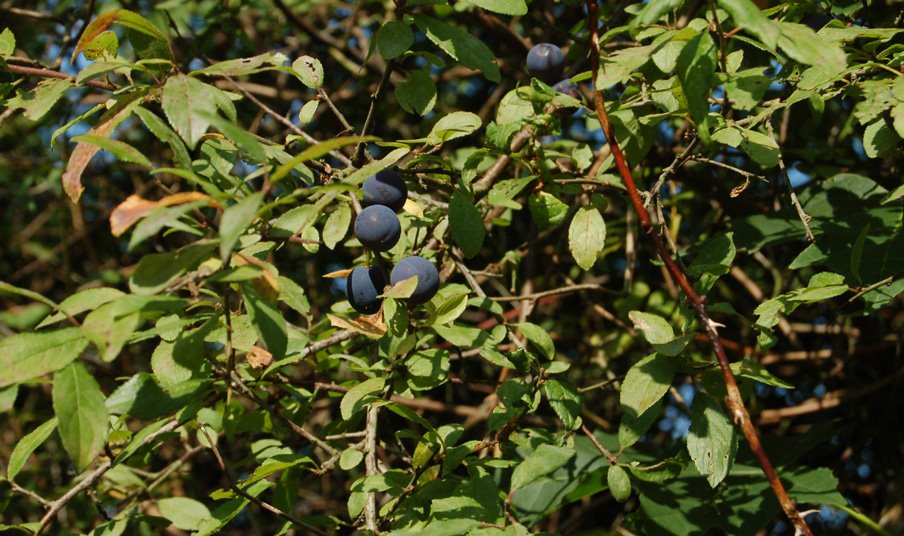
Blackthorn / Slåen


Prunus spinosa

Blackthorn grows at cliffs, embankments along the beach, cleanings on edges of woodland, thicket and fences. It is extensively planted for hedging and a cover for game birds. Some forms are grown for ornament and flowers. The fruit is called sloe, which is similar to a small damson as plum suitable for preserves, but too tart to eat. The berries are best after the first night's frost, but if they are plucked before that period, they can either be pricked by a fork or put in the freezer for a few days. Sloe is used for juice, syrups, jams, jellies, liqueur, wine and snaps.

The foliage is sometimes eaten by larvaes of  Lepidoptera (like the Brown and the Black Hairstreak butterfly). The pocket plum gall is found on the fruit, where it results in an elongated and flattened gall, devoid of a stone.

In the 1700s and 1800s:
It was a common thing in the time after harvest and after the first nigh frost to gather sloe, scold them and eat them. Infusion gave a well-tasting and healthy juice, which people drunk together with porridge instead of milk. The berries cooked with syrup or sugar and fermented on a wooden barrel was popular as a porridge. Sloe-must was made by just pouring cooked water over the berries and let the infusion ferment for 3-4 weeks. Berries crushed with the kernels gave a juice with a spicy taste. After the first night of frost the farmers' wives plucked the sloe-berries in large baskets and made a fine red juice, which was hidden in a barrel until Christmas Evening. The clear light red juice drunk in wine glass and sweetened with sugar was a popular refreshing drink during summer. It tastes a little like red wine, bad red wine was despisingly called "sloe-juice". Beer cooked with the berries makes such a good taste that it is like old red wine. From the flowers were made aqvavit, and the berries were used to clear must. They bring a pleasant taste to beer and a pretty colour, but they can also improve apple-must during the fermentation.

Jam, Cheese and Tea.
The berries preserved with sugar and cinnamon gave jam for a winter salad or a steak sauce, after they had got frost they were put with honey in jars as a jam. In Vendsyssel (North Jutland) were sloe-berries used when preserving pumpkins. If the barch was used when making cheese the cheese wouldn't rotten. The new dried leaves were a good tea, also the dried flowers mixed with strawberry-leaves.


Sloe-Wine and Liqueur

In 1580 the vasal at Kronborg let gather 2-3 barrels of sloe, from which the king's cupbearer made sloe-wine for Frederik II. The wine made by chrushed berries and kernels was very intoxicating and was only served on special occassions. During WWII a wine firm in Odense (at Funen) advertised for sloe-berries. From the fruits are also made a liqueur.
 
Sloe-Gin
In rural Britain a so-called sloe-gin is made from the sloe. It is not a true gin but an infusion of vodka, gin, or neutral spirits with the fruit to produce a liqueur. In Navarre, Spain is a popular liqueur Patxacan made with sloe. Sloe is also excellent for a herbal snaps. From fermented sloes are made wine in Germany and other central European countries. Sloe is also good as jam and if preserved with vinegar, have a similar taste to the Japanese umeboshi.


Folk Medicine:
The juice of sloe was used for stomach pain - and the flowers drawn in warm beer was used for childrens' motions. It was also used to cure tooth-ache, pain in the eyes , blood poisoning, shingles and much more. Physician Christiern Pedersen 1533: crushed leaves and barch used on on shingles. Eyedrops from the pulverized barch in wine. Physician Simon Paulli 1648: berry-juice with beer for stomach problems. Children with constipation had the flowers in warm beer. Vinegar-decoct from the green medium barch was effective against toothache. The flowers in a healing morning drink , destilled water from the flowers for bronchitis, cleaning the body etc. A tea cleansed the blood and was laxative. The barch was used against malaria, the berries gave a healing drink against fevers, and mixed with cherries against diarrhoea. A milk decoct from flowers for a drink or a bath to remove freckles. The fruit juice for sores in the mouth or to rub upon swellings and against nosebleed. In 1772 flowers and fruit were entered into the pharmacopoeia.

Dye:
Unripe berries dye black, the juice of the ripe berries dye pale brown, while the dried berries make wool red. The barch gives with alun a red dye, unripe berries with iron vitriol give a dye like black ink. The unripe berries and the barch were used in tanning.


Other Use:
Blackthorn was recommended for hedges around gardens and fields, in Denmark this is much used especially at Funen. Many loads of cut blackthorn from the hedges were brought home as a fuel for the baking ovens. Before or in the killing season at the farms when sausages were made, the children gathered thorns from sloe, which in the evening were scraped clean , dried upon the oven and eventually burnt in the tips and then used as sausage-sticks; this was a tradition in most parts of the country  (DK) - and the sausage sticks were sold at the market. Boys also used the thorns as arrow-heads. From the wood were made music instruments, it was commonly used in turner-works and for mathematical instruments. From the tough wood were made walking sticks, hammer - and axen handles. During WWII gramophone needles were made from sloe thorns, they gave lesser needle-noise and lesser wear on the records than metal needles.

Blackthorn makes and excellent fire wood that burns slowly with a good heat and little smoke.

Straight blackthorn stems have traditionally been made into walking sticks or clubs (known in Ireland as a shillelagh). In the British Army, blackthorn sticks are carried by commissioned officers of the Royal Irish Regiment; the tradition also occurs in Irish regiments in some Commonwealth countries.

Ink: 
Shlomo yitzhaki, a Talmudist commentator of the High Middle Ages,  writes that the sap (or gum) of P. spinosa (or what he refers to as the prunellier) was used as an ingredient in the making of some inks used for manuscripts.

Fishing: 
A "sloe-thorn worm" used as fishing bait is mentioned in the 15th century work, The Treatyse of Fishing with an Angle, by Juliana Berners.The expression "sloe-eyed" for a person with dark eyes comes from the fruit, and is first attested in A.J.Wilson's novel Vashti.

Making snaps:
Put sloe berries in a glass or bottle with double amount alcohol. Filtration after 2-3 months. There is now a pretty dark red to violet essence, which can be thinned as you like. The berries can be used again together with the crushed stones in a new amount of alcohol to draw for a month or two, which gives a drink with a taste of almond. A sloe snaps gets better and better when stored. It is excellent for herring and cheese. Added honey makes it a snaps for desserts.


text and photo: grethe bachmann

Sunday, March 11, 2012

Sweet Flag/ Kalmus

 Acorus calamus


photo Gudensø: stig bachmann nielsen, naturplan.dk
In the foreground Kalmus and højt sødgræs (Glyceria) out in the water vandpileurt (Amphibious bistort).In the background bathing guests.

Acorus comes possibly from a Greek word meaning without, chore means pupil, referring to the medicinal use of the plant. The Danish name kalmus is Latin, and the same name is used in Germany and Sweden. The name kalmus origins from  the 1200s, from the older name calamus meaning tube or pipe.  Most used English name according to Liber herbarum is Sweet Flag. Other names: Calamus, beewort bitter pepper root, Myrtle Flag, Sweet Calamus, Sweet Myrtle, etc.

Kalmus has a thick white rootstock and sword-shaped 40-100 cm long leaves, the small flowers sit in a green bulb, "like little needle-houses". The whole plant has a strong spicy scent. It's found in Denmark in ponds by lakes and water streams. It is sometimes confused in non-botanic literature with German iris and reed. Kalmus likes to grow in water, best along water streams, but the plant can easily thrive in moist soil. It rarely produces flowers in Denmark, and it is reproduced by the outlets.

The species is said to be brought from Asia minor(Constantinople) in 1557 to Europe, where it reproduces only with loose rootstocks, but it was known in Europe long before as an imported droge (medicine) from India, and it might already have been brought from Baltikum in the Middle Ages to the Danish kloster- and castle gardens. In the 1600s it was both wildgrowing and plant in fish ponds. The roots were used for medicine, and descendants from kalmus have been found in several kloster- and castle ruins.


Cancer 
It has been discovered that the etherial parts of the plant can cause cancer, and the plant is prohibited for internal use in Denmark today.


Today's Use: 
The dried and pulverized root is now only used as a fixative in potpourris, since it holds on  to the scent of the other dried scent herbs. Internal use of kalmus was prohibited by den danske levnedsmiddelstyrelse in 1977.


 Folk medicine:
1300s: decoct as a drink for liver and bowl disease; boiled and put in a compress upon abscesses; cures old cough.
Henrik Smid 1546: pickled roots against stomach ache and coldfever (malaria); eaten in the morning for evil and poisonous smell - and it gives a fragrant breath; it is diuretic, it heals disease in blatter and kidneys, it crushes blatter stone and promotes menses.
Christiern Pedersen 1533: decoct to drink for heart trouble; the crushed root in wormwood-water as a drink against stomach diseases; pulverized kalmus together with the juice of mullein (kongelys) against haemorrhoids.
Simon Paulli 1648: The juice works as a diuretic, helps the spleen, "which is hard from evil mucoid and salten fluids", makes impure eyes clear; the roots pickled with honey and sugar is "an extremely wonderful and good healing for cold stomach and cold head", katarr and cold diseases; furthermore against cough and heart's distress and anxiety, bad breath is driven away, in times of plague it makes the air healthy; pulverized and drank in chervil-water to drive out the sweat in order "to loosen the blood which has gathered after blow and impact".

Medicine and Good Advice:  
The rhizome is a component in an appetizing vinegar-drink, (1600s); and it was very used in stomach tonics, put on snaps against colic and used to stimulate digestion; a decoct against stomach ache and a tea from the root to regulate the gastric acid. The droge (bought at pharmacy) was still used  in the 1900s against indigestion. If it was added to snaps together with the root of elecampane (alant) and angelic, then it became "the wise man's snaps" against heartburn, the root was also used against arthritis; together with the root of European birthwort (slangerod) and angelic in rum against chest disease (tuberculosis) and cough; a wise woman let her jaundice-patient drink snaps with kalmus root, and "it had to be drunk by a full moon".

The rootstock was noted in the pharmacopoeia in 1772, and its reputation as a highly invigorating and strengthening medicine caused a big sale of the droge. Det kongelige landhusholdningsselskab ( a union of farmer households) rewarded in 1814 a man, who had gathered 1251 pounds of kalmus- and angelic roots for the pharmacies, and in the late 1800s large amounts were gathered in the river Gudenå by Randers.


If it was very cold, people did chew a piece of kalmus root and sank the juice (1789);  the root was chewed against toothache - or the sore tooth was rinsed with a decoct of water and vinegar, the last drink was also used against scurvy, and the gums around loose teeth could be rubbed with pulverized kalmus root and china bark.

If people were afraid of being infected from patient visits, they chewed a piece of kalmus root; this promoted  a large portion of saliva, "therefore it is used as a means against infection". In 1800 it was said to be enough to walk with the root in the pocket. Kalmus was chewed against infection during "The Spanish Flu" in 1919-25.

Cattle and Horse.......
If the root is thrown into the water, the animals stay healthy. The kalmus root is included in a complex cure "from ancient times" against cattle diseases, and especially if the cattle is bewitched. If the cow is able to stand up in spring, kalmus root and pepper is put into a scratched wound; kalmus was used against abortion of the calf, used together with juniper or the root cooked with juniper and resin in beer. If the cow gave blue milk,  it was given kalmus and cumin in chalked water, and if the milk was without cream, the cow had a powder of kalmus and lovage root, mixed with slaked lime dissolved in water.

A horse who has "stepped over" = sprained the hoof joint, is bathed with a spirits-extraction of the root cut in  cubes, the extract is also poured over the bandage (ab. 1900). It was given for the pig's vomiting, and was the part of an advice against defects in geese. The veteranians used the root as a stomach and appetizing tonic.


Other use:
In order to protect the harvested corn and the heaps against mice and rats, fresh cut kalmus roots or leaves were placed upon the barn floor and/or between each layer of sheaf. It was recommended to plait a cornband of the leaves, since the mice could not cut them; the root or leaves could also be placed in rooms and spread on the floor against fleas, or put into the mattress to keep away the fleas. "Who did not sleep in kalmus root in the old days?" This plant was extremely popular as a bedstraw, and it was harvested in numbers and sold to the citizens. Kalmus mixed with carbamate (hjortetaksalt) was used to drive out ants. Many Jutlanders chewed the root instead of chewing tobacco.  "He's smelling of kalmus root, of smoked lard and fish",  is told in an old song. The children gathered the bittersweet rootstocks to chew them.

The hay bundles were tied with kalmus band, which could last for 10 years, reed mats made from the kalmus leaves had a strange smell. Sour beer would be welltasting, if kalmus root was put into the barrel, (1600s). The root was also used for smoking against bad smell in rooms.

Food and Drink:
A jam from the root is mentioned from the 1500s till the 1800s. It was often put into snaps as an extra taste and it was the part of many herbal snaps, stomach bitters and liqueurs.  (like Benedictine liqueur and chartreuse).

Superstition
If you put a piece of the root into a wash bowl or a water tank, it could rinse the water from toxic substances. The root was also used as a sacrifice to the gods.

Source: V. J. Brøndegaard, Folk og Flora, Dansk etnobotanik, Rosenkilde og Bagger, 1980; Anemette Olesen, Danske Klosterurter, Aschehoug  Dansk Forlag, 2001.
photo Gudensø: stig bachmann nielsen, naturplan.dk
photo and photo copy: grethe bachmann

From wikipedia: 
Use in other countries:
In Britain the plant was also cut for use as a sweet smelling floor covering for the packed earth floors of medieval dwellings and churches, and stacks of rushes have been used as the centrepiece of rushbearing ceremonies for many hundreds of years. It has also been used as a thatching material for English cottages.
In antiquity in the Orient and Egypt, the rhizome was thought to be a powerful aphrodisiac. In Europe Acorus calamus was often added to wine, and the root is also one of the possible ingredients of absinthe. Among the northern Native Americans, it is used both medicinally and as a stimulant. It is believed by some that calamus is a hallucinogen. This urban legend is based solely on two pages of a book written by Hoffer and Osmund entitled The Hallucinogens. To date there is no solid evidence of any hallucinogenic substances in calamus. Acorus calamus shows neuroprotective effect against stroke and chemically induced neurodegeneration in rat. Specifically, it has protective effect against acrylamide induced neurotoxicity.The essence from the rhizome is used as a flavor for pipe tobacco. When eaten in crystallized form, it is called "German ginger". It's also used in bitters.

Zephyrus and Chloris

The kalmus has long been a symbol of love. The name is associated with a Greek myth: Kalamos, son of the river-god Maeander, who loved the youth Karpos, of Zephyrus, (the West Wind) and Chloris (Spring). When Karpos drowned in a swimming race, Kalamos also drowned and was transformed into a reed, whose rustling in the wind was interpreted as a sigh of lamentation. The plant was a favorite of Henry David Thoreau,  (who called it "sweet flag"), and also of Walt Whitman, who added a section called the  "Calamus" poems, to the third edition of Leaves of Grass (1860). In the poems the calamus is used as a symbol of love, lust, and affection. The name Sweet Flag refers to its sweet scent (it has been used as a strewing herb) and the wavy edges of the leaves which are supposed to resemble a fluttering flag.  
                                                               GB

Wednesday, December 02, 2009

Rowan Tree/Almindelig Røn


Rowan Tree/Almindelig Røn
Sorbus aucuparia


The rowan tree grows in forests, gardens and parks. Orange or red berries that grow in large clusters are hard, and they ripen between August and October. They hold three times as much C-vitamin as orange. The berries are edible, but very tart in flavour. Freezing causes the bittertart berries to turn sweeter, one may also put them in a freezer for 12 hours before processing them. NB: The berries contain a damaging substance which at worst can be harmful to the kidneys, - so it is advisable to heat-treat or freeze them before use.

Old Norse name: reynir, familiar to the name red, possibly to Samic raudna or rune = a secret magical sign, since rowan wood was used for runic sticks and the tree was put down to several
supernatural powers.


Use of wood, barch, leaves and fruits:
1)From the Ertebølle-culture (ab. 5000-3000 BC) was in Ordrup mose at Copenhagen found a small cup carved in rowan wood; 2) sticks of rowan stuck through the eyes of bronze vessels from Bronze Age; 3) rowan wood was a part of a bridle from the 1200s.

The 1800s: the wood of rowan was used for planks, wheel spokes, pipe stems and fuel, the barch and the young branches for tanning etc. After 1900s: the wood from rowan used by coach builders, joiners, turners and carvers, the Swedish Whitebeam was said to be the best for pins, balls, drawing-tools and rules, furthermore for hammer-handles and spirits-barrels.

Dyeing:
The barch dye red brown, and grey with vitriol.


Food and Spirits before and now:
Rowanberries were used for snaps; a small factory at Langeland produced in the beginning of the 1800s rowan aquavit. From the fruit were made vinegar. A rowan jelly was mostly served for venison at the manor houses, common people did not like the pungent taste. Some house wives put a cluster of rowan berry in the preserved cucumbers, a little cooked juice in stewed apples , the berries were during WWI gathered for marmalade and for export, some were sold at the pharmacies. The name Bornholmske rosiner (raisins from Bornholm) was a name for the fruits of Whitebeam and Swedish Whitebeam, known from 1688 when the farmers' wives used them in black puddings and Christmas cakes as a substitute for raisins. During WWII the berries were dried and cooked into raisins.

Today many like the rowanberry jelly or the berries preserved in sugar and vinegar - especially for venison, the dried berries can be used as a spice in venison-sauce and fruit-soup, the juice a fine spice in liqueurs and in preserved pumpkins, stewed fruit etc.The berries make an excellent jelly because of the high amount of pectin. Rowanberry jelly with cognac is the traditional accompaniment to venison and is also excellent with game and fowl. The berries can be used to make purés and juices, or they can be dehydrated and ground into powder to be mixed in porridges or bread doughs.


Decoration:
The bright red fruit clusters were a decoration for garlands and chandeliers at harvest feasts (in the 1800s) and for funeral garlands; berries and leaves were often used as a table decoration in festivities, i.e. hunting dinners.

Livestock:
Leaves, barch, young branches and fruits gave a good fodder for the livestock; dried berries softened in water for the chicken; turkeys could be fed up with rowan berry; dried rowan berry was a good winter fodder for birds. In the 1700s: when people planted rowan in their gardens it was mostly in order to lure kramsfugle (little birds) to the berries and catch them in snares. It was later forbidden by law.

Folk Medicine:
The juice of the berries were used against diarrhoea, stomach ache and dysentery. Wild Service Tree or Sorbus torminalis: the fruits were traditionally known as a herbal remedy for colic, the tree's Latin name, torminalis means 'good for colic'. The pulverized barch was used against malaria. Children with scrofula were rubbed with the berries; an extract from spirits was an ancient means against rheumatism; a special means against rheumatism was to eat raw rowan berries, one berry the first day, two the next until twenty, then counting down to one. The leaves, barch and berries were also used in various medicine for the farmer's livestock.

Against vermins and fire in corn:
A piece of rowan wood in the corn-heap drove vermins away. Between the corn layers were placed fresh rowan branches against rats and mice; the vermins could be driven away from the house in the same way. - At Lolland people put chips of rowan wood in the seed corn before it was sowed in order to prevent fire.


Acainst witchcraft and other superstition:
The rowan tree was probably already in ancient times ascribed to magical powers. The superstition especially paid attention to the "flying rowan", a small bush grown from seeds in wall cracks. In a Bronze Age grave from 1300-1100 BC in Maglehøj at Frederikssund was found a box with a rowan sprig. The cross of Christ was from this tree; therefore a tool from rowan cannot be bewitched, the tree is holy and prevents all evil. The flying rowan never touches the ground, and therefore witches had no power over it. If people used rowan wood as a fuel there would be unluck in the livestocks. If they found a flying rowan far from the city they had to plant it in their garden for luck. In Midsummer's Night let a twig hang under the ceiling, this brings luck to the house. Still in 1930 rowan was planted by the farm gate in order to secure happiness.

If people had a twig of flying rowan in their pocket it gave luck in trade, placed under the doorstep of the stable luck to the cattle, sticks of rowan carved on Midsummer's Night were sold by wise people as an amulet guarding against withcraft, a piece of rowan sewed into the shirt guarded against evil eyes. On Midsummer's Day people put rowan sprigs above all doors, gates, windows and upon tools and wagons against witches, who did not like the smell and thus were prevented from riding away on the farm horses. When the cows were driven home on the evening on the 1. of May they were decorated with rowan sprigs. Twigs were placed in the doorstep of the stable, and when repairing old houses twigs of flying rowan have often been found. In a legend from West Jutland two red calves are bound together with rowan twigs in order to prevent the merman from taking them with him to the North Sea; and when the cattle in summer were driven out on the fields, they were bound together two and two with rowan, and witches and trolls could not harm them.


The dead did not haunt the house, if the coffin was closed with rowan nails. Rowan twigs were used when exorcising ghosts in Himmerland; a wise woman sold, against haunting, bags with earth from the church yard. A cross of rowan above the bed prevented the sleeping from being murdered in the night. Wise people let patients with a disease, given them by witches, creep naked three times through a bend rowan branch or a garland of rowan branches. A tooth ache could be transferred to the tree. A twig, cut from a flying rowan on an evening in May, cured sores just stroking over the wound. Flying rowan in general had healing powers. But witches could also misuse the rowan, and that's why some people did not want a rowan tree on their ground. If people slept with a rowan twig in their bed, they were told a lucky lottery number; rowan crosses placed under the beehive in autumn bind the bees to the place. It was not advisable to graft apple upon rowan.

Omens:
Many rowan berries are a sign of a large rye harvest; if the rowan berry is red, the rye is good for bread; many rowan berries are a sign of a hard winter.

Proverb:
"They are sour sad the fox about the rowan berries, he couldn't reach them". This proverb is known in Denmark from 1682 and is a re-write from Æsop about the fox who could not reach the grapes.

Source: Folk og flora, Dansk Etnobotanik 3, V.J. Brøndegaard 1979.


Making snaps:
Use ripe rowanberries after frost. Put the berries in a glass or jar, 2/3 berries, fill up with alcohol. Drawing time ab. 6 weeks, now the essence has a fine red colour, after filtration the snaps is ready and can be thinned as you like but it grows better in storing.
Added honey and vanillla makes it a liqueur.

photo 2006/2008/2009: grethe bachmann