Thursday, September 08, 2011

But the Days grow short when you reach September.........

A Taste of Denmark
September is my month. I was born in September. I love the bright colours and the fresh cool air in September. It is also a month, where the signs of decay are gradually growing more visible. And it is a month where you might have a beautiful Indian summer which reaches all the way into the month of October if you're lucky.


The first sight of the park was rather lightgreen, almost spring like. It was like May! It must be the rain and the mist which soften the colours. Here is a white Hortensia. I had one like this in my garden once, but there are many Hortensias in the parks and the gardens now, mostly the blue and the pink with giant round heads. Very decorative, but I'm not sure they are the best flowers for insects! Sorry!  They are very lovely, but although they want much water ,they cannot endure all the heavy rain, which has been pouring down lately. It is the second-wettest summer since the weather-folks began counting the rain-millimeters.

The park is not a place to find and pluck berries; there are some blackberries close to the forest and rowanberries in the park. The black berries are not ripe yet, and there are better places to pluck them if I want to make some jelly. I decide each year to gather berries, but time flies and I fly across both blackberry and elderberry and rowanberry and suddenly it's too late. Next year I'll have to pull myself together.  (I have said that for some years now!) I once made a fine rowanjelly with brandy. It was so popular among my friends that it disappeared like hot cakes! And hip is so healthy, now claimed to be one of the most healthy berries of all. So I bought some hip-jelly in the super market!


It was Sunday and the park is a stamping ground for families. Here is an excellent play-ground for children and some new training-apparatus along the upper hedge for their parents and other adults, who might want to improve their fitness! (apparatus!! I really don't know if the word is right here, the Oxford dict tells me so. Do you have another word. Training-tools ? Equipment? )  When it's high-summer the big lawn is swarming with people in week-ends, and a new custom has been introduced. The new-Danes bring grills, and there is a scent of grill-food all over! It's cosy and I think it might be a common habit. There are also big arrangements with tents and lots of people and cars, and the lawns are completely destroyed and muddy and have to be repaired afterwards. This I don't like!!! He-Hem!  There is a place by the beach where they have prepared the grass for circus and markets. They might use that instead of spoiling the pretty park! Okay, I'll stop quarrelling now.

A bright red color along the edge of the forest belongs to the Red Elderberry. It's not edible like the common Elderberry with the black berries. The red berries are tempting for children, but they are poisonous. Many parts of this plant are poisonous and have been used as a traditional emetic. The fruits are reportedly safe to eat when cooked. The bush achieves very fine autumn-colours, and the berries stay on the bush long after defoliation. The flowers are fragrant and visited by hummingbirds and butterflies.This shrub is very important in providing food for several birds, who distribute the seeds. 

Another red colour among the green. This is also a plant with poisonous red berries, the wild Arum, in Denmark called Dansk ingefær (Danish ginger).  The English names are many like Adam and Eve, Cows and Bulls, Devils and Angels, Lords and Ladies, Wake Robin. Almost all parts of the plant are poisonous, but especially the pretty red berries are the cause of poisoning among children. The root was used in folk medicine.


please click to enlarge some of the photos


I went to the herbaceous border in the section called the Rømerhaven. It was so beautiful last year, the flowers were like a symphony of colours, and there were lots of pretty butterflies, but I was too late this year - and you can easily see the decay.  There are still some beautiful flowers, but they have begun to wither and the bees were gone. Only one White butterfly visited the flowers. Summer has ended. There were some fine paradise apples though. Also fine for jelly! And the last rose of summer. Well , a beautiful white rose in the corner by the trellis. Not the last. There are still roses in October! Always something to look forward to....


Close to the park along the beach way are some lovely villas. I like this one. Looks cosy. Another one on top of the hill. The queen's summer house. Too big!! Many paths were filled with small ravines from the rain. You had to tread carefully not to break the ankle! I passed the ice house without buying an ice cream! What a strong character! I knew I had an ice cream back home in my freezer!  I hadn't visited the park for a long time, and this tour was a little sad. I feel it's too early to prepare the mind for winter, isn't it?     ...


The last place to visit as usual - when I walk up the tough hill - are the Races.
hello, come on....
And this hill is one of the toughest I know for bikers and walkers, although it doesn't look like it. The rise kills me every time. But in the middle of the hill are the Races and the horses, and I'll have to go and say hello to those beautiful creatures.
waiting
A sceptic eye
One of the horses was running to and fro. Very temperamented. A nervous thorughbred!

It seemed to be waiting.for someone, and a few minutes later came a guy and took the horse with him. The horse must have known that someone was on his way.

Stayed a little by the other horses, but it was beginning to rain, and I had to go home. My flat is only five minutes away from there....

Soon there will be a great display of autumn colours in the park -and I'll forget all about dark winter feelings!  

See you soon!  

Photo September in the Park 2011: grethe bachmann


Tuesday, September 06, 2011

The Skagen Rose

Skagen rosen
When the bud of a willow bush is changed into a rosetta, it is due to a gall-mosquito, which lays its eggs in the bud. A gall is created, where the leaves are crippled, taking the shape of a little rose. In spring and summer the rose is green, but in the autumn the rose is drying. The dried Skagen Rose is popular in decorations and as a souvenir. According to local custom the gild and silvered rose is used as a jewelry.


photo Skagen: grethe bachmann

What People write...


"  billet doux"


Some crazy nuts strike out the naughty words in our library books. I wouldn't have noticed the naughty words at all, if I wasn't compelled to hold up the book in the light to see what's printed. It's deadly irritating. 

Of course I'd like to share the rest of my life with you, but I would really like to start Saturday, since I'm invited to a great party!

Feminine, timid, super-helpless little woman wanted by man, who has just divorced the opposite...

Even a busdriver with lots of passengers might feel lonely...

After having been divorced for 17 years I'm beginning to miss a man. 

Help! All I've got a grasp on is my spice rack. 

My breasts are very small, so I always wear big sweaters. If a guy feel like touching me, he cannot find them, and it is so embarrassing.

What I want is difficult to define. I have just heard that the most furious things happen both in and outside bed.

Hair stylist-trainee wants a room with access to kitchen and toilet. It's urgent...

If  a guy says I've got pretty eyes I shut up like an oyster. I'm sure he's having me on....


The wild life is boring. I tried it last night..

Love without sex is hopeless. Sex without love is double hopeless. This is my starting-point.

I'm not naive. From friends in Paris I have just received a purple silk sheet for my water bed. 

Women-legs are very pretty, and I don't bother to look at women in slacks . That's why I was divorced...

I have decided that I want a good family life. To this belongs in my old-fashioned opinion  a man - at least on Sundays...


That's all for now............

photo wedding in Rye.: gb

Sunday, August 28, 2011

Mouse Trouble!


There is something wrong with the mouse! It won't take no for an answer.
In July it was the screen, I've got a new screen now, in August it was the printer, I've got a new printer now............
And  the mouse is behaving like a confused squirrel here in the last days of August. Enough is enough. The mouse must die. I don't know how long I can work here. Sometimes the mouse behaves well, but suddenly the lines jump up and down and I can't get out of the page. I 'll have to get hold of a mouse-trainer.
See you soon - maybe.
Grethe

Thursday, August 25, 2011

Dråby and Glatved Strand, Church and Nature.........


Dråby
It was actually because I needed some photos of a church that we went to Djursland that day. I went for Dråby church, called Djursland's cathedral. I hadn't been there since 2002, but I counted on that the building would still stand - after all it has been on that spot since the 1200s. The oldest interior is a Romanesue granite font from the 1200s, which almost all the old churches has kept. The fonts were probably too difficult and to heavy to move, I suppose. It's fascinating to imagine all those babies, who were baptized there! Or else the interior is marked by the Baroque. But I'll not talk about churches on this blog!! Only that it is a pretty church, and I love the history of our old churches.


So after having visited the church and the village we drove off to Glatved strand, three black storks were seen last Tuesday, but I'll say at once that those three blackies were gone. Never mind you'll never be bored out in nature. Glatved strand is a super place for coast fishing and a fine resort for nature lovers and for divers. The beach is with round pebblestones and the water  is deep  from the edge. The deep water makes it good for sports fishing, and there are sea trout, cod, garfish and flaffish to be caught. The area is marked by the limestone quarry, but it stopped working in 1981. It is now an interesting place for botanists and bird-watchers.


Hjelm


Some folks went on top of the stone mountain by the limestone quarry, and that's not wise. But what can you do? Just keep an eye with them I guess. Good to have a cell phone after all. The area along the beach is lovely, for here is the salten breeze from the sea and here's peace and quiet. It is not a bathing beach -  and there is not yet season for sports fishing. I like the anglers - they are nice people, but a bathing beach with oily people frying in the sun! I have grown from that!  So there's time enough to walk along the beach and see what's what. Out there in the mist I see the small island Hjelm, maybe the most famous island in Denmarks' history. A flock of noblemen, who were accussed of killing the king, became outlaws and used Hjelm as a base of a fleet and of counterfeiting. The leader Marsk Stig's castle upon Hjelm and the looting expeditions and the myth around the king and Marsk Stig did create a lasting track in the form of many medieval folk ballads. The island is now inhabited, it is not allowed to land there. I was there once, but it was because I had to write a report about the island and the telephone connection to my company-magazine in the 1980s. Of course I wrote more about the medieval history than I should, but it was accepted!!


Pimpinella


But let's leave Hjelm and look down on the ground. Here is a lovely elegant Pimpinelle, dressed in a white lace robe. In English the name is Burnet saxifrage, Lesser burnet or Salad burnet, but it is also named Pimpinella, and this is the sweetest name I think. Sounds like a ballet dancer. Pimpinella looks much like wild carrot, but the wild carrot has an involucre under the umbel. The pimpinella has not.
The older herbalists held this plant in greater repute than it enjoys at the present day. Pliny recommended a decoction of the plant beaten up with honey for divers complaints.It was recommended as a healer of wounds, it is a cordial and promotes perspiration. Infused in wine and beer it was used as a cure of gout and rheumatism. The bruised leaves smell like cucumber and taste somewhat like it, and it was added to salads and cups. You can still buy pimpinelle-drops at the pharmacy, it's used for cough, cold and bronchitis. It is still so amazing to me that almost every litte herb has got a useful function, which has been known for centuries.


Rock Grayling


Common Blue


Well here's a little fellow I need not talk so much about! A pretty little thing ,one of the blue butterflies - and it looks like a Common Blue. When it is sitting with the upperside of the wings in the sunlight, then the blue colour is fantastic. It looks like a little jewel. And here's another one, with modest colours, but a fine pattern, the Rock Grayling /Sandrandøje,  the Danish name has something to do with sand, so it is in its right place here by the beach.Upon a white robe of lace sits a beetle, the Danish name is Guldbasse ( =a golden "thick guy") . It really has some fine metallic colours. It is known in English as the rose chafer or the green rose chafer, because it feeds in particular on roses. Rose chafers can fly very fast, they do it with their wing cases down thus resembling a bumble bee.


No wonder why it stands there looking so proud and dominant among the flowers in the field. It is immensely healthy and contains lots of vitamins and minerals - the Sea buckthorn (Havtorn)  - and it grows wild in many places in Denmark, even in the outmost western parts of Jutland in the dunes, with storm, sea fog and sandy soils. It is among the first plants which came to the land of the Danes more than 10.000 thousand years ago, together with the reindeer. The Latin name Hippophae (hippo = horse in Greek) is classical Latin for "shining horse",  and the name supposedly came after feeding racehorses with the leaves, which made them healthy and with shining skin. The leaves contain much protein and can be used as a fodder for domestic animals and pets. A legend tells a fascinating story: the leaves were the preferred meal for the winged, flying horse Pegasus, the horse of the God Zeus, and the leaves were the resaon, why Pegasus could fly.
The berries are described as being very healthy and one of the most nutritious berries. They contain several vitamins and antioxidants-connections. An English research-report has concluded that it is the most healthy fruit cultivated in England. A Canadian investigation considers it as one of the best natural sources of vitamin A, C, E, carotines and large contents of several B-vitamins. But the story about this plant is much longer, so I'll stop talking about this one.


Wild carrot


We'll go on after a coffee-break near some aromatic roses. I love the scent of these wild roses. It's such a delicate scent. When we're having coffee I nearly always bring Wiener-Pecan cakes. They taste so  gooood, but they are not healthy.
My eye caught some wild carrots. I like these white lacy flowers, they are all over the field together with Pimpinella. A white ballet by the beach. Next to some Pimpinellas is some grass, I think it's hjertegræs (heart's grass)). In English it is burdened with so many names that it is impossible to tell about it - eighteen names. I'll choose Pearl Grass - or Earthquakes! It's pretty and frail and moves in the slightest breeze. It's not easy to see on the photo. You'll have to enlarge.


Pimpinella and Pearl Grass(I think)


Yarrow


Viper's Buglos


I always talk much about the pink yarrow, when I see it - and there have been so many pink yarrows this year. No one else seem to notice! I think they are sweet. It must be the character of the soil, which give them the pink shade, like the changing shades of Lupin and Hydrangea. Yarrow gives a fine snaps- maybe the pink is stronger? Theres a fine blue flower next to the pink yarrow. This is Slangehoved (Snakes' head). In English it has got 10 names, I'll choose Viper's buglos. It has something to to with a snake. It is a fine nectare plant, attracting lots of bees. On warm summerdays it might be covered in honey bees and bumble bees. Aha! In the old days it was used against snake bite!


A Merlin  showed its characteristic silhouette high up behind a tree.  Unfortunately it disappeared at once.


Carline thistle


There was a plant I hadn't seen before, but a plant, which is typical for this habitat. It's the Carline thistle, a thistle with modest brownish colours, it almost stands quite unnoticed on the ground. There were suddenly lots of them in the field. Cinderella in her ashy clothes. But now we are going to another place at Djursland.


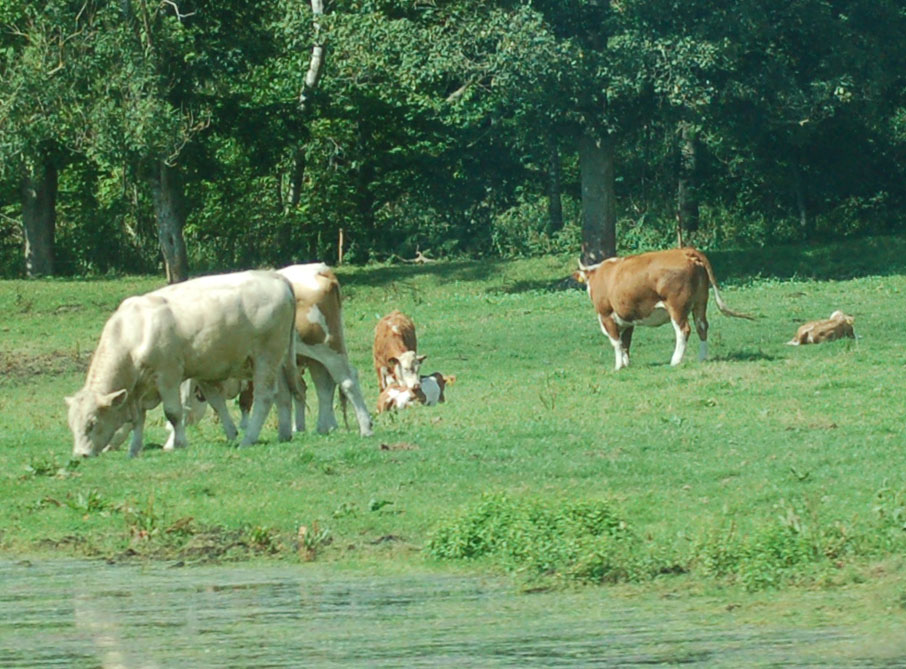
It's harvest time and the farmers are busy before the rain comes. On top of a corn field is a grave hill overgrown with bushes. There are lots of  dolmens at Djursland, worth a study in itself, round dolmens, long domens, passage graves - reminders of  men and women who lived thousands of years ago. And two other photos, guess what. Cows of course. It's necessary to have the cows. Those sweet animals with the pretty eyes. And then off to another place at Djursland............   


photo Djursland August 2011: grethe bachmann

Wednesday, August 24, 2011

Skarresø, a Field in an Old Gravel Pit

In a field by an old gravel pit at Skarresø (Djursland) are good possibilities to find some rarities. That was not what we found on this day, but there is always something to see, and it is still summer after all!


Sedum
The Sedum with many names like: Sedum live forever,  Witchs' moneybags,  Frog's stomach, Harping Johnny was before considered a love herb, since it was used as an omen. A girl or a guy could check where to find a sweetheart - and even find out if the relationship would last. They put some cuttings in the roof, and if the plant continued to grow it was the most positive omen they could think of. If there were side shots it meant that they would have children. So this was a practical herb - it was also used in medicine against burns. Sap from the leaves were smeared upon the wound, which also helped by nosebleed and haemorrhoids.


Mullein
Mullein. As you can see, the thicket around the still flowering mullein looks rather withered. It's already beginning to move close to autumn in some places! There are various species of Mullein, and it has a long, long history. It was used in medicine as a treatment for asthma and respiratory disorders, and the plant extraxts are an effective treatment in ear infections.Mullein is the active ingredient in many alternative smoking blends. An old superstition existed that witches in their incantations used lamps and candles provided with wicks of this sort. In most parts of Ireland, besides growing wild, it is carefully cultivated in gardens, because of a steady demand for the plant by sufferers from pulmonary consumption. The seeds are said to intoxicate fish when thrown into the water, and are used by poachers for that purpose, being slightly narcotic.


Southern Hawker/ Blå Mosaikguldsmed is the largest dragonfly in Denmark It flies with a fine agility and a speed of  25-30 km pr. hour while catching insects in a catch basket, which is shaped with its legs. The prey is eaten in the air and you can hear the crunching! It flies often far from water , hunting along hedges and forest glades. Here it is in a forest glade  - and unfortunately it is difficult to see its fine wings.


Red Admiral


Red Admiral/Admiral. A fine admiral in a plum tree. It loves the sap from those sweet fruits. Both admirals and some other butterlies are often seen among plums or on trees with sap running down the wood. The butterfly can be quite intoxicated and is easy to come close to in that condition.  The admiral is a migrating butterfly - and each year arrive new butterflies from southern Europe. It is one of few butterflies who live far north, it flies even to Iceland. 


The Map


The Map Butterfly/Nældesommerfugl is rather unusual, since the spring- and summer generation is not  alike. In Swedish, German and English is it called the Map (Landkort), caused by a characteristic pattern in beige, chocolatebrown and blue on the underside of the wings, which look like a map with roads and land areas. This fine little map flew quickly away.  Bye, bye, see you next year!


  Bush Cricket/ Løvgræshoppe. I had never seen a bush cricket before, and I was actually schocked to see the size of it. I understand why it is able to bite a human! I was afraid if it would jump up in my face! They are also known as long-horned grasshoppers, although they are more closely related to crickets than to grasshoppers. The bush cricket is 22-53 mm. Its habitat is in the whole  of Denmark except in Mid- and West Jutland. The calls of the male can be heard several hundred meters away - it calls from tall plants and trees. It makes sounds by rubbing the front wings. The bush cricket is a predator, eating other insects -  and if you catch one it might bite. Its enemies are birds and lesser animals.


Red Bartsia
Red bartsia/Rødtop is a half -parasite. It fastens on to the roots of neighbouring grasses, taking water and minerals from them, as a result the affected grasses' growth will be stunted. It was once offering a cure for toothace  since the botanical name odons is Greek for tooth. Carder bees and also a specific solitary bee feed on red bartsia.


Agrimony
Agrimony/Agermåne has a long history of medicinal use.The ancient Greeks used Agrimony to treat eye ailments, and it was made into brews to cure diarrhea and disorders of the gallbladder, liver, and kidneys. Anglo-Saxons made a solution from the leaves and seeds for healing wounds; this use continued through the Middle Ages and afterward, in a preparation called eau d'arquebusade, or "musket-shot water". Later, agrimony was prescribed for athlete's foot. Although the plant has no idiopathic properties, tradition holds that when placed under a person's head, Agrimony will induce a deep sleep that will last until removed.
As you can see this agrimony disappears almost in the withered grass and thicket. It was a dry place.  The grass was dry as dust, but a few days later came the rain.


Skarresø church
The trip was over, I've got some problems walking too many kilometers! We took a rest opposite a small lake downside a church. There was a nice flock of ducks on the grass, and I thought they would come swarming over to us, but I was surprised to see them all waddle down to the water and disappear over in a corner of the lake. Ducks are usually not that shy, but maybe someone has been teasing them. This happens - and it's a shame.

please click to enlarge - most photos need it this time!


photo Skarresø, August 2011: grethe bachmann