Showing posts with label A Taste of Denmark. Show all posts

Thursday, December 06, 2018

Legends of Denmark / Sagnenes Danmark


The source:
Legends of Denmark (Sagnenes Danmark)  is the result of many year's persistent investigations and studies, gathered and written by author, Gorm Benzon, whose work presents and summarizes substantially knowledge which never before was accessible to the general reader. 


A small extract: 


Rugaard Manor
The witch-hunter Mogens Arenfelt's wellknown and numerous witch processes are not just legends, they are  well documented history. He sent lots of innocent women to be burned at the stake -  and he often accused women who asserted their innocence. He had a certain test for an accused witch. She  had to be tested in a small pond on the road outside his manor Rugård. Her hands and feet were tied and she was thrown out into the pond. If she floated upon the water, she was a witch and was burned on the stake. If she sank she was innocent and she drowned.

Arenfeldt had a chamber on the third floor of the south-western tower, named Hamburg. When his creditors came to see him he would hide in this room, and the servant told the unwelcome guests that his lord and master was in Hamburg.

One of the later owners of Rugård manor told how his mother-in- law often saw someone sit in a chair in the living room. During a party she saw a grey lady walking  through the room. Other guests did not see her but they involuntarily went aside to let her pass.


Sebber Kloster 
 In old days they tried to build a church at Sct. Nicolai Bjerg near Sebber, but what was built in the day time was torn down at night. The trolls in the hill did not like the sound of church bells. Two rich ladies lived at the kloster and they had the church moved to where it still stands.

A notorious attorney took over Sebber Kloster in 1781 (he died in 1791). He was extremely despised. The farmers hated him and his peers of
the landowners disdained him. After his death he was haunting the kloster, and he was a very noisy ghost. Several priests tried to summon him without success. A priest named Bloch in the nearest village was not able to completely get the better of him, but managed to tie him to the peephole in the kloster church. Finally a priest succeeded after a long race - where he was above land and the ghost below land - to have him put down in the stable on Sebber manor, just behind the horse he rode while he was alive. Now people had finally found peace, but when the stable boy came out in the morning he could see how the horse was lathered as if it was highly ridden during the night.

A young girl served at Sebber kloster for several yeas. After her death she was haunting for some reason. In warm summer evenings she hovered above the building and disappeared on the church yard.


Kalø Slot
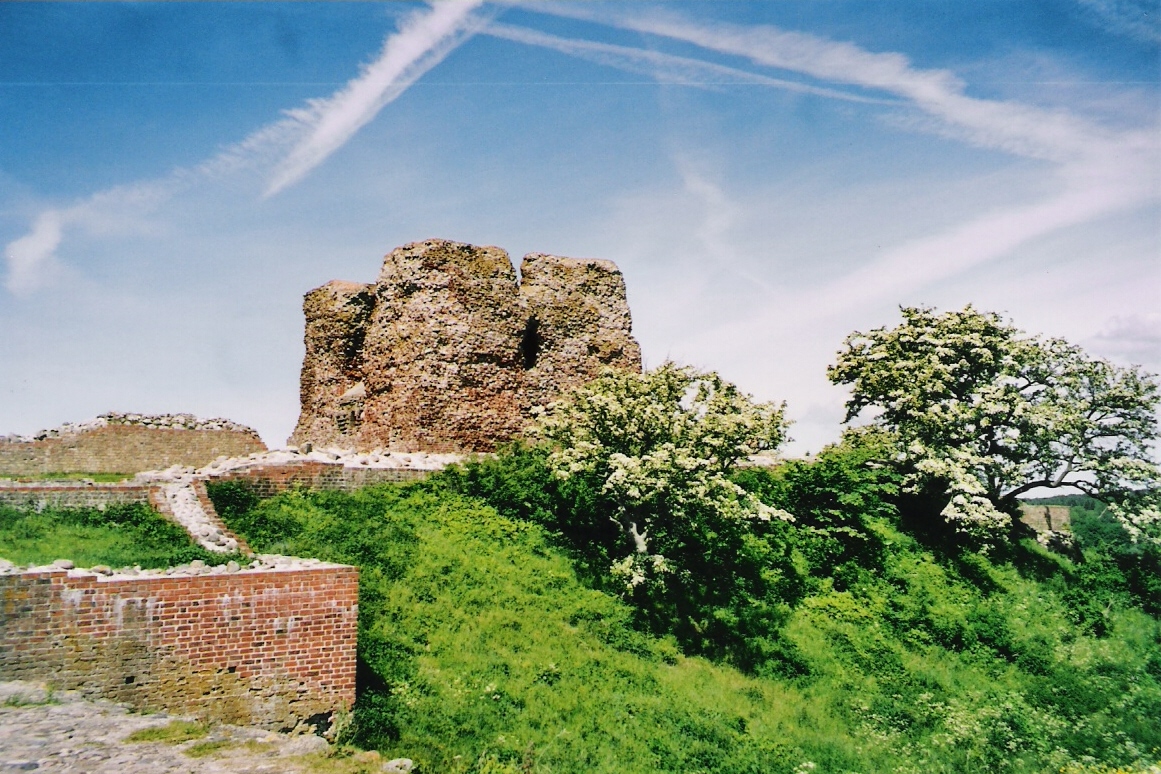
Below the ruin is a great treasure hidden - reportedly as much as the taxes in Denmark for seven years! It is not easy to find it and raise it, for it is well hidden and well protected somewhere in the ruin of Kalø. Probably under the big tower is a copper gate leading to a secret cave and a secret passage. The passage leads to Hestehave forest on main land and in the cave lies a dragon and guards a copper kettle filled with money.

Many have tried to dig for the treasure but only a few have reached the gate. The first who entered the cave was a German, but the dragon attacked him and tore him into a thousand pieces. The next entering the cave were two peasants from the local district, the dragon could not hurt them for some reason, and the peasants spoke harsh words to the beast and made it so scared that it crept over into a corner of the cave, while the two men picked up the kettle and began to walk away. The poor dragon, who was the guard of the treasure, was now in a terrible pinch, which gave it a stomach ache -   and in its embarasment it let a poisonous wind go. This was a rescue both for the dragon and for the treasure, for the two men rushed off coughing and sputtering up into the fresh air, and they never showed their face on Kalø again .

The only possible way in fetching the treasure was said to be  in the summertime. The dragon was like all other dragons fire-breathing - and it was over heated in summer and had to fly to Norway to cool down. It was easy to see when it left for Norway  - there was a trace of fire in the air from Kalø  in the direction of Norway.

A manager who lived a Kalø drowned. He might have committed suicide. He had no rest in the grave, for he had done wrong against his landlord and the Kalø-farmers. He sometimes rode in the castle yard on a white headless stallion, but he was often also running around in the rooms as a big black dog, impossible to catch. Finally people succeeded to summon him down into a meadow, and a pole was driven through him.


Lynderupgaard.
 Lynderupgaard is one of the finest timbered manors in Jutland, and it is rich in legends. Upon the castle yard the clear spring water runs down from the oldest fountain in the North into a cord of hollow oak logs , coming from a spring in the hills behind the house. It is  said to be the best water in Denmark. The well might have a past as a holy spring. Once in the night when it is a full moon a black ghost dog comes running into the yard and drinks the clear water.

Sseveral people have told that they saw a funeral procession coming out from Lynderupgård. It came out from the wall in the west wing and went across the open moat and disappeared on the other shore. When one year they digged on that spot at the castle castle bank they found traces of an entrance from the house and across a bridge across the moat.

It was told that when landlord Friis in 1777 took over Lynderupgård there were two skeletons upon the attic. He let them bring down to be buried, but there was never again any rest on that attic.

In the old days was in the park a carved wooden sculpture under which a nun was buried. Maybe it is she who each night sits upon the "Virgin bench" with a baby on her lap.

People at Lynderupgård have met a priest when they at night went in the great halls and rooms. No one knows who he is, but he might have been there ever since Lynderupgård's stone house was a part of a bishop's manor.

When big changes have to happen in the family at Lynderupgård, mostly sad changes, a big black and white cat, named Whitehead, comes jumping across the floor in big clumpsy hops and disappear under some furniture, but when you look for it there is no cat.


Skaføgaard.
One of the owners of Skaføgaard had sold himself to the devil, and he even knew when his time has come. When he was dying the devil arrived in the form of a black dog and sat by the head end of the bed. Now the man regretted that he had signed such a contract, and he called for seven priests to come and save him, but no one was able to drive the devil out -  not until the eigth priest arrived the devil had to give up. Unfortunately the priest made a fatal error already in the initial maneuvers.He used a wrong word about God, and the devil - who is a terrible stickler, worrying about the smallest trifles -  attacked the priest and turned his head, so it was awry for the rest of his life and his voice took lasting damage. In spite of these handicaps he was able to talk so resourceful that he drove away the devil. He drilled a small hole in the window where the devil had to disappear through. So the priest had now saved the landlord's soul.

But when the priest togtether with his coach was on his way home he started to talk about what had happened, still before they were out from precincts of Skaføgård. Each clerk could have told him that this was the work of a crazy man to talk like that - and it did not last long before the devil attacked him again. The priest succeeded in jumping down from the waggon and pull off one of the rear wheels. Now he had peace, for the devil had to walk instead of the wheel. When they came to the vicarage the coach drove the waggon out upon the dunghill, and the devil had to stand in manure up to his knees until he was free  at sunrise and could run home to his great-gandmother.

About the landlord is said that he did not get peace after his death. He has still been haunting at Skaføgaard. 


Source: Gorm Benzon, Sagnenes Danmark, bd. 2. Himmerland, Ommersyssel, Djursland og dele af Midtjylland. Aarsleff og Friis 1984.


photo GB:  Rugaard, Sebber kloster, Kalø slot og Skaføgaard:

photo wikipedia: Lynderupgaard .

Sunday, August 20, 2017

Ebeltoft - one of the loveliest little towns in Denmark.........


Ebeltoft (earlier Æbeltoft) lies at Djursland in East Jutland - it is a popular tourist city, not least because of the old timbered houses in the middle of town. The old market town atmosphere reflects a piece of Denmark's history through centuries . It has a colourful shop- and museums life and the inhabitants are doubled in the summer period. Close to Ebeltoft is the Nationalpark Mols Bjerge with many fine beaches and summer houses.


photo:gb

photo:gb

photo:gb
Ebeltoft was probably established around year 1200, and the name Ebeltoft is seen the first time in king Erik Menved's letter of 21 January 1301, where he gave the town its municipal rights. In the beginning the place was a village or a fishing village and an annex to the village Draaby up till the reformation. On  25 August 1317 the king issued a new letter where he gave the citizens laws and regulations like the cities Viborg and Aarhus.
photo:gb
photo:gb
photo:gb

In 1558 was established a Latin school in Ebeltoft.The town suffered much during he  plague 1619-1620 and was damaged during the wars of the 17th century. The main business of the town was maritime trade, espcially in the second half of the 17th century with large merchants- and warehouses, ship buildings and profitable traffic, especially from Norway.  The large timber transport from the royal forests in the neighbourhod brought much life to the town.  In 1672 the town had 817 inhabitants, after Den Store Nordiske Krig 562 inhabitants in 1769. The latin school was abolished in 1739. The town developed little in the 19th century because of the wars. At the census in 1930 Ebeltoft had 1897 inhabitants , in 1945: 2.104 and in 1965: 2.485 inhabitants. Now in 2017: 7. 430.


Along the beach road and by the Fregat Jylland are still seen the rest of the old seaweed dikes. They were built as a protection of west-facing gardens against intrusion of sea water. The dikes are now listed.

photo:gb
photo:gb

photo:gb

photo:gb

In the various shops in Ebeltoft are arts and crafts in a class of its own, lifestyle and fashions shops etc. In the streets are often music and entertainment in the summer period. Ebeltoft is a lively tourist town with several restaurants and cafés - and walking the old cobblestoned streets there is suddenly a wonderfull scent from the waffle bakery where they sell the most delicate ice cream cone, named Molbo Vaffel. In another old street is a sweet scent of sugar and fruit from the little Bolsjekogeri (candy factory Mols Bolsjer) ) where they make candy in various tastes and looks in the backyard.In Ebeltoft is one of Denmark's largest concentrations of small studio glass work shops.

photo:gb
photo:gb

photo:gb

photo:gb
Glass Museum and the Fregat Jylland.  The fregat lies in the water and is connected to a museum on land, here is the history of the old fregat told in a factual and entertaining way. The Glass Museum lies nhttp://glasmuseet.dk/
photo:gb
earby, it has various local and international exhibitions and its own glass workshop - and the museum arranges various activities for children and adults. The children can borrow a children's suitcase and go exploring the many halls of the glass museum. Ebeltoft houses numerous galleries and several renowned glass blowers are working in the town. 
photo:gb

photo:gb


photo:gb
A large part of the medieval streets are listed, and Ebeltoft was in 2015 at the top of a list of the best preserved medieval towns in Denmark. It is one of the  most popular holiday towns with cobblestoned, narrow streets and crooked old houses with roses and hollyhocks.

The old town hall is a charming attraction. Many couple choose a wedding at the picturesque town hall, in 2017 have already been celebrated 300 weddings in Danish, German and English . It is is a small building with a tower and with a rich history since 1576, and here is also an old dungeon.

Close to the town hall is a funny little museum Siamese Samling. The museum was established by Rasmus Havmøller, who worked and lived in Siam (today Thailand) from 1914-1933. He opened in 1940 the exotic museum with lots of objects from his life in the East.

The vægterne (watchmen) of Ebeltoft walk the old streets in the summer period .They call in the night each night walking and singing the watchmann's song through the streets . They start at the old town hall at 20.00, 21.00 amd 22.00.


Since the 1890s Ebeltoft was a seaside resort for better-off people from Aarhus, and the fine holiday houses along the coast remind about a time where people went to the resort to bathe and take their vacation. From the 1960s common people could gradually afford to build summer houses -  and today are many large areas with lovely summer houses in and around Ebeltoft. Many can be rented in the summer period.


The name Ebeltoft comes from apple/abel/abild. The apple tree is seen in the oldest seals of the town (Latin: pomagrina and pomagrium).The first "Ebelfestival" (Apple Festival) started in 2004, and it has since become an established part of the cultural life of Ebeltoft. It is held each year in week 42. The vision is to give some good experience and knowledge about appless and about the history and culture of Ebeltoft.
http://ebelfestival.dk/


Den europæiske Filmhøjskole in Ebeltoft is one of the world's best basic film schools and it takes students from all over the world (always 50 % Danish). Among the most famous former students in the Nordic countries are actor Pilou Asbæk ('Borgen'/'The Fortress', 'Lucy'), director/screenwriter Nikolaj Arcel ('A Royal Affair', 'The Girl With the Dragon Tattoo'), director Joachim Trier ('Reprise', 'Louder Than Bombs'), cinematographer Charlotte Bruus ('The Hunt', 'Far From the Madding Crowd'), director Michael Noer ('R' and 'Northwest'), cinematographer Magnus Nordenhof Jønck ('The Killing', 'A Highjacking') and cinematographer Sturla Brandth Grøvlen ('Victoria', 'Rams').
http://kurser.hojskolerne.dk/hoejskoler/hoejskole-soeg/den-europaeiske-filmhoejskole


Safari Park/photo:gb

The big animal park : Ebeltoft Safari is finansed by the Karsten Ree.
http://www.reepark.dk/


photo: 
grethe bachmann
and from wikipedia.
Source: 
Danmarks købstæder, Søren Olsen, 2000
Politikens Danmarksbog , Søren Olsen, 2003


Friday, December 02, 2016

JUL, JÓL, CHRISTMAS, WEIHNACHT, NAVIDAD................


Scandinavian Jul in the Viking period and in the early Middle Ages.
(source: Middelalderhistorie, Århus Universitet)


Candle in Vor Frue Kirke, Århus/ GB
The word Jul or the Old Norse Jól was used long before Christianity came to Denmark and Scandinavia. Jul was the term for the winter feasts when days of the year again began to grow longer - but today it is difficult to know what these ancient feasts really meant to people. 


Carl Larsson, Midvinterblót, (wikipedia)
The linguistic history of the word Jul are somewhat lost, but it has probably German roots. An early example of the use of the word is in the Gothic language spoken in Central and South Eruope in late Antiquity and in the early Middle Ages. The word Jul is first seen in the 300s. It was among others used in the form jiuleis which was the name for November or December. A few centuries later it is seen in Old English where it occurs as goiuli giulæi or youle  - as a description  of the period December-January. In Old Norse ( the language in Scandinavia in the Viking Age) the word seems to have had several meanings, but everything points to that the Old Norse Jól can be translated into feast. The word seems to have spread in Europe in Antiquity and early Middle Ages, the periods which in Denmark are named Iron Age and Viking Age. It was everywhere used about the same time of the year, but it is uncertain what the word actually covered -  also in the Nordic context.


Viking House, Fyrkat/ GB
There are no contemporary written sources which describe the before-Christian Jul. A few Nordic sources like scaldic verses and sagas, which use the word jul/jól, were written down in the Christian period, and they therefore reflect the world view of the Christian writer. In most source-cases where jul is mentioned, it is used about the Christian celebration, but a few Nordic sources indicate that the jul in Scandinavia  - also in the time before Christianity -  was a special event in December or January.


Harald Haarfager/ wikipedia
This is seen in the probably earliest Nordic source which mentions the word jul. It is a scaldic verse ( ab. year 900) by the scald Thorbjørn Hornklofi,  composed to king Harald Haarfager of Norway (king ca. 872-930). The  verse sounds like this: "the king will drink jul out ... and make Frej's play". The first words probably refer to how a ruler in the Viking Age had to move around a lot if he wanted to keep his power. It is not clear what is meant by Frej's play, but the drink sacrifice took a central role in the before-Christian religion, where the Vikings drank to honor gods like Frej and Odin. Maybe the verse refers to a sacrifice like this.


Odin, Hugin and Munin/wikipedia
Another scaldic verse pays tribute to king Harald Hardrada of Norway (king 1046-1066) for his victory at the battle field. It was said that the king prepared jul for Hugin's hird. Hugin was one of Odin's ravens, so the verse refers probably to the men killed in the battle and being food for the ravens. Maybe here is also referred to the unusual numbers of food taken in at the feasts of jul.


Hakon the Good/ wikipedia
The Icelandic Christian chronicle writer Snorri Sturlasson mentions jul in a saga about the Norwegian king Hakon the Good  (king ab.
933- 959). The saga was written down in ab. 1230. He describes that king Hakon decides to celebrate jul at the same time as the Christians. The saga also tells the story about a Viking chief, who after being a Christian, still held on to the tradition to celebrate three big feasts during each year, three yearly sacrifice feasts: one at the beginning of winter, one in midwinter and one in the start of summer.
Snorri Sturlasson,C.Krogh/ Wikipedia
When he became a Christian he continued celebrating three feasts each year, which were now named gæstebud (banquets): one in autumn, a jul-feast in winter and one at Easter. How the feasts were celebrated is told by Snorri: "the Christian king Hakon was invited to a jul-feast by some heathen farmers, who according to tradition wanted the king to take part in the sacrifice. (blót) The Christian king would not take part in this, but he needed to have the support of the farmers, so he found a compromise: he eat a little horse liver and drank some memorial cheers without crossing his drinking cup. Making the sign of the cross was a Christian custom which the farmers would never accept.


Jolagjafir/ wikipedia
The sagas holds also the first example e of the word julegave (Christmas gift). It is seen in a description of Norway's king Hakon (king 1093-1095). He was supported by a part of the Norwegian population if he refrained from filing the traditional taxes which the Norwegian people had to give the king, including julegaver/jolagjafir. In other parts of the sagas are examples of julegaver which remind of the phenomenon, known today. Scandinavian Viking chiefs gave gifts to their families around the turn of the year, and thus he followed a custom which had spread in the European courts. Princes also used gifts traditionally to attract important people and thereby establish or hold on to their social status. In time these gifts were connected to the jule feast.


Jul in Lejre, Zealand/ wikipedia
The German history writer Thietmar of Merseburg wrote in the beginning of the 1000s about a sacrifice feast which was held each year at Lejre in the Danish isle Zealand. Archeologists have here found a very important place, which probably functioned as the royal court of the Danes. According to Thietmar the Danes sacrificed humans and  animals in Lejre at a time where Christians celebrated the Holy three kings on 6 January, these sacrifices were held in order to please the underground people. Thietmar's descriptions reflects a Christian's negative view upon a heathen society -  and it is not certain if his description can be connected to the before-Christian jul, but it indicates that people of Scandinavia in December or January celebrated ritual blót-feasts.


Sacrifice place, reconstruction, DK/ wikipedia
After the introduction of Christianity in Denmark several sources mention how Danish kings kept magnificent feasts in order to celebrate the Christian jul. German history writers like Arnold of Lübeck describe in the 1100s how Danish kings had great drinking feasts. Similar descriptions are also seen in the Danish chronicles. The history writer Saxo wrote ab.year 1200 about a jule feast at the Danish court. The king invited the greatest men of the kingdom to magnificent feasts where they eat and drak for several days.


Sacrifice of food,reconstruction, DK/ wikipedia
Some are of the opinion that the before-Christian jul was at winter solstice, 21 or 22 December, others that it was at midwinter night between 19-20 January. Both suggestions could be true. There were probably several ritual feasts, which were held on various times in December or January. The feasts have varied from district to district, maybe even from family to family in some cases. There was probably a summer solstice feasts,  a feast at midwinter, and in other cases a fertility feast. The jól of winter was regarded as one of the intersection points of the year.


Feast in Middle Ages/ wikipedia
The jul was a ritual event, connected to the middle of winter. It seems that great men from the social elite often were the focal point of important feasts. Like the king the powerful men of the kingdom were often central in the ceremonies which were connected to the practice of the before-Christian religion - and they played undoubtedly an important role in marking the Jul. They drank, eat and sacrificed, and the sacrifice was probably held in one of the great halls where the elite resided. The jul-feast contributed to hold on to and to develop the social and religious structures of society.


Earliest Danish cross, Vor Frue kirke, Århus/ GB
In Scandinavia the word jul survived the introduction of Christianity, while other parts of Europe began to use words, which came from Christianity, like the English Christmas, the German Weihnacht and the Spanish Navidad etc. Likewise the considerable intake of food and drink seemed to live on in new forms. People did not cheer in the honor of Odin and Frej, but celebrated the birth of Christ. Although it immediately looks as if central parts of the before-Christian jul continued after the introduction of Christianity, it is important to say that the informations were written down by later Christian writers. They saw the past through a Christian lens and might therefore have transferred a part of their contemporary jul-celebration to their description of the past.


Source: Middelalderhistorie.dk, Århus Universitet.


Sunday, August 14, 2016

The first morning on a holiday tour to the Thy district...


On a country road through Himmerland 

On our way to Thy via Himmerland and Aggersund we passed a fine little Romanesque church, Stenild church, by the country road, built in pretty carved granite ashlars. The broad tower was in red bricks and ashlars.The earliest artifact in the church is a very large Romanesque granite baptismal font, a socalled lion font with impressive reliefs of lions. Between the lions are reliefs of human faces. The church has two bells, one from John Taylor and Co, England in 1959,  and the other from Århus in 1651.


Aggersund Bridge, a connection between Himmerland and Thy.
 The bridge at Aggersund is from 1942. It  is a pretty arch bridge with a double link span in the middle, which is opened by the watchman, when ships pass Aggersund on their way to and fro the town of Aalborg. The bridge has a fine placement in the flat landscape in the western and narrowest part of the Limfjorden


A view to a Salt Marsh by Aggersund

A salt march is marked by the nearness of the sea. The air-contents of salt is high, and the marsh is often flooded by heavy winter storms. This causes a flora, dominated by species which can tolerate salt. The salt marshes are habitats for waders, ducks and seagulls. In the winter they are also a foraging area for some birds of prey.
The Danish salt marshes are protected nature types. They represent only 1% of the total area in Denmark. The increased interest for and the increased funding for landscaping has resulted in a positive development of the management of the Forest and Nature Agency's areas of the salt marshes. In several places are planned or carried through nature restoration of earlier salt marches.

After the Aggersund Bridge we have left the Himmerland district -  and we are now in Thy, which among many other things has a National Park -and not at least the North Sea!

Coffee break at Aggersborg, a very special place with one of the Danish Viking Trelleborgs, Aggersborg. There is no castle or buildings left, only a large circular grassy site.


Aggersborg is the largest Viking fortress in Denmark with an inner diameter of 240 meter. The whole plan along the outer edge of the moat is 299 meter broad. The site is difficult to date since underneath is a village with houses from German Iron Age, but it was probably built approximately the same time as the other trelleborgs in Denmark, most likely around year 980, when Harald Bluetooth and/ or Svend Forkbeard ruled the country. The fortress was built during 1-2 years and was only used for about 5-20 years.
 The situation of Aggersborg was a protected one and yet accessible by ship. This should be considered in the light of that the Limfjorden at this time was open for ships in three directions: west, east like today, but also to the north through the access Sløjen. Besides this the Aggersborg was placed by one of the three passages of the ancient Hærvej across the Limfjorden. It is not known if Aggersborg was a power center for control of trade and internal feuds, or if it was a barrack/ training camp in connection to Svend Forkbeard's raids to England.

Here you can see a piece of the circle. On the photo of the Aggersborggård you can see the whole circle of Aggersborg from air.


Archaeology

 Among many archaeological finds at Aggersborg was a fine and heavy gold bracelet. (now at the National Museum) A copy of the bracelet is at the Minimuseum at Aggersborg.


Aggersborggård is a Danish manor which history goes farthest back in time, to the year 1086. Aggersborg was a king's manor from 1086 till 1579. The present farm lies in the edge of the moat of the Viking fortress Aggersborg.


Aggersborg kirke
North of the mighty Aggersborg site lies Aggersborg kirke, probably built in the 1100s. On the walls of the church are some runic inscriptions. The church is open daily.


Minimuseum by the church. There are no traces of the Viking longhouses on the site but north of Aggersborg by the church lies a small museum where it is shown how the fortress looked and how the longhouses were built.


photo August 2016 : grethe bachmann
gold bracelet and Aggersborggård: wikipedia.