Showing posts with label Burgundy snail. Show all posts

Friday, March 27, 2015

Burgundy Snail / Vinbjergsnegl - Escargot

Burgundy snail by castle ruin Fussingø, photo gb.

Helix pomatia


The Burgundy snail or the Roman snail is an edible snailn  -  named  Escargot in the cuisine. It is a speciea of large edible air-breathing snails,  a terrestrisl pulmonate gastropod mollusk in the family Helicidae. It is the largest shell-snail in Europe. As adult it has a height of ab. 4,5 cm and a broadth of 4 cm. It is considered a fine delicacy, especially in southern Europe.

Denmark
As for its spread in Denmark it was important that it was edible. In the Middle Ages snails were not considered to be meat and therefore allowed as a meal during Lent. Both klosters and manors farmed these big snails. Today the snails are often seen around old manors and klosters  - and by the kloster ruins. 


by old  church dike, Skarresø, photo gb
The Burgundy snail / Vinbjergsneglen is protected in Denmark.to the extent that commercial gathering of the snail is not allowed. It is allowed to gather the snail for private use, but it is encouraged to spread this gathering in order to avoid excessive interference in the various  habitats

The snail achieves the age of 6-8 years in the wild, but it s not unusual to see older specimens.

The Burgundy snail/Vinbjergsnegl and the common Garden snail come out in big numbers after heavy rain in spring. The mating takes place in May or June. The snail is hermaphrodite. After the mating the snail buries itself into the ground and lays about 60 eggs.

The natural habitat in Denmark is upon large and smaller hills and in open thickets, but seldom in people's gardens. The snail's food is mostly decomposing plants and dead animals. Since there are foxes and badgers in the habitats they are considered natural enemies of the snail, 

In the middle of November the snail closes its house with a sealing of chalk in order to hibernate.


in Bjerre forest, near Boller castle , photo gb

Europe
It is called by the French name Escargot when used in cooking. Although this species is highly prized as a food it is difficult to cultivate and rarely farmed commercially.

The shell is creamy white to light brownish, often with indistinct brown colour bands. The shell has five to six whorls. The aperture is large.The apertural margin is white and slightly reflected in adult snails. The umbilicus is narrow and partly covered by the reflected columellar margin.


In southeastern Europe, H. pomatia lives in forests and open habitats, gardens, vineyards, especially along rivers, confined to calcareous substrate. In central Europe, it occurs in open forests and shrubland on calcareous substrate] It prefers high humidity and lower temperatures, and needs loose soil for burrowing to hibernate and lay its eggs. It lives up to 2100 m above sea level in the Alps, but usually below 2000 m. In the south of England, it is restricted to undisturbed grassy or bushy wastelands, usually not in gardens; it has a low reproduction rate and low powers of dispersal.
Average distance of migration reaches 3.5–6.0 m.]


Lolland, near Aalholm castle. photo gb.

Protection
Great Britain: In the west and south of England in southern areas on chalk soils. Its common name in the UK is "Roman snail" because it was introduced to the island by the Romans during the roman period (AD 43–410). In England only (not the rest of the UK), the Roman snail is a protected species under the Wildlife and Countryside Act 1981 making it illegal to kill, injure, collect or sell these snails


In central and southern parts of Sweden, Norway and Finland, isolated and relatively small populations occur. It is not native to these countries, but is likely to have been imported by monks from Southern Europe during medieval times.


Germany – Listed as a specially protected species in Annex 1 of the Bundesartenschutzverordnung.

Czech Republic - least concern species (LC) its conservation status in 2004-2006 is favourable in the report for the European Commission in accordance with the Habitats Directive.


Conservation
This species is listed in IUCN Red List, and in European Red List of Non-marine Molluscs as Least Concern. Helix pomatia is threatened by continuous habitat destructions and drainage, usually less threatened by commercial collections. Many unsuccessful attempts have been made to establish the species in various parts of England, Scotland and Ireland; it only survived in natural habitats in southern England, and is threatened by intensive farming and habitat destruction. It is of lower concern in Switzerland and Austria, but many regions restrict commercial collecting


Escargot, photo wikipedia.
Escargot  is a dish of cooked land snails, usually served as an appetizer in Spain and in France.  The word escargot is also sometimes applied to the living snails of those species which are commonly eaten in this way. Not all species of land snail are edible, and many are too small to make it worthwhile to prepare and cook them. Even among the edible species, the palatability of the flesh varies from species to species. In France, the species Helix pomatia is most often eaten.

Heliciculture  snail shells have been found in archeological excavations, indicating snails have been eaten since prehistoric times. A number of archaeological sites around the Mediterranean  have been excavated yielding physical evidence of culinary use of several species of snails used as escargot. The Romans, in particular, are known to have considered escargot an elite food, as noted in the writings of  Pliny. ]

Like most molluscs, escargot is high in protein and low in fat content (if cooked without butter). Escargot is estimated to contain 15% protein, 2.4% fat and about 80% water.


Source. Danish and English wikipedia, Naturstyeelsen, Danmark om Vinbjergsneglen.

Wednesday, June 01, 2011

A Small Lake, a Beach and a Forest with Orchids

A small lake lies downside a church hill with an old stone dike. This is a place where you can find plants which has grown here since centuries ago - living relicts from the past.  There's a rattle in the rush, two ducks fly across and over in a corner. That's odd. Ducks are usually not shy to people, but they have possibly a nest nearby. They do not live in the duck house in the middle of the lake. No matter how many duck-houses people put up in village ponds and small local lakes the ducks are not interested. Wrong architects maybe?


The Escargot


The uncultivated border outside the church dike is listed, and it is against the law to spray pesticide here (although some do). And here are often small bushes where the little birds can live. It's a good place for finding special plants. And look - here is a relict plant, the poisonous yellow Greater Celandine, which was a medicine  and dye-plant, used against  eye- and liver diseases and in dyeing, where it gave fine blue and yellow colours. Greater Celandine  is also a fine indicator for that here was once a medieval garden. Nearby shows another visitor from the old days his face. The Burgundy snail, Roman snail, edible snail or known in cooking as the Escargot. This snail was popular in the Middle Ages, since it was not regarded as meat, so the monks were allowed to eat it during lent. The concentration of this snail is often seen around old manors and closters, or by old ruins. Today is it listed in Denmark in the extent that commercial gathering is not allowed out in the nature.

The lake is divided in two parts, and the second part is a little larger with some cosy village houses along the edge. One of the houses is charming with a vigorous lilac leaning up the wall and the thatched roof. In the garden by the country road is a beautiful elm tree. An elm with fruits wakes up some memories from my childhood. Yes, just laugh! I'm growing old, thinking about my childhood!! Did you ever eat those elm-fruits called manna? We did. In the park at home was an old elm tree. I don't think we children had too little food at home. Maybe we needed some vitamins from the manna? And it tasted good as far as I remember! And when you walk by the lake there is often a small boat hiding among the rush, this one is apparently well cared for with paint, but when is it used? Waiting for a complete angler who's out in the early morning or the late evening, for fishing trouts - or pikes. The pike is a dangerous fish for the little ducklings. The ducks live fortunately in the small lake with no pikes.


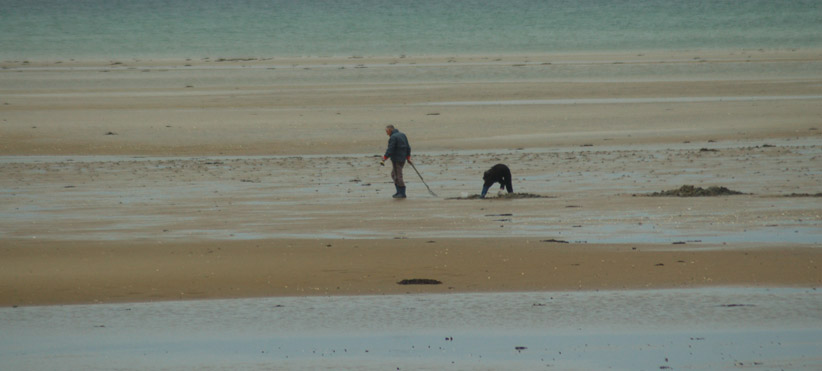
How rude! Almost all cows turned their back. Wouldn't talk! The next stop was at a fishing village Bønderup, which is a lively place in the summer season. Right now is it quite silent and desolate. There are still a few fishing boats, but just ten years ago was here an active fishing harbor. It's not always an easy task to be a fisher. To men were out digging worms for some fishing from a row boat I suppose. The windmills are overall in the Danish lanscape, inland and by the coast. Green energy. The small holiday houses are awaiting the summer guests. Next month is here overpopulated and you'll have to queue to get an ice cream.


The last stop was a small forest close to home,where I had only been once on a winter's day. It's a little strange, for I always want to see places a little far from home. Although the distances in Jutland are small compared to your distances abroad like in Britain and the USA, then a usual tour of ours takes a day. There is time enough to see the nearby places in winter! The forest had such a lovely May-meadow with lots of various flowers, but I'll try to restrict myself to a few pictures. There were thousands of broad-leaved  marsh-orchids in the meadow and my photo does no justice to the sight. A few years ago it began with a few of those beautiful purple orchids in this place, and now, after nature care there are thousands. It's a miracle. Nature is so generous when we allow it to be. A walk through the forest under the ever dripping raindrops  -  a look at the sweet woodruff with white miniflowers. This herb gives one of the finest and most elegant light green herbal snaps! The rain grew worse and now it was time to go home.............


photo May 2011: grethe bachmann