Showing posts with label Easter. Show all posts

Monday, February 26, 2018

The Month of March - Daffodils and Birthstones

March is the first month of spring in the Northern Hemisphere (North America, Europe, Asia and part of Africa) and the first month of fall or autumn in the Southern Hemisphere (South America, part of Africa, and Oceania). Birthstones of March are Aquamarine and Bloodstone /Heliotrope.

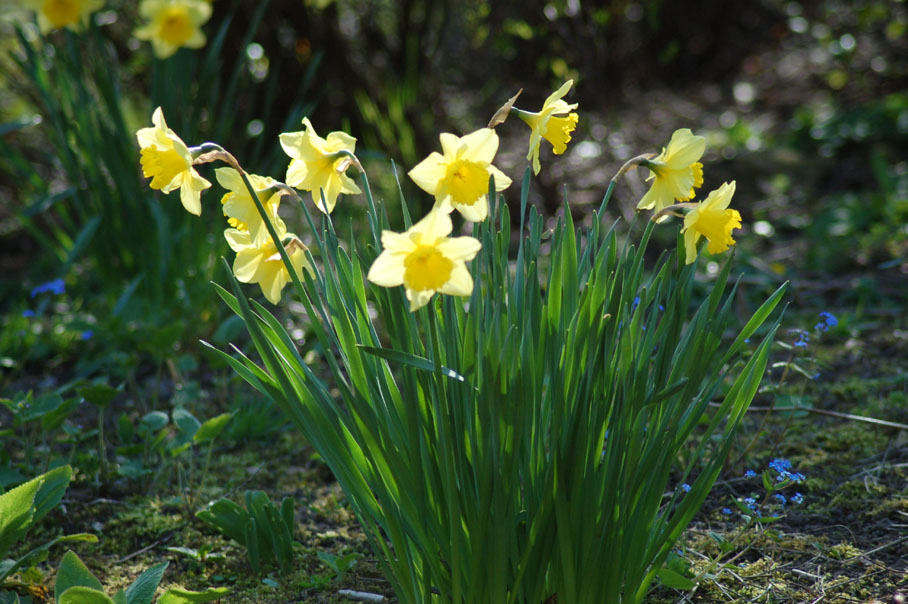
Flower emblem of March is Daffodil.  

Daffodils, Mindepark, Aarhus/GB
The Danish name Paaskelilje refers directly to Easter, and it is impossible to imagine a Danish Easter without bundles of those pretty yellow flowers as a decoration in the house together with the Easter eggs and all the other traditional Easter decorations. The name Narcissus is mostly connected to the legend about the youth in Greek mythology who became so obsessed by his own reflection that he kneeled and gazed into a pool of water until he fell into the water and drowned. The legend says further that the Narcissus plant first sprang from where he died. Narcissus is the botanic name and there are many variations. The common English name Daffodil is sometimes used for all varieties. The Narcissus was listed as a medicinal herb in 'De Medicina' by the physician Aulus Cornelius Celsus, who said that 'it was powerful to disperse whatever has collected in any part of the body'.


Birthstones of March:

  • Aquamarine/Beryl
    Aquamarine (from Latin: aqua marina = water of the sea/ referring to its sparkling ocean colour. It is a blue or cyan variety of beryl. The gem-gravel placer deposits of Sri Lanka contain aquamarine. The deep blue version of aquamarine is called maxixe. Maxixe is commonly found in the country of Madagascar. Its color fades to white when exposed to sunlight or is subjected to heat treatment, though the color returns with irradiation. Aquamarine is in several localities in USA, Brasil and in Africa. The largest aquamarine of gemstone quality ever mined was found in Marambaia, Minas Gerais, Brazil, in 1910. It weighed over 110 kg (240 lb), and its dimensions were 48.5 cm (19 in) long and 42 cm (17 in) in diameter. The largest cut aquamarine gem is the Dom Pedro aquamarine, now housed in the Smithsonians institutions National Museum of National History.

    Facetted Aquamarine, wikipedia.
    Aquamarine evokes the purity of crystalline waters, and the exhilaration and relaxation of the sea. It is calming, soothing, and cleansing, and inspires truth, trust and letting go. In ancient lore, Aquamarine was believed to be the treasure of mermaids, and was used by sailors as a talisman of good luck, fearlessness and protection. It was also considered a stone of eternal youth and happiness. Today it protects all who travel by, over, or near water, and opens the channels of clear and heartfelt communication.

    Art Deco  Aquamarine ring,1920s (Pinterest)
    Ancient seer considered it to be under the influence of the moon, an orb exerting very great magnetic influence. Present day supporters of crystal-gazing suggest that when using an Aquamarine to view coming events, do so when the moon is increasing. The magnetism of the moon on the included iron oxides will strengthen the stone's forecasting ability.Aquamarine embodies all things connected to the sea, as well as those things relating to Heaven reflected on the surface of the water. It becomes a mirror, reflecting itself indefinitely, making it possible to discover hidden meanings of reality. As a stone of symmetries, it is conducive for meditation and revelation, a stone of prophets, shamans, healers, and mystics. It also allows us to explore the darkest depths of our souls, face to face with ourselves, and with other


    Aquamarine is the blue variety of Beryl, though the Beryl family forms in other colors used as gems, such as green Emerald, yellow Heliodor and Golden Beryl, pink Morganite, Red Beryl or Bixbite, and the colorless variety, Goshenite.


    bloodstone/wikipedia
    The mineral aggregate Heliotrope,  also known as Bloodstone , is a variety of jasper or chalcedony. The "classic" bloodstone is green jasper (chalcedony) with red inclusions of hematite. The red inclusions are supposed to resemble spots of blood; hence the name "bloodstone". The name "heliotrope" derives from various ancient notions about the manner in which the mineral reflects light. Heliotrope was called "stone of Babylon" by Albert the Great and he referred to several magical properties, which were attributed to it from Late Antiquity. Pliny the Elder (1st century) mentioned first that the magicians used it as a stone of invisibility. Damigeron (4th century) wrote about its property to make rain, solar eclipse and its special virtue in divination and preserving health and youth. Heliotrope features as an invisibility stone in one of Boccacio's stpries in the Decameron and as a healing magic item in a musical comedy derived from it. Heliotrope is sometimes used in carved signet rings and is the traditional birthstone for March.

    In the Middle Ages, bloodstones were associated with the crucifixion of Christ. According to the legend, when Christ was crucified, blood dripped onto the green ground, and this red-green stone was formed.  Greeks and Romans wore Bloodstones during athletic games to increase their strength and endurance. They are most commonly sourced from India, but can also be found in places like Brazil, China and Australia. Bloodstone is a good birthday gift for someone who would value a reminder of their strength.

Sunday, April 08, 2012

Pulsatilla/Pasque Flower - Easter flower

Pulsatilla - Pasque Flower (Easter Flower) - Kobjælde

Pulsatilla pratensis, Pasque flower, Nikkende kobjælde: The 6 purple flower heads are silky haired and longer than the many yellow stamens. The fruit stand is easy to recognize. It looks like a powder puff, the seeds are hairy and has a 5-6 cm long griffel. The fruit stand is not nodding like the flower is, but upright. The flower is rarely yellow-green or white. It can make hybrids with Pulsatilla vulgaris, but this is very rare.

The pratensis can be mistaken for the vulgaris, but the vulgaris is upright while flowering, and it is more bluish purple than the pratensis. The pratensis has a massive stem, filled with marrow, while the vulgaris has a hollow stem.It flowers in April-May (in DK) here and there on sunny hills, especially in North Jutland and upon the Isles. It grows in open calcium-rich sand- or gravel soil and is especially known from pastures, hills and banks.

Pulsatilla pratensis is relatively rare in Denmark.


The Pulsatilla pratensis is vaguely poisonous and with a sharp taste of the substance anemonol - and it is avoided by grazing animals. The Danish name Nikkende Kobjælde means nodding cowbell, and the nodding flowers look like the bells around the cow's neck in Norway and the Alps - but the name might also have a relation to its habitat and to the flowering, which is when the cows come out on grass in spring. Like many other flowers it had many nicknames in the old days: fluffy boys, cowbell, ox-ear, king's bell , boy's shaving brush. People appreciated it because it was one of the finest spring flowers and the very first which like a little bell was being moved here and there by the wind, like it was ringing people and cattle to dinner. It was swept in the finest fur and the fluffy flowerbuds looked like little feathered baby birds in a nest. "It appears like a small fluffy troll in his tight white fur". "It looks like a little harefoot springing up from the sand".
There were many sayings about this little Easter flower.


Pulsatilla vulgaris/ Common Pasque flower/Opret Kobjælde
Pulsatilla vulgaris, Common Pasque Flower, Dane's blood /Opret Kobjælde appears with the bell-shaped flower in early spring. It grows here and there in Jutland. It has purple flowers, but there are white and light red sorts. Its habitat is pastures or banks with a calcium-rich gravel soil. It is dependent on that grass and other aggresive herbaceous plants are being grazed or cut. Upon the grazed areas the plant is favored by that the cattle avoid it because of its toxicity. In Cotswold in England is a large colony of Pulsatilla vulgaris.


The Pulsatilla vulgaris is the most important ingredience in the French tonic hépatotum, taken for the liver (Crise de foie) and for the production of gall.  It has some old nicknames too, like blue weather herb and cow ball.

Pulsatilla vulgaris is rare in Denmark and should not be plucked in nature.


The Pulsatilla vernalis , Spring Pasque Flower/ Vår-Kobjælde), is a very low plant, with redbrown or purple, silky haired flower head. It grows in a few places in Jutland. Large bell-shaped, first nodding, then upright flowers - and the vernalis cannot be mistaken for any other flower plant in Denmark. After flowering a large tuft of light seed-wool is formed. The vernalis flowers in April-May-June on dry, poor soil in heaths in Jutland. The fresh plant is poisonous. It was used as a medical herb in various diseases. It was latest seen in Denmark 10 april 2009 in Ulfborg statssskovdistrikt. The Pulsatilla vernalis is the county flower of Oppland, Norway and is depicted in the county coat of arms.

Pulsatilla vernalis is very rare in Denmark , and it is totally listed. 

Pulsatilla in general:
Folk Medicine:
1546: a wine decoct from root or seeds to drink in order to drive out bladder stones and menses; the herb or destilled water from the herb to cleanse bad wounds, remove dead meat.

1648: the crushed plant placed as a compress upon the wrist against coldfever (malaria); the juice rubbed upon warts; the dried and pulverized root provokes sneeze like snuff.

1688: the flower used as a compress on a fever pulse; a tea from the plant was drunk against gouts. The herb was sold in pharmacies.
 
Other Use:
copy from Inks and pens.
Children made the fruitstand wet and combed back "the hair" and braided blades of grass into it;  they tickle each other with this "hairy brush" under the nose and said: " Do you wish to smell this hairy boy?" The stiff stalk with the fruit stand is called the boys' shaving brush.

1761: From the flower juice was produced green ink. Easter eggs were coloured green with the flowers in the boiling water.

In WWII  it was recommended to use the roots, which contains saponin as a surrogate for soap bark for  delicate wash.

Source: V. J Brøndegaard, folk og flora, bd. 2 Dansk Etnobotanik,  Rosenkilde og Bagger; Danmarks fugle og Natur, Felthåndbogen, april 2012. 

Photo, Bjerre, Thy: stig bachmann nielsen, Naturplan.dk 


Monday, March 26, 2012

Medieval Easter Dinner at the Bishop's House

The Middle Ages.


The medieval bishops were powerful men. They had a place in the Danish king's council and acted more like princes and statesmen than church leaders.  A bishop's residence was often a castle - a typical bishop-residence was Spøttrup castle in North Jutland which today is a medieval museum. It is one of very few medieval castles left in Denmark. Spøttrup was one of the most modern fortifications in Denmark during the 1500s with high embankments with palisades and double moats - a powerful fortification and a magnifcient residence for a bishop.

The bishop celebrated Easter dinner in the great hall together with his highly trusted employees and possible guests. The other staff had dinner in the associated rooms. On a daily basis all dishes were served at the bishop's high table only, while the staff in the other rooms had fewer dishes - but at a great feast like Easter each dish was served to everyone in the house. Easter was the greatest church feast of the year, and the account from the bishop's house reveals a little about the cuisine at that time. The commodities and the choice of menu was an expression of a wide and advanced range. The dinner had 10 dishes, and the ceremony took several hours.


The bishop sat in his high seat with his fine bishop's cap on his head and his majestic bishop-rod in his hand. He might wear a purple velvet cape, bordered with ermine, and all his guests and all his staff were dressed in their finest clothes. The table was covered in fine tablecloths in several layers. The utensils were mostly ceramics or wood and possibly pewter. In an inventory list from the bishop's household are mentioned 15 drinking horns, carved in animal horn, and 6 candelabres, a part of the table decoration.The Swedish historian Olaus Magnus (1490-1557) recounts that the Scandinavians rarely used glassware, since they had a habit of crushing the glass after drinking, and glass was extremely costy. The utensils were knives and spoons and the fingers - the fork was not yet known.

The Easter Dinner was initiated by the chancellor who said the grace, and the chaplain later read from the holy scripture. During dinner was entertainment with musicians with pipes and drums and a performance by the jester. The basic idea in these feasts was that the music and other cultural events accompanied a high gastronomic cuisine. The symbol of the Easter meal played a decisive role. The first dish was roast lamb or mutton with bread, the second was wine soup, possibly with saffron, and later boiled eggs. The festival bread, called vegge, was possibly also coloured yellow with saffron. Saffron was the most expensive spice together with pepper and reserved for the upper class. All dishes were accompanied by wine. Royal accounts shows that spices from the Middle East and India like saffron, cinnamon, pepper, ginger, nutmeg and cumin were bought in large amounts. It was probably only the upper class, who could afford these exotic spices on a daily basis, while the less fortunate as much as possible imitated the delicate food at festivals and celebrations.

The return of the meat was important in the Easter meal after 40 days' Lent, which had been dominated by bread, cabbage and salt fish. Most meat was salted, and it was a rare thing to have the popular fresh meat like beef, lamb or pork. Venison was a very desirable delicacy, which mostly was reserved at the princes' table. A substantial part of the menu was the beverage: mead, wine and beer.

Mead, wine, beer and herbal water are mentioned as medicine in the medical books. Honey was also considered a medicine; it had to be cleansed carefully before using it in the cuisine and in the preparation of various drinks. Mead was one of the earliest known drinks;  it was produced with water, honey and herbs like sweet gale or hops and with beer yeast. It was a common thing to put a linen bag into the mead barrel. A recipe from an old medical book reports contents like: pepper, ginger, cardamom, clove and cinnamon. This brought a better taste and durability to the mead. Wine was imported and a very rare drink in Denmark. Sweet wine was preferred, maybe sweetened with honey and spices. There is a myth about the Middle Ages: that everyone was drinking beer all the time. This might not be wrong, but the beer was very thin and with a low alcohol percentage; the quality of drinking water was bad, especially in the towns - this might be an explanation why beer was preferred. The water was boiled during the brewing process, and although people did not know about bacterias, they might have noticed that beer caused fewer health problems than tap water.
 
Magnificent display-dishes were carried past the bishop and his guests between each serving. Large decorated centerpieces with a peacock or other animals were crowning the dish. They were not meant to be eaten, but they were shown together with decorated patés, where the lid described the content, and the whole scenery was a festive sight to the dinner party. During and after meals servants appeared with jugs and dishes with fragrant water, mostly rose-water, and with towels, for the dinner guests to wash and dry their hands. A comprehensive serving staff was present at big parties like the Easter festival. They were young men of nobility - as a part of their education they had to serve the Easter dinner to the gentry in the most distinguished way.


A cupbearer, the Kredens, had to cut the meat and the bread - and furthermore taste the food and drink before it was served to the party. At that time people were not afraid of salmonella and other food poisoning, like we are today - they were simply afraid of being poisoned by their enemies. If things went quite wrong they used an antidote called theriaca. It was an Arabic invention from the late 1100s. The content of this medicine was: *slangerod, (snake root), gentian, laurel , the best and noblest myrrh and honey. The original Arabian theriaca contained snake, which in the new recipes was replaced by a crushed powder from the root of the strong and poisonous root of the snake root- herb. It was a common advice to use the powder of this root against snake bites and as an emetic.

* Danish name : Slangerod , Latin:  Aristolochia clematitis ; English name: European Birthwort. 


A  reconstruction of an Easter Dinner anno 1520:
spit-roasted leg of lamb
wine soup
cooked beef
poached eggs
roast game tenderloin
boiled pike
venison paté
roast pigeons
fresh cheese
fig dessert.

Wine Soup in a translated version from a  medieval recipe :
4 egg yolks
50 gram sugar,
1/2 teaspoon grated nutmeg,
saffron,
6 dl white wine,
1 cinnamon stick,
1/2 teaspoon grated ginger.


1. Whip egg yolk with sugar and nutmeg, crush saffron in a mortar and dissolve it in a little wine.
2. Mix wine, saffron, cinnamon and ginger in a pot. Boil the mix in moderate heat. Just before it boils remove from heat. Remove the cinnamon stick.
3. Whip a little wine mix slowly into the egg mass. The egg mix back into the pot while stirring. Heat the wine soup slowly while stirring, until it is smooth and hot, min. 75 degree Celsius. Serve the hot soup - accompanied by butter-toasted wheat bread.

GB

Source: Bente Leed, Danskernes mad i middelalderen, Forlaget åløkke a/s, 1999

photo Spøttrup: grethe bachmann
images: bishop chess piece in ivory 1200s; medieval castle kitchen; Bayeux tapestry;  
Feast-Canterbury Tales; Theriaca pharmacies jar.
 

Sunday, March 18, 2012

Easter Customs in 16th Century's Scandinavia.

Pieter Bruegel the Elder: Netherlandish proverbs.
 
A Time of Change. 
Easter was not only a Christian celebration in the 16th century. Many customs were influenced by the early Middle Ages and before that, both by ancient Norse mythology and ancient pagant belief. It was not easy for the Catholic church fathers to handle or "rule" the Scandinavian people during Easter, considering all those various opinions and old customs. In some desolate districts of Norway the customs were still of an ancient origin and still very much alive, and in all of Scandinavia people still believed in witches and witchcraft. But when the reformation arrived in the middle of the century everything changed. This was the end of the Middle Ages. A time of change.

The Quiet Week. 
Ghirlandio: St. Jerome
Although the fasting-time was abandoned since the reformation, there were still old-fashioned people, who maintained the ancient customs around Lent - even people in the next generations who knew nothing or little about the Catholic period. But although people in general did not take it so seriously, it was very characteristic that nobody held a party, wedding or alike between Shrovetide and Easter. The last week before Easter was called "the quiet week",  and on Palm Sunday were some religious customs with inauguration of palm leaves or of flowering willow twigs. It was not easy to get hold of palm leaves in Scandinavia. But these customs disappeared quickly as soon as the Catholic church fathers  said good-bye after the reformation. The quietness and the gravity from before were more obviously seen in tne names of the Easter days: Palm Sunday, Blue Monday, White Tuesday, Ash Wednesday, Maundy Thursday.


Cabbage and Loke's Sleigh.
Loke
Contradictions met at Maunday Thursday. Folklore fought between light and darkness on this day. The bright sides of the day were first of all the power transferred to the only green plant which had survived winter, the cabbage. Nine cabbages cooked together protected against disease and other evils in the year to come, nine various cabbages or herbs, plucked and gathered in the morning and cooked together. The air had a healing power on that day. If the clothes were hang out in the air they would be freed from the moths, and the bedlinen would be freed from the fleas.  In Telemarken in Norway they had to do a little more work to free the bedlinen from the fleas, they had to plait three strings to help the god Loke's broken sleigh. Every Maundy Thursday Loke came with a load of fleas and since the load was heavy his sleigh broke, and if they did not assist him, they would not get rid of the intruders in their bedlinen the whole next year.


Malicious Witchcraft on Maundy Thursday. 
Medieval drawing.
Maundy Thursday was influenced by some sinister witchcraft. This day was similar to other wellknown witch-days - Valborg's Day and Midsummer's Day - and everyone who did not safeguard himself against the evil was higly exposed to danger. In a socalled "clerical law" from Christian II's time the magistrate ordered to closely watch all, who were suspected of witchcraft. But it was not easy to watch the elusive witches, when they in the dead of night on Maundy Thursday rode on a broomstick to their meeting-place. The safest precaution and protection against the witches was to fasten steel above the doors, put steel into the bed and with the cattle, and to spread axes and iron wedges upon the newly sown fields. Furthermore they had to remove the fourth wheel from the plough, so the witches, who planned to ride the plough, would fail. But it was impossible to keep oneself completely safe from the powerful and malicious witchcraft. A witch, Ingeborg Bogesdatter in Högalöff in Sweden, confessed in 1618  ( most probably under torture) that she had stolen a calf, put a bridle on it and rode above the forests, fields, mountains and waters to Blåkulla, where she took part in the witch-feast. Before her airborne journey she had been so sneaky to blow wind into her nightgown and made a skin in her own looks, whom she laid down beside her husband. Young witches did not need any mount or traffic tool. They had power enough by themselves to rise in the air and fly away.

Ringing the Bells, Finding the Witches.
woodcut 1700th century
The best way to avoid all this witchcraft was to ring the church bells. Still in the 19th century people rang the bells in Smaaland in Sweden each "Dimmelonsdag" ( "Ringing Wednesday") in the evening after sundown and the next morning, on Maundy Thursday, before sunrise. People knew that the witches wanted to whip the church, a very  dangerous witchcraft to the church and to everyone. So they wanted to ring down the Easter witches. There are many stories about this.  A Dean's servants rang the church bells, while three witches flew above the spire. They fell down, but changed skin and transformed into goats. The three goats run up into an old birch, but a man next to them cut one goat in the foot, and since then an old woman in the neighbourhood was limping, and no one doubted that she had been on her flight to the feast of the witches. In another case the downfallen witch transformed into a white sow. Three Easter witches, who had been rung down just before they had to whip the church, were found downside the church, quite naked. People were able to examine the witchcraft in their neighbourhood, if they used an egg, which had been laid by a hen on Maundy Thursday. It was best if this was the very first egg the hen had ever laid.  If they brought the egg with them to church in their pocket, this might be good enough, but the best way to discover the witchcraft was to look through the egg in the sunshine when they came to church. Then they would be able to see among the churchgoers exactly who was a witch and who had been out flying the night before.

Queen Elizabeth I and the Foot-Washing.
Hilliard: Elizabeth I
In England was celebrated a special act in the 1600s, which is still used in some Catholic countries. A number of poor people were gathered at the palace, and queen Elizabeth had to wash their feet. The cleaning was rather thorough, since everyone, before meeting the queen, was being washed by a washer woman, then by the subordinate of the charity-man and at last by the charity-man himself. When the gospel of the foot-washing had been read, the queen washed everyone's feet the fourth time, assisted by a noble lady. The humbleness of the queen increased with the years, this was indicated by the numbers of the poor which corresponded to the queens' age. 39 poor  people had their feet washed in 1572.  After having finished the washing, the queen kissed them, gave each one both money, clothes, food and drink and a towel and let them go at sunset.

Whipping, Weighing and Salt-cookies.  
After the sinister Maundy Thursday the Dark Good Friday came. (Danish: Langfredag). No one was allowed to be happy on that day, and the fasting and the self-torture reached a peak. In some places in Norway everyone had to be whipped with rods in the morning, no one had anything to eat until the evening, and they had to use all their strenght and torture themselves with overwhelming work. The conditions were just as strict in Denmark, the priest at court let his children summon into his study each Langfredag , where he flogged those poor little kids, so they could feel how awful the Saviour had suffered on Good Friday.  A reason for a punishment was, if someone did not pass the fasting-test. In many districts people had to be weighed, and if they had not lost weight after the Lent this indicated clearly that they had not respected the fasting - and they had to be punished. In some districts people knew how to prepare themselves for this test. On the first weighing before the Lent-period  they put sand in their stockings and pebbles in their pockets to get a better result and to avoid punishment on the second weighing. The fasting was also extended to the livestock. On Good Friday the cattle did not get their usual fodder, but only what was found in the forest and in the field, and humans had the humblest meal in the evening time, usually flour-porridge or eggs in a mustard sauce. In some districts they remembered how thirsty Christ were on that Friday, and before bed-time they had to eat three salt-cookies, which of course evoked an unbearable urge to drink water during the night.

Food-Blessing and Mass
Pieter Bruegel the Elder: Wheat Harvest.
Next day, Easter Saturday, the preparations for the happy time finally started. In days of the Catholicism the priest blessed the food and sowing seeds of the farmers, and this continued for a period after the reformation. The blessing still took place in 1566. People came with all kinds of food, rye, barly, oats; the priest blessed it and read a special prayer, a mass was held in the evening and the farmers were now sure that their food and corn were secure for the whole following year. But both the food-blessing and the mass were later prohibited by the bishop of Sjælland. (Zealand). People were now forced to be content by celebrating the Easter Saturday inside the walls of their own home with the old feast-dishes, sweet porridge and soft-boiled eggs.

Dancing Sun and Evil Smoke. 
di Paolo: Angels dancing in the Sun.
The Easter Sunday was entirely a happy festive. People were up and about from early morning to watch the sunrise, to see the sun play and dance with joy upon the sky.  Only in a few places some sad superstitions were connected to this Easter morning. In a Norwegian district the farm-people were afraid of lighting the fireplace, they believed that the smoke from the house meant they would be plagued by predators. They were later persuaded to forget their fear, but they were still cautious; instead they used nine kinds of wood and a wooden spoon, the ear of a pot, a broom and gunpowder and sulphur to light the fire. In this powerful way they intended to cleanse the chimney from the infection, which had been there since the night of Maundy Thursday, where the witches flew through the chimney. Even the smoke was infected. Everyone went out to see where the smoke went. If the smoke went towards the church, it was an omen that someone in the house was a coward and was soon to die.

Agnus Dei silver jewelry.

Easter Lamb and Agnus Dei.

Lam with cross, church North Jutland/gb
A Christian custom was the distribution of the socalled Easter lamb. In the beginning of the 16th century when the Catholic church was still the ruler, this distribution took place in the old-fashioned manner, the priest gave or sold after the mass on Saturday Evening the churchgoers some inaugurated Easter lambs made of  wax; they were considered to be some secret means against all evil. But their miraculous power made people wish to own them in a better material than wax and to carry them always. A custom evolved, where rich people wore an Easter lamb in silver or gold in a chain around the neck.  The jewelry in the chain was like a medal or a coin with the image of an Easter lamb. Jewelry like this was given the name Agnus Dei, and it was very popular both in Scandinavia and in Europe in general. But after the reformation the custom with the lambs were  just as unpopular as the other custom-rests from the Catholic period. The wax lambs disappeared together with the mass on Easter Saturday, or they were inaugurated secretly, until the custom went into oblivion. In Denmark most of the Agnus Dei-jewelry was probably lost during the next century. The silver and gold lambs were still worn openly, but the meaning was soon forgotten. The thirty-year war and the wars between Denmark and Sweden swept away all the old gold and silverware, and towards year 1700 there were only few Agnus Dei left. In the 19th century the old Easter lambs entered the market again, not in wax or as a jewelry, but as some kind of playtoy in sugar or cotton with an attached crossbanner.

Easter, Oster and Ostara
When people came home after the church service in the Easter-period,
Two devils with eggs, National Museum by Kornerup.
they spent their time with all kinds of fun. A special Easter pleasure was the  Easter eggs. They were like today, coloured eggs, usually red, blue, yellow, sometimes with inscriptions. They were used as gifts or in various plays.  The most common play was to let them roll down a hill. The players had to touch or crush the shell of the other down-rolling eggs. In Germany and England was also another play, where the eggs were hidden in "hare-nests". The use of Easter eggs is one of  the oldest known and most spread feast-customs. The blessing of food on Easter Saturday, which in Scandinavia was about both eggs, food in general and seeds, was in the southern countries only about eggs. In the Roman and Greek-Catholic church the Easter began with the enjoyment of eating the inaugurated Easter eggs. And Easter eggs were known from Scandinavia to Egypt,  from England to Persia and Siberia. The eggs were since time immemorial a symbol of the introvert and yet vigilant, fertile, emerging life, and it could as well be used as a sign of spring or resurrection. The English "Easter" and the German "Oster" both origin from the old Saxon word oster = to resurrect. But if it is referred to the resurrection only, then this is weakened by that the ancient Germans worshipped a goddess of spring named Ostara. Her name is connected to the East, to the dawn.

GB


Source: Dagligt liv i Norden det 16. århundrede, Årlige fester, Projekt Runeberg, 1914-1915. 
Thursday, March 15, 2012

Letters with Love Knots and Riddles

 
Bindebrev from 1600s
A Bindebrev was a letter, used in Denmark between the 1600s and 1800s, which had to bind or tie the receiver. The letter had some verse and a silk cord with a lot of knots attached. The idea was that the receiver had to loosen the knots, and if this was impossible, then the receiver was bound to hold a party, give a kiss or whatever it might be. The point was to bind the knots so tight that it was impossible to loosen them. The letter was binding from the moment when the receiver touched it the first time, and the sender had to sneak it into the hands of the receiver.
  
 a letter like a love knot
The binding letter was connected to a person's name day (they did not celebrate their birthday, but only name day in the 1600s) or it could be used at one of four special days during the year called tamperdays. The binding letters came to Denmark from Germany and were known and used since the 1600s.  It was difficult to make contact between the sexes at that time, and the binding letters were originally love letters. The knots on the silk cord were called love knots.  The letters were often very artful and decorated with colours, flowers and verse. A  bindingletter is known from Christian IV to his mistress Karen Andersdatter.

how to begin
a very fine gækkebrev


They were replaced by the gækkebreve. A gækkebrev is a specific Danish tradition from Easter. It is a letter cut in paper in a fine symmetrical pattern. The name gækkebrev is connected to the flower vintergæk (English snowdrop), and besides containing a riddle, a verse or a poem the letter often has a fine pressed flower of the pretty vintergæk. A gækkebrev is sent anonymously with dots instead of letters . "Mit navn det står med prikker. "(My name is with dots) - and often a little Easter poem is added. The poem might be a few sentences or nonsense verse or a more poetic verse.


Gækkebreve are mostly used by children today. When those Easter letters replaced the binding letters they were still used by adults, and the love knots were cut like complicated paper clip, where the pattern fx formed several hearts. The receiver had three guesses to find the name of the sender and if he or she  hadn't guessed it after three attempts, they had to give the sender an Easter egg. 

The word gække : 
To gække means to trick or to fool , which also lies in the word vintergæk, the flower which tricks summer and is in full bloom in winter. To gække each other is to trick each other in a playful way.

If you could not guess the name of the sender, you were a gæk (fool) - and if you had forgotten to attach a vintergæk, then you were also a gæk. But there were many variations. 
GB

Sunday, April 03, 2011

Folklore - Easter


Monday before Easter was called Blue Monday. The communion table was in the Catholic period covered in a blue cloth. This was the quiet week with Shrove Tuesday (Hvide tirsdag) and Ash Wednesday (Askeonsdag) On Shrove Tuesday people eat hot milk and æggesøbe = eggs whipped with sugar and added beer, and with white bread or wheat buns. Ash Wednesday was both the day before the lent at Shrovetide, but also the Wednesday before Maundy Thursday. People had to meet in church with an ash cross painted on their forehead. The ash cross was abolished at the reformation, but the name is still used


Maundy Thursday (Skærtorsdag): The Danish name: skær means clean, referring to that Christ washed the feet of the disciples on that day. This act was copied by the monks, who as a sign of Christian humility washed the feet of the poor. Maundy Thursday had both dark and light sides, one of the light was that the day was for the founding of the Holy Communion, one of the dark that Christ was betrayed by Judas.


It was a good time for the  farmer to read signs from the holy  Easter period  in the old days for the coming field work and the harvest of the year. If the weather was mild on Maundy Thursay this would give a good harvest, and if it was raining this would mean gold for the farmer. In the western Jutland was a custom to carry clothes and linen out in the free to be aired, whatever the sun was shining or it was snowy weather. People meant this would free the clothes from fleas and moths for the year to come. There was a certain verse about the Ase-god Loke, who drove a sledge with the weight of so many fleas that the sledge went into pieces. Maundy Thursday was actually regarded as a dangerous day in the North. It was the big witch-day, where people had to take precautions against all magic from the witches. The witches were out flying the night before Maundy Thursday, but they always came back before the evening. They had to go to church!
  
The household had to eat nine cabbage at Maundy Thursday (see previous article Spring Equinox). And if it was too early in the year to get hold of all nine cabbages, it was okay to use the first spires of dandelion, goutweed, nettle and buds from trees. Nine was a holy number, probably because of the nine months from conception till birth. Nine has also a mathematic peculiarity; no matter which single number you multiply with nine, the sum of the digits will be nine. No other numbers are like that. And if people had eaten nine cabbages, they were protected against the evil magic of the witches.


Some people were afraid of going to church on the evening of Maundy Thursday - because the witches went to church that night. But if they wanted to find out which churchgoers were doing magic, they had to use the very first egg from a young hen. This gave them power to see the witches. People, who went to church with an egg like that in their pocket, could describe that the witches - who the rest of the year looked like everyone else - were dressed in the strangest head-wear: clay-pots, frying pans, vases and much else.

Good Friday  (Langfredag) was a quiet and sorrowful day, where people only had to go to church and remember Christ on the Cross. The superstitious people read their signs from Good Friday and said that he/she, who gets married on Good Friday, will be childless. If someone was sewing or spinning the wheel, they would get bad fingers -  or the horses would be limp. The weather of Good Friday influenced the rest of the year. If it was fog, then it would be necessary to ask God for help - but if it was a clear day, it would be a good and fertile year.

On Good Friday people had the most simple food. Rye flour-porridge was common, but if they put honey on the porridge, they would not have stomach ache the rest of the year

Easter Saturday (Påskelørdag) was called Skiden lørdag (Filthy Saturday) because it was a washing day, and people had for lunch Skiden æg ,boiled eggs in mustard sauce.  


Easter Sunday was the egg-day. Although we are not that superstitious anymore, many parents tell their children that the Easter bunny  is the deliverer of the delicious chocolate Easter eggs. But in the old days it was the chicken eggs, which owned the status as the real  Easter eggs. Superstition said that the more eggs you received, the more healthy you would be in the year to come. Another omen might stop the most eager egg-eaters from eating too many eggs, since the more Easter eggs you had eaten, the more snakes would you see in the year to come.


Source: Carsten Lingren, Hverdagens Overtro i det moderne Danmark, 2003.

Tuesday, March 29, 2011

Spring Equinox/ Forårsjævndøgn


After spring equinox we are closer to the light period of the year and the lovely light summer nights. The days grow longer and on the 7. May begin the light summer nights - which last all too short.  The longest day is already on 21 June, when it is summer solstice. Some wise men say that our division of the day and night goes back to the old Babylonians who lived in the present Iraque about 4000 years ago.


Spring equinox in various places: 
The March equinox marks the first day of various calendars including the Iranian calendar. The ancient Iranian new year's festival of Nowruz can be celebrated March 20 or March 21. According to the ancient Persian mythology Jamshid, the mythological king of Persia, ascended to the throne on this day and each year this is commemorated with festivities for two weeks. These festivities recall the story of creation and the ancient cosmology of Iranian and Persian people. It is also a holiday for Azerbaijan, Afghanistan, India, Turkey, Zanzibar, Albania and various countries of Central Asia as well as among the Kurds. 


Sham el Nessim  was an ancient Egyptian holiday, which can be traced back as far as 2700 B.C. It is still one of the public holidays in Egypt. Sometime during Egypt's Christian period (c. 200-639) the date moved to Easter Monday, but before then it coincided with the vernal equinox. In many Arab countries, Mother's Day is celebrated on the March equinox.
The Jewish Passover usually falls on the first full moon after the Northern Hemisphere vernal equinox, although occasionally (7 times every 19 years) it will occur on the second full moon.The Christian churches calculate Easter as the first Sunday after the first full moon on or after the March equinox. The official church definition for the equinox is March 21; however, as the Eastern Orthodox churches use older Julian calendar, while the Western Churches use the Gregorian calendar,both of which designate March 21 as the equinox, the actual date of Easter differs. The earliest possible Easter date in any year is therefore March 22 on each calendar. The latest possible Easter date in any year is April 25.


Modern culture:  World Storytelling Day is a global celebration of the art of oral storytelling, celebrated every year on the spring equinox in the northern hemisphere.In Annapolis, Maryland in the United States boatyard employees and sailboat owners celebrate the spring equinox with the Burning Of The Socks festival. Traditionally, the boating community wears socks only during the winter. These are burned at the approach of warmer weather, which brings more customers and work to the area. Officially, nobody then wears socks until the next equinox. Earth day was initially celebrated on March 21, 1970, the equinox day. It is currently celebrated in various countries on April 22.


photo: grethe bachmann

Spring and Easter Dishes

Danish Caviar and Filthy Eggs
Nine Cabbage
lumpsucker
lumpsucker caviar on blinis
It is not real spring until the first serving of lump-sucker eggs arrives at the kitchen table with a scent from the fresh salten sea. The fish which delivers this special popular spring dish is  ugly  - and it is incredible that it is able to bring that good tastiness to a dish. The meat of the fish is clotted, but the eggs are delicious. The lumpsucker eggs, Denmark's Pink Caviar and Easter go well together. The egg is one of the Easter's strong symbols. 

Lumpsucker caviar is often served upon freshly baked blinis and mixed with creme fraiche and red onion. The fine pink caviar can also be served in a cut avocado, decorated with creme fraiche and chervil. To serve the caviar  together with meat is a refined contrast between sea and land. Green asparagus with lumpsucker caviar is another fine Easter dish.

Skidne Æg with Mustard Sauce
Mother Hen and Easter chickens


Another traditional old Danish Easter dish is Skidne Æg (actually meaning Filthy Eggs!); they are boiled eggs served in a mustard sauce (fish mustard), decorated with cress, a simple and good dish on the Easter brunch table. Skidne æg tastes especially good together with smoked ham and a good porse-snaps.That's a real spring and Easter dish.

Nine Cabbage:

Easter food was marked by eggs and by the healthy and green food. In old descriptions are told that you had to eat an apple on Easter Morning - on an empty stomach. And the apple might be followed by a snaps! The snaps-apple had to counteract illness like backache and alike in the year to come. 
Nine Cabbage. Among the traditional Easter dishes was the popular nine-cabbage, a cabbage soup made from nine various cabbages. This healthy soup was eaten on Maunday Thursday - also good for the health. If you eat "nine cabbage" it might heal different disabilities in the year to come like headache, stomach pain and back pain. If there was not enough cabbage to choose from, then it was okay to use other green food, like nettle-leaves etc.  
Porridge and Eggs. Rye flour-porridge is mentioned as a dish on Good Friday -and Skidne æg ( Filthy eggs) on Easter Sunday or Easter Saturday.  Easter Saturday was also named Skidtlørdag or Skiden lørdag (Filthy Saturday), because it was the washing day. Another name Stumpelørdag ( short Saturday) showed that the day was too short for all the things people had to do before the Easter Sunday. Today Skidne æg is a common course, and as a counterpart to the Christmas-traditions many families have an Easter-Lunch, where egg-dishes and roast lamb are commonly represented.