Showing posts with label runestone. Show all posts

Sunday, December 11, 2016

The Scandinavian Woman in Viking Age


Viking grave site, Lindholm Høje, photo:GB


The Viking Age is often displayed as a violent time, dominated by  men who conquered countries and built kingdoms, but the image has changed during the latest 20 years. Archaeological finds from Scandinavia and the Continent bear witness  about the Viking women's daily activities, their power and status from slave to queen.


The daily Life of a Viking woman.


Hjerl Hede, photo:GB
Silkeborg Bymuseum, photo:GB
Most people in  Viking Age were farmers -  or they lived in farms. The management was maintained by a household: the family, some slaves, farm workers and servants, although the knowledge about a Viking household like this is limited today. The economy of the farm was (in Dk) based upon livestock, agriculture and production of textiles and other things for own use. All members of the house took probably part in the daily doings - the archaeological finds show that the production of textiles and metal objects and timber work were gender based for respectively women and men.

Textiles, Silkeborg Bymuseum, photo:GB


textiles, photo:GB
Women could work as craftsmen in the cities, often with the production of textiles for trade, and  they might also take part in doing the trade on behalf of the family. It seems that some women were specialized textile workers since the production- techniques were complicated. The production and trade of textiles were an important part of the economy.


The daily life in the city and on the farm was lived both inside and outside the house. Women took care of the children and of the elderly, they made food and conserved food, like dairy-products and other processing of raw products. The textile production included also processing of wool, spinning and weaving. Unfortunately the textiles from Viking Age are rarely preserved up till today, but some small fragments are found and they show a wide width in the techniques they used and in the quality of the textiles.


The gender roles via the burials of the Vikings tells something. Men and women were often buried in
Højstrup viking graves, photo: GB
their prettiest clothes with grave goods and eventually with sacrificed animals. During the 9th century and in the first half of the 10th century wealthy women wore a dress held together with two oval clamps on the shoulders and with more grave goods  like broches and pearl necklaces and spindle-things - often also with small chests containing textile equipment. Keys are also a common thing in women-graves - maybe marking the status of a house wife. But rich women-graves and rich men- graves were in general rather few. The rich graves seem reserved to the highest class in the social hierarchy. Common people were buried with one or two objects or nothing.


Silkeborg Bymuseum, photo:GB
The ideal Viking woman was a woman between 16-40 years of age. At 16 she was ready to marry and have children and she could take part in the physical hard life on the farm.She enjoyed to some extent more freedom than women in other parts of the medieval contemporary Europe. Written sources represent the Scandinavian woman of Viking age as independent and with rights. Runic inscriptions, especially from Mid Sweden, bear witness about the woman's right to dispose over her property and her rights to inherit. The married couple was jointly responsible for the household and had to trust the partner's willingness to cooperate. An apparently good relation was between a Swedish couple, Holmgaut and Odendisa, since Holmgaut let carve runes in a memorial after his wife "no better housewife will come to Hassmyra to look after the farm" This inscription describes the woman's role in the management of the farm, the organisation of the household and maybe the control of people, animals and ressources. If the husband was out on a Viking expedition the responsibility of everything at home fell to the woman.

Monday, October 05, 2015

The Vikings - Odin,Thor, Tyr.....


                            Three Nordic Gods 


Uppsala temple, Carl Larsson, wiki
                                                                                        
 The religion of the Nordic Vikings was like the religion of the Egyptians, the Greeks and the Romans -  polyteistic. They believed in many gods, and there were many gods at hand -  a god for everything a human might need.


Odin, Icelandic, wiki

Odin is the main god, a magnificent demonic and  terrifying, sadistic figure. He was obsessed of a quest for wisdom, and he sacrificed one eye for this knowledge. He is merciless, capricious, heartless, he is the god of war and warriors, he owns the spear Gungner, the selfrenewing goldring Drøpner, the eight-legged fast horse Sleipner, and he is guarded by his two wolves and achieves news from everywhere by his two ravens Hugin and Munin -  he consults with Mimer's severed head,  he finds the runes and knows their power, he hunts by night with his escorte over mountain, forest and field, he reveals himself on the battlefield and for the men dedicated to death as a one-eyed gestalt, swept in his cloak and witha wide-brimmed hat.


Odin and Sleipner wiki
Odin is also the god of the bards, he is the leader of the mysterious assignation, the rage of the soul. He knows about witchcraft and seid, nothing is alien to him, he is the god of magnates, aristocrats, and a dangerous god. Sometimes he is called Alfader, which is true, since he is in the lead of the Asa-gods, but he is  not a kind old man like an Alfader should be, he is not loving and protective, mild or understanding, he is not a typical Alfader-figure. His clients among humans are kings, earls, chiefs, magicians, poets and those who are killed in the battlefield. They are led by the valkyries to Valhalla and end up like a part of the incalculable warrior troop, the Einheries, the forever fighting and resurgent warriors, who'll have to assist Odin when Ragnarok arrives. 

In order to reach all his goals, all his purpose, all his collecting knowledge and wisdom, Odin does not hesitate, he avoids no fraud, cunning or broken promises, he is tough on everyone and not less tough on himself, he is both chynical and cold, he is wild and ecstatic. He is the deepest and most grandios god among all gods, and there is a long distance from him to Thor, the next Asagod.


Thor and chariot, drawing 1895 wiki
Thor is mostly depicted as a red-bearded, powerful fellow with his hammer Mjølner - he is associated with thunder, lightning, storms and strenght and with his chariot pulled by two goats.Thor is a democrat, Odin an aristocrat,  Odin takes care of the upper class, while Thor is a popular guy. A thing is missing around Odin by those who describe him, namely the humour, of which Thor has got enough. There are lots of myths and anecdotes about Thor. He was the strong and faithfull protector of the Viking-farmer, and  he is the brawler among the giants, who are always goals of his  wielding hammer.

Thors Hammer, wiki
Thor fishing, runestone, Hørdum kirke, Jutland.GB
The thunder was rolling when Thor swept above the clouds with his goat chariot. He was humorous and ready for fight when he stepped forward with his hammer in his hand, but there was one thing he missed. He was neither cunning or sly. The giants, who knew about witchcraft, often brought him into trouble. The Nordic Vikings composed many colourful and entertaining adventures about the deeds of this favorite god: He fetches the mighty beer kettle by the giants, he fetches his stolen hammer, he goes fishing for the Midgard serpent by himself,  he experiences the strangest events when visiting the king of the giants, Udgardsloke, where he is escorted by the sly Loke.


runes on a lanse, wiki
Viking farmers Faroe islands , wiki
Thor could be extremely tempered but he soon was reconciled. The Viking-farmer understood him and liked him. Thor brought entertainment into the evenings by the fireplace, but he was more than that, he was  also very important to the farmer, except for Norway, since he was the protector of the harvest and the wellfare of the farming. He was an agricultural god and played a central role in daily life and was often considered to be more necessary than Odin himself, this seemed to appear in a report from Adam of Bremen, who told that Thor's figure, and  not Odin's, took the middle place in Uppsala Temple, where three main gods were placed for worship, Odin, Thor and Frej  Thor could also be summoned at the weddings to give the bride fertility, and when the runestones had to get protection from a god, it was Thor and not Odin who had to "vi the runes" (to inaugurate). It is also characteristic that when the heathen Nordic people found a sign to put up against the Christian cross  they chose Thor's hammer, not Odin's spear. Thor was a more common god than Odin, he was summoned by all kinds of people besides the farmer, by smith, fisher, captain of the sea. He was much more close to life and confidential to Everyman than the incomprehensible and distant and dangerous Odin.


Tyr as Asagod is a  much more pale character than Odin and Thor, he is brave and frank, he loses one hand when the the Fenris wolf has to be tied, and he fights during Ragnarok
Tyr and the Fenris wolf. wiki
with the Hellhound Garm itself. The Nordic people tells not much more about him.


work of Tacitus, wiki


Those three Asagods are not new in the religious belief of the Germanic people,  they are all mentioned with Roman names in the famous book about the Germans by Tacitus, written about year 100 A.C.. Odin is Mercury, Thor is Hercules, Tyr is Mars. It is said about Mercury that he is the supreme Germanic god, and humans are sacrificed only to him. Odin has in common with the Roman Mercury and the Greek Hermes that he is the leader of the dead and appears with a cloak, a broadrimmed hat and a spear (staff) - or else there is not much alike between the two gods, and it is probable that the capacity of savagery and demonic capriciosity, which characterizes Odin - but is missing in Mercury -  is due to the East Germans neighbouring to the wild Asian nomads, who overturned Europe in the Migration period. Together with the Gothic culture stream from the areas of the Black Sea towards the North.this Mongol-like Odin-figure might have reached Sweden and from here the rest of Scandinavia.

Baby Hercules, strangling a snake, wiki
To translate Thor into Hercules suits well, but it does not explain the thunder and the lightning hammer. Thor must be an ancient acgriculture god and thunder god. Also Tyr is only partly covered by his Roman partner Mars, whose Nordic name Tyr, Tir, Ti is related to the Roman Jupiter,  the Greek Zeus, the Indian Dyaus. It is not known how old these threesome gods of the Germans are. Maybe not that very old. Cæsar says that the Germanic people worshipped the powers of nature: fire, sun, moon. The Germanic people named three weekdays after three gods:  tirsdag: Tyr, onsdag: Odin, torsdag, Thor. 


photo wikipedia
photo: Hørdum kirke, runestone; GB

Friday, July 20, 2012

The Mask in the Stone

Viking Age
The Sjellebro Stone/
Sjellebrostenen. 

North of Allingå river stands a special stone. It is easy to recognize from the country road, and when you go up to it in the meadow you can see a carved troll-like image with plaited beard on the flat side of the granite stone. Opposite to the runestones from that time - which were removed from their original place -  this stone still stands in its original place, where it has marked an old crossing point by the river. It was probably coloured in the Viking period, and it was possibly meant as a protection for the wayfarers against evil powers.

The Sjellebro-stone


The stone was found in 1951. It rested with the mask image downwards upon the same place where it had been for time immemorial, until the owner of the meadow sent for the National Museum; he had observed strange lines on the stone. The secret of the stone was revealed, showing a carved male head, a grotesque mask with a pointed chin, large round eyes and a clumpsy nose and a plaited beard. A bogeyman? A troll? Or was it the merman?

Four Prehistoric Roads
The find lead to an archaeological excavation in the meadow, and 4 well-preserved road-layouts from prehistoric time were found. The excavation revealed timber and heavy oak planks, a  road which was placed close to the Sjellebro Inn, plank by plank. It is wellknown that there were skilled engineers in the late prehistorics, and the four uncovered roads  increased the respect. From Iron Age was a paved ford, a solid road of timber from the middle of the 700s and an even better bridge from ab. 1000. The roads have replaced each other through centuries. The meadow was probably under water in winter and sludge has covered the soil. When one road was buried in sludge they built a new one. Other and later roads are seen in the shape of raised and grassgrown  road dams between the mask stone and the present high road dam.

Upon the wooden roads rested the planks of the driving road upon longtimber, which again rested upon cross-timber. For more support were poles driven in or downburied - each was securely strengthened. The poles stood three and three with regular intervals, but they did not support the timber foundation of the road, they supported instead the planks of the roadway. The stone roads,which rested upon layers of timber and branches, were edged with heavy field stones.

Through many centuries there was a road here at Sjellebro, and when one road decayed they built another. The tecnique changed and they built a bridge in 1860. The road was still placed between the mask stone and the present country road, the bridge was oak timber, but in 1928 the last rests of this road disappeared, which at least came from Chr. IV's time. Today the country road is asphalt, the bridge is granite and concrete.

The mask stone belonged presumably to the upper plank road. It was placed in the roadside bringint its message  - whatever it was  - to the wayfarers. 


The Århus-Stone, (Mammen style)


Similar Mask Stones

There were no runes on the Sjellebro stone. Similar mask images are known from other stones, both in Denmark and Sweden, and they all have runes. The most wellknown and the prettiest of all mask stones is the Århus stone with an inscription saying:  "Gunulv og Øgot og Aslak og Rolf rejste denne sten efter deres fælle Ful. Han fandt døden ... da konger kæmpede".

English: Gunnulfr and Eygautr/Auðgautr and Áslakr and Hrólfr raised this stone in memory of Fúl, their partner, who died when kings fought.


Market
It is not that long ago the passage was difficult and dangerous. Sjellebro was then a place where people stopped and met, and the Sjellebro Inn still lies  here, but it is now a boarding school. Far back in time there was a market at Sjellebro which was celebrated up till the 1920s. People traded horses, cattle, pigs and especially sheep. There was entertainment too, like a medival market. The trade was mostly in open air, but there were tents and sheds for the incomers.The Sjellebro Inn and the trading life at Sjellebro might go as far back as to the Viking period.


The Merman, Elsinore

The Merman
At Sjellebro it was in the old days important to beware that there was a merman in the river - and he claimed an annual human sacrifice. Sometimes it took years before accidents happened; once it took 6 years, but in the 7th year a waggon with 7 people crashed and they all perished in the river. The merman had got what belonged to him on back payment.

Various legends and sinister stories went from mouth to mouth through generations. An old woman told in the 1950s what her parents and grandparents had told her, about a married couple, who drowned in the crossing point on their way home from market in Randers. She knew their graves on the church yard in the village Lime.

 Today the country croad at Sjellebro is broad and safe, and the merman has died - or at least disappeared, but both the legends and the finds from the excavations remind about the traffic of the past in the meadow downside Sjellebro Inn, west of the present Randers- Ebeltoft road. The place is quiet. Cars are quickly passing upon the road without noticing the ancient stone in the meadow or the pretty river valley, but the Merman is still waiting down there, speaking his old words: "Time has come - but the man has not yet come....."


Source: 
Danske Fortidsminder, Danmarks Kulturarv Forening; Skalk, nr. 4, 1957, Sjellebrostenen, Georg Kunwald ; Danske Runeindskrifter, Natiolnalmuseet.

Sunday, February 20, 2011

The Jelling Stone exposed to Vandalism Last Week....

King Harald's Jelling stone/photo:gb


The Jelling stone, - one of our national treasures and Denmark's "birth certificate"  is together with king Gorm's stone, the church and the two giant Jelling-grave hills a part of the Jelling-monuments which are at the Unesco World's Heritage list. The two rune stones reflect the transition from the heathen Viking period to the Christian Middle Ages.

The big Jelling stone, king Harald's stone was together with other things in the church area exposed to vandalism recently. It was painted over with graffiti , and it is not just an easy thing to remove the paint. First there was a fear if the paint had forced into the stone. Since the vandalism have Danish, Norwegian and Swedish experts worked together to find the most careful way to clean the stone. After some experiments at the National Museum have they found that the cleaning must be done as fast as possible, since the graffiti-paint is not yet fully hardened - it is actually a race against time. However - the stone-conservators are satisfied with the cold weather, since the frost has delayed the chemical processes in the paint.

The vandalism, photo: Politiken.DK


In the beginning were many theories about who was responsible for this.  It was a 15-year old local boy from Jelling who had painted the stones for fun. He has now found out that it was not funny at all.

Addition:
The boy in Jelling is autistic and suffers from Asperger's syndrom. His parents are very sad. The stones are considered sacred by the inhabitants of Jelling and are protected by the people in town. The boy's parents have told the authorities that the boy recently had changed his behaviours - he has actually painted the word Gelwane in other places of the town.

It's a sad story in every respect.


Source: Politiken, DK. 20. - 21. February 2011

Sunday, June 06, 2010

The Hærulf Stone, Immervad Bridge and Sct. Helene's kilde


The Hærulf Stone at Hærvejen, South East Jutland.

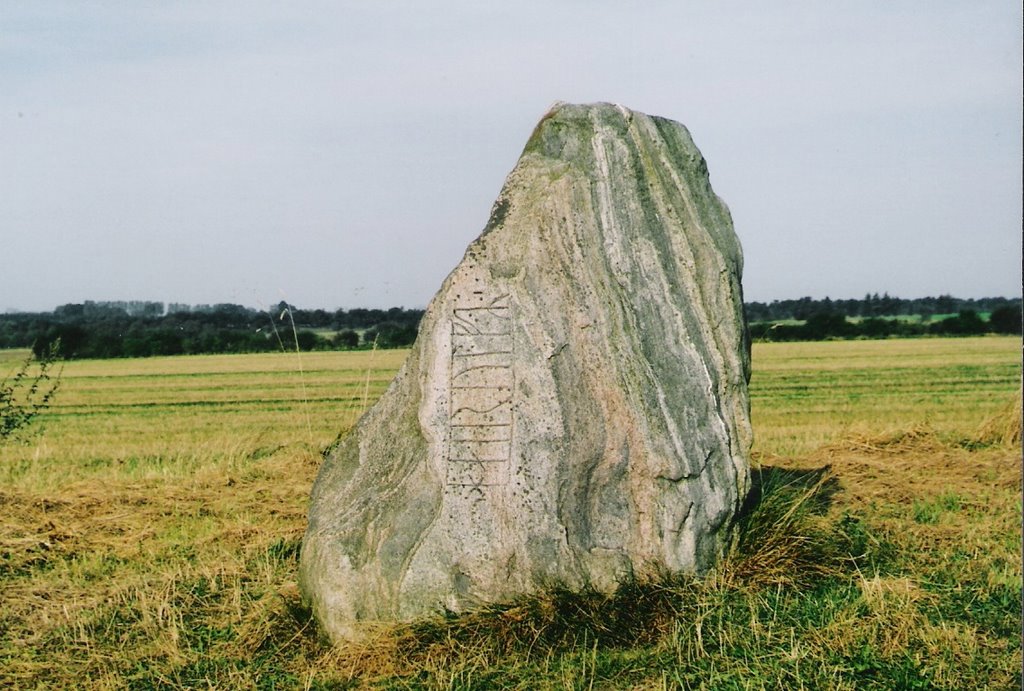
The Hærulf Stone is a rune stone at Hærvejen between Immervad and the village Hovslund. The stone was one of the first known from Denmark's about 200 rune stones from the Viking Period and was mentioned already in 1592. The placement of the Hærulfstone at Hærvejen (the Army Road) both illustrates the historic importance of the road and that the area at the village Hovslund was inhabitated for a very long time. The granite stone can be dated to the years 850-900 (Viking Period); it is ab. 2 m tall and weighs ab. 4 tons. The inscription is only one name "HairulfR" , a man's name, written in runes. The name is Old Norse and known from Norway and Iceland and is supposedly a contraction between "Hær" (Army) and "Ulv" (Wolf), which indicates that the Hærulfstone was raised to honour a great warrior. This is supported by an old legend, saying that Hærulf was an earl of the Vikings here in the area more than 1000 years ago.
The Hærulfstone has travelled far and wide. In 1854 it was listed and made a property of king Frederik 7., who placed it upon a nearby lawn, but already 10 years later, after the Danish defeat in 1864, it was brought to Berlin by the Preussian prince Friedrich Carl, who placed it in the park of his hunting castle "Dreilinden" in Wannsee.

Since the reunion in 1920 were made persistent attempts to get back the stone to Denmark. There were many plans. A man had planned to kidnap the stone, but when the car with the lift and camouflage was ready to start, he became scared and his courage failed. But the stone came back to Hovslund by more diplomatic means. In October 1951 the stone was successfully released to Denmark, among others by the help of Berlin's mayor Ernst Reuter who was born in Åbenrå. In a nice and clean condition it was delivered to Hovslund railway station in a German waggon. The stone was moved to a car, which brought it back to its righful place at Hærvejen between Hovslund and Immervad, where it still stands.

It has earlier been referred to as "The Hovslund Stone" or the "Øster Løgum Stone", but is now only known as The Hærulfstone.
Superstition: About 200 m east of the Hærulf stone is a Bronze Age hill called Strangelshøj. Upon the foot of the hill stands a 2 m tall menhir. According to folklore the stone turns around when it smells newbaked bread."

Immervad Bridge at Hærvejen, South East Jutland

A little info about Hærvejen: Before cars and railroads came to, the main road of Jutland followed along the watershed up through the peninsula. *Hærvejen was at that time small gravel roads and sunken roads. There was not only one road, a network of roads formed, what today is named Hærvejen (Army Road). It was used by tradesmen in oxen carts, drivers with their cattle and pious pilgrims. In troubled times it was the army's natural march road. At Immervad the roads from north, west and east met and continued southwards.

* other names: Oksevejen, Adelsvejen and Pilgrimsvejen.
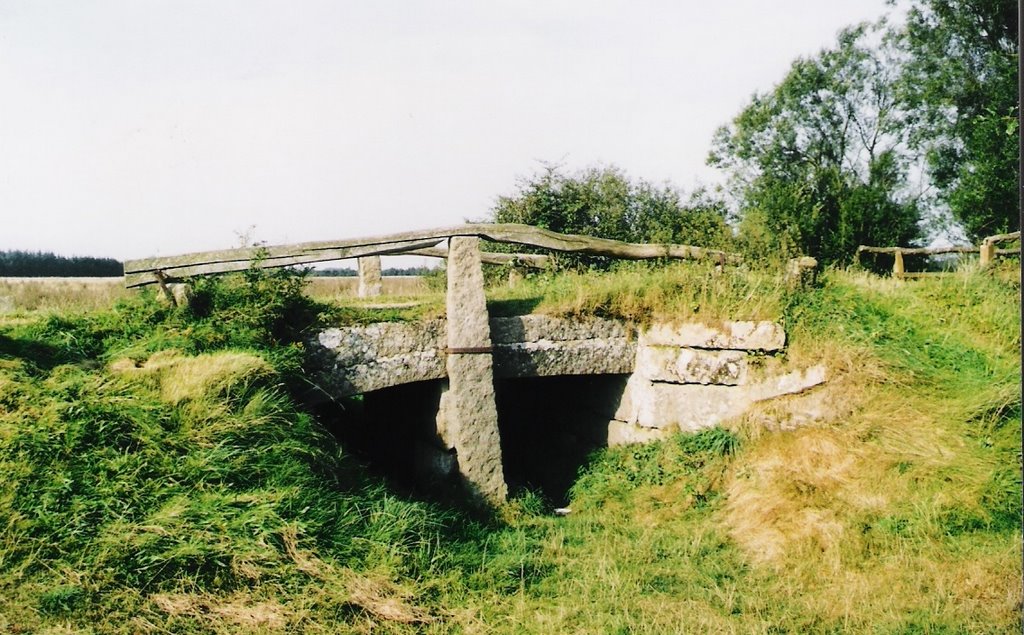
Immervad Bro: A few km north of Hovslund, where Immervad Å-river crosses the Hærvejen (Army Road) lies Immervad Bro. This stone bridge is the most famous bridge of the Army Road. The area Immervad with the bridge is known in history from a battle between king Erik of Pommern and the Holstein grafs in 1422. The battle was said to be so violent that the water in the river was coloured in blood.

In ancient times people had to wade or drive through the water in the lowest part. Later was built a wooden bridge, but in the late 1700s it was so ramschackled that it was dangerous to use it, and it was replaced by a stone bridge. The bridge meant that it was easier for the cattle-drivers to walk their cattle from Denmark to the markets in Hamburg and Rendsburg. On an average day about 700-800 oxen passed the bridge, which was of great advantage to the nearby Immervad Inn.

The stone bridge was built in 1787, and all the stones used were carved from one big granite stone. The bridge was built by a farmer, who together with his neighbour cleaved the long beams out from the stone, which was found at a field near the village Hovslund. It was a difficult work - some of the stone-beams are 3,5-4 m long with 35 cm diameter. It is said that only half of the big granite stone was used in the building the bridge.
Since then the water stream has been led round the old stone bridge. Today it stands as a relic of the past, but it is still a popular resort for locals and tourists.


Spring trickling up from the soil, Mid Jutland.

The Sacred Spring
: Upon a private ground in the hills between Hovlund and Barlund is a sacred spring, which might be one of the explanations, why the area of Hovslund was inhabitated for so long. From far away came sick and palsied to the spring to be healed. The spring was named "The Holy Water" - and still up till 1850 it was visited by many people.
Legend: The correct name is "Helene's kilde", since it gots its name from a princess from Skåne(Sweden),who was famous for her beauty and piety and had a miraculous power of healing by laying on of hands. It was said she was at king Valdemar Sejr's court - and she accompanied the king on his travels and war-expeditions. Once near Hovslund the king was in great pain because of a sprained foot. Helene came up and offered to help. She led him to a place where a spring came up from the ground. She filled a cup with water from the spring three times and poured it over the king's bad foot, while she stroke her hand over the foot mumbling some incomprehensible words. The king's entourage , horsemen, archers, pages, courtiers etc. stood around the place. Helene fell on her knees and prayed the Lord's Prayer (NB: both heathen and Christian customs) The king stood up ,completely well again. The bishop Peter now came to and baptized the spring "Helene's Kilde", and whenever king Valdemar later came to the neighbourhood, he always visited the spring. Sct. Helene's Kilde was through many centuries a very visited shrine like other sacred springs in the country.


photo 2002/2010: grethe bachmann

Monday, October 22, 2007

Bække Church/ Bække Kirke and Klebæk Høje, Hærvejen


South West Jutland in Ribe District

In 1807 a runestone was found in the dike by Bække Church. It dates from 925 and is placed upon a small hill in front of the church. The inscription says that "Tue Ravnsunge and Funden and Gnyble , they made Thyres Hill ". (Thyras Høj).


Klebæk Høje at Hærvejen

The runestone from the 900s is placed in the stem of the stone ship. The text says that 'Revne and Tobbe made these 'kumler' after their mother Vibrog'.


Klebæk Høje are also named "The Bække Monument". They consist of two grave hills from Bronze Age (ab. 3000 years ag9) and a 45 m long stone ship from Viking Age with a rune stone in the stem of the ship. From the beginning were about 60 big stones, but they were removed during the centuries for building purposes. Some small stones have been placed in order to mark the ship .Across a part of the area some wheel tracks from Hærvejen are visible. Hærvejen/The Ochsenroad was established later than the stone ship.

photo 20 october 2007: grethe bachmann

Thursday, December 15, 2005

Sønder Vissing Church, Middle Jutland


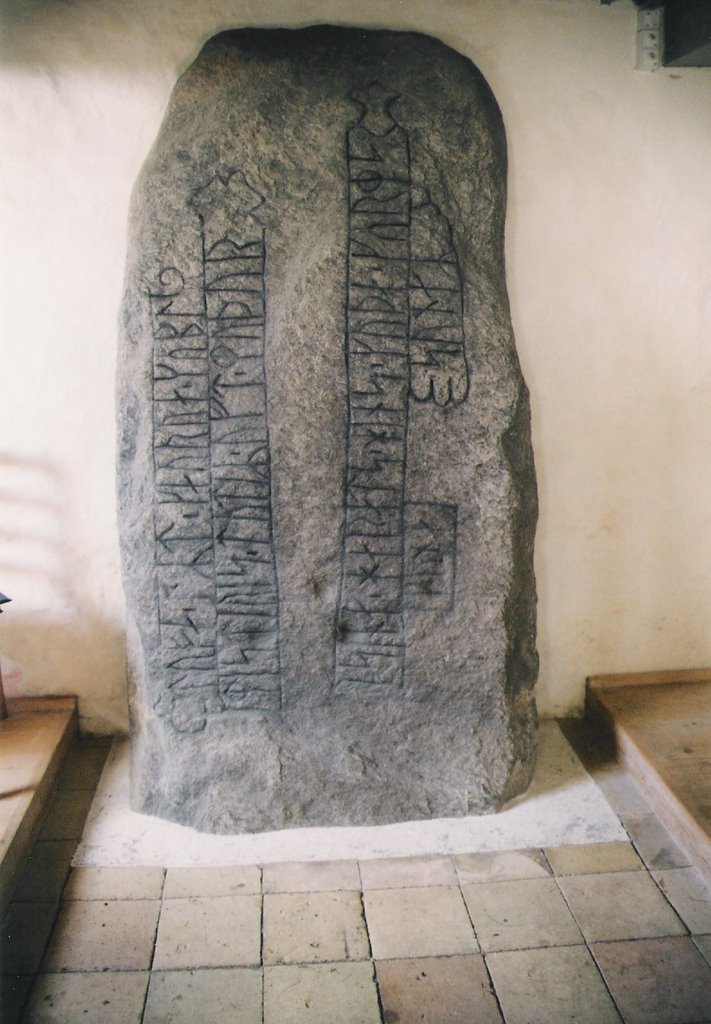
The big runic stone inside the church.
photo:grethe bachmann


The inscription from the second half of the 10th century on the big runic stone inside
the church says:
TOVE,MISTIVES DATTER,
HARALD DEN GODES,
GORMS SØNS KONE,
LOD GØRE DETTE MINDE
EFTER SIN MODER.

Tove, Mistives daughter,
Harald the Goods,
Gorms sons wife,
let do this memory
after her mother.

Gorm and Harald must be Gorm the Old(died ab. 940) and Harald Bluetooth, who reigned
Denmark from ab. 940 to 985. Tove was the daughter of the Obotritterfürst Mistive/Mistivoj.
Sønder Vissing Church, Middle Jutland


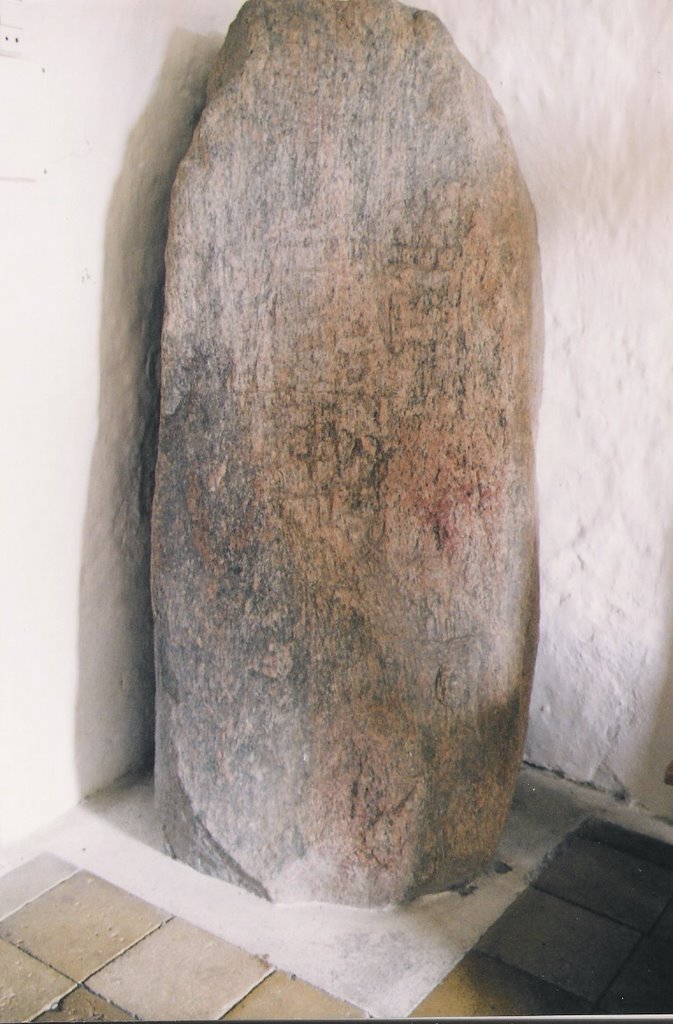
The small runic stone in the porch.
photo:grethe bachmann


The insciption on the small runic stone from the period close to year 1000 says:
TOKE GJORDE DETTE MINDE
EFTER SIN FADER ABE (EBBE)
EN KLOG MAND

Toke did this memory
after his father Abe (Ebbe)
a wise man.