Sunday, October 04, 2015

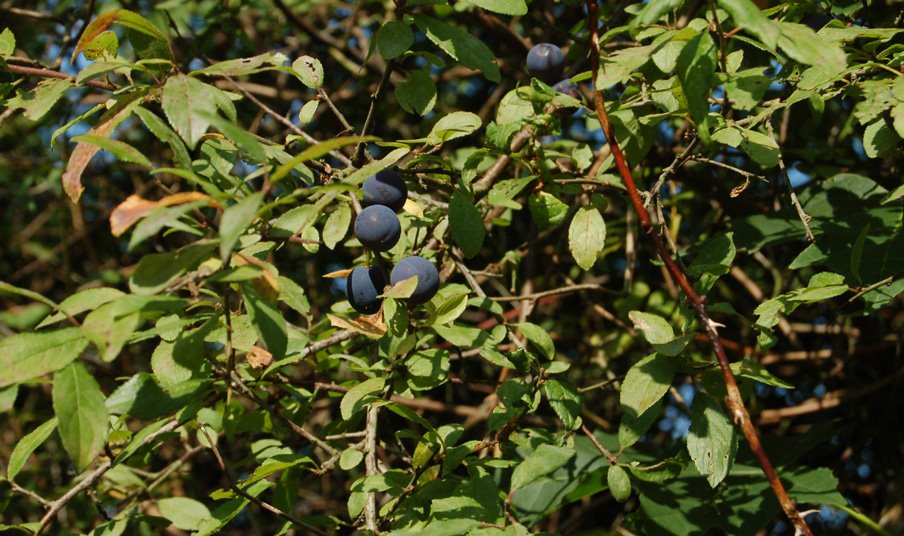
Blackthorn / Slåen


Prunus spinosa

Blackthorn grows at cliffs, embankments along the beach, cleanings on edges of woodland, thicket and fences. It is extensively planted for hedging and a cover for game birds. Some forms are grown for ornament and flowers. The fruit is called sloe, which is similar to a small damson as plum suitable for preserves, but too tart to eat. The berries are best after the first night's frost, but if they are plucked before that period, they can either be pricked by a fork or put in the freezer for a few days. Sloe is used for juice, syrups, jams, jellies, liqueur, wine and snaps.

The foliage is sometimes eaten by larvaes of  Lepidoptera (like the Brown and the Black Hairstreak butterfly). The pocket plum gall is found on the fruit, where it results in an elongated and flattened gall, devoid of a stone.

In the 1700s and 1800s:
It was a common thing in the time after harvest and after the first nigh frost to gather sloe, scold them and eat them. Infusion gave a well-tasting and healthy juice, which people drunk together with porridge instead of milk. The berries cooked with syrup or sugar and fermented on a wooden barrel was popular as a porridge. Sloe-must was made by just pouring cooked water over the berries and let the infusion ferment for 3-4 weeks. Berries crushed with the kernels gave a juice with a spicy taste. After the first night of frost the farmers' wives plucked the sloe-berries in large baskets and made a fine red juice, which was hidden in a barrel until Christmas Evening. The clear light red juice drunk in wine glass and sweetened with sugar was a popular refreshing drink during summer. It tastes a little like red wine, bad red wine was despisingly called "sloe-juice". Beer cooked with the berries makes such a good taste that it is like old red wine. From the flowers were made aqvavit, and the berries were used to clear must. They bring a pleasant taste to beer and a pretty colour, but they can also improve apple-must during the fermentation.

Jam, Cheese and Tea.
The berries preserved with sugar and cinnamon gave jam for a winter salad or a steak sauce, after they had got frost they were put with honey in jars as a jam. In Vendsyssel (North Jutland) were sloe-berries used when preserving pumpkins. If the barch was used when making cheese the cheese wouldn't rotten. The new dried leaves were a good tea, also the dried flowers mixed with strawberry-leaves.


Sloe-Wine and Liqueur

In 1580 the vasal at Kronborg let gather 2-3 barrels of sloe, from which the king's cupbearer made sloe-wine for Frederik II. The wine made by chrushed berries and kernels was very intoxicating and was only served on special occassions. During WWII a wine firm in Odense (at Funen) advertised for sloe-berries. From the fruits are also made a liqueur.
 
Sloe-Gin
In rural Britain a so-called sloe-gin is made from the sloe. It is not a true gin but an infusion of vodka, gin, or neutral spirits with the fruit to produce a liqueur. In Navarre, Spain is a popular liqueur Patxacan made with sloe. Sloe is also excellent for a herbal snaps. From fermented sloes are made wine in Germany and other central European countries. Sloe is also good as jam and if preserved with vinegar, have a similar taste to the Japanese umeboshi.


Folk Medicine:
The juice of sloe was used for stomach pain - and the flowers drawn in warm beer was used for childrens' motions. It was also used to cure tooth-ache, pain in the eyes , blood poisoning, shingles and much more. Physician Christiern Pedersen 1533: crushed leaves and barch used on on shingles. Eyedrops from the pulverized barch in wine. Physician Simon Paulli 1648: berry-juice with beer for stomach problems. Children with constipation had the flowers in warm beer. Vinegar-decoct from the green medium barch was effective against toothache. The flowers in a healing morning drink , destilled water from the flowers for bronchitis, cleaning the body etc. A tea cleansed the blood and was laxative. The barch was used against malaria, the berries gave a healing drink against fevers, and mixed with cherries against diarrhoea. A milk decoct from flowers for a drink or a bath to remove freckles. The fruit juice for sores in the mouth or to rub upon swellings and against nosebleed. In 1772 flowers and fruit were entered into the pharmacopoeia.

Dye:
Unripe berries dye black, the juice of the ripe berries dye pale brown, while the dried berries make wool red. The barch gives with alun a red dye, unripe berries with iron vitriol give a dye like black ink. The unripe berries and the barch were used in tanning.


Other Use:
Blackthorn was recommended for hedges around gardens and fields, in Denmark this is much used especially at Funen. Many loads of cut blackthorn from the hedges were brought home as a fuel for the baking ovens. Before or in the killing season at the farms when sausages were made, the children gathered thorns from sloe, which in the evening were scraped clean , dried upon the oven and eventually burnt in the tips and then used as sausage-sticks; this was a tradition in most parts of the country  (DK) - and the sausage sticks were sold at the market. Boys also used the thorns as arrow-heads. From the wood were made music instruments, it was commonly used in turner-works and for mathematical instruments. From the tough wood were made walking sticks, hammer - and axen handles. During WWII gramophone needles were made from sloe thorns, they gave lesser needle-noise and lesser wear on the records than metal needles.

Blackthorn makes and excellent fire wood that burns slowly with a good heat and little smoke.

Straight blackthorn stems have traditionally been made into walking sticks or clubs (known in Ireland as a shillelagh). In the British Army, blackthorn sticks are carried by commissioned officers of the Royal Irish Regiment; the tradition also occurs in Irish regiments in some Commonwealth countries.

Ink: 
Shlomo yitzhaki, a Talmudist commentator of the High Middle Ages,  writes that the sap (or gum) of P. spinosa (or what he refers to as the prunellier) was used as an ingredient in the making of some inks used for manuscripts.

Fishing: 
A "sloe-thorn worm" used as fishing bait is mentioned in the 15th century work, The Treatyse of Fishing with an Angle, by Juliana Berners.The expression "sloe-eyed" for a person with dark eyes comes from the fruit, and is first attested in A.J.Wilson's novel Vashti.

Making snaps:
Put sloe berries in a glass or bottle with double amount alcohol. Filtration after 2-3 months. There is now a pretty dark red to violet essence, which can be thinned as you like. The berries can be used again together with the crushed stones in a new amount of alcohol to draw for a month or two, which gives a drink with a taste of almond. A sloe snaps gets better and better when stored. It is excellent for herring and cheese. Added honey makes it a snaps for desserts.


text and photo: grethe bachmann

Brown Hairstreak / Guldhale

Thecla betulae


The Brown Hairstreak has a wing span of 33-41 mm. It is easy to recognize by the golden colours of the underside and the marked black/white lines. From the upperside the female is recognizable by the large, orange spot on the front wing. The male can - seen from the upperside - look like the Satyrum-species, but these always keep their wings folded during rest.

The flying period is from first August til mid September and sometimes even later. The flying period starts later than any other Danish butterfly. Brown Hairstreak lives in pastures and light-open thickets and glades with a large growth of blackthorn or cherry plum. It overwinters as egg upon the branches of the fodderplant, and the caterpillar first develops inside the egg in spring. The caterpillar's fodderplant are blackthorn (Prunus spinosus), cherry plum (P. ceracifera) and sometimes plum (P. domestica), wild cherry (P. avium) or other Prunus-species.

The flight of this butterfly is fast and restless, but the species spend much time in the treetops, where they sit in the sun with half spread wings or seek food like honey dew. They also seek to thistle, yarrow, goldenrod, hemp-agrimony, heather or other flowers or to overripe fruit (i.e. fermenting blackberry still on the vines). Females, who need much energy by the oviposition, are seen more often on flowers and fruit than males.

Brown Hairstreak is in some years seen in large numbers, but as a rule it is few in number and difficult to find. It is in decline in the agricultural areas. It is very susceptible to pesticides and is never seen in sprayed areas. It has disappeared from some places on the Danish islands during the 1950s.

Source: Michael Stoltze, Dagsommerfugle i Danmark, 1997.


Black Hairstreak/Slåensommerfugl , Satyrum pruni,  - is a very rare butterfly, today seen in Midwest- England. It might be extinct in Denmark. Not seen since 1987.

White-letter Hairstreak/ Det hvide W/ Satyrum w-album, ccommon in most of Denmark but might be diminish because of the sick elm-trees.  

The Ilex Hairstreak /  Egesommerfugl / Satyrum ilicis, is  close to extinction  in Denmark, only known from one place.

The Purple Hairstreak/ Blåhale  (Neozephyrus quercus) common in Denmark

text and photo: grethe bachmann
photo of Brown Hairstreak, Sletterhage, Helgenæs August 2007: grethe bachmann

Alder Buckthorn / Almindelig Tørst

  Rhamnus frangula


Rhamnus frangula is a bush, rarely a small tree, with a grey brown barch, oval leaves often pretty red in autumn, small whitish flowers which are hard to see, and small stone fruits, which change colour from green to red and black. It is common in light forests, mostly among oak and alder. The whole plant is poisonous. The bush can transfer kronrust, i.e. plant rust to oats. It has often been confused with bird cherry and alder.


Alder Buckthorn is also known as Arrowwood , Berry-bearing Alder, Black Alder, Black Aldertree, Black dogwood, Buckthorn , Glossy buckthorn. In spite of its name it has no thorns. It grows mostly on damp and peaty soil, near bogs, in marshes, damp moorland and open woodland. It may form part of the shrub layer in the Alderwoods of the fens and in open woodland. It is native of Europe, Central West Asia and North Africa.


NB: Barch and berries are poisonous to humans

Gunpowder
The buckthorn was of major military importance in the 15th-19th century as its wood provided the best quality charcoal for gunpowder manufacture. Both alder buckthorn and common buckthorn (Rhamnus cathartica) were used in fabrication of gunpowder, especially powder for hunting.

The long twigs were traditionally used to make arrows as well as butchers spikes and skewers. The coppiced branches have also been used for walking sticks as well as pea and bean sticks. Along with willow and split alder they have also found use for cane seating and basket work.


Dyeing:

The inner barch dye yellow like saffron, the berries are used for dyeing green in 1686, the barch dyes the wool yellow, the berries dye green, dried barch softened in beech ash lye gives the wool a madder-red colour, green berries make the wool yellow, ripe berries dye greyish, with salpeter blue, with vinegar violet and with bismuth green; if bricks were burnt together with the wood they grow bluish. The barch gives a bronze yellow dye, which after a handling with potash turns into a brick red.

Folk Medicine:
In the Middle Ages a juice was made which could drive out all kinds of bad fluids as well as all other filthiness from the bowels, but since the barch has a very drastic effect (  poisonous) the juice had to be added caraway, anise, cardamom or cinnamon. Juice from the inner yellow barch had a strong laxative effect; the barch cooked with butter or crushed with apples was put on scabies; tea from the innerbarch was used against rash, jaundice and ague(malaria).

The barch was stated in Dansk Farmakopé in 1772, the fresh barch and the fruits were used as an emetic, the dried 'frangulabark' was matured at least one year and was a part of mildly laxative medicines, added malt beer, liqueurs and other dietic drinks.

 NB: The barch and fruit were used as a purgative in the past, though their potentially dangerous violent action and side effects means they are now rarely used.


Bees and butterflies
The flowers are popular with bees and the plant is food plant for the brimstone butterfly.


Other Use: 
The berries were in 1775 mentioned as a means against some horse diseases. The leaves were said to be a good fodder for goats, and if the cows did eat them they gave much milk.(although it is also said that the cattle do not like to eat them because of the thorns). The smell of branches stuck into mole-passages drove away the vermins. The wood was used for inlaid works and shoemaker-pegs, the branches gave a good grip around beer jugs etc. In Vendsyssel (North Jutland) the branches were bound around vessels, and baskets were plaited from the split branches etc. The branches were baked in front of the oven to soften them and then straighten them out into walking sticks. Charcoal from this wood was the best for hunting powder, in 1895 a forest cultivation was recommended for this - from Mårum Skovdistrikt were sold logs and branches for the army's powder work in Frederiksværk.


Text and photo: grethe bachmann
Source: Folk og flora, Dansk Etnobotanik 3, V.J. Brøndegaard 1979.


Common Brimstone / Citronsommerfugl

Gonepteryx rhamni


The Common Brimstone has a wing span of 54-64 cm. When it is resting both sexes are easily recognizable because of the wing shape. During flight the male is easy to know because of the lemon yellow colour, while the female reminds about a Large White butterfly.


The middle spots varie a little in size and colour, but else are almost no variations. Flying time is July-October and again after overwintering in March-June. It is one of the earliest butterflies of the year. Usually it shows in the first sunny days, when the temperature is above 10 degrees (Celsius). It can live almost one year as an adult butterfly.


The brimstone overwinters as adult butterfly among branches and leaves. The fodderplants are alder buckthorn and common buckthorn. Its habitat is forest and thicket with alder buckthorn and common buckthorn  The brimstone is roaming and is often seen in open flowerrich terrain, like in lucerne fields, where the species seek nectare before overwintering.


The brimstone is very "seeking" to flowers, both spring and autumn. In late summer it seeks especially the Asteraceae-family,  like cabbage-thistle and other thistles -  and to red clover and lucerne, or to the buddleias in the gardens.The species is seen on the first sunny days of the year where the temperature reaches 8-10 degrees Celsius. It flies unsteady and low, and in early spring it is often sitting upon sunny spots in the forest floor to get some warmth.


Frequency and spread:
Common Brimstone lives in Europe, North Africa and Asia; across much of its range it is the only species of its genus and is therefore simply known ad "The Brimstone"

The brimstone is very common in Denmark, especially in and around moist thicket-woods. It is rather scarce in West Jutland. The frequency varies from year to year, and the species might roam far and wide and reach even small islands with no permanent living conditions.

Source: Michael Stoltze. Dagsommerfugle i Danmark, 1998.
text and photo: grethe bachmann 


Elder / Hyld

Sambucus nigra


Elder or elderberry is native to most of Europe, northwest Africa and southwest Asia. It is commonly named elder or elderberry, but has got many other names like Black elder, European elder/elderberry, Elder Bush etc. The Latin Sambucus is a Greek word for instrument, and nigra means black in Latin, black like the elder berries. It grows in a variety of conditions , it stands shadow, frost, salt and wind well. The leaves and the bark contain bitter substances, but not as much as the related red-berried elder. The whole elder bush except the flowers and the berries is poisonous.

The plant was possibly introduced to Denmark in prehistoric time. It is common all over the country, but grows especially at houses, in fences, edge of woods, as underwood etc. It has been in Denmark since Ertebøllekulturen, a Stone Age culture between 5000-3000 B.C.. About 300 years ago the elder grew in big numbers all over the Danish country, especially in villages, upon church yards, at fences, in cabbage gardens and in hop gardens etc.The ripe berries are very sought after by birds, and today the elder has spread by the help of birds up to the northern part of Sweden and in Norway up to the Polar circle.
.


Elderberry is an old medicinal plant. Also prehistoric people, the Egypts, the Greeks, the Romans used the elder as a medicinal plant. Dekokt from the flowers was supposed to be antipyretic and diaforetic, and the berries were used to relieve cold and flue. The leaves, flowers, branches, roots, bark, berries were used to heal many diseases like earache, headache, deafness, boils, indigestions, heart pain etc.


But also in the kitchen is elderberry good. The flowers are used in the popular elderberry-drink, and they taste well when dipped in a thin pastry, fried and sprinkled with sugar. The berries are used in juice and soups. They have a very high content of A- and C vitamin. Several things: tea from the dried flowers; wine and snaps of berries and flowers; put the berries in sugar and eat them like red-currants; the green berries in vinegar and sugar make fine capers. The flowers have also been used in perfume.


Mosquitoes.
If you rub elder-leaves against your skin it is said to keep mosquitos away, or if you carry a fresh branch or stand under an elder-bush! The berries should have the same effect, and you can use them as an insect repellant, if you like the colour purple!

The Garden:
Some gardeners use a strong elder extract as a means against plant diseases. It is considered effective especially against fungal diseases in fruit trees and  against aphids. It is also good as an addition in the compost heap and active  against caterpillars in seed plants. 


Poisonous substance:
All kinds of Sambucus contain a poisonous substance:Samburigin (cyanoglykocid) in leaves and in the unripe fruits. The druehyld is the most poisonous but its poisonous effect is limited to stomachache. In the past the sambucus was used  as a vomiting means . The seeds in all sambucus contain  a resin which gives dizziness and is diuretic , but the resin is destroyed by cooking.


The elder was called the Poor Man's Tree, the elder had no homestead - and yet it belonged everywhere.

Below material from V.J.Brøndegaards Danish work "Folk og Flora" bd. 4

Use of elder branches, wood, marrow:
The elder was the favourite tree of all foresters, it was used as hedgerows around the new-planted woods. In Jutland, especially in West Jutland elder was planted as hedgerows in the fields and around the dunghill in order to give shadow, so the sun did not dry out the power of the manure.
Branches were used for wicket sticks and for fuel. The wood was used to make spoons, shoe plugs pipe tubes, truncheons, spinning wheels, reels, looms, yarn reels, rules, meter rules, handles, fishing needles, and young shots were used for enemas. In Svendborg (Funen) was found a spoon from the 1200-1300s, made of elder wood.The wood gave good charcoal and from the ashes was made potash.
Furniture made of elder wood  did not get worm-eaten
People used a "blowing pipe", (made from a stick where the marrow was removed) to blow the fire in the morning on the embers in the fireplace.
The fodder for the bees was placed in an out-marrowed elder stick. Upon the island Agersø people smoked herring with green leaves of elder or ash. The marrow was also used for polishing optic lenses and for electrical experiments.

Use of elder berry, leaves, flowers:
The juice was commonly used, and no farmer's wife or house wife did not know how to cook the berries or have som house depot in case of need.
People went out in the countryside with baskets, gathering berries for sale, they were sold in shops and on market places for the juice making. (1875)  Upon Copenhagen's marketplace was in 1967 sold 160.380 kilo elderberries
From the berries was also made a snaps (1890).In july 1603 the Danish queen was delivered elder flowers, strawberries and red roses for having made akvavite.
Juice and sugar in snaps gave a  "redwine-toddy". Elder tea was made from dried flowers. Old people drank each night a cup of elder tea in order to keep themselves healthy. The tea was sweetened with syrup. It might be spiced with cinnamon, mint or yarrow. In winter season elder tea was often used instead of coffee (1880-90). The coffee was sweetened with elderberry syrup.
The flowers gave a spiced elder vine. Apples and pears get a taste like muscatelwine if they for some time have been placed among elder flowers.The fruits gave an elder wine and the seeds an oil (ab. 1800).
Elder-puré = cooked juice + honey on bread instead of butter (1809) . The berries were dried in the oven or in the sun and saved for elderberry soup. Young green leaves were used in cabbage soup and omelet (1920) Dried or sugar-cooked elderberries = currants. Green pickled berries were used as  capers. The flowers were baked in the panncakes.


Playthings:
Elder-guns: the marrow was removed or being burnt out with a thin iron stick so a piece of a branch made a pipe Small bullets made of paper, yarn, potatopieces, or marrow were pressed down with a loading-stick into the pipe in the opening.
Some boys made very long elder guns. A farmer at the island Fanø paid a boy 4 skilling to shoot against the priest while he was preaching in the church, but the boy hit the dove in the sounding board above his head instead.

Folk Medicine
Henrik Harpestræng ab. 1300: Elder gives vomit. Cooked leaves or oil from elder heal mange and blisters - open and clean wounds, ease earache.
1400s: bark and berries crushed with vinegar used as a cover for head pain, the juice from the seeds to drip in the ear against deafness and earache. Beer decoct from bark against constipation, the juice from the root against dropsy. 
Christian Pedersen 1533: destilled flower-water was a part of an advice against headache,  flowers or leaves cooked in beer for spleen disease, 
Henrik Smid 1546 the cooked berry juice was a good antidote and was used against inner swellings  and all poisonous fluids which came with the sweat. 
Simon Paulli 1648:  linen with destilled elder-water or a decoct of a red cow's milch to put upon the skin disease erysipelas (red skin). 

The elder bark, buds, flowers and berries were specified in the Pharmacopoeia  in 1772, the berries up till 1948.

The elder syrup was one of the farmers most popular universal means (except snaps) ( 1770).
Elder puré cooked with berry juice + honey works sudorific, dissolving, laxative etc.
No farmer must forget to have this medicin, which he can easily make himself. (1800)
Where someone has an elder and a beehive in the garden the doctor need not to come.
The elder was like a home pharmacy to the farmer.

The physician Th Bartolin 1616-80 adviced the pesasants to drink a decoct from  young elder leaves against dropsy..
The peasants drank ( 1798) the juice from the fresh root.
Oil mixed with elder in wine was used against fatigue.
Elder flowers were a part of a means against blatterstone (1720).
The bark eased all stomach ulcers.
Smoke from henbane-seeds was lead through an elder-stick to the bad tooth.
A spice-bag with dried elder flowers upon the cheek. 
Cure against malaria:
Elder tea with camphor drops..
The patient had to eat the first elder spring-shots of the year.
Tea from the flowers counteracts fever attacks.(1800)
Elder tea with egg yolk is a good sweating cure against fever diseases. 
Various diseases:
Elder tea with honey eases cough and pain in the breast.
People bathed running eyes with a milch decoct from the flowers.
Poultice against haemorroids ,  flowers soaked in vinegar against thick knees.
A balm of fresh flowers mixed in lard or vaseline bound upon scalding or burns (ab. 1800) - or upon chronic wounds. It was a good cure to bath pimples with elder-flower water added rum or brandy.
Tea from elder flowers mixed with lard was a fine beauty means in 1900.
Green elder leaves against swellings, abscesses, felon, (the upperside of the leaves draws out the inflammation, the underside heals the wound.) 
Adderbite:  bind elder leaves and mustard upon the bite.
A balm of the green middle bark cooked or fried with thick cream and rubbed or put upon open wounds or impetigo, throat-abscesses and excema on children's head, on their felon and ringworm
Smear oatmeal and goose-shit upon swelling after forgiftning. and with swine-lard upon bone-infection. A wise man blew through an elder stick upon ringworm


Livestock
Elder leaves were used against the horse-jaundice and elder tea against horse-hives. Elder syrup was used against cattle plague (1745) . A good cure was to bath the cow's teeth, mouth and tongue with tea of elder and camomile flower and sage, added honey and saltpeter (1750). Elder + butter healed wounds and fissures on the cow's udder.
Berry juice was the ingredience in a cake for sheep's cough (1632) . Dried and crushed berries with salt against the sheep's liver fluke and tea of elder leaves for lamb with tetanus.
Chicken could get sick by eating the green berries.

Vermits 
In most parts of Denmark people put the new leaves and/or the debarked branches down in the passages of the moles. The moles would flee because they didn't like the smell. (1800)
In harvest-time the farmer put a green elder branch on each corner of the barn in order to keep mice and rats away from the corn.
The crickets could not survive in a room  warmed up by elder wood (1761) - and the smoke from fresh leaves and branches upon a brazier drove them out. .
People put elder leaves in their  button-holes to keep away the mosquitoes. Concentrated elderwater was recommended for rubbing the skin against mosquitoes (1907).
Elder branches put by the entrance of the house drove away flies from house and stable. Leaves were spread upon the floor against bedbugs and put into the bed as a protection against pests. 
Elder juice mixed with lard = a balm which protected the horse against insects. The top of the branches were the part of a decoct which was used to bath the cattle against flies.
The elder was a popular bush by the living house because it kept away moths . Little bags with dried flowers put among the clothes could drive away moths. (1880)

Desinfection
Barrels and vessels which smelled moldy had to be rubbed with a handfull of fresh-plucked leaves from elder or blackcurrants. (1880)
If the milch in the summer-time got a bluestained surface the vessel had to be rubbed inside with green elder leaves.

Dyeing
Elder branches and leaves give a green/brown colour,especially for saddles. The bark dyes bismuth-treated wool bluegrey, the linen stained with alum and cooked with the berries and verdigris gets yellowbrown. The berry juice makes paper purple and snaps reddish or bloodred.

Omens

If an elder grows up by the house it means good luck.
If an elder is blooming twice in a year or in winter it is an omen that a death will happen in the owner's family
When the elder berries are ripening the chicken begin to drop their feathers.
If the elderflowers send out an extraordinary strong scent it  will be rain or thunder.
When the cat tears the elder tree it will be rain. 

Prophecies.
There are many alike prophecies about the elder.tree growing by a church. When it is so big that it is possible to bind a horse by the tree a king will arrrive upon a white horse. He will bind the horse by the elder tree and go into the church. Or:  Two kings will meet and bind their horses by the elder tree. They have come to  negotiate about peace.
King Magnus and his men are sleeping under the elder tree but if Denmark is in need they will wake up and come to rescue the country.

Legends and myths.
The elder is often gnarled and crippled. It was said that Judas Iscariot hang himself in the elder tree. Upon the elder grows the fungus Jew's ear (In Denmark called Judasøre)
An elder with branches like human fingers like the fingers of a murderer grew up from the grave of a  a murdered shepherdess in a village south of the town Tønder (Jutland).The tree was removed in 1930. An elder upon Helnæs (Funen) could not be removed. It grew up again. According to a legend a child was killed and buried here.There was supposedly a treasure under an elder by the village Tanderup (island Samsoe). People had seen light there in the night. East of the island Omø people can see a green elder on the bottom of the sea in clear weather.


Superstition:
A Jutland saying: "No man can live where the elder cannot grow."
It was a common belief that an elder must not be removed or destroyed. Then bad luck would really hit the family, but they could bring the bad luck to and end by wetting the stub with milch. This was done even as late as 1924 in a village at Zealand.
If  a man removed an elder without first having said a prayer he would have bad luck with his domestic animals. It was considered  a neccesity that an elder bush grew upon each giant grave hill. No one can say why but this rule was followed in many places all over the country. It was dangerous to remove it from the hill. After having removed an elder tree upon a giant grave hill in a village on Funen and brought it home as fuel, the owner's farm was harrassed by ghosts and his cattle died . So he brought the elder root back to the hill and planted it.
In a farm in North Jutland the chicken were bewitched and could not lay eggs. A wise man let cut two elder sticks which he marked in a certain way and placed as a cross under the roof of the hen house - This helped.
The farmer planted the elder outside the stable door and hoped thereby  to prevent the witches to reign inside.

Sickness placed inside the elder.
It was considered possible to place a sickness inside the tree by the help of a nail.. A wise man put in this way  the sickness of a boy (rakitis) into the elder tree. Still in 1885 were used warnings against coming close to a lonely placed elder tree, which might have been implanted with sickness.
"He who draws out the nail gets the disease". said people. This was still a belief in 1937 ( Schleswig).
Children who were playing near the elder were warned not to remove plugs from the tree.
A wise man from Funen  made a cut in a branch for each wort of a patient and rubbed blood from the patient into the cuts  In this way the man got rid of 37 worts.
People had to take care not to come close or damage certain elder trees since they risced to get the sickness which had been put into them. It was also dangerous just to urinate on the tree.
A wise woman in the village Asminderød lead the patient through an opening made of together-bound elder branches.

Gout
An advice from the superstition section: "Thursday evening after sunset, cut nail-pieces from hands and feet, rub them in a cloth from the patient's shirt and put them in a quill pen , which is stuck the same evening in a one year elder shot ,which is stuck into the earth where three field-borders meet, while saying the words: "Now my gout is buried and dead like God's son was buried without pain - (he crosses himself three times) - Amen!" This is a story from the town Kolding, Jutland.
A child with rakitis must stand in a digged hole under an elder while a wise woman treats him,  some of the out-digged soil is poured over his head. (Bakkebølle,Zealand).Or the child's clothes were put into the hole and milch from a darkred cow. poured over it. Next morning the child had to put on the clothes.

Toothache
An often mentioned advice against toothache was to cut the tooth into blood with a splint of elder and put the splint back under the bark. If the bark and the wood grew together the toothache would disappear, but it all had to happen in secrecy.
An elder in a wise wife's garden was still in the garden long after her death. No one dared to remove it in fear of getting a toothache or some other disease

Malaria:
Bark of elder and 8 other trees put on snaps, which is being hid under the elder-roots - but also been drunk.

The Elder people 
In the old days people believed that hyldefolk (the elder-people) lived at the foot of the elder bush. They called out for people in moonlit summer nights, and if you went to sleep under the elder, you would be "elder-shot", spellbound and mad. People also thought that the strong aroma of the elder could scare away trolls and other evil creatures. It was said that the goddess Freja lived in the elderberry bush; she protected people from evil, therefore it was necessary to care take care of the elder bush; if you cut down the elder outside your house without planting a new one, then all kinds of misfortune would hit you
People might get sick by felling an old elder which might grow upon the home of the underearth people (1798)
As far as the shadows of the elder reach is the home of the unearthly.
There were seen small pixies under an elder tree at Femø island  in 1860. The elder wife lived in giant hills or under the elder trees.The elder people spread sand and swept nicely around the elder tree in the garden by Ørslevkloster in North Jutland.
By an old elder the horses became frightened in the evening. In this place the Black Wife was seen.
People had great respect for an elder bush by a house near Roskilde: Strange sounds were heard from it and two creatures were seen nearby.
A sorcerer said: As long as the elder gives shadow to the bedchamber window there will not be born disfigured children in the house.
It was said that one could learn to do magic under an elder tree.


Elder Mother /Hyldemor
                                                                               In a German story from 1691 about heathen religion a priest from Åbenrå(Jutland)  told that he in his younger days (ab. 1670) often had seen people kneel and bare their heads and say a prayer with folded hands by the elder tree. They wanted to be allowed to fell "Madame Elder" and said: "Give me some of your wood, then I shall give you some of it back when it grows in the forest".
This precaution is known from many later records: People must not make furniture or tools from the elder,  the elder was Elder Mother's property. Before it was removed they had to promise to plant a new elder, and what had not been used from the elder had to be digged down under the new elder in order to reconcile it.
Below an elder people could be hit by the elder people ("elder shot", 1700) People said: " He has been under an elder" = he was mad or intoxicated. .
The peasants dared not cut the elder until they had asked for permission and then they spit three times as if they would drive away the evil trolls (1772).
In warm moonlit nights the spirit of the elder people cries on people and they must not answer for then the spirit would get power over them.
In 1757 it was told that people planted elder everywhere. This was a kind of heathen ancient rest of a religion. The almue worshipped the goddess Hikti (still in 1819). The Elder Mother is mentioned, she took revenge of all damage. It was told about a man who suddenly died that he had felled an elder. This was still a talk among people in Nyboder ( Copenhagen) in 1940.


In Denmark elder is named hyld, and the goddess Freja was later known as hyldemor.
H.C. Andersen wrote a lovely fairy tale "Hyldemor": (The Elder Tree Mother)


Summer Elder (Sambucus ebulus)
A young speciman of the common elder must not be mistaken for the close related summer elder which differs by having heavy, cringing rootstocks and almost white or light reddish flowers. Summer elder is also an old medicinal plant with healing qualities, but it requires accurate dosing in order to avoid poisonings. It is therefore not recommended for use.


text and photo: grethe bachmann


Red Elderberry / Druehyld


Sambucus racemosa


Red Elderberry is native to Europe, the Middle East and Asia. The whole plant is poisonous to people, also the tempting red berries. Other common names for Red Elderberry are Scarlet Elder, Mountain Elder, Stinking Elder, Bore Tree etc.

The name Sambucus is from Greek sambuca = a stringed instrument supposed to have been made from elder wood, and racemosa comes from the Latin racemus, the stalk of or a cluster of a bunch of grapes "with racemes". The flowers are greenish-white,the berries bright red and round, the marrow is brown in contrast to common elder which has white marrow.

The plant provides valuable nesting and perching habitat for birds - and the berries provide food for many species of birds - in Denmark especially blackbird, thrush and songbirds. The berries are also food for deer, squirrels, foxes and mice.

The wood is hard and has been used for combs, spindles, pegs, pipestems, flutes, toy whistles. Medical use has been made of all parts. Dyes can be made from the bark, fruit and stems, and an insecticide from the dried leaves.

Red Elderberry is useful in stabilizing soil and controlling erosion on moist sites.


Poisonous substance:
All kinds of Sambucus contain a poisonous substance:Samburigin (cyanoglykocid) in leaves and in the unripe fruits. The druehyld is the most poisonous but its poisonous effect is limited to stomachache. In the past the sambucus was used  as a vomiting means . The seeds in all sambucus contain  a resin which gives dizziness and is diuretic , but the resin is destroyed by cooking. ( see wikipedia for more information)


text and photo : grethe bachmann

Marsh Fritillary / Hedepletvinge


Euphydryas aurinia

Characteristics:  Wing span  33 - 42 mm.  In freshly hatched condition the species are easy to recognize on the narrow wings and the variegated drawings in black, yellowish and orange brown. The colours vary much and in between the basic colour is uniform orange brown. The male can be very small with a wing span of 30 mm                                                                          

Behavior:
The flight is low, changing from whirring to hovering . Both sexes eagerly seek to flowers and are seen on fx Marsh-thistle, Common ragwort or Arnica.

Flight period:  The flight period is short and  rarely stretching over more than three weeks in the individual years. The safest period is 1-2 weeks in June, but the flight time may start late May in warm years stretching into July in cool years.

Habitat: The habitats are difficult to characterize. They are often border areas between moist and dry areas in nutrient-poor soil, like in the edge of heaths or bogs and in low places between the inner dunes and the heaths behind them.

The larvae: The larvae overwinters together with halfgrown larvaes in close webs upon the fodder plant Devil's bit Scabious (Succia pratensis)

Frequency and Spread:  earlier spread in local populations in big parts of Denmark but has collapsed since the late 19th century. Disappeared from Zealand in the 1920s and from most of Jutland in the period 1950-1990. Since 1990 only known from about 20 small localities in North Jutland.


Protection of the species:  the species endures no types of fertilization of their habitats. Disturbances like grazing are necessary - eventually with intervals of several years and never at the same time in the localities. It is necessary to examine how the species react in the rest of the habitats. PROTECTED.


Source: Michael Stoltze "Dagsommerfugle i Danmark", 1997

Photo juni 2010 Nordjylland: stig bachmann nielsen Naturplan Foto

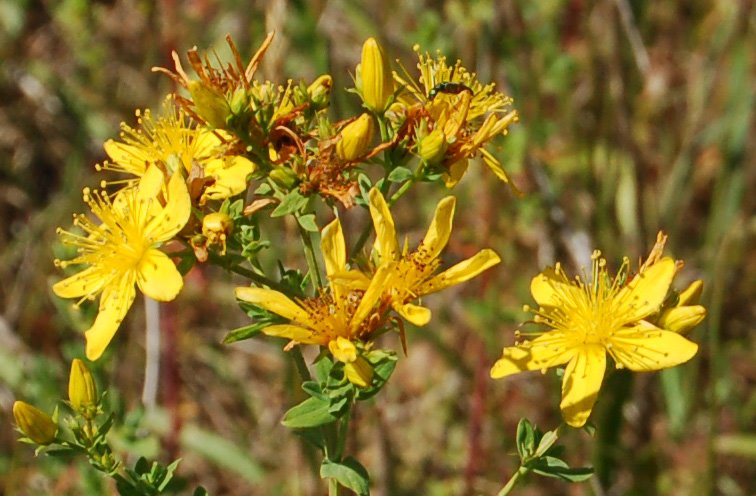
Sct. John's Wort /Perikon


Hypericum perforatum


The lovely yellow St. John's wort is flowering in the summer fields now among white, blue, pink and other yellow flowering plants. It's got many different names, Man's Blood, Man's Power, Christ's Blooddrop, Sharon's Rose, Aron's Beard, Devil's Escape ( Fuga daemonum), Earth Hop, Lady's Herb and Snaps Herb.

Hypericum Snaps (Perikon snaps)The flower buds are the base for the famous Hypericum snaps. The fresh unopened flower buds without leaves are the best. Cover them with some neutral alcohol and let the snaps draw for a few days before filtering. The finished extract is dark red, like the colour of a precious ruby, and it has a wonderful taste, (when thinned of course)! It can be stored, and the red colour changes into brown along the way, but the taste is still fine. Dried or freezed flower buds are also okay for making a good snaps. There are many ways to mix and draw herbs in alcohol: an ancient recipe from folklore shows that people mixed fresh ginger with St. John's flowers in their snaps.


Folk Medicine: 
St. John's wort is a classical medicinal plant. In ancient times herbalists wrote about its use as a sedative and a treatment for malaria as well as a balm for wounds, bums and insect bites. The strong red colour inside the plant was considered to be blood-cleansing and being able to heal inside wounds like in the kidneys. Exterior damages like rheumatism were cured with tinctures, plasters, ointments and oils.

There is some scientific evidence that St. John's wort is useful for treating mild depressions. Today St. John's wort is used in alternative medicine as a means against mild depressions, but since it is known to cause photo-sensitivity it is advisable to take care. For exterior use St. John's wort is stimulating and healing for the skin. A St. John's wort oil on the base of flowers and sesame seeds is softening and make the skind supple.
NB: Every alternative medicinal use of any herb needs caution.

Legend and Superstition.There were many stories attached to St. John's wort. According to legend the plant grew up, where the blood hit the ground from John the Baptist's decapitated head, but the common name comes from the fact that it traditionally flowers by and is harvested on St. John's day, 24. June. Actually it flowers all summer.
The Devil had a role too in the legend. He was terribly irritated over this herb, because it created such great medicinal cures for the human beings - and he tried to destroy the plant by pricking holes in it with his pitchfork, but he didn't succeed in killing it. Both the Devil and all kinds of evil spirits were dominating in society then. People thought that insanity were evil demons helding the body captured, and they tried to drive them out with St. John's wort, from this the name 'The Devil's Escape.' On Midsummer's Night people burnt St. John's wort in order to drive away evil spirits from the family place.
Healing could be achieved with St. John's wort. People had to dig it up or pluck the flowers on Midsummer's Night, (St. John's Night) and if they wore the herb, then they became invulnerable. Even soldiers were assisted. If a soldier smeared his flintlock inside with the plant juice he would never miss the target.
By the ancient Norse St. John's wort was dedicated to the God Balder, and people were sure that it had magical powers and aroused a mad desire of love. The herb was also said to cure impotence and from this came the name 'Man's Power'. One of the other names 'Earth Hop' indicates that it was used as a spice in beer brewing.

Plant-dyeing : yellow and green shades can be extracted from St. John's wort

photo grethe bachmann

Monday, September 21, 2015

The Danish Coastline is in danger.


The Danish Folketing (Parliament)  allowed at the turn of the year via 10 pilot projects to build at the coast of the country - inside our 300 meter broad protection beach-line. The Venstre-party at once suggested to remove the loft of project-numbers and to loosen the beach-protection in general. Since the month of May 100.000 Danes have said not to loosen the rules for our beach-protection by signing a petition.
 
Denmark's coastline is something special for us. We've got no mountains, we've got our coasts. We can walk along the beach all over the country, no one can forbid us that -  and since the coastline is 300 meters free it appears as a beautiful place to be all year. For all of us. I myself would be very sorry if some hotel or industry suddenly filled the place by the beach. And if first they are allowed and begin to build then it will be impossible to control . Then our precious coastline will be destroyed forever for us and for those who come after us. Shame on us.

Our politicians must take responsibility in this case. It should not be a choice between outsourcing to a commumity or to preserve our common nature.


Keep your hands off our coasts! 


Grethe Bachmann
photo Kaløvig: grethe bachmann