Showing posts with label history. Show all posts

Sunday, May 02, 2021

PARSLEY /PERSILLE


Are you going to Scarborough Fair?
Parsley, sage, rosemary, and thyme
Remember me to one who lives there
She once was a true love of mine


Spice Herb


Petroselinum crispum


Parsley Petroselinum crispum is a species of Petroselinum in the family Apiaceae, native to the central Mediterranean region and naturalized elsewhere in Europe - it is widely cultivated as a herb, a spice and a vegetable. The Latin name Petroselinum means "that which grows upon a cliff". Parsley was in ancient time shipped from Egypt to Greece and brought on to the Romans who brought it with them to Middle Europe. Today it is cultivated all over the world. Two main groups of parsley used as herbs are curly leaf and the Italian flat leaf group (Petroselinum crispum neapolitanum). The flat leaf group more closely resembles the natural wild species. 


In Denmark parsley is not a part of our wild flora but it is often seen feral from cultivating. Parsley is the spice herb most commonly used in Scandinavia.

The fresh look of the plant means that it can be cultivated among the flowers in the garden and it is a fine border plant in the kitchen garden. The ancient Greek gardens were often framed with a border of parsley. Flat-leaved parsley is preferred by some gardeners as it is easier to cultivate, it is more tolerant of both rain and sunshine and has a stronger flavor, while curley leaf parsley is preferred by others because of its more decorative appearance in garnishing. A third type, sometimes grown in southern Italy, has thick leaf stems resembling celery.

Devil, Fanefjord, Møn /GB
Parsley is biennial, the second year arrive lots of umbels with yellowgreen flowers and with the characteristic two-piece fruits. After the blooming season the leaves have a bitter taste. Parsley is easy to cultivate but it takes 7-8 weeks before you see a hint of something above ground. In the old days it was said that it took such a long time because the little seeds had to go seven times to and from the devil to ask permission to get up. Each tour took one week. But when Christianity arrived all the poor  little seeds had to go seven times to and from the pope before they could get up through the soil.


The seeds can be sowed directly in the earth or in pots in spring. Some give the advice to put the seeds in lukewarm water for 24 hours before sowing.  The seeds have a bitter taste and are not suited for food. Parsley does not require the big care, but the rows with the new plants must be kept free of weed and the earth must be loose  If the parsley stands in a very sunny spot it is necessary to  water them regularly. Parsley should never be cultivated in the same place two years in a row.
 
You can start to pluck the leaves as soon as the plant has achieved a fair size. If the plants get enough water they will grow well. Parsley tolerates low temperatures well and you will be able to pluck fresh parsley until Christmas. The plant can overwinter but likes to be covered with sprigs of spruce in the cold period, then you'll have the old plant to pluck in early spring until it blooms and withers, while the newly sowed parsley grows up and is ready for use in early summer. 

Before the cold weather arrives in the winter season the plant can be moved to a pot and brought inside.  When the leaves are plucked regularly the plant will remain fine and bushy. 
 
Kitchen: 
Anna Ancher - Wikipedia, den frie encyklopædi A Greek proverb "to be in the parsley" means that you have just started something. 
Parsley can be used as aroma and flavor enhancer in various dishes like vegetables, sauces, soups, stew and fish. Parsley reconciles all kinds of flavor so they go up in an artitstic unit. Parsley leaves and root should be used while fresh, they should not be kept more than two days before use. The leaves loose quickly the C-vitamin contents which is also reduced by cooking 

Fines herbes is traditionally: estragon, parsley, chervil, chives.

Bouquet of herbs for bouillabaise: fennel, lovage, 1 stalk hyssop, parsley, thyme, basil, sage, a bay leaf, and a little whole allspice. 


Parsley can be frozen or dried, when it is dried it is easy to crush in the hand. When drying parsley the leaves easily grow yellow if the drying proces is too long. It is better to dry the leaves in an open oven by 35 degrees  The dried leaves are kept in a glass jar.


After a big meal a cup of parsley tea or a little parsley in vegetable juice is good. If you chew parsley after meals with garlic or onion you'll get a fresh breath .Fresh parsley is also suited for freezing. Put fx finely chopped parsley in the icecube tray and it is then ready to put into the sauce.  


Poisonous:
The difference between parsley and hemlock: crushed hemlock has a very unpleasant odor resembling cat piss. 


History:
Parsley is described in a Greek herbal in the 3rd century B.C. In the Middle Ages parsley was often called the Devil's herb. People were convinced it meant death if the plant was moved from its place. The ancient Greeks considered parsley a bad plant and as a symbol of death and therefore it was used in funeral rituals.

In Rome however parsley was very popular. A garland of parsley was said to stop drunkenness - and the Romans had already discovered its good qualities in the kitchen too. 

In Greek mythology the hero Archemorus took part in the Istmian Games -  religious festivals which were celebrated at the island Isthmos in honor of the god Poseidon. Archemorus was wounded and when the drops of blood fell to the ground the parsley grew up and a victory garland was made for him from the herb. The Greeks and Romans decorated themselves with festival garlands where bunches of parsley were braided together with other plants and flowers.

King Mithridates, king of Pontos, was a fine botanist who knew all poisonous plants. He murdered his own family with poison, but he was afraid of being poisoned himself, and he invented an effective antidote: thyme, coriander, rue and many other spice herbs and lots of parsley. Nero later improved the  recipe.

Medicine:

The Romans gave the gladiators parsley before they had to go to fight in the arena -  it had almost the same effect as the spinach had on Pop-eye whose arm muscles grew to the double !
Parsley was also used as a medicine plant in Antiquitiy, but Plinius warned however people against eating parsley beause it might make men and women unable to have children. 

Plinius also wrote that the plant was useful to spread in a fish pond in order to cure sick fish.

Highly fragrant plants  had a prominent place among the contraceptives and here was the origin of the brides' myrtle wreath, which should manifest that she no longer needed to drink parsley tea. Since parsley is strongly diuretic and contractive with a strong effect on the uterus, parsley oil was in the past used as a means to induce abortion, The frivolous girls' streets in Paris were called "The Parsley Streets". 
 
Parsley is a useful drug as well as a well-tasting spice herb. In spite of some superstition parsley was highly appreciated in ancient times, also as an effective aphrodisiac. The doctors prescribed it in medicine for almost all everything. It was also in great demand as for gastronomy -  and Galen said about 1800 years ago that it was a good and healthy herb to have in the garden. Culpeper said that parsley was ruled by Mercury who was the light messenger of the gods  Later he became the protector of the highwaymen and the god of trade.

parsley root, wiki

In medicine it was especially the root and the seeds of the plant which were used. They were a good help in bladder diseases, urinary infections, dropsy, kidney disorders. Soldiers in WWI, who suffered from kidney disorders associated with diarrhea, had prescribed parsley. Parsley's etheric oil contains apiol which irritates the kidneys and therefore works strongly diuretic. It is also used in rheumatic diseases, since it works conducive on the secretion  of accumulated waste products in the body. 

As said above parsley is strongly diuretic and well suited for the treatment of urinary infections and for water retention, parsley stimulates the uric acid excretion and is good for gout, it increases the amount of breast milk and works stimulating in the musculature of the womb. It is the cause using parsley in migraine, asthma and other conditions which have to do with cramps in the smooth musculature. The substance apiol, which is a part of the etheric oil, works however specifically stimulating on the musculature in the uterus. Apiol is by far the highest concentration of the seeds and pregnant women should not take parsley seeds or compositions made from these. 

Parsley , wiki
Parsley was like uniper berries a means against edemas and a good means against long bladder infections The parsley seeds were used in a decoct against malaria, and it was used as a painkilling medicine in neurological disorders. The fresh leaves were put on tumors and insect bites.It was also used in problems with prostate after an inflammation. A mix of chopped parsley, salt and oil was used against toothache. 

The fruits and the root are still used in folk medicine against kidney disorders and dysmenorrhea, intestinal colic and as a diuretic. 

Warning: Since the fruits -  because of the apiol-content - in large doses and for a  long times' use  can give severe liver damage, intestinal inflammations and even paralysis of the central nervous system they must be used with utmost care, 


Vitamines 
Parsley is extremely valuable as a nutrient. 
Lots of vitamin A, it is also one of the most valuable  C-vitamin plants which contains almost twice as much ascorbin acid as black currant. Besides this it has also considerable amount of B vitamin . Parsley has seven times more A vitamin than carrots and four times more than in Spinach and it is very rich in minerals. Parsley is also rich in iron and strengthens the blood.


Cosmetics

Decoct of parsley as face water or upon protruding veins. 
Parsley juice used to bleach freckles. 
Macerated in water used as a hair rinse.

Source:
Anemette Olesen: Krydderurter i Haven; Annemarta Borgen: Krydderurtehaven på Knatten; Helbredende urter, Politiken ; Li Hillker: Naturens egen lægebog;  Magna Leth: Havens Krydderurter; Lægeplanter i farver, Politiken ; Hans Wohlmuth: Lægeplanter og Krydderurter til husbehov.

foto: grethe bachmann
foto: wikipedia

Saturday, May 11, 2019

Horseradish/ Peberrod


Armoracia rusticana


Horseradish (Armoracia rusticana, syn. Cochlearia armoracia) is a perennial plant of the family Brassicaceae (which also includes mustard, wasabi, broccoli and cabbage). It is a root vegetable used as a spice and prepared as a condiment.


The plant is probably native to southeastern Europe and western Asia. It grows up to 1.5 meters (4.9 feet) tall, and is cultivated primarily for its large, white, tapered root.

The intact horseradish root has hardly any aroma. When cut or grated enzymes from the now-broken plant cells break down sinigrin to produce  mustard oil, which irritates the sinuses and eyes. Grated mash should be used immediately or preserved in vinegar for best flavor. Once exposed to air or heat it will begin to lose its pungency, darken in color, and become unpleasantly bitter tasting over time.

After the first frost in autumn kills the leaves, the root is dug and divided. The main root is harvested and one or more large offshoots of the main root are replanted to produce next year's crop. Horseradish left undisturbed in the garden spreads via underground shoots and can become invasive. Older roots left in the ground become woody, after which they are no longer culinarily useful, although older plants can be dug and re-divided to start new plants. The early season leaves can be distinctively different, asymmetric spiky, before the mature typical flat broad leaves start to be developed.


History
Horseradish has been cultivated since Antiquity. According to Greek mythology, the Delphic oracle told Apollo that the horseradish was worth its weight in gold. Cato discusses the plant in his treatises on agriculture, and a mural in Pompei shows the plant. Horseradish is probably the plant mentioned by Pliny the Elder in his natural history under the name of Amoracia, and recommended by him for its medicinal qualities, and possibly the wild radish or raphanos agrios of the Greeks. The early Renaissance herbalists Pietro Andrea Mattioli and John Gerard showed it under raphanus. Its modern lonnean genus Armoracia was first applied to it by Heinrich Bernhard Ruppius in his flora Jenensis 1745, but Linneaeus himself called it Coclearia armoracia.


Medicine
Both root and leaves were used as a medicine during the Middle Ages both in fol medicine and in traditional medicine , fx as a means against fever. As a means against gouts a poultice with horseradish was placed upon the sick joint.

Kitchen
The root was used as a condiment on meats in Germany, Scandinavia, and Britain. It was introduced to North America during European colonialization; both George Washington and Thomas Jefferson mention horseradish in garden accounts.William Turner  mentions horseradish as Red Cole in his "Herbal" (1551–1568), but not as a condiment. In The Herball, or Generall Historie of Plantes (1597), John Gerard describes it under the name of raphanus rusticanus, stating that it occurs wild in several parts of England. After referring to its medicinal uses, he says:
"[T]he Horse Radish stamped with a little vinegar put thereto, is commonly used among the Germans for sauce to eat fish with and such like meats as we do mustard."
The word horseradish is attested in English from the 1590s. It combines the word horse (formerly used in a figurative sense to mean strong or coarse) and the word radish.

Cooks use the terms "horseradish" or "prepared horseradish" to refer to the grated root of the pepparroot.


Horseradish sauce made from grated horseradish root and vinegar is a popular condiment in the United Kingdom and Poland.  In the UK, it is usually served with roast beef, often as part of a traditional Sunday roast; but can be used in a number of other dishes also, including sandwiches or salads. A variation of horseradish sauce, which in some cases may substitute the vinegar with other products like lemon juice  is known in Germany as Tafelmeerrettich. Also popular in the UK is  Tewkesbury mustard, a blend of mustard and grated horseradish originating in medieval times and mentioned by Shakespeare. Falstaff says: "his wit's as thick as Tewkesbury Mustard" (in Henry IV Part II). A very similar mustard, called Krensenf or Meerrettichsenf, is popular in Austria and parts of Eastern Germany.  In Russia  horseradish root is usually mixed with grated garlic and small amount of tomatoes for color.

In the US the term "horseradish sauce" refers to grated horseradish combined with mayonnaise or salad dressing. Prepared horseradish is a common ingredient in Bloody Mary cocktails and in cocktail sauce, and is used as a sauce or sandwich spread.

In Central and Eastern Europe horseradish is called khren, hren and ren (in various spellings like kren) in many Slavic languages, in  Austria, in parts of Germany (where the other German name Meerrettich is not used), in North-East Italy, and in Yiddish. There are two varieties of khreyn. "Red" khreyn is mixed with red beetroot and "white" khreyn contains no beetroot.

horseradish with beetroot
In Ashkenazi European Jewish cooking beetroot horseradish is commonly served with gefilte fish. In Transylvania  and other Romanian regions, Red beetroot with horseradish is also used as a salad served with lamb dishes at Easter. In Serbia, ren is an essential condiment with cooked meat and freshly roasted suckling pig.In Croatia, freshly grated horseradish is often eaten with boiled ham or beef.In Slovenia, and in the adjacent Italian regions and nearby Italian region of Veneto, horseradish (often grated and mixed with sour cream, vinegar, hard-boiled eggs, or apples) is also a traditional Easter dish.Further west in the Italian regions of  Lombardy, Emilia-Romagna, and Piedmont, it is called "Barbaforte (strong beard)" and is a traditional accompaniment to Bollito misto. In the southern region of Basilicata it is known as "rafano" and used for the preparation of the so-called "rafanata", a main course made of horseradish, eggs, cheese and sausage. Horseradish is also used as a main ingredient for soups.

wasabi plant , painted by Asaki Kanen.

  
Relation to wasabi
The Japanese condiment wasabi although traditionally prepared from the true wasabi plant (Wasabia japonica), is now usually made with horseradish due to the scarcity of the wasabi plant. The Japanese botanical name for horseradish is seiyōwasabi or "Western wasabi". Both plants are members of the family brassicaceae.


Pests and diseases

Widely introduced by accident, "cabbageworms", the larvae of Pieris rapae, the Small White butterfly, are a common caterpillar pest in horseradish. The adults are white butterflies with black spots on the forewings that are commonly seen flying around plants during the day. The caterpillars are velvety green with faint yellow stripes running lengthwise down the back and sides. Full grown caterpillars are about 1-inch (25 mm) in length. They move sluggishly when prodded. They overwinter in green pupal cases. Adults start appearing in gardens after the last frost and are a problem through the remainder of the growing season. There are three to five overlapping generations a year. Mature caterpillars chew large, ragged holes in the leaves leaving the large veins intact. Handpicking is an effective control strategy in home gardens.


Thursday, March 15, 2018

Borage / Hjulkrone


Borago officinalis


Borago originates from Europe where it was cultivated by the Arabs in the south. It grows wild along roads and in fields.

Borago is in Denmark also known as agurkeurt = cucumberherb. The plant is 30-60 cm tall with elliptical leaves covered in rough hair, the flowers are wheelshaped with a fine skye blue colour all summer untill october. The plant smells of cucumber when it is chopped. Borago is actually not a spice herb. Today there is a warning against eating the rough leaves since the plant is related to comfrey, Symphtym officinale, which is forbidden to use for food. 

The borago keeps its germination for up till three years, and it is best to saw it in May. Make small grooves in the garden bed with 25 cm's distance between the rows and 7 cm between each seed and cover the seeds  The seeds have to be covered with soil since they need darkness . The plant throws many seeds, so it will germinate in many places the next year, especially since it is spread by ants.


The plant thrives well in all kinds of soil, but mostly in a nutrient rich and moist soil. If it grows in a sunny place it will flower long -  if the surroundings are too dry, the leaves will collapse and have to be watered. A poor soil must be given compost before seedling.

Borago can be plant in pots in window boxes or plant together with dill, fennel ananas-sage etc in jars on the terasse. It is loved by the bees and it has a rich flowering all summer. Borago is an annual self-seeding summer flower Only the flowers and seeds of borago is recommended in cooking.

Food: Vegetable use of borage is common in Germany, in the Spanish regions of Aragon and Navarre, in the Greek island of Crete and in the northern Italian region of Liguria. Although often used in soups, one of the better known German borage recipes is the Green sauce (Grüne Soße) made in Frankfurt. In Italian Liguria, borage is commonly used as a filling of the traditional pasta ravioli and pansoti. It is used to flavour pickled gherkins in Poland.


Drinks: 


Borage is traditionally used as a garnish in the Pimms Cup cocktail, but is nowadays often replaced by a long sliver of cucumber peel or by mint. It is also one of the key "Botanical" flavourings in Gilpin's Westmorland Extra Dry Gin.  

History: Pliny the Elder and Dioscorides say  that borage was the "Nepenthe" mentioned in Homer, which caused forgetfulness when mixed with wine. Francis Bacon thought that borage had "an excellent spirit to repress the fuliginous vapour of dusky melancholie." John Gerard's Herball mentions an old verse concerning the plant: "Ego Borago, Gaudia semper ago (I, Borage, bring always courage)". He states that "Those of our time do use the flowers in sallads to exhilerate and make the mind glad. There be also many things made of these used everywhere for the comfort of the heart, for the driving away of sorrow and increasing the joy of the minde. The leaves and floures of Borage put into wine make men and women glad and merry and drive away all sadnesse, dulnesse and melancholy, as Dioscorides and Pliny affirme. Syrup made of the floures of Borage comforteth the heart, purgeth melancholy and quieteth the phrenticke and lunaticke person. The leaves eaten raw ingender good bloud, especially in those that have been lately sicke."

Companion planting: Borage is used in companion planting. It is said to protect or nurse legumes, spinach , brassicas and even strawberries. It is also said to be a good companion plant to tomatoes because it confuses the mother moths of tomato hornworms or manduca looking for a place to lay their eggs. Claims that it improves tomato growth and makes them taste better remain unsubstantiated.

 Folk Medicine: Harpestræng 1300s: to drink together with wine makes the heart happy; a decoct with honey for diseases in lungs, heart and throat.  Christiern Pedersen 1533: against heartache and pain, eat leaves in salad; the flowes with wine; plant juice to mix with decoct of leaves and flowers in honey against jaundice  Henrik Smid 1546: a kale dish of the plant  and spinach is healthy for sick and fragile people; destilled water from flowers help against malaria; the ashes of the burnt herb mixed with honey for  mouth rinsing; the flowers pickled with sugar strengthens the heart. 

The herb was written into the pharmacopoeia in 1772


source: Brøndegaard Folk og Flora , Anemette Olesen Krydderurter i haven; Wikipedia: Borago officinalis

photos from wikipedia  


Friday, December 22, 2017

The Story about the Church Bell begins a long, long time ago.......

Oudrup kirke, Himmerland/gb


The first Christian churches had no church bells, and since Christianity was considered an enemy of the state, services were performed in private homes or in secret. When Christianity was acknowledged in the year 313, churches were built everywhere, but without bells, since the bell ringing was considered a heathen custom. Paulinus (+431), a bishop in Nola in Campania was said to be the first to ring bells, shaped as bellflowers to call people to prayers. According to legend he was inspired to this because he fell asleep in a meadow where he was awakened by small ringing bells carried by angels. It was also said that Pope Sabinianus (+ 606) introduced bell ringing to call together for communion .

Hedeby klokken
The oldest preserved church bell in Denmark is the Haithabu bell (Hedebyklokken) from the 900s. Haithabu became bishopric already in 948. The bell was discovered in an archaeological excavation in 1978 in the water outside Hedeby where the harbour was situated in the Viking period. The well-preserved bell is today a part of the exhibition in the Haithabu/Hedeby museum. A copy is at the Klokke museum in Jels, Jutland. The Hedeby bell was not the first church bell in Hedeby, already in 854 Haarik 2. gave the inhabitants permission to ring a church bell. The rests of this bell formed in 1998 the base of a reconstruction of the socalled Ansgar-klokke. In 829 Haarik 1. had given permission to build Denmark's first church at Hedeby. The churches were at that time of wood and the church bells were placed in a wooden tower by the church. The wooden church itself could not carry such a heavy bell.(see also next chapter about Scandinavia)


I in 1526 the Danish king Frederic 1. ordered that if a church owned two bells the biggest one had to be delivered for making canons - if the church had three bells the biggest and the smallest had to be delivered. In the whole country were gathered 1.180 church bells with a collected weight of 375 tons.


Superstition:
In folklore the church bells' booming sound could drive away all evil from the parish. A little scraped rust from the church bell was considered a help in many diseases. It was said that when Thomas Beckett was murdered, the bells of the Canterbury cathedral began ringing by themselves. In France the bells are not ringing on Good Friday. The story goes that the bells flew to the Vatican. On Easter morning the children run out into the garden to look for the the bells coming flying home from Rome.


Scandinavia:There are 2 written sources and 2 archaeological finds about the very first church bells in the North.

1) From the bell-producing Fulda kloster (built 744) the abbot Hrabanus Maurus writes to bishop Gauthbert in Birka that he very soon will send"unnam gloggam et unnum tintinnabulum". This happens around year 831.
Sct Patrick's bell
2) At Ansgar's visit by the Danish king Haarik in 855/856: "He (Haarik II king 854-870) even allowed that a bell must ring by the church, a custom which the heathens (Vikings) considered illegal". (from Vita Ansgarii chapter 32 by Rimbert who became Ansgar's successor as archbisop in Hamburg- Bremen archbishopric).


1) One of the archaeological finds is the rest of a bell from excavations at Hedeby (Haithabu), an excavation which was led by dr. Hans Dresche, a famous bell-expert and earlier leader of the Helms-Museum in Hamburg/Harburg. The find is a melted bell -bronze which has flowed out upon a piece of charred oak from which is also a piece of a Carolingian profile. The reconstructed bell's diameter is 23,5 cm, a height of 21,5 cm and wall-thickness 4 mm. Inclusive the trifora the height is 28 cm. The metal alloy contains much lead, which gives the bell a very dumb and short after sound.

It is on exhibition in the foyer of Norddeutsche Kirkenamt.

(Deutsche Glockspielvereinigung, Mitteilung 38. The bell has the name " Ansgar's Bell."


2) The other find is the famous bell-find from the former Hedeby (Haithabu) at Slien, which was the most important Nordic trading town and transit harbour between east and west in the Viking Age. The find was a complete and almost unused bell with armatur that lay by a row of harbour poles. Hedeby was known for its until 60 meter long wharfs. It seems that the bell simply was lost down into the muddy water when it was being transferred to ship-transport. The profile of the bell belongs to the style from ab. year 950 - and it was supposedly a precursor for the later, but still very old "beehive- bell". The bell is on exhibition at the Viking Museum in Hedeby.


Missions


The first very early missions in the North (Scandinavia) were done by Irish and English monks who  landed with their small skin-boats (curraghs) at the west coast of Jutland and also often went out to all corners of the world on a dangerous journey. The monks were travelling in small groups and one monk probably carried a tintinnabulum. These early travels in the 600s were missions or exile/pilgrim-journeys with the mission as a byproduct if they met other people.


The pilgrim-journeys arose in order to replace the earlier socalled bloody "red" martyrdom with the "white" martyrdom . The "white" martyrdom was an idea about the voluntary excile being the highest Ascetism. In England and Ireland were already at that time thriving culture centres. Christianity had appeared to be quickly absorbed in the society by the druids, and their strong connection to the clans gave the hermit-monks the possibility to go on their pilgrim journeys.

The population was estimated to only 1-2 millions in Scandinavia in the 600s, most of them lived in easy available areas like Denmark, Scania (Skaane), Viken (Oslofjord). Additionally lived people on the Baltic islands like Bornholm, Øland and Gotland and in the area around Mälaren (near present Stockholm). The rest of the North was probably almost no man's land, only inhabited by skridfinner
( named like this because they transported themselves by the help of skis.


There were no inhabitants at Iceland when the Irish/English monks arrived there. When the first Vikings later came to Iceland they called the monks papar, the Greek-Roman word for priest ( ref. to the Icelandic island, papay, where they probably lived. The biggest city at that time was Byzans with 500.000 inhabitants, and the concept priest was not an unknown territory to the Vikings who were familiar with travels across the great rivers to the East.


The meeting between monks and Vikings were probably often fatal to the monks, and a procedure was made in order to make the meeting safer. If a king or a chief ( who was already a Christian) wished to establish a mission in a socalled heathen country, a delegation was appointed where the leader was a high level cleric, mostly a bishop. It was important that the leader of a mission-delegation had a high title, if the title was low it would seem insulting and not give any protection.


Willibrord
The mission-delegation with a leading bishop seeked at first the chief or regent of the country in order to win his interest and get protection and accomodations. A country was considered Christian if the regent was baptized. Thereafter the monks went back to their klosters with local boys who were educated to go on mission back in their homeland. Another method was that the monks simply destroyed the heathen shrines, which usually were placed outdoors in a grove or a moor, but this method was very riscy. Deviant religious imaginations were traditionally accepted in the North, but not desecration or disrespect to the old sacred places of society. In ab. year 710 the English missionary brother Willibrord was on a northern mission to the Frisian king Radbord in "the land of the wild Danes" and to the island Helgoland (Forsiteland). He was welcomed very friendly in Frisland and with honour by the king of the Danes Angantyr (Ongendus), but he had no luck in converting anyone. However Angantyr gave him 30 boys to be educated for the mission. On their way home the entourage stranded at Helgoland, where they slaugthered the holy cows and desecrated a sacred spring. For this offense some of them suffered a horrible death. Willibrord and many other monks had the custom to practise vandalism on the shrines of the heathens whereever they met them.


Maybe there is a clue of some form of retribution for these monks' desecrations of Scandinavian shrines, when the Vikings then started the violent attacks and destructions of klosters and the sale of Christian slaves during the next 200 years' lootings and ravaging. The monastery at the tidal island Lindisfarne in the northeastern England was one of the first klosters exposed to a Viking attack on the 6th of June 793. Several other Irish and English klosters were also exposed to attacks and ravage in the following period. The year 793 is traditionally specified as the beginning of the Viking Age.


The monkary, which came a little later, was reigned more directly from the papacy - and they were
Ansgar preaching at Harald Klak's yard
competing with the Irish/English monks. One of these from the new monkary was archbishop Ebo of Reims. He was in the summer 823 on a mission in the land of the Danes together with bishop Halitgar of Cambrai and Willerich of Bremen. According to their own reports they succeeded in baptizing many people during the long summer stay in 824-827. Ebo did however not succeed in converting any Danish magnate or any Danish king. The monk Ansgar was more lucky a few years later. He was named "the Apostel of the North" and he took over Ebo's missionary work. The first Danish king, who was baptized was Harald Klak. In 826 he was driven out of the land of the Danes by the Godfred-sons - and he arrived with his wife and a large entourage of 400 men, and they were all baptized. This happened at the castle Ingelheim at Mainz. The baptism abroad was a political action from Harald Klak to secure the help of the emperor Ludwig the Pious. In return Ludwig demanded Harald's son Godfred to stay as a hostage and a guarantee. Ansgar had to go with Harald Klak to Denmark. He was accompanied by his friend, the monk Authbert. They brought both church things and maybe a tintinnabulum in their luggage. 
In 827 Harald Klak had to escape southwards to his vasalry in Rüstringen in east Frisland between the rivers Ems and Weber, a county which was given to HK as a christening gift from the emperor. Ansgar and Authbert had to stay with Harald Klak and to follow him back to the Christian region. Here they bought children and established a Christian school for the boys, but only outside the land of the Danes. Brother Authbert got sick in 827, he went back to the kloster and died. In the same years delegates came from Svitjod (Sweden) to the emperor at the Reichstag in Worms. The delegates mentioned people in the northern part of Scandinavia who longed for a Christian worship.

Ansgar agreed to go to Sweden and was followed by a priest named Vitmar, while Harald Klak now had a priest called Gislemar. In 830 the travel began up to Birka in Sweden, but not on the usual and quick transit road west-east across Slesvig to Hedeby. This route was on the river Eider (called Fifeldor, later Egifor, Ægirs door, the sea god= the port of the sea) and up the side river Treene to Hollingsted with a reload to waggons and then a drive of 2 Danish miles (14 km) across land to the bottom of the Slien, in Hedeby was reloaded to ships and the sea travel to the east.


The Danish king Haarik I was Harald Klak's enemy, therefore Ansgar was not at all welcome to use the transit route across Slesvig to Hedeby. The ship had to sail around Jutland where it was attacked by Vikings on the halfway near the present Gøteborg. Ansgar and several others survived, they jumped overboard and swam to the coast. 40 books , all the luggage with the church things and the emperor's gifts were lost. If they had brought a bell and a tintinnabulum too they disappeared into the sea. Some of the merchants went back home, since they had lost their stocks, but Ansgar and Vitmar continued on foot through the land of the Goths, off and on taken onboard boats - in this way they crossed the big Swedish lakes. Finally they came to Birka where they were welcomed in a friendly way by king Björn. Birka was situated to the east on the birchtree-island Björkö. The trading town was at that time half the size of Hedeby. The king gave permission to the monks to preach and the king's friend and advisor, Herigar - who was the chief of Birka - was baptized and built a small wooden church by his farm.


Birka /museum)
Ansgar and Vitmar got in contact with several Christian prisoners who wanted to hear the evangelium. The prisoners were probably slaves from the southern regions since Birka was not at war with anyone, but the Vikings made a good profit by taking slaves on their lootings and transmit them to fx Byzans . Hedeby functioned as a transit harbour for this affair. Sweden or Svitjod meant at that time the region around Mälaren (near the later Stockholm). Ansgar and Vitmar stayed at Birka for 12 years and went back in the end of 831 with a runic letter, a message carved in a wooden stick from king Björn as a proof that they had accomplished something.

Ansgar was devoted to archbishop of the North in 831 with residence in Hamburg/ Hammaburg. He also got a kloster Turholt in Flandern as a refuge since Hedeby was dangerous place. At Turholt he established a boys' school for Normannic boys from the slave markets.There were peaceful times for a couple of years in Hamburg, but then a Danish fleet arrived to Frisland where they ravaged and looted the area and the town Dorestad each year. Haarik I Godfredsen (814-854) was king in Denmark, and he was not at all amused by the situation, so he was busy in sending messages to the emperor,ensuring him that he had nothing to do with these attacks. The exiled Harald Klak was - although christened - active in these loottings, and some of them probably came from the vasalry he had in east Frisland.


After the emperor's death in 840 the kingdom was divided in three parts, and the situation grew worse for Ansgar. His bishopric was by Ludwig the Pious' death now under king Ludwig the German as a part of east Franken. Ansgar's Turholt was now under Charles the Bald. Charles tried to befriend the very looting-active Regner Lodbrog (Reginar)by giving him Turholt. So Ansgar lost Turholt - and Reginar, who was not a friend of the Christians, closed the boy school and sent the boys out on field work. Ansgar's assisting monks left him and went home to old Corbien. Later Charles the Bald got angry with the uncontrollable Reginar and took back Turholt.
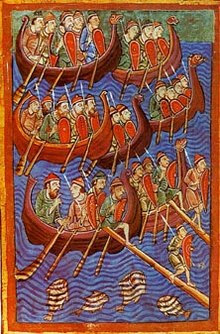


Emperor Lothar gave in 841 Harald Klak more land: Dorestad, the island Walkeren and the rest of Frisland as an attempt to stop the lootings which Harald did together with the Danish Vikings. In those years were many lootings - many klosters and churches were destroyed or exposed to ravage and many Christians were taken prisoners and sold as slaves.Ludwig the German went up to the other side of the Elben by the Abodrites to incorporate their country into his empire and to make them his taxpayers. This was too much for the Danish king Haarik I who considered both the Frisian and the Abodrites his taxpayers. He rearmed with 600 ships and sailed up the Elb to Hamburg which was plundered in 845. Ansgar's archbisopric was burnt down with the large "handwriting " library which Ludwig the Pious gave him. The Danes drove out Ansgar from the town, but a pious lady gave him the farm Ramsola ( about 30 km from Hamburg). In 847 Ansgar got instead the archbishopric Bremen which was put together with the rest of the archbishopric in Hamburg. After this Bremen- Hamburg was archbishopric in the North until 1104.

Regnar Lodbrog
One of the main persons behind the lootings was Regner Lodbrog. Historically speaking he returned home to king Haarik I's residence bragging with all the silver and gold he brought. Hearing this bragging were also Frankisch diplomats . The mightiest man in Saxony was their spoaksman. The presence of Franks by king Haarik indicated that they together with Haarik were clearing the outstandings with the Abodrites' tax and the burning of Hamburg. It seems however that the Viking, Regner Lodbrog was infected with a disease, many members from the expedition were also sick. According to the Franks Regner Lodbrog got a very unpleasant, but well-deserved death. King Haarik considered this a bad omen and took the opportunity to execute the Vikings who were not already dead from the disease. He released their Christian prisoners.

As the road was now cleared king Haarik sent for Ansgar and allowed him to build Denmark's first church and a house for the priest in Hedeby in 849. It was the first time in Denmark that Christianity was allowed in this way. There was however no permission for bell-ringing. In Hedeby was an active heathen opposition against Christianity, but Ansgar's church was built, and it was tolerated that the priests did missionary work, but Jarl Howi in the lead of the leading circles of the town forbid bell-ringing. Haarik shared in 830 the power with 2 nephews, but the Viking lootings went on. Ansgar visited often king Haarik in the king's last years.


replica, Viking church, Moesgaard, Aarhus/gb
In 854 came an army to Denmark led by Guttorm, possibly a nephew of Haarik. Almost the whole royal family and the nobility were killed in the 3 days long battle which followed. King Haarik I and Guttorm were killed - and a little boy was now king Haarik II. Jarl Howi and the leading circles in Hedeby took the opportunity and closed the church in Hedeby and drove out the priest. Denmark's first church was closed 5 years after the building. 

A messenger came in 855 from the new king Haarik II to Ansgar. Jarl Howi was thrown out of town. Ansgar went back to Hedeby ca. 856 and was welcomed by king Haarik. Christianity was again allowed, the church opened and the priest came back. Haarik gave permission to ring one bell in Hedeby. Ansgar got a piece of land in Ribe for the building of a new church and a house for a priest. The priest was allowed to do missionary work, but there was no permission for bell-ringing.

Ribe was founded between 704 and 710.


In general the mission tried to achieve allowance to build a church at places where Christian
Viking town/museum
merchants were, like in Hedeby and Birka. Hedeby was mentioned for the first time in 810; it was established as an international trading center. Hedeby and Birka were the largest cities in the Viking period and the most interesting areas for the mission. Birka was a fortified international trading center with own rights. It was situated inside Skærgården inside Mälaren, the fjord outside the present Stockholm and east of Björkö.

Ansgar sailed to Birka in 828 and went back to Saxony in 831. After Ansgar and Vitmar left Birka in 831, bishop Ebo sent a sister's son, bishop Gauthbert to Sweden together with the priest Nithard. Gauthbert was by Ebo equipped with everything for his important office, and there might have been bells in the luggage, according to information from the Fulda kloster.


In Sweden bishop Gauthbert was driven out of Birka by an exited crowd of people ab. 837-842. He might have bothered or purged the great heathen temple in Uppsala. His priest Nithard was killed. The expulsion of Gauthbert took place at the same time as king Haarik I's dissatisfaction with Ludwig the German's tax prints from the Abrodites and the retributive actions against Hamburg and its bishopric. Gauthbert became bishop in Osnabrück and did not go back to Sweden again. During the years 845-851 there was no priest in Sweden. After this pause of 7 years Ansgar sent in 851 a hermit Ardgar( or Hardegar) to Birka as a priest and to assist Heringar. When Heringar died in 851 the hermit went back home.

Ansgar went to Sweden in 852 together with the priest Frimbert (Erimebert), a nephew of Gauthbert and brother of the killed priest Nithard. They went together with a priest of Danish descent, Anfrid. Bishop Gauthbert was still missionary bishop in Sweden, a title he got from Ebo. This time the travel went via the transit route Hedeby and took only 20 days. The new Swedish king Olaf welcomed Ansgar in a friendly way; the king was baptized, and church and priest were allowed again. Ansgar went back home. Gauthbert's two delegates went back from Sweden 3-4 years later. Gauthbert died in 860. The next to be sent to Sweden by Ansgar was Ragebert, but he was attacked by Danish Viking pirates and died. A priest Rimbert of Danish descent was then sent to Sweden

In the northernest mission of Sweden - which probably was not a popular place of deployment - the mission died out with archbishop Unnes 17 september 936, and the land became heathen again. There was a pause of at least 100 years - and thereafter came the other competing Christian mission, the English missionaries and resumed the work. First of all Sct. Sigfrid who became bishop of Växjö.


The largest church bell in the world is the Zar bell, cast in 1733-35 in Moscow. It is now on exhinition at the Ivan Velikij bell tower in Kreml.It weighs 200 tons, is 14,6 m tall and with a biggest diameter of 6,6 m.


photo wikipedia
photo + text: grethe bachmann

Friday, December 08, 2017

Santa Lucia in Scandinavia (13.December)


The Scandinavion tradition with Lucia processions is relatively new and origins from 1928, where a Swedish newspaper graded "Stockholm's Lucia". Today each Swedish town has its own Lucia, who each year is graded Lucia long before 13 December. All the Lucias take part in a competition as "Swedens Lucia", a title which don't just mean to drive in a cortege to Skansen in Stockholm, but that the lucky girl gets a pr-tour to Italy and Syracusa where Lucia came from.


The Swedes have actually celebrated the Lucia night  ("lussenat") since the 1600-1700s, especially in the western part of the country, where tradition says that the young girls in the farm wake everyone with coffee and bread in the dark early morning. In Sweden the tradition has been cultivated with the special Lucia "lussebröd", a bun,  which is shaped like a wreath with four loops and spiced with saffron.


The Santa Lucia celebration song is a Sicilian folksong in the honour of Lucia, but the Scandinavian text is not so much about the historic Lucia, rather about the Swedish tradition where the Lucia Bride carries a tray with food to "those in need". Maybe this comes from the old legend, where Lucia brought food to the Christians in the catacombs during the persecutions. Lucia has nothing to do with Christmas which is seen in the Lucia songs. Sweden has lots of Lucia songs while the Danes only know a single one ( about the locality Lucia south of Napoli.) The first Lucia procession in Denmark was during the German occupation in WWII, and since then it has become a permanent part in Danish schools, but the Lucia feast in Denmark has never reached the same importance as in Sweden.


The story about Lucia begins in 283 at Sicily in the town Syracusa. Her family was well off and her  prospects were good, but at a young age Lucia conversed from the Roman religion and was baptized, which later cost her life. Sicily was a part of the Roman Empire -  and in order to maintain peace the inhabitants had to sacrifice to the emperor. The Christians denied to bring these sacrifices.

The Romans considered Christianity a dangerous religion and an enemy of the Roman empire, and the Christians were tortured and executed in the most brutal way. Many Christians lived a secret life where they either hid their faith or lived underground in the catacombs. Lucia helped her fellowmen. At night she brought food to the Christians in the catacombs -  and in order to find way in the dark she wore a wreath upon her head with lit candles.

According to customs she was promised to a man, who was a Roman from a reputable family, but she rejected the husband and the marriage. Her faith and her vow to God were incompatible with marriage, but in the eyes of the Roman her reasons were not just ridiculous, but also dangerous, and he indicated her to the authorities. Lucia would not sacrifice to the emperor and she was convicted guilty. At first she was sent to a brothel, but by divine intervention she was being protected. She was  then exposed to torture and sentenced to die at the stake, but once again God intervened. At last the judge took his sword and stuck her, and she died on 13. December year 304. 
Lucia was buried in her hometown Syracusa and as early as in the 400s she is mentioned in written sources. In the 600s where Christianity now was a state religion in the Roman kingdom she was a part of the Catholic liturgy. Her celebration day is the day of her death on 13. December, which is celebrated as a light feast in Scandinavia, especially in Sweden and Denmark. According to tradition the Lucia Bride walks in front of the light procession wearing a crown with candles upon her head. This is the virgin crown as a memory about Santa Lucia who gave her life to God as the bride of Christ .

Santa Lucia is connected to more than light and joy. She has become the patron saint for blind people and people with eye diseases. She is often displayed with a small bowl containing two eyes.


humorous drawing from 1848 by Fritz von Dardel


Thursday, November 16, 2017

Poinsettia/ Julestjerne


Euphorbia pulcherrima


Poinsettia/ Julestjerne  is an ornamental plant originally from Mexico . It is  a commercially important plant and is widely used in Christmas floral displays. It derives its common English name from Joel Roberts Poinsett, the first United States Minister to Mexico, who introduced the plant to the US in 1825.

Poinsettia is a shrub or small tree, typically reaching a height of 0.6–4 metres (2–13 ft). The plant bears dark green dentate leaves that measure 7–16 centimetres (2.8–6.3 in) in length. The colored bracts—which are most often flaming red but can be orange, pale green, cream, pink, white, or marbled—are often mistaken for flower petals because of their groupings and colors, but are actually leaves. The colors of the bracts are created through photoperiodism, meaning that they require darkness (12 hours at a time for at least five days in a row) to change color. At the same time, the plants require abundant light during the day for the brightest color.

Young plants are partly succulents. The short branches are from beginning herbel-like and juicy, but they gradually turn wooden-like. The barch is first olive green, but later greyish brown with crevices. The upperside of the leaves is dark green, while the underside is light green. 
The flowers of the poinsettia are unassuming and do not attract pollinators. They are grouped within small yellow structures found in the center of each leaf bunch, and are called cyathia.

Like in other plants of the spurge family (vortemælkfamilien) the juice is latex-containing and white. People with latexallergy must avoid to get the juice on their skin. The plant iself is only vaguely poisonous .

There are over 100 cultivated varieties of poinsettia.

In areas outside its natural environment, it is commonly grown as an indoor plant where it prefers good morning sun, then shade in the hotter part of the day. Contrary to popular belief, flowering poinsettias can be kept outside, even during winter, as long as they are kept frost-free. It is widely grown and very popular in subtropical climates.


The plant requires a daily period of uninterrupted long, dark nights followed by bright sunny days for around two months in autumn in order to encourage it to develop colored bracts. Any incidental light during these nights (from a nearby television set, from under a door frame, even from passing cars or street lights) hampers bract production. Commercial production of poinsettia has been done by placing them inside a greenhouse and covering the latter completely to imitate the natural biological situation.


Poinsettias are susceptible to several diseases, mostly fungal, but also bacterial and parasitic.


The poinsettia is native to Mexico. It is found in the wild in deciduous tropical forests at moderate elevations from southern Sinaloa down the entire Pacific coast of Mexico to Guatemala.
The species is naturalized in many other tropic districts.  

The poinsettia has been cultivated in egypt since the 1860s, when it was brought from Mexico during the Egyptian campaign. It is called bent el consul, "the consul's daughter", referring to the U.S. ambassador Joel Poinsett

The Aztecs used the plant to produce red dye and as an antipyretic medication. In Nahuatl, the language of the Aztecs, the plant is called Cuitlaxochitl, meaning "flower that grows in residues or soil". Today it is known in Mexico and Guatemala as Flor de Noche Buena, meaning Christmas Eve Flower. In Spain it is known as Flor de Pascua or Pascua, meaning Easter flower.

In Chile and Peru, the plant became known as Crown of the Andes.  In Turkey, it is called Atatürk's flower because Atatürk, the founder of the Republic, liked this flower and made a significant contribution to its cultivation in Turkey.  In Hungarian, it is called Santa Claus flower, and it's widely used as a Christmas decoration.
 
The plant's association with Christmas began in 16th-century Mexico, where legend tells of a girl, commonly called Pepita or Maria, who was too poor to provide a gift for the celebration of Jesus' birthday and was inspired by an angel to gather weeds from the roadside and place them in front of the church altar.  Crimson blossoms sprouted from the weeds and became poinsettias.

From the 17th century, Franciscan friars in Mexico included the plants in their Christmas celebrations.The star-shaped leaf pattern is said to symbolize the Star of Bethlehem, and the red color represents the Blood Sacrifice through the Crucifixion of Jesus.

Poinsettias are popular Christmas decorations in homes, churches, offices, and elsewhere They are available in large numbers from grocery, drug, and hardware stores. In the United States, December 12 is National Poinsettia Day.