Friday, September 10, 2010

The Horse


There is something about the outside of a horse that is good for the inside of a man.

Winston Churchill.


The daughter who won't lift a finger in the house is the same child who cycles madly off in the pouring rain to spend all morning mucking out a stable.

Samantha Armstrong


photo Lille Vildmose 2007: grethe bachmann

Bat/Sydflagermus in Daylight

Eptesicus serotinus


Bat , Vestermølle , at Rørbæk Sø

Bats are the only flying mammals. In Denmark's fauna are 17 species, and internationally are about 1000 species; every 4th mammal on earth is a bat. The Danish name flagermus comes from Old German Fledermaus, fleder meaning flagre (fluttering, flitting).

In the 1400s the bat was called: bakke, in 1603 aftenbakke, comes from Old Norse Blaka = flagre (fluttering, flitting).

Many of the Danish bat species overwinter in Daugbjerg and Mønsted's Kalkgruber (lime pits) in Mid Jutland. The lime pits are situated in Fjends Kommune (community) , which has a bat in its city seal.

Vestermølle, at Rørbæk sø

Magics, Omens, Fairy Tales.

Some connects bats with horror and thriller movies. It might especially be caused by the gory vampire-stories, amongst those the story about the infamous count Dracula. It is known since the early Middle Ages that there was much superstition around this little mysterious animal.

In the 1400s they said that bat-blood stopped the growth of hair.
A bat has only three drops of blood, they are under the left wing, if they are rubbed upon a girl without being noticed she will forever feel attached to the one who did it.
If the blood was rubbed upon the eyelid or in the eyes then this would make you psychic, you would be able to see what was invisible to other people, both day and night.
If you drink three drops of a bat's blood you'll become invisible.

A bat's heart or head worn in a black cloth under the right arm would make one sleepless until it was removed.
Wearing a dried bat made you a winner in cardplaying. You would be a winner in games when the magic word was written with a bat's blood and black ink upon your left arm.
If a bat's head hangs in a pigeon house, the doves cannot leave it.
If more bats than usual fly in the evening the weather will be fine the next day.
If a bat flies into the house it's a death warning to the family.

Those people who live at the moon have bats as milch cows and poppies as corn. All bats and poppies on earth came originally from the moon.

In a fairy tale a princess is held prisoner in a hill, where she finds a bat, she drinks its blood and achieves strength anough to dig herself out.

A princess is an accomplice of a troll in a mountain, she flies in the night over the city in a large white robe and with long black wings.

The hall of a troll is decorated with glow-worms and skye-blue bats. (H.C.Andersen's fairy-tale: Rejsekammeraten (The Travelling companion) translated by Jean Hersholt.


Vestermølle, at Rørbæk Sø, after a short flight in the early
afternoon the bat flew up under the roof eaves.


NB:
If people might find a bat upon the ground then this might be a sick animal or a big young one who hasn't yet found out how to fly. Exhausted bats who hasn't found food can reduce their metabolism and almost hibernate. The best solution is to get the bat up on a secured place, fx on a branch or in a shelter under the roof eaves. Some bats can be infected with rabies, which can be transferred to humans in a bite. So its important to wear gloves when handling a bat.

Rørbæk Sø

Source:
Folk og Fauna 3, Dansk etnozoologi, V.J. Brøndegaard, edit. 1986.

Naturguiden
Mønsted Kalkgruber

photo 18. April 2009: grethe bachmann

Thursday, September 09, 2010

Viking Fashion


Two women-figures in silver from the Viking period, Sweden.


An experiment! I imagine the woman to the left has a fur collar and fur-pompoms on the red woolen cape, the woman to the right has a cape in gold-brocade.

Clothes for Viking men and women are known from some findings, especially in a tapestry from the Oseberg-ship in Norway. In the male dress the Viking was seen in full coat of mail with a white-painted shield and a spear, in his civilian clothes he also had his indispensable spear. The civilian dress is a coat or pea jacket coming to the middle of the thigh or a little higher; it has long sleeves, maybe a belt , but usually loose-fitting. But it is tailor-made with a dart like in a tight-waisted coat. This coat is also known from Gotland picture-stones, and a coat almost similar is seen on the Lindisfarne reliefs.

There are two kinds of pants on the Oseberg tapestry, either long and tight, or wide and puffy, almost like plus-fours or golf-pants. They are also seen at the Gotland picture-stones. The Arab Ibn Rosta once mentioned in the 10th century these Rus-merchants with their excessive fabric-rich trousers, which were fastened at the knees. At a stone from Gotland two Vikings wear wide trousers , which look as they are supported by an inner "construction" like in a crinoline. Trousers like that were probably made for rich, aristocratic people. The fashion was and is still dictated not only by vanity, but also by a desire to display one's riches.

A third piece of cloth belonging to the male Viking dress was a long cape, which ended in 2 ends, almost reaching the ground and worn in various ways, the ends stood either outh to both sides or front and back. This cape is also known from Gotland. Canute the Great is pictured elegantly dressed in an English manuscript , which shows the king and his queen below hovering angels, placing a large golden cross upon the altar in New Minster in Winchester.

The woman's dress is also shown in the Oseberg tapestry. Furthermore a textile expert Agnes Geijer has studied cloth-rests from the graves at Birka (in Sweden) and has given a valuable contribution to our knowledge about the aristocratic or more wealthy woman's dress in the Viking period. Next to the skin the woman wore a fine pleated shift or shirt, above this the gown, sleeveless and in two parts and hanging in straps in two oval bronze-buckles upon the chest. The gown was foot-long with a train. Above the gown a shorter or longer sleeveless cape. The Viking-lady probably looked impressive with train and an abundance of fabrics, with pearl-necklaces and oval breast-jewelry, from where hang fine chains with scissors, needle-case, knife and keys.

Her hair was tied in a heavy chignon, gathered in a hairnet or under a head-cloth. Young girls might have dressed less conventional, like the girl upon the Oseberg-waggon, who whore a short skirt and long boots. The male Viking was often pictured with a pointed or round-crowned cap in fabric or coat/ leather. The woman also wore a cap or a cap-like head-wear. From the Oseberg-finding were women-shoes in tanned leather.

The Vikings loved luxury.There have been found exquisite dress-finery in their graves, mainly in Birka. Chinese silk, Byzantic and oriental gold-thread embroidery made in the most complicated technique, there are passementeries, heavy gold-brocade and braidings in the best quality. The silk is of course imported, and several other things, but the brocade-work has often an unmistakeable Nordic style.

A Nordic warrior's luxury equipment is seen in a grave from Mammen in Mid Jutland, where the dead was lying with his silver-inlaid war axe and with an eiderdown pillow under his head. Only small pieces of his cape were left with an embroidery in a free pattern. Most well-preserved were his two bracelets in woolen-pad silk, interwoven with gold-thread, and two extremely finely made streamer-shaped silken bands, where the mid fields were sewn with gold thread in a very artificial winding-pattern. Probably were these two bands the warrior's headband, the diadem-like headband, which in the Sagas is known as the "hlad". Even the toughest Viking liked to smarten himself up. According to the Saga the most ferocious of the Njal-sons, Skarphedin, wore his fine silken-hlad on his forehead, when he went to the Thing.

Source: Johannes Brøndsted, "Vikingerne", Gyldendal, 1960.

sketch: gb

Wednesday, September 08, 2010

New Scientific Research

Antidepressives in the Water:


The rising use of antidepressives is visible in nature, where the level is rising in river mouths and coastal areas. Shrimps that live in water with rests of antidepressive medicine are five times more inclined to swim towards the light and thereby be eaten. This is shown in a scientific research from the University in Portsmouth - and this might be a serious problem. The shrimp plays an important role in the food chain - and a change in its natural behaviour can turn the natural balance in the eco-system upside down, says the leader of the research dr. Alex Ford.


The Honey Bee in Crisis.
There are problems in the honey-bee pollination right now. Since 2006 has a mysterious syndrome spread, where the honey-bees suddenly and without known reasons leave their hives. This was one of the themes at a World's Insect-Congress at Copenhagen's University this summer. 750 leading scientists from over 40 various countries met in order to exchange knowledge and experience from the new research-results, among others the honey-bee problems. This "Colony Collapse Disorder", as it is named, is an increasing problem for bee-keepers in Europe and North America, and it might threaten the honey-bee's crucial pollination of plants. The scientists of the congress met the Danish bee-keepers to try to find an explanation of the mystery. The solution might be found in the new DNA-technology. The value of bee-pollination in Denmark is about 700 million kroner, which was stated by Institute of Agriculture and Ecology at Copenhagen's University in 2007. Besides this is the huge importance the bees have on the biodiversity in our wild nature. The increased use of pesticides in the farmland and a decline in the number of bee-keepers has also marked the honey-bee's pollination.

Source: Danmarks Naturfredningsforening, Natur & Miljø, nr. 3, September 2010.

photo 2008/2010: grethe bachmann

Tuesday, September 07, 2010

Wild Chervil/Vild kørvel

Anthriscus sylvestris


Wild Chervil, Jernhatten, Djursland

Wild chervil or cow parsley is native to Europe, western Asia and north west Africa. It is related to parsley, carrot, hemlock and hogweed. It grows in sunny or semi-shaded locations in meadows and at the hedges of hedgerows and woodland. Roadsides are lightened up with wild chervil in May-June.

The plant is attractive to a huge number of insect species. In the old days it was known that a swarm of bees was easier to shoo into the beehive if it was rubbed in wild chervil. It was and is still used in the process of dyeing wool and linen. The flowers give a light yellow and green dye. Around 1800 they used the dried umbels cooked in oil in order to dye yellow, while leaves and stems gave a green tone.

Warning: Cow parsley can be mistaken for the similar looking Poison Hemlock (Giftig skarntyde) and Fool's Parsley (Hundepersille).

Folklore and habits in Denmark:
The boys used to cut flutes of the hollow stems of wild chervil. In 1666 wild chervil was used in cakes which was said to be very delicious. The plant was used to support the first shots of hop in order to protect it from the wind. The wild chervil was removed on June 24th in Midsummer and the hop was equipped with the traditional long poles. Garlands made of wild chervil and elm leaves were decorations in Midsummer feasts.

In the 1300s wild chervil was crushed and mixed in wine as a compress upon cancerous ulcer, a drink was taken with wine and honey for pains in the side. In he beginning of the 1400s a juice mixed with vinegar was used to drive out roundworms, in 1546 the physician Henrik Smid recommended young chervil cooked with cabbage for the stomach and the head. The plant was in a wine dekokt which was good for headache. In 1648 Simon Paulli advised to eat a thin cabbage soup for difficulty in breathing. A chervil pie was good for the stomach and gave a sweet sleep.

And it was said that to drink chervil water in the morning strengthened the memory !

photo Jernhatten, Djursland 2008: grethe bachmann

Helgenæs and Sletterhage, Mols, East Jutland


Always lying there by the road to Mols, the castle ruin from the 1300s, built by king Erik Menved. It was once an important fortification, now it is just a ruin visited by thousands of people each year. On the land of the castle island are many interesting plants, especially by the steep slopes behind the ruin.


The water is calm and blank and the warm light of summer has been replaced by the clear light of the beginning autumn. The temperatures are cooler today.


Oh, they really have a nice days those cows, just look at them, resting close to one another, one with her head upon the shoulder of her neighbour.


Now the farmer is ploughing the land. Harvest is over, next season has to be prepared.


Another field with graphic shapes and an amazing blue sea. On the other side of the bay is a glimpse of the southern part of the city Århus.
,

Now we are on Helgenæs, close to the place where Harald Bluetooth according to a legend was killed.


A very small harbour at Kongsgaarde. Here was once a king's estate or a castle. Nothing is left but the name.


On the Helgenæs and Sletterhage area are many galleries, open in the summer period. This one is Bo Bendixen's gallery on the road to Sletterhage.


I wonder if those two retrievers are guarding the garage or they are only enjoying their nap after dinner. They look rather un-guarding!


When the yellow house shows at the corner the south tip of Helgenæs with the coast at Sletterhage is near.


Sletterhage,near the lighthouse are some firs giving a little shelter if that's what you want ......


but we're going down to the stony beach and the salty air........


...........isn't it just a lovely sound when the water runs over the stones and back again, trickle, trickle....... if my bedroom was close to such a place I would be able to fall asleep.......


.....if you like to gather stones - here are lots and lots of pretty stones, flat ones, round ones, with holes to put them on a long leather rope at your window or your door, some fossilized sea urchins etc.


I love the sea, and I feel like an old sailor when I'm here........ although I get seasick......


This island, Samsø, here seen from Sletterhage, is one of many Danish islands. There are 443 named islands. 76 islands are inhabited. The Danish coastline is 7 314 km. Almost all areas of Denmark are close to the coast, no area is more than 52 km from the sea.


Hjelm, a small island with an exciting history. This is the famous Marsk Stig Andersen Hvide's island.
If you like: Stig Andersen Hvide


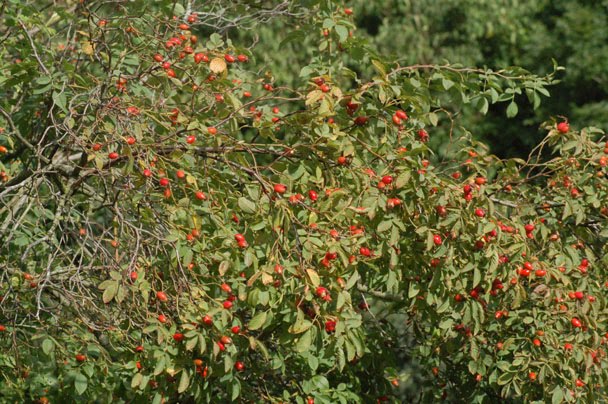
Hips,hips everywhere - do I have spare time to make some marmalade?


Anagallis arvensis:) This plant has a tiny, tiny red flower, and I seldom see it. In Danish: Rød Arve (or Rød Pimpernel) - and in English: Scarlet pimpernel, also known as red pimpernel, red chickweed, poorman's barometer, shepherd's weather glass or shepherd's clock. It is most well known for being the emblem of the hero The Scarlet Pimpernel.


As shown in blog Flora and Fauna, we were also on a little tour to the Mols- Laboratory, where we said hello to the sweet Galloways.


After this on the narrow road up hill into the sky and back home.


photo Mols 4. September 2010: grethe bachmann

Sunday, September 05, 2010

The Galloway Cattle


The Molslaboratoriet belongs to Naturhistorisk Museum in Århus and is placed in beautiful surroundings in Mols Bjerge Nationalpark. It is EF habitat area 186 and lies on the southern part of Djursland. In this area was since 1941 done a comprehensive ecological research.

The Galloway cattle is grazing in this area.


This Galloway bull was not at all interested in any contact. He disappeared as quickly as possible behind some trees. He looked very heavy and butterfat.

The Galloway cattle has its origin from the district Galloway in southwest Scotland. It comes from a dominant hornless race, which survived as feral cattle in Great Britain until the beginning of the 1800s. It is supposedly related to the hornless domestic cattle of the Scythians. (485-425 B.C.) It came to the British Isles before written sources exist and its arrival might coincide with the immigration of the Celtic tribes. But the prototype was spread in middle and northern Europe. Hornless domestic cattle is continuously mentioned in historic sources with traditions back to the Skoto-Saxon period (400-800 A.C.)

The original use of Galloway was as milking and beef cattle. In the early Middle Ages the agriculture was changed caused by an expansion of the wool industry in Europe, and the sheep became the dominating domestic animals. The main task of the cattle then was to keep the good grazing, where some of the plants were neglected by the sheep. This way of grazing is still kept in the Galloway district, where they say: "The sheep provide the bread, but the Galloway the butter and jam."


Although black is still the most common colour for Galloways, they can also be red and several shades of dun. A variation is belted Galloway. Galloways are quiet and easy to deal with, but if they are exposed to a threat, the flock sticks together to face the enemy. They are capable of digesting large amounts of nutrient-poor growth like heather and can survive at very poor grazing-areas - like heaths. The animals live long and are very fertile. The cows are known as solicitous mothers with much milk, and they can raise calves even under difficult conditions. Their fur and their resistance to diseases make them very tough and they can stay out all year. In Denmark the Galloway cattle is especially used for nature care. There are about 1000 Galloways in Denmark p.t.

Source: Molslaboratoriet, Naturhistorisk Museum, Århus Universitet.


The Galloways are not shy, they are just not curious or interested in a talk like the Hereford cattle, which is also grazing in this neighbourhood. This lovely fat bull calf had no comments.

"Hello sweetie, what fine curls you have!"
"Mmmmnn"
"May I take a photo?"
"Mmmnnn"
"Thank you, curley! Have a nice day!"
" Mmnnn! I couldn't care less!"

photo 4 September 2010, Molslaboratoriet, Strandkær, Mols: grethe bachmann

Wednesday, September 01, 2010

Another Walk ...........................


You'll have to put up with me in another walk, if you like! It was a beautiful weather, a little windy - but the sun was shining and it was too tempting. I really had to bring my camera today. Usually I walk in order to get some training - fast and steady, and usually I only bring my camera out in the week-ends. My daily walk is often down to the beach, where I pass the Races, Marselisborg Castle with the queen's garden, the forest and the Memorial Park, which is between the castle and the beach road. There was a butterfly I wanted to find - it has not been seen in many numbers this year, and I hope it would be in the herbaceous borders in a garden corner of the park. Among the first houses I pass on my way is this one. I call it The Italian House. I think it's charming. I love the tiles by the door.


I took a little break by the horses, but only one was out today. A cute little swallow was curious, looking down to see what happened.


Marselisborg Castle, queen Margrethe's summer-house, somewhat bigger than the summer houses I have rented in my holidays. From the big lawn in the park is a view to the sea and to Skødshoved, Mols and Helgenæs on the other side of the bay.


The park is filled with trees and bushes and fine hedges. To the right a walnut tree which drops walnuts in numbers on the ground. I have used some for snaps. Walnut-snaps is one of the best among snaps, almost like a cognac.


Crows walk two and two. These two had a crisis. One walked to and fro and to and fro. Was it the female, looking like she had got a perm of the neck-feathers. The male was sitting by the nearest tree philosophing over, why she had got that perm. Was she flirting with some young fool? He was really sad. (click the picture to see the perm)


Much rain and much sun. Lots of berries. Here hips from a rose, flowering with the most wonderful scent in May-June. I don't know the name, but I guess it is a tea rose. To the right rowanberry, and like the elderberries I told you about, there was one year where I experimented with berries from nature. Gathering, cleaning, cooking, it took a h... of a time, but the rowanberry-gele was absolutely fine. I had made a large portion and my friends all got a part. They loved it. I had put cognac in it!


I was very excited when I finally came to the herbaceous perrenials. Each year they have various flowers and colours in the park. Last year were the colours more vigorous, this year lighter. But they are beautiful. My mother had a lovely garden with such flower beds.


Here is the butterfly I wanted to find. Underside to the left. And like other butterflies it has a pretty English name. I'm sure the man who was sitting there many years ago, deciding the names of the butterflies, was a real romantic. Painted Lady is the name of this one. I'll write about it in my blog Flora and Fauna.


Painted Lady with underside (Cynthia cardui)


The Red Admiral and the Peacock


Small White and Small Tortoiseshell


The heavy rain last week caused problems in many places, here it has created a "ravine" in the walking path and in another path through the forest section it was necessary to wear waders. .


Two Whites were sitting for a long time "looking" at each other before they got closer. They were flirting I think.


They look like Green-veined White? A jogger came running and they disappeared.


There are two small houses in the park, "Donbækhusene", now uninhabited. They once were homes for servants from the Marselisborg Castle and for foresters in the 1900s. The Poplar Avenue along the edge of the Memorial Park is a lovely shadowy place when it is hot. But I don't need a shadowy place, so I walk on across Kongevejen (King's Road) to.........


Forsthaven or Forstbotanisk have with trees and bushes from all over the world. A bench by a small pond and the well by the pond. In spring are lots of frogs.


Mushooms in the grass by some beech trees upon a hill.

In some places the decay is supported, here a tree overgrown in ivory and leaning up another tree, a good place for the squirrels! Large fungus at the foot of an old tree.


This plant is named Dansk ingefær (Danish ginger). I can only give you this explanation from Wikipedia: Arum alpinum is a member the plant family Araceae. Certain occurrences of Arum in Denmark were previously labelled as the subspecies A. alpinum ssp. danicum, but these are now recognized as Arum cylindraceum. The picture to the right is from the small brook in Forsthaven. (click to enlarge all the small pictures)


In the corner og my eye I saw a movement. It was a squirrel. It is so quick, so quick that little guy! Disappeared in the ivory up a big tree.

At the foot of the same tree was a nuthatch and a great tit.


It is so majestic this Sequoia-tree. Just look at the strong red bark. And this one is small compared to the Sequoias in their native land in USA.


I came to the small lake in Forsthaven and saw this dragonfly at once. It was very busy and sometimes stopped in front of me! I'm sorry I could not take a close-up photo of this "dangerous" creature. Imagine there was once a dragonfly with a wing span of 70 cm ab. 300 million years ago - before the dinosaurs. This one is a Southern Hawker, with fine metallic blue-silver.


The dragonfly took care of its territory in a very agressive way. Two Small Whites tried to come near many times to get to some flowers by the lake, but the dragonfly chased them away each time, and it followed them across the path where I was and returned to the lake, where it stood like a little shining helicopter. In between it took a quick turn and stood in front of me, and I felt it was staring. "What are you doing here?"


In many gardens it is IN to have Hortensias. They are beautiful, but they do not attract much life. To the right some villas behind the Memorial park.


There are many grand white villas at the beach road, but I like this one, because it has kept some of its old charm.


The Marselis Marina. Lots and lots of yachts and masts - only one boat out. In the week-end I have noticed almost the same picture. Why do they "park" all those fine boats instead of getting out on the sea. Are they afraid of getting seasick?


In the corner of the bay beside Marselis Marina is a place named Tangkrogen. In the old days - when I was a child - it was a bathing beach. It was also called the Fly-Paper, because everyone went there. Tangkrogen means a place with seaweed, and there was much seaweed in the corner today. Here are all the small boats - also in big numbers - all the way along the corner up till the marina. To the left is a small section of the big lawn behind Tangkrogen, which is now used for circus and concerts etc. Behind the young people you see a little of Århus.


This is the last station on my walk. Here opposite the small ice kiosk is the bus-stop where I take the bus home. This ice kiosk has been here for hundreds of years! As long as I can remember anyway.


After the bus-tour I pass a house with this welcoming comité. It's a lovely way to welcome a guest. Notice the dog behind with a bristle on its back to clean your footwear.

And now home for a fresh cup of black coffee and a biscotti! Have a nice day!


photo 31. August 2010: grethe bachmann