Showing posts with label birds. Show all posts

Wednesday, June 29, 2016

34 Griffon vultures went on a Summer Holiday in Denmark

Griffon vulture (from wikipedia)


34 griffon vultures arrived last week for some days to the North Jutland village of Volsted south of Aalborg. This is really a rare event. Only about six griffon vultures have been since in Denmark since 1858.

Usually there are no griffons in Denmark. They live in the Spanish mountains and in South Eastern Europe, but sometimes they might fly north with the summer heat. Flocks have been located in Holland .

The 34 griffons in North Jutland are probably young birds from last year - and they might fly south again when it gets cold in DK. They cannot find much food here, there are no carrions out in the Danish fields. 

The griffon vulture is black, brown and white with a wingspan about 2,8 meter and a weight of ca. 11,3 kilo. 

source: various articles in the Danish News. 


Wednesday, November 11, 2015

A little about Bird Migration

Geese gathering at Alrø bird reserve

The migratory birds move thousands of kilometres each spring and autumn, in spring to the north to their breeding places in Scandinavia in order to nest and have kids. Here is a lot of space and food in summer. In autum the migratory birds fly south to their winter-quarter in the warm countries, where they can rest and find food while snow and frost cover the earth in Scandinavia.

Denmark is a crossroad for both water birds and land birds Birdwatchers estimate that about half a a billion birds pass the southern Scandinavia each autumn.

The land birds prefer to fly over land as far as possible before the flight across sea - therefore they follow the coastline until they are forced to cross the sea.
The water birds prefer to fly across water as far as possible -  therefore they also follow the coast line  until they are forced to fly over land.

An extreme example of bird migration is the Arctic tern which breeds far north near Arctis and overwinters at Antarctis. The species fly usually a yearly migration of ab. 34.000 kilometer. Some individuals can even traverse over 80.000 kilometer yearly, which is the double of the circumference of the earth.


The birds' orientation, the ability to find their way, is genetically determined. How the birds orient themselves is not quite clarified, but it is known that birds use several methods like the Terrestrial magnetic field, constellations, the sun and moon position, polarized light and visual Memory.

Some examinations have shown that the birds not only feed on their fat-reserves but that some of their organs grow smaller during the migration - so the birds exploit the bound energy from fx muscles, stomach, liver and other inner organs. In this way the birds get both energy and a lower weight, which makes the flight easier.

During the migration the birds feed on metabolic water, which is released as a biproduct during the metabolism when the stored fat is burned. The biggest loss of fluid during the flight happens via the exhaled air,  but the birds lose only little fluid through their droppings.

Most of the big birds, like swans and geese, must be taught by their parents in order to find the right migratory route between the winter quarter and the breeding place.

Several migratory birds can fly at least a week in a row without landing.

Some species, like geese and swans, fly in formation during the migration like the V-formation (the wedge formation). A common misunderstanding is that a formation like this has a leading goose in front,  but the birds change place alternately.

It is relatively easy to imagine that a big bird of prey can hover all the way to southern Europe or Africa on spread wings, but it is difficult to imagine a little bird on such a long trip. A bird weighing 10-15 gram has to bring fat in order to be able to survive the tour over long stretches, where it might have no possibility to seek food, water or shadow.

And what I have found here above is just a small part about this fantastic bird migration, the source is wikipedia, the photos; grethe bachmann . 


The bird migration is a wonderful miracle, isn't it? 

    Sunday, October 04, 2015

    Red Elderberry / Druehyld


    Sambucus racemosa


    Red Elderberry is native to Europe, the Middle East and Asia. The whole plant is poisonous to people, also the tempting red berries. Other common names for Red Elderberry are Scarlet Elder, Mountain Elder, Stinking Elder, Bore Tree etc.

    The name Sambucus is from Greek sambuca = a stringed instrument supposed to have been made from elder wood, and racemosa comes from the Latin racemus, the stalk of or a cluster of a bunch of grapes "with racemes". The flowers are greenish-white,the berries bright red and round, the marrow is brown in contrast to common elder which has white marrow.

    The plant provides valuable nesting and perching habitat for birds - and the berries provide food for many species of birds - in Denmark especially blackbird, thrush and songbirds. The berries are also food for deer, squirrels, foxes and mice.

    The wood is hard and has been used for combs, spindles, pegs, pipestems, flutes, toy whistles. Medical use has been made of all parts. Dyes can be made from the bark, fruit and stems, and an insecticide from the dried leaves.

    Red Elderberry is useful in stabilizing soil and controlling erosion on moist sites.


    Poisonous substance:
    All kinds of Sambucus contain a poisonous substance:Samburigin (cyanoglykocid) in leaves and in the unripe fruits. The druehyld is the most poisonous but its poisonous effect is limited to stomachache. In the past the sambucus was used  as a vomiting means . The seeds in all sambucus contain  a resin which gives dizziness and is diuretic , but the resin is destroyed by cooking. ( see wikipedia for more information)


    text and photo : grethe bachmann

    Tuesday, January 13, 2015

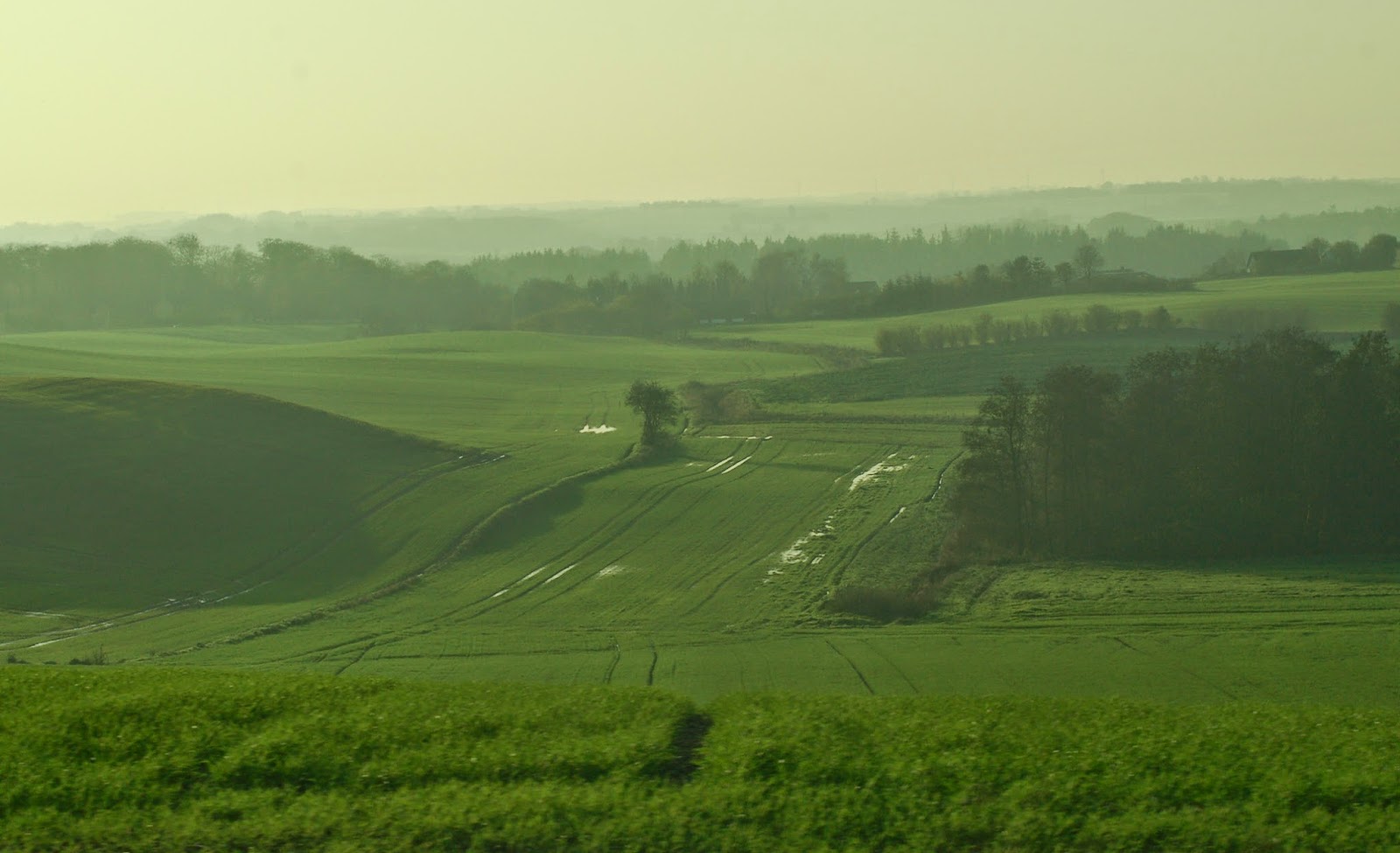
    Green Fields in Winter

    A Taste of Denmark


    The winterseed creates lovely green fields during the winter season. On a  mild day in December the sun was shining through a haze across the winter-green fields.

    The green fields are also good for geese and whooper swans who do some grazing up here North in winter.


    You might almost believe that this is a spring morning and the church bell is ringing for service, but it is in the afternoon and the sun is already slowly on its way down.


    If the winter is hard it can be a very costy business for the farmer. The extra expenses can be enormous if the seed is damaged. The winter is mild until now, sometimes with plus 10 Celsius which is a very high temperature in December.  But you can never tell. January and February can be a tough period for the winter seed.


    A cosy little village lies surrounded by green fields.

    A centralization in the 1960s meant that many shops, manufacturing business and schools have disappeared from the villages. But the increasing interest for the local community, environment and nature has caused that many villages have become attractive for people who are commuting to their job or go shopping in the big cities.

    In some regions called udkantsDanmark  ( outskirtsDenmark) are problems because the necessary  jobs are only to find in the big cities. One of the results are many empty houses in the villages and no shops at all. A sad development.


    It looks so peaceful and beautiful. This might be a scene from a Jane Austen film with d'Arcy and Elizabeth coming in from the right.............


    Now it's later in the afternoon and the green fields are darker green.  Today's painters do not (usually) create their paintings outdoors. ( Maybe when they do watercolours). But when it was common to work on a painting outdoors they had to work fast in order to catch the light and the shades which many French impressionists have described. .


    The last landscape from this day in December. The light is quickly fading. See you next time!


     photo East Jutland December 2014: grethe bachmann


    Thursday, August 21, 2014

    Guelder Rose/ Almindelig Kvalkved

    Guelder Rose, Bjerre skov/gb

    Viburnum opulus


    When winter comes and most fruits have fallen from the trees, the Guelder Rose still stands with its fine red fruits and richly coloured autumn leaves. The shrub forms underwood and edges in mixed hardwood forests in wet and mineral rich soil all over Europe. It thrives both in full sun and half shadow and stands wind and frost.

    Guelder Rose, Bjerre skov/gb


    It has got a lot of names in English: Cramp bark / Cranberry tree / Dog rowan tree / European cranberry bush / Guelder rose / High cranberry / Highbush cranberry / King's crown / May rose / Pempina / Pimpina / Rose elder / Silver bells / Snowball Tree / Water elder / Whitsun bosses / Whitsun rose / Whitten Tree / Wild Guelder rose.


    The Guelder Rose was earlier ascribed to the honeysuckle-family, (like snowberry and elder) but genetic studies under Angiosperm Phylogeny Group have shown that it belongs to the Adoxaceae-family. The botanical name is Viburnum opulus. It is a species of Viburnum native to Europe and Asia. The common name Guelder Rose appears to have originated because a popular cultivar, the snowball tree, supposedly first originated in the Dutch province of Guelderland.
     
    The White flowers of Guelder rose(wikipedia )


    The white flowers are pollinated by various insects; the inflorescence reminds about the hydrangea. The seeds are dispersed by birds, and the leaves are often eaten by caterpillars. The shrub is also cultivated as a component of hedgerows, coverplantings, and as part of other naturalistic plantings in its native regions. Guelder Rose is a good bush in the garden, not just because of the fruits, but it is a good hiding place for birds and their nests. Guelder rose is spread both by seeds and root-suckers. Berry-eating birds ar very fond of the berries, especially winter birds like fieldfare and Bohemian waxwing. The berries are poisonous to humans. The leaves are often eaten by caterpillars.


    Kvalkved/Guelder rose, Vestamager, Sjælland/gb
    From September it stands with red glistening fruits which stay at the bush until January-February. First when the fruits begin to rot, they are very much sought after by birds.

    The fruit is actually considered poisonous, but however used in some countries to make jelly. It is  very mildly toxic, and may cause vomiting or diarrhea if eaten in large amounts (Plants for a Future).


     Practical use. The berries have anti-scorbutic properties. They turn black in drying and have been used for making ink. The wood was used for combs making combs in looms, tobacco pipes etc. From the straight branches were made pipe tubes and walking sticks, the strongest branches were used to make knitting needles. 


    The berries were used as baits in bird traps.

    Folk Medicine: The dried bark was used in a tincture, known as "Cramp Bark," to alleviate painful menstrual cramps.This herb was mainly used for treating feminine problems like menstrual cramps, postpartum discomfort, preventing miscarriages and internal hemorrhages and was used as a uterine sedative also.

    The Nix ( Theodore Kittelsen, Norway 1904/wikipedia
    Folklore: In Danish its common name is Kvalkved, an old name is Ulvsrøn and in folklore it is called Vand-hyld (Water-Elder). The God in the water stream, Noekken,  (the Nix) was said to lie in wait for people under the water-elder, playing enthralling music. The Nix was most dangerous to women and children.
     
    If people had a stick of Guelder rose in their pocket, the underworld had no power over them.


    Source: Brøndegaard, Etnobotanik, Folk og flora; Danmarks natur; Gyldendal, Politikens havebog, samt Wikipedia. 

    photo Bjerre skov, Horsens in September : grethe bachmann
    photocopy  from wikipedia

    Thursday, July 17, 2014

    Eurasian bittern / Rørdrum


     Botaurus stellaris


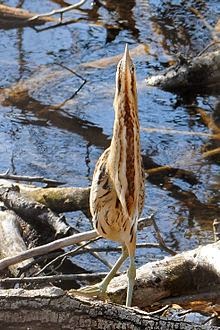
    The Eurasian bittern or great bittern  is one of the most peculiar birds in Denmark. The Danish name is Rørdrum.

     It is a wading bird of the heron family Ardeidae, and it is one of the species to which the Agreement on the Conservation of African-Eurasian Migratory Waterbirds AEWA applies.

    The Eurasian  bittern is a medium-size heron with a lenght-striped,  goldenbrown pliumage. When it is disturbed it shows its striped underside and stretches the head and neck up into the air. This makes it almost invisible in the reed beds. The bittern is a rare sight, it is extremely well camouflaged, it lives very hidden and is very shy - but in return the male bittern delivers the mystic song in spring  -  in Denmark called PAUKEN - which is so strong that the sound can be heard for miles. 

    The Eurasian bittern is spread in Europe and in a broad belt through Asia and North Africa, except in the northerh Scandinavia. It breeds spread in most of Europe, but is most numerous in eastern Europe, while it breeds only sporadically in the British Isles and in southern Europe. 


    In Denmark the bittern breeds spread in most of the country, except Bornholm. The bird occurs in large reed beds and marshlands, and it is common at the fjords of West Jutland. The best locality in Denmark for the bittern is the birds sanctuary Vejlerne. Here are about one hundred pauking males. There is a good chance to experience these birds, especially in July, where they are flying around a lot. 

    The Danish Eurasian bittern is probably a resident bird as far as the winter climate allows. If the habitats are frozen, the bittern has to seek other habitats, or it might overwinter primarily in western and southern Europe. 

    The bittern's food is fish, amphibians and other little animals.  

    photo:  habitat of the bittern in Lille Vildmose


    Folklore/ Legend
    No other bird in Denmark is surrounded by so much mystery as the bittern. Both the hidden ways of living, the owl-like flight and the strange voice, which sounds like the roar of a bull, have contributed to this mystery. People were scared of this mystic bird who had a voice as strong as any mammal, and furthermore it was  prancing around in the night hours - and when people met it in the dark of the night they were convinced it was a ghost.

    The voice of the bittern created legends about the farmer's water cows roaring and yearning to get ashore.
    A brutal landlord from Limfjorden was hated by everyone, and after his death his spirit was hazarding like a big black bird across the landscape, flying with silent wing beats and crying the hoarse scream of the bittern.

    In the 1600s the voice of the bittern was compared to the roar of a bull, which is also seen in the Latin name Botaurus. With its beak stuck under wing or down under water, mud or eath its roar could be heard far away. 

    The sound is also compared to deep tones from a far away bell buoy, or a foghorn, as when the wind is howling into a barrel. The voice of the bittern was called the rarest sound in Denmark, a strange hollow voice like the hooting of a distant steamer ,or the sound you made as child when you were blowing into an empty water bottle.  it is called the rarest sound in denmark , a strange hollow voice like the hooting of a distant steamer or like the sound you made as child when you blew in an empty water bottle, but only much more powerful.


    The farmers took many omens from the voice, if it was heard early spring it would be a fertile harvest.
    If the bittern was pauking in the reed rain and storm would come. If the bittern was pauking for a long time it meant that war would come. 

    The claws were  - mounted in gold or silver- used as toothpicks. 


     photocopy: wikipedia


    source: Brøndegårdsamlingen, folk og flora 2 ; DOF Danmarks fugle,


    photo: grethe bachmann, Lille Vildmose, July 2014.

    Friday, June 13, 2014

    Lille Vildmose in Himmerland, Northeast Jutland.


    It was magnificent summer weather in late May and start June - and one of our first summer trips went to the Lille Vildmose in  Himmerland (Northeast Jutland). Lille Vildmose is a raised bog, it is an endangered habitat, not just in Denmark but also in Europe. A project LIFE+ focuses on securing the raised bog and to create conditions for the decomposed part of the raised bog to re-emerge in the long run. This area is the largest left raised bog of the lowlands in northern Europe, and it includes more than half the total raised bog in Denmark. Lille Vildmose is appointed as a Natura2000 area (7824 ha) and a Natura2000 plan has been prepared with a focus in keeping and extending the raised bog area.

    From the reed beds sounds the voice of the bittern.

    Eurasian Bittern 


    When this is said the large moor in Himmerland is a wonderful place to visit, also because of the boardwalks across a big part of the area. It would be impossible to cross the moor without these boardwalks and bridges. The animal and plant life is very rich and you'll never know how much or what you'll see on such a tour. Birds of prey, like the golden eagle, the whitetailed eagle, the marsh harrier or the Eurasian hobby. We did not see the large birds of prey this time, but we heard the rare golden oriole. We did not see this beautiful yellow bird, but we later came to a place where we heard another rare bird. The strange voice of the Eurasian bittern sounded from the reed beds -  and a few moments later an Eurasian bittern flew above our heads and disappeared in the reeds. A rare sight. There are approximately about 22 Eurasian bitterns in Lille Vildmose right now. We heard its strange voice calling out like an angry  bull every five minutes.

                                                                      
    Legend
    No other bird in Denmark is surrounded by so much mystery. Both the hidden ways of its living, the owl-like flight and the strange voice have contributed to this. People were scared of this strange bird with a voice as strong as any mammal - and when it was strutting around in the night hours people thought they met a ghost. The voice of the bittern created legends about the Merman's cows, roaring and  longing for coming ashore. In the old days lived a landlord, named Mads Spejser, at Aggersborggård at Limfjorden opposite the town Løgstør. He was a brutal master and a nasty neighbour and very much disliked. His spirit is said to hazard like a dark bird across the landscape at night, flying with silent wing beats, uttering hoarse cries like the  bittern. 


    New Observation Tower

    A new observation tower has been raised in 2014,  called Brandtaarnet (the fire tower). Until the 1980s was here a fire watch tower, where a guard supervised the moor to observe if  there was fire or smoke. The new tower is a part of an ongoing and very comprehensive EU-LIFE nature-restoration project  Brandtårnet is the sixth observation tower in Lille Vildmose. It is 6-7 meter tall, and half as tall as the tower at the Vildmose Center at Vildmosevej. But it is tall enough since the moor is as flat as a panncake -  and there is a fine view across the earlier peat-extraction area, which during WWII gave work to 1200 men. Today it is a bird-rich restoration area, and from the new yellow tower it is possible to follow the rapid change of the nature area in these years.


    The moor was earlier overgrown with birch which has now been removed. Only a few birches are allowed to stay in the landscape.


    cloudberry, no flowers yet.
    cranberry flowers
    Plants
    The plant life is special in a moor, there are tufts of spaghnum moss, cranberry, rosemary heather, bell heather, cloudberry, sundew, cotton grass, white-beak-sedge etc.

    bell heather
    cotton grass


    Kærguldsmed / Leucorrhinia pectoralis


    A Dragonfly...........


    In Europe, dragonflies have often been seen as sinister. Some English names, such as "devil's darning needle"  and "ear cutter", link them with evil or  injury.  A Romanian folk tale says that the dragonfly was once a horse possessed by the devil. Swedish  folklore holds that the devil uses dragonflies to weigh people's souls. The Norwegian name for dragonflies is Øyenstikker ("eye-poker"), and in Portugal they are sometimes called tira-olhos ("eye-snatcher"). They are often associated with snakes, as in the Welsh name gwas-y-neidr, "adder's servant". The Southern United States term "snake doctor" refers to a folk belief that dragonflies follow snakes around and stitch them back together if they are injured.
    For some Native American tribes they represent swiftness and activity, and for the Navajo they symbolize pure water. Dragonflies are a common motif in  Zuni pottery; stylized as a double-barred cross, they appear in Hopi rock art and on Pueblo necklaces. They have also been used in traditional medicine in Japan and China. In some parts of the world they are a food source, eaten either as adults or larvae; in Indonesia, for example, they are caught on poles made sticky with birdlime, then fried in oil as a delicacy.

    And two Butterflies


    Moserandøje /Large heath.
    Bølleblåfugl / Cranberry Blue


    in Portland Mose

    some restoration work in the moor.


    a view from Portland Mose out to the coast (to Mulbjerge)
    A poppy field near the Vildmose.

    the limestone quarry near Lille Vildmose.


    It was a lovely summer's day in Lille Vildmose.


    photo: grethe bachmann, June 2014.

    Sunday, March 02, 2014

    Whooper Swans singing a Swan Song in March


    I don't think I have seen so many swans in one flock before. I guess there were about 500, it is common that they gather in large flocks of 500-1000 swans in winter. They were singing their special song,and  they were really singing loudly  - as if they were all joining the Pilgrims Chorus from Tannhäuser.  Suddenly they got agitated over something and their voices rose to inferno and chaos. I'm not sure the farmer-family on the other side of the road has a good night's sleep if the swans stay there for some days, singing  their swan song each night !!

    But they are beautiful birds, and it was a great experience to watch such a big flock. Soon they will fly eastwards to their breeding places in Scandinavia and Russia, some of them will fly all the way to Sibiria and to the Pacific coast. It is so amazing.   

    I did not use a wide angle lens - I did not have space enough for a photo of the whole flock, which spread over a large area.


    The Whooper Swan (Source: DOF, Dansk Ornitologisk forening, Fugle og Natur) 
    The whooper swan is of same size as the mute swan, but easy to recognize with its yellow beak, which has no black knot like the mute swan. It keeps its neck more straight and higher than the mute swan, and it has a strong and very sonorous voice, sounding almost like a trumpeting - contrarily to the mute swan, which usually is silent, except from the rhytmic singing sound from the wings during flight. 

    The whooper swan is a common guest in Denmark in the winter season and is often seen in large flocks in fields or in the the outskirts of flocks of mute swans in lowwatered areas.

    The whooper swan breeds in forest moors and lowwatered lakes in a large nothern region from Iceland, Norway, Sweden, Finland and in a broad belt in Russia and Sibiria till the Pacific coast. The whooper swan has expanded with breeding pairs south to Skåne and also eastern Germany. In Denmark a single pair has tried to breed in North Jutland. In 2007 three breeding pairs were registered in Denmark, two pairs in  West Himmerland in some small moors, and one pair in Bølling Sø (lake) at Silkeborg. One pair in Himmerland had eight chicks.

    Denmark is together with Germany the most important overwintering area for the whooper swan in Europe. It also overwinters in large numbers in Great Britain and Ireland, but is seen in most European countries in the winter season, except in Spain, Portugal and Italy. The whooper swan stays mostly in Denmark during mild winters, but migrates southwards in hard winters.

    The food of the whooper swan is water plants, grass and winter crops like wheat and rape. 


    Thrre swans came flying and landed by the flock.
    They had been out on a little study trip I suppose! 


    photo 1 March 2014, a field near the village Løve: grethe bachmann