Showing posts with label landscape. Show all posts

Sunday, October 11, 2015

Salten Langsø - undisturbed landscape

Salten Langsø holds a safe distance to disturbers.


Salten Langsø is a lake in Mid Jutland, about 12 m deep and 6 km long and very narrow, it lies in a tunnel valley in the lake district of Mid Jutland west of the lake Mossø. Salten Langsø has winding shores, and it mirrors the shape of the melted deadice-lump from Ice Age, which created the lake. The lake bassin has steep sides and is divided into four parts. In the western part is an island and the lake is here divided into two inlets.


the map is too dark, but you can of course see it better on Google Earth.

Salten Langsø with the valleys, the Salten river valley and the lake itself, is a side branch of the Gudenå river, and it is among the most undisturbed nature areas in Denmark.


Salten Langsø is like Mossø a part of Natura 2000-area in the Mid Jutland lake district , and it has some of Denmark's most beautiful and varied nature. The lakes and the valleys  are some of the most imprssive and illustrative Ice Age landscapes. ( the Gudenå river crosses north- south )


Salten Langsø is in several places only a few hundred meter broad. On the northside of the lake are high, forested hillsides (Høvil and Højkol skov) and Ildal skov. The southside, Addit Næs and Salten Næs in a relative flat area with forest, heath, farmland and several small lakes. The terrain rises again to the southwest , Addit skov, which is difficult to access. The highest point is Møgelbjerg (137 m).

Blueberry bushes
.

The forests are privately owned, but driven with great emphasis on nature - and therefore the planting is very varied, and several areas have the characteristics of a natural forest. 


Along the path were hundreds and hundreds of digger wasps nest in the earth. I saw no wasps


, but it was interesting to see those little nests, looking like little volcanos ! I 'll recommend you to search for the digger wasps on the net for there are so many species!


The area around the lake is ,considering Danish conditions, sparsely populated. The lake is a part of Salten Å-river's water system, which is a side branch of the Gudenå- river. The lake is a natural eutrof lake with an average depth of 4,5 m, and a max depth of 12 m. Half of the lake area is under 4 m deep. The shore vegetation is mainly a narrow fringe of alder (Aldus glutinosa) (Danish: rød-el.) In a few places grow reed. 

In the DOF-list were in january 2012 registered well 17500 observations of 188 bird species, only few waders, but all other possible forest birds.
The area north and south of Salten Langsø is mostly covered in forest, but it contains also a combination of lakes and forests which makes it one of Denmark's best terrains for birds of prey. Both the whitetailed eagle and the osprey are often seen. The white-tailed eagle has been breeding since 2008.

It is not a great fungus year this year, but at least there was one Karl Johan and a one of the little pretty red ones.


photo Salten Langsø September 2015: grethe bachmann


Saturday, October 10, 2015

Skarrildhus 2015 - the Stone Salmon, the Church Yard, the Raven, the Hawker and the Tar Ovens


The Salmon


The stone salmon at Karstoft Å (near Skjern Å river.

The Salmon, head


A huge stone sculpture of  the Skjern Å-salmon was created  at the spot close to Karstoft Å, Skarrildhus in West Jutland  by the Aarhus-sculptor Jørn Rønnau.

Seven Danish artists will use nature in the future National Park Skjern Å as a gallery for six Land-Art Works.


Karstoft Å, Skarrildhus


Land Art is the description of a direction of visual art  which emerged in USA in the late 1960s based between sculpture and landscape architecture


 Jørn Rønnau's giant 45 meter long stone salmon at Skarrildhus is not the only Land Art work in this neighbourhood, fx an area will be decorated with winding paths with small heart figures made of chausse stones and grass; a poem will be created about light and words; a poetic landscape with four small islands in a forgotten wetland -  and much more.

 
fish bench, Skarrildhus


The coming National Park Skjern Å has already manyfold initiatives created by local citizens, unions and traders, and there will be a cooperation between them and the Land Art artists.


information about the Skarrildhus-area, Naturplan.dk


Skarrild church yard.

The Church Yard

Information from link: 
www.airmen.dk/p353.htm
 
"In connection with the RAF´s first bombing raid to Königsberg (here, now Kaliningrad) in East Prussia Lancaster ME650 crashed on 27 August 1944 at
Clasonsborg in the parish of Skarrild. All of the crew perished. The German Wehrmacht wanted to bury the deceased "on the spot", but local Danish citizens obtained
that they were interred on the churchyard. This was quite an achievement from the Danish side, as the Germans just from 27 August 1944 started obeying an order to
dig down allied airmen "on the spot". Residents of the parish were accused by the Germans of being pro-English, as they showed up to accompany the airmen to
their graves."


the Raven, Skarrildhus

I always like to see the raven in the air and listen to its rough voice. A very clever bird. 

Info from wikipedia: 

The Raven
Some notable feats of evidence that the common raven is unusually intelligent.  Over the centuries
it has been the subject of mythology, folklore, art, and literature.  In many cultures, including the indigenous cultures of Scandinavia, ancient Ireland and Wales, Bhutan, the northwest coast of  North America and Siberia and northeast Asia, the common raven has been revered as a spiritual figure or  god.


Southern Hawker, Skarrildhus 


Southern Hawker /Aeschna cyanea. 
It is one of the largest dragonflies in Denmark. 67-74 mm. Southern hawker is a great flier, it flies with a speed of 25-30 km hour, while it is catching insects in a fangkurv (trap) which it shapes with its legs. The prey is eaten in the air -  you can hear the crunch! 


Tar Oven,  foto stig bachmann nielsen, naturplan.dk


Tjæreovnene/ Tar Ovens
Near Skarrildhus are some interesting industrial buildings where two old tar ovens have been repaired and restored to remind about a trade which has died out long ago. The rebuild of the small industry was established in order to show the production of charcoal and wood tar and to communicate a piece of cultural history from the first half of the 1900s. The production functioned from 1910 until right after WWII.


photo Skarrildhus/Skarrild kirke:  2003/2015: grethe bachmann
photo: tar oven, stig bachmann nielsen, naturplan.dk 


Friday, March 06, 2015

A Foggy Day in the Countryside...............


It's easy to see from the landscape ahead of the country road that the it's foggy today . The sun will hide until tomorrow afternoon. A foggy day has its own charm, the shades and colours are soft and  pretty, and there is something magic in the landscape -  as if the fairies might suddenly peep out...


A lake swept in fog is also a magic landscape - it is hiding something from the past, a forgotten world. Looking across the silent lake it is like wating for the barge from avalon coming out from the mist. The mystic in the air expands ones imagination - while a sunny day holds no mysteries.


The cattle is grazing in a frosty field, it seems they don't mind. Much cattle of today are used to stay out in the winter season. They have got enough wool to keep them warm. I'm not sure they would like to lie down in the grass however!


“One day many years ago a man walked along and stood in the sound of the ocean on a cold sunless shore and said, "We need a voice to call across the water, to warn ships; I'll make one. I'll make a voice like all of time and all of the fog that ever was; I'll make a voice that is like an empty bed beside you all night long, and like an empty house when you open the door, and like trees in autumn with no leaves. A sound like the birds flying south, crying, and a sound like November wind and the sea on the hard, cold shore. I'll make a sound that's so alone that no one can miss it, that whoever hears it will weep in their souls, and hearths will seem warmer, and being inside will seem better to all who hear it in the distant towns. I'll make me a sound and an apparatus and they'll call it a Fog Horn and whoever hears it will know the sadness of eternity and the briefness of life."
" The Fog Horn blew.


Ray Bradbury, The Fog Horn 


photo February 2015 Mid Jutland : grethe bachmann

Tuesday, January 13, 2015

Green Fields in Winter

A Taste of Denmark


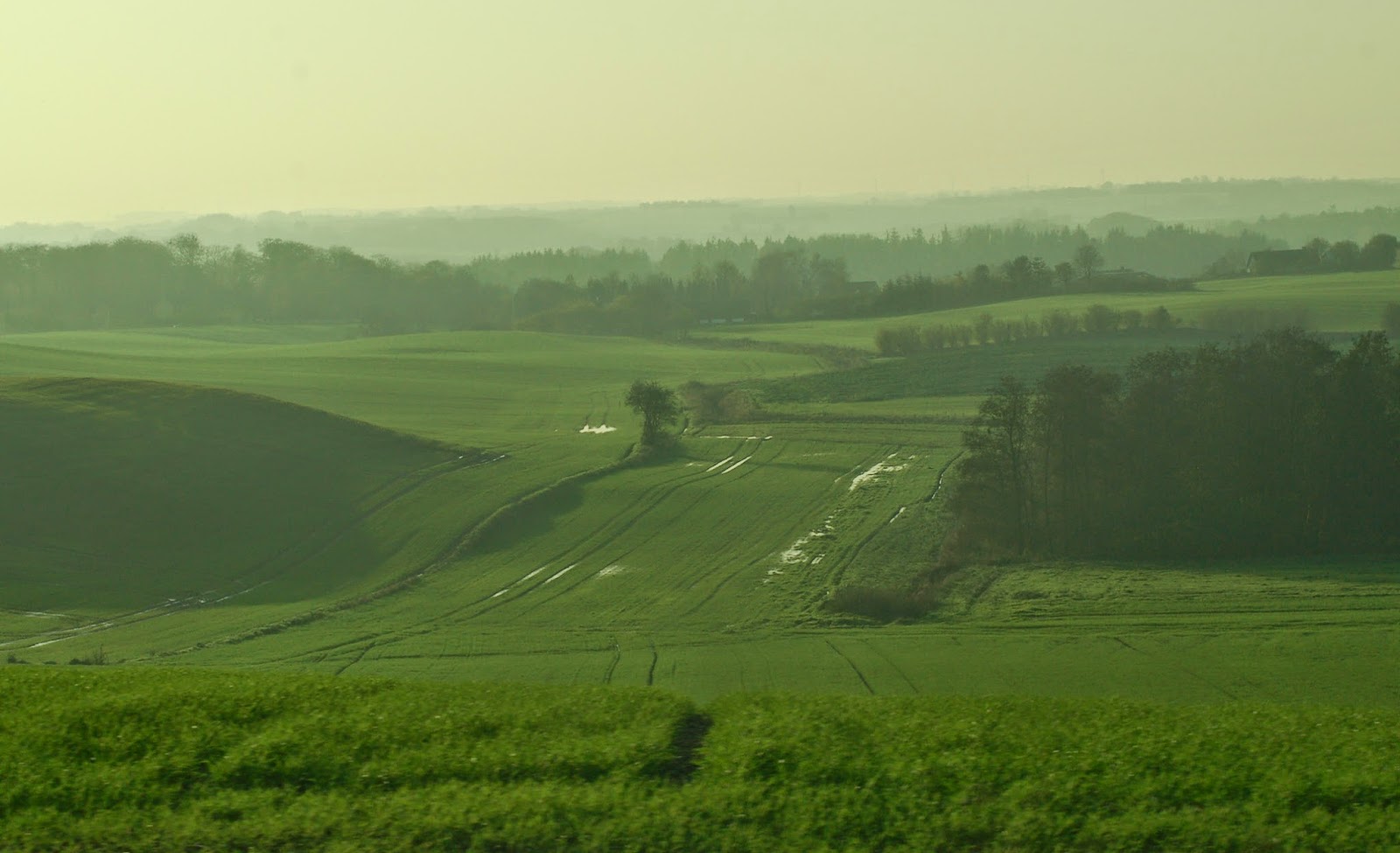
The winterseed creates lovely green fields during the winter season. On a  mild day in December the sun was shining through a haze across the winter-green fields.

The green fields are also good for geese and whooper swans who do some grazing up here North in winter.


You might almost believe that this is a spring morning and the church bell is ringing for service, but it is in the afternoon and the sun is already slowly on its way down.


If the winter is hard it can be a very costy business for the farmer. The extra expenses can be enormous if the seed is damaged. The winter is mild until now, sometimes with plus 10 Celsius which is a very high temperature in December.  But you can never tell. January and February can be a tough period for the winter seed.


A cosy little village lies surrounded by green fields.

A centralization in the 1960s meant that many shops, manufacturing business and schools have disappeared from the villages. But the increasing interest for the local community, environment and nature has caused that many villages have become attractive for people who are commuting to their job or go shopping in the big cities.

In some regions called udkantsDanmark  ( outskirtsDenmark) are problems because the necessary  jobs are only to find in the big cities. One of the results are many empty houses in the villages and no shops at all. A sad development.


It looks so peaceful and beautiful. This might be a scene from a Jane Austen film with d'Arcy and Elizabeth coming in from the right.............


Now it's later in the afternoon and the green fields are darker green.  Today's painters do not (usually) create their paintings outdoors. ( Maybe when they do watercolours). But when it was common to work on a painting outdoors they had to work fast in order to catch the light and the shades which many French impressionists have described. .


The last landscape from this day in December. The light is quickly fading. See you next time!


 photo East Jutland December 2014: grethe bachmann


Thursday, May 02, 2013

A Visit to a quiet Peninsula............


There is a pretty hilly landscape on a little, broad peninsula east of the town Skive. It has no name expect the old district-name; Fjends herred - and now Ørum parish. The first place for our visit one of the last days in the windy and cold April was the old manor Staarup Hovedgård, which is now a center of antique furniture and artifacts from the 1700s-1900s. I had visited the main building before, this time it was the gatehouse-wing with antique Chinese furniture. I didn't buy anything, they were rather expensive. No wonder! They have been laquered and laquered "a thousand times". I saw a little red (low)  cupboard. I loved it. I would like this in my home.
In the summer period there is much more life here with a well-visited cafeteria and restaurant and many concert arrangements etc.


The peninsula is surrounded by the waters of Skive fjord and Hjarbæk fjord, both are parts and corners of Limfjorden. The landscape is hilly and pretty and marked by being a socalled herregårdslandskab, a manor-landscape, which only makes it better. You are driving through small villages and passing fine churches and you are close to a fine view from the old winding country roads everywhere. 


Here is also an old kloster, Ørslevkloster, where I had to do a stop for I wanted to get a photo of a chessboard ashlar on the church wall. I was told they had found one. I didn't find it, but there was no access to the south side of the church, and I later discovered that the chessboard was there of course.
Since the last time we was here there is now public access to the kloster garden with an old lime avenue leading down to a fine little water stream.
bikes outside the refugium
The garden is now being renovated and here will be a perfect place for people to visit.

The kloster itself is now a  refugium for students and artists, authors etc. who wish peace and quiet.
In my blog Church and Manor is an article about Ørslevkloster. 


yellow farm

Strandet

Two Good Friends 


Again a drive through a pretty landscape. I love it. It is such a rest for the eye and a joy for the mind. The next place was also a manor, called Strandet. Two horses walked next to each other in the field downside the manor, a big heavy horse and a very little cute one; they followed each other step by step.  I don't think a horse likes to be alone in a field. They are social like everyone else.
The whitewashed manor Strandet lies upon a hill close to Jordbro Å-river, a fine fishing river with sea trout, trout and rainbow trout. Strandet is from the 1400s, but was rebuilt after a fire. Opposite upon a hill in the meadow lies the Romanesque church Nr. Ørum. Close nearby was a harbour in the Middle Ages.

Am I boring you? Then stop reading and start something else, for the next place to visit is also a manor. Tårupgård, situated close to Hjarbæk fjord. Access to the fjord via a nature path. History about this manor is also in my blog Church and Manor. Both Staarupgård and Tårupgård were during the Middle Ages owned by the family Kaas, a family who owned a big part of North Jutland. The church lies close to the manor with steps from the yard up to the entrance - everyone had to go to service, it was  really a duty at that time. No excuses I suppose. The little son probably tried  "I have a stomach ache, daddy!". -  "WHAT? Off you go".  -  And off he went and up all the steps on his small legs to listen to the thunder sermon of the priest.

But we'll leave Tårupgård and continue along the beautiful scenery to the fishing village in the corner of Hjarbæk fjord.


Hjarbæk port was once the sea port of the town Viborg, when the church was rich and powerful the bishops of Viborg guarded zealously the fishing and sailing in Hjarbæk fjord. The Viborg bishop's ship lay at Hjarbæk harbour,  but also the rich aristocracy used the port at Hjarbæk in the Middle Ages.
There was furthermore a constant sailing with salt-barges to and from the island of Læsø. (you can still buy the Læsø salt in shops). The salt extraction was a very good business and the clerics in Viborg controlled both the production and the transport. 648 barrels salt were sailed to Hjarbæk each year in the late 1400s.

Today Hjarbæk is a cosy little fishing village with a lively tourist life in summer. Each year is held a VM in sailing with boats, called "slægts", the boats similar to the fishing boats from the old days.
 
Hjarbæk Fjord is an International Nature Protection Area, under Natura2000 Project, and it is both a Bird's Protection Area and EU-Habitat Area. 


And in the afternoon we were leaving Hjarbæk fjord and the little peninsula after a good day.


Some pretty clouds for you


A beautiful horse was running up and downhill in a very frisky manner with  some very elegant moves. And just try to look at this fine head and neck.  It's a noble horse.


photo April 2013: grethe bachmann


Læsø Sydesalt


 Here's a picture of the salt from Læsø(for sale in shops and supermarkets.