Showing posts with label horse. Show all posts

Monday, September 04, 2017

The Viking from Fregerslev


The Viking Period
The Viking period is dated to ab. 750-1060 AC. The word Viking means "sea warrior" or "warfare at sea". Many strong men went on Viking expeditions which were often lootings and assaults, but most Vikings lived a more quiet life with farming, fishing and hunting. The Realm formation and the formation of cities and a new religion had a great impact on the development in Denmark. The Society was sharply divided and the differences of rich and poor, free and unfree were significant. The Fregerslev find is - from the golden brackets - dated to the middle of the 900s. The royal power was well founded in that period , although dependent on the aristocracy which supported the king. The aristocracy had an important role in the king's maintenance of the power, and they enjoyed the privilegies from this. 


 You can see the first photos from Skanderborg Museum of objects from the Fregerslev grave at their website:

 http://www.vikingfregerslev.dk/


Bayeux tapestry

The Find at Fregerslev.
In 2012 a unic grave site emerged in an archaeologic excavation at Fregerslev near Skanderborg.(Jutland) It was a complex of chamber graves, several from a younger part of the Viking period, the time of the Jelling Kings. A small investigation in one of the graves showed a magnificent decorated horse bridle, lavishly decorated with gilt bronze brackets and a silver plated trense.Supposedly the Viking from Fregerslev had a funeral with all the equipment necessary for his travel to Valhalla. The find from Fregerslev is probably one of the richest graves from the Viking period ever found in Denmark, and the scientific potential is  invaluable.The excavation of the fascinating grave ended 11 May 2017 but the adventure is not yet over. Many years ahead is a massive work with excavation and interpretation of many earth blocks, which were taken in from the grave. Some X-rays reveal something hidden in the blocks, like metal pieces from the harnes of the Viking's horse.

Chamber Grave.
Some of the Viking Age's wealthiest people were buried in chamber-graves. A chamber-grave consists of a wooden chamber, which is either dug down into the earth or placed in a mound. From Denmark and the old Danish area we know of around 60 chamber-graves. Most of the burials have been found in the area south of the Danish-German border. But they can also be found in Jutland, as well as on Funen, Langeland and Lolland. Such chamber-graves are yet to be found on Zealand. The grave type comes into use at the end of the 800s – perhaps to counter the advancing Christianity?

A chamber grave (Kammergrav) was a grave form reserved for the elite. It was a wooden chamber with enough place for the deceased, grave gifts and personal equipment. Chamber graves with a horseman's equipment are rare, they are only known from 45 finds from the Viking period in the old Danish region: the present Denmark, Skaane, Halland , Blekinge and Schleswig-Holstein. Few of these graves are well documented, especially because of old unfinished excavations or just old clearings of  grave hills. The latest excavated grave with horseman's equipment appeared in 1983 in Grimstrup at Esbjerg.


Viking Ship Museum, Oslo,Bridle, Viking horse,wiki
In few welldocumented graves are few fine parallels. In Schleswig upon the grave sites Thumby, Bienebeck and Lanballigau are horseman's graves with objects which- as for shape and decoration - are contemporary to the decoration brackets in the Fregerslev grave. A few objects are almost identical and must be considered made in the same workshop. Maybe the king has ordered several identical set of bridles which he could give as an alliance gift to his faithful subjects.

The grave site in Fregerslev consists of a large grave chamber complex and two lesser graves. The two small graves are excavated, one grave measured at surface 267x172 cm, length north-south. The grave was only 38 cm deep and had no preserved objects. The other grave measured 265x170 cm at surface and was oriented west southwest. This grave was 120 cm deep - and in the fill were two layers of giant stones. In the bottom of the grave were traces of an oak coffin which had been lightly burned before the laying.


Bayeux tapestry
The Viking from Fregerslev
 At the same time were traces of a skeleton of a person 165-170 cm tall. The person lay on his back with head west. The skeleton was much dissolved, but it was however possible to see a strange crack upon the shine leg. The leg had possibly been broken, but it is uncertain if this happened before or after death. In this grave were not found any preserved objects, except a single iron nail, which probably was a part of the construction of the coffin. Around the grave was built a hedge or a small building. It is unusual to find constructions around the graves from the Viking period. With a broken shine leg and two layers of giant granite boulders above and a possible fence the person must have been something special - someone who should not rise from his grave. 

The Top of the Hierarchy.  
Based upon the richly decorated bridle for theViking's horse there is no doubt that this is a man from the top of the hierarchy in the Viking period. The uppermost power was the king, and his role depended on personal alliances military strength and foreign contacts. The Viking from Fregerslev might have had the title of Jarl (earl). He might have been an army chief administering a large piece of land, and one of his duties was to be a host for the king on his travels in the country. If - after the excavation - it would be possible to identify him as a known historic person or legendary figure depends on whether there are unic finds, like objects with runic inscriptions or other special finds, which might tell us,who this Viking was.


Jelling stones, Jelling, photo:gb 


The research project is a cooperation between Skanderborg Kommune, Slots- og Kulturstyrelsen, Nationalmuseet, Aarhus Universitet and Museum Skanderborg with appropriations from Augustinus Fonden and Den A.P.Møllerske Støttefond as well as funds from Slots' og Kulturstyrelsen and Skanderborg Kommune. The first part is to secure the find by excavation and following conservation of the grave equipment and performance of scientific examinations. Later come part two and three with respectively research and publication and exhibition and communication.

.
Source: Skanderborg Museum and National Museum.


Friday, November 27, 2015

The Sun always shines above the Clouds..............


Sunset, Gilleleje, Zealand
It is late November - and it is soon midwinter, the sun sets early in the afternoon. The earth in my garden is wet, wet, wet -  and the sun has no power in the short time it shows its face during the day hours. But from December 21 at winter solstice the sun will slowly return to its usual power in spring and summertime. And then we can sing "Here comes the sun......"


We do not worship and sacrifice to the sun like the ancient people did. The sun's power over mankind was always great, especially in the countries to the North, where the sun at midwinter is like a far disc,  pale, golden and cold as the moon  -   and in some places like in The Land of the Midnight Sun it disappears for a period. No wonder the ancient people tried to recreate the sun above the southern horizon, the warmth  had to come back to bring life over nature after a dark winter -  and when the sun appeared again, its return was celebrated with cheers throughout the settlements.

Trundholm Sun Chariot
Petroglyphs with sun sign
During Stone Age and Bronze Age the sun was one of the lifegiving powers which people feared the most, but it was also the power which was mostly worshipped. It was the first of the heavenly powers which was brought to the North with the first farmers and cattle breeders about 5000 years ago. When the sun chariot from Trundholm was found,  it was a proof that the sun was worshipped in ancient times. The sun chariot was the costiest thing people had, with a golden disc and a magnificent horse, and they always sacrificed their most valuable item to the sun god.

The horse was in Bronze Age a sacred animal, it was only used in religious celebrations, stallion fights and in the first sacred ploughing of the New Year. The chariot and the horse is an unambiguously witness that the sun was worshipped in early Bronze Age - or else the sun is in ancient times most often reproduced by a sign: a wheel cross, a circle, a spiral or a fully carved disc which is seen on some petroglyphs. It is known that in the near Orient and in North India the wheel was in ancient times a commonly used image of the sun. The circle or the ring is the simplest reproduction of the sun, and together with the spiral those signs decorated the disc of the Trundholm chariot.


Midsummer celebration, Sweden, 1969.
Although people was still worshipping the sun it lost some prominence during Bronze Age. The sign of the sun did not disappear. through the times and up till present, it was still there, seen mostly as a wheel with four or more spokes . A weak reflection has been kept in the sundance on Pentecost morning . Especially in spring and midsummer many places in the North and bordering areas to the south continued the fertility-belief, which was linked to the sun and the power of the sun. They rolled burning wheels and discs down over hillsides or threw them up in the air. A sign of the sun like plaited wreaths are still put on new buildings as a celebration or at a midsummer pole -  and no one wonder why or know that this is a continuation of a fertility cult.

Sami family in spring celebration.
A special source of information about the sun cult from Prehistoric time is probably the Sami people's worshipping of gods, which continued up till the 17th  and 18th  century. It was written down by officious Swedish priests and Norwegian missionaries,  who fought a destruction-war against this worshipping. This part of the Sami religion might be due to the contact they had with the Norse people in a very distant period.
 When the Sames got lost in the mountains because of bad weather and fog, they placed as a sacrifice to the sun a holed wooden disc : a wheel. On Christmas morning they saluted the sun and drank its tribute and took omens about good or bad luck in the year to come from the sunshine upon a brass ring in water. After the homecoming they drank a tribute to the fertility gods and brought sacrifices to the sun, the bones of the sacrificed animals were placed in a circle upon a sacred table - or meat hung up in a circle-bend wicker twig. The sun would then recognize its sacrifice through the sun signs. At midsummer wreaths of leaves and grass were hung up in honour of the sun.


Swedish Christmas cakes 16th century.


A link between midwinter's solstice, old ancient sun-belief  and the fertility of the next year,  were up till present time kept in the Swedish Christmas bread,which was decorated with the signs of the sun, the wheel and the spiral. The Christmas bread was stored in winter - and in spring it was crumbled and given in small bites to both humans and animals in the farm on the first day of the spring-sowing in order to secure a good harvest.
.


Archaeological magazine SKALK nr. 4, 1961: P.V.Glob, "Solens Tegn".
photo Gilleleje: grethe bachmann
other photos: wikipedia. 

Friday, October 23, 2015

Grazing with Cattle, Sheep and Horses in Mols Bjerge


So- called half-cultural areas like meadows, heaths and pastures can today - as a part of nature conservation - be preserved by grazing with cattle, sheep and horses.


Cattle 
Cattle is ideal for nature conservation . They eat the grass and don't like the bitter tasting flowers like buttercups. Furthermore they do not graze by the cow dungs. In this way several plants will be allowed to flourish for the benefit of the propagation of flowers and insects.

In public areas a specially developed forest breed is used, which is a crossbreed between 2 Danish dairy breeds and 9 various beef breeds. They are though animals , adapted for grazing in nature land all year.

At the Mols laboratory small longhaired cattle of the Galloway race is used. They are imported from Scotland and have the same properties as the breeds mentioned above.


.

A cute Galloway calf - just look at those eyelashes!


Sheep 
Sheep are especially good for nursing the archaeological sites, the slopes and other vulnerable places. Sheep are better than cattle to keep trees and bushes down, but their grazing results in a more flower-poor cover of plants. Icelandic sheep are used at the land of the Mols laboratory.


Horses.
Horses are used in a few places in Mols Bjerge for nature conservation. Horses are better than cattle and sheep to eat the wavy hair grass, which is the most common grass in the open fields. Unfortunately the horses are not well-suited where the public is allowed to go because of their curious and restless behaviour.   


a small part of Øvre Strandkær's buildings


Mols Laboratory is owned by Naturhistorisk Museum in Aarhus. It is used as a field lab by scientists and students from universities and colleges.

Øvre Strandkær is a property of Miljøministeriet (Ministry of Environment). Here is an exhibition and from here is managed the forest-district's cattle-herd , ab. 200 animals, which are used for nature conservation. at Mols and Helgenæs. They are peaceful animals, which thrive in the nature land all year.

photo: grethe bachmann. 
source: Aarhus Amtskommune Naturafdelingen. 


Thursday, May 02, 2013

A Visit to a quiet Peninsula............


There is a pretty hilly landscape on a little, broad peninsula east of the town Skive. It has no name expect the old district-name; Fjends herred - and now Ørum parish. The first place for our visit one of the last days in the windy and cold April was the old manor Staarup HovedgÃ¥rd, which is now a center of antique furniture and artifacts from the 1700s-1900s. I had visited the main building before, this time it was the gatehouse-wing with antique Chinese furniture. I didn't buy anything, they were rather expensive. No wonder! They have been laquered and laquered "a thousand times". I saw a little red (low)  cupboard. I loved it. I would like this in my home.
In the summer period there is much more life here with a well-visited cafeteria and restaurant and many concert arrangements etc.


The peninsula is surrounded by the waters of Skive fjord and Hjarbæk fjord, both are parts and corners of Limfjorden. The landscape is hilly and pretty and marked by being a socalled herregÃ¥rdslandskab, a manor-landscape, which only makes it better. You are driving through small villages and passing fine churches and you are close to a fine view from the old winding country roads everywhere. 


Here is also an old kloster, Ørslevkloster, where I had to do a stop for I wanted to get a photo of a chessboard ashlar on the church wall. I was told they had found one. I didn't find it, but there was no access to the south side of the church, and I later discovered that the chessboard was there of course.
Since the last time we was here there is now public access to the kloster garden with an old lime avenue leading down to a fine little water stream.
bikes outside the refugium
The garden is now being renovated and here will be a perfect place for people to visit.

The kloster itself is now a  refugium for students and artists, authors etc. who wish peace and quiet.
In my blog Church and Manor is an article about Ørslevkloster. 


yellow farm

Strandet

Two Good Friends 


Again a drive through a pretty landscape. I love it. It is such a rest for the eye and a joy for the mind. The next place was also a manor, called Strandet. Two horses walked next to each other in the field downside the manor, a big heavy horse and a very little cute one; they followed each other step by step.  I don't think a horse likes to be alone in a field. They are social like everyone else.
The whitewashed manor Strandet lies upon a hill close to Jordbro Å-river, a fine fishing river with sea trout, trout and rainbow trout. Strandet is from the 1400s, but was rebuilt after a fire. Opposite upon a hill in the meadow lies the Romanesque church Nr. Ørum. Close nearby was a harbour in the Middle Ages.

Am I boring you? Then stop reading and start something else, for the next place to visit is also a manor. TÃ¥rupgÃ¥rd, situated close to Hjarbæk fjord. Access to the fjord via a nature path. History about this manor is also in my blog Church and Manor. Both StaarupgÃ¥rd and TÃ¥rupgÃ¥rd were during the Middle Ages owned by the family Kaas, a family who owned a big part of North Jutland. The church lies close to the manor with steps from the yard up to the entrance - everyone had to go to service, it was  really a duty at that time. No excuses I suppose. The little son probably tried  "I have a stomach ache, daddy!". -  "WHAT? Off you go".  -  And off he went and up all the steps on his small legs to listen to the thunder sermon of the priest.

But we'll leave Tårupgård and continue along the beautiful scenery to the fishing village in the corner of Hjarbæk fjord.


Hjarbæk port was once the sea port of the town Viborg, when the church was rich and powerful the bishops of Viborg guarded zealously the fishing and sailing in Hjarbæk fjord. The Viborg bishop's ship lay at Hjarbæk harbour,  but also the rich aristocracy used the port at Hjarbæk in the Middle Ages.
There was furthermore a constant sailing with salt-barges to and from the island of Læsø. (you can still buy the Læsø salt in shops). The salt extraction was a very good business and the clerics in Viborg controlled both the production and the transport. 648 barrels salt were sailed to Hjarbæk each year in the late 1400s.

Today Hjarbæk is a cosy little fishing village with a lively tourist life in summer. Each year is held a VM in sailing with boats, called "slægts", the boats similar to the fishing boats from the old days.
 
Hjarbæk Fjord is an International Nature Protection Area, under Natura2000 Project, and it is both a Bird's Protection Area and EU-Habitat Area. 


And in the afternoon we were leaving Hjarbæk fjord and the little peninsula after a good day.


Some pretty clouds for you


A beautiful horse was running up and downhill in a very frisky manner with  some very elegant moves. And just try to look at this fine head and neck.  It's a noble horse.


photo April 2013: grethe bachmann


Læsø Sydesalt


 Here's a picture of the salt from Læsø(for sale in shops and supermarkets.

Thursday, September 13, 2012

A Huge Dog - and Two Attentive Horses.......

I saw a huge dog lately. It was so muscular that it was moving like in slow-motion as if its muscles were too heavy. The photos are taken from inside the car. I dared not go outside although I was on a good distance. I was a sissy. But I felt it like I had to beware a lion in the lion park at Billund.
The horses are attentive. ....
This slow and maybe lazy dog might be able to move fast - like a heavy bear. Have you seen a polar bear when it's moving fast ? I didn't want to be noticed outside the car by that dog.


What kind of dog is it? I googled the Mastiff, and it looks like the English Mastiff, doesn't it? The owner looks so thin and little next to it. If you had just seen this dog and the way it was moving. Like a predator on guard. Maybe it's a nice dog. Like the Great Dane. It's a nice dog, but it doesn't move like this one.

they are  whinnying and shaking the mane.


 Notice the horses. They are very attentive from the first beginning. They stand in a defensive attitude - and one horse shakes its head so the mane is flying! (if you enlarge you can see it)


Maybe it's a nice dog, but I wouldn't depend on that.


He is so little isn't he? The owner I mean............


photo Viborg August 2012: grethe bachmann

Tuesday, September 04, 2012

Those Lovely Horses............

 It was on a very hot day in Mols Bjerge. The air humidity was high and the horses looked like they were suffering a little from the heat, one looked as if it couldn't keep its eyes open.  They were all staying in the same spot under the trees. So it's not only us humans who are plagued by the heat!! It was one of those days with thunder on its way. 

They are so lovely those Icelandic horses.


photo Mols Bjerge August 2012: grethe bachmann.


The daughter who won't lift a finger in the house is the same child who cycles madly off in the pouring rain to spend all morning mucking out a stable.  ~Samantha Armstrong
 

Tuesday, April 24, 2012

Pippi Longstocking's Horse


"Pippi-horse"
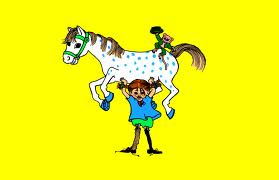
The other day I saw one of those horses we in Scandinavia call a Pippi Langstrømpe-hest. Pippi had this white horse with a lot of spots and she was able to lift it one-handed.  The books about Pippi are loved by every child in Sweden and the rest of Scandinavia.


I guess that most of you know Pippi (Peppi) Longstocking. Astrid Lindgrens books are translated into 64 languages

Astrid Lindgren's first three Pippi-books were published from 1945-48. Pippi was named by Astrid Lindgren's then nine-year-old daughter Karin. Pippi is unconventional and has superhuman strenght, she is able to lift her horse, she mocks and and dupes adults, but she reserves her worst behaviour for her most pompous and condescending of adults. Her anger is reserved for the most extreme cases, such as when a man ill-treats her horse, Like Peter Pan Pippi does not want to grow up.

Pippi claims her full name is Pippilotta Delicatessa Windowshade Mackrelmint Ephraim's Daughter Longstocking (Swedish: Pippilotta Viktualia Rullgardina Krusmynta Efraimsdotter LÃ¥ngstrump). Her fiery red hair is worn in pigtails, so tightly wound that they stick out sideways from her head.
Pippi lives in a small Swedish village, in an exciting house Villa Villekulla with her monkey hr. Nilsson and her horse, but no adults or relatives. She's got two friends Tommy and Annika, two children who live next door. Pippi's two main possessions are a suitcase full of gold coins (which she used to buy her horse) and a large chest of drawers containing various small treasures.
Pippi is the daughter of seafarer Ephraim Longstocking, captain of the sailing ship  Hoptoad (Hoppetossa in Swedish), from whom Pippi inherited her common sense and incredible strength. Captain Longstocking is the only person known who can match Pippi in physical ability. He originally bought Villa Villekulla to give his daughter a more stable home life than that onboard the ship, although Pippi loves the seafaring life and is a better sailor and helmsman than most of her father's crew.

Villa Villekulla
The story goes on and on with Pippi  and Tommy and Annnika, and Astrid Lindgren is one of the most loved authors of children books. She is the world's 18th most translated author and has sold roughly 145 million copies worldwide.The best-known books by Astrid Lindgren: The Pippi Longstocking series, Karlsson-on-the roof-series, Emil of Lönneberga, The Bill Bergson series, Madicken, Ronia the Robber's Daughter, Seacrow Island, The Six Bullerby Children, Mio, my Mio, The Brothers Lionheart.(some of the books are on film and TV).

Astrid Lindgreen died in 2002, 94 years of age.