Showing posts with label migration. Show all posts

Wednesday, November 11, 2015

A little about Bird Migration

Geese gathering at Alrø bird reserve

The migratory birds move thousands of kilometres each spring and autumn, in spring to the north to their breeding places in Scandinavia in order to nest and have kids. Here is a lot of space and food in summer. In autum the migratory birds fly south to their winter-quarter in the warm countries, where they can rest and find food while snow and frost cover the earth in Scandinavia.

Denmark is a crossroad for both water birds and land birds Birdwatchers estimate that about half a a billion birds pass the southern Scandinavia each autumn.

The land birds prefer to fly over land as far as possible before the flight across sea - therefore they follow the coastline until they are forced to cross the sea.
The water birds prefer to fly across water as far as possible -  therefore they also follow the coast line  until they are forced to fly over land.

An extreme example of bird migration is the Arctic tern which breeds far north near Arctis and overwinters at Antarctis. The species fly usually a yearly migration of ab. 34.000 kilometer. Some individuals can even traverse over 80.000 kilometer yearly, which is the double of the circumference of the earth.


The birds' orientation, the ability to find their way, is genetically determined. How the birds orient themselves is not quite clarified, but it is known that birds use several methods like the Terrestrial magnetic field, constellations, the sun and moon position, polarized light and visual Memory.

Some examinations have shown that the birds not only feed on their fat-reserves but that some of their organs grow smaller during the migration - so the birds exploit the bound energy from fx muscles, stomach, liver and other inner organs. In this way the birds get both energy and a lower weight, which makes the flight easier.

During the migration the birds feed on metabolic water, which is released as a biproduct during the metabolism when the stored fat is burned. The biggest loss of fluid during the flight happens via the exhaled air,  but the birds lose only little fluid through their droppings.

Most of the big birds, like swans and geese, must be taught by their parents in order to find the right migratory route between the winter quarter and the breeding place.

Several migratory birds can fly at least a week in a row without landing.

Some species, like geese and swans, fly in formation during the migration like the V-formation (the wedge formation). A common misunderstanding is that a formation like this has a leading goose in front,  but the birds change place alternately.

It is relatively easy to imagine that a big bird of prey can hover all the way to southern Europe or Africa on spread wings, but it is difficult to imagine a little bird on such a long trip. A bird weighing 10-15 gram has to bring fat in order to be able to survive the tour over long stretches, where it might have no possibility to seek food, water or shadow.

And what I have found here above is just a small part about this fantastic bird migration, the source is wikipedia, the photos; grethe bachmann . 


The bird migration is a wonderful miracle, isn't it? 

    Sunday, December 13, 2009

    Vejlerne, North Jutland


    Marsh harrier

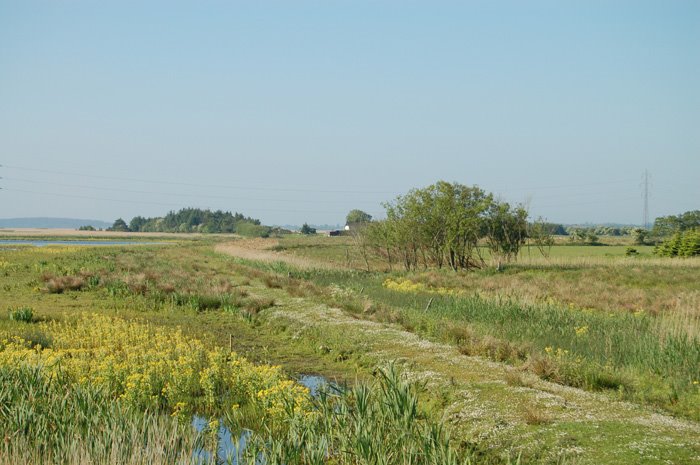
    Vejlerne is a huge nature area situated between Lønnerup fjord to the west, Lund fjord to the north, Bygholm Vejle to the east and Limfjorden to the south. The area is about 6000 hectare, and it covers various nature types like meadow, reed wood, moor and fjord. The many fjords in the area were earlier connected to Limfjorden, and the areas with the byname Vejle (Bygholm Vejle, Arup Vejle, Krap Vejle etc) were a section of the waters close to the coasts of Limfjorden.

    A drainage project had its beginning in 1866. Engineers, entrepreneurs, landowners tried with lesser succes during 40 years to drain the low waters of Limfjorden (Østerild fjord, Vesløs/Arup Vejle, Tømmerby fjord, Lund fjord and Bygholm Vejle), but they had to give up after having fought against weather, wind and the power of nature - and at last they had to admit that it was an almost impossible task to drain the earlier sea-bed.(with the technique from those days).


    Krap Vejle

    Krap Vejle, I heard but didn't see the Eurasian bittern


    Krap Vejle, a young one

    The area has since the stop of the drainage project been laid out as a protected nature reserve with national and international rules, and it is now assigned to the rules for EU-bird-protection-areas, Ramsar- areas and hunting-free areas. The varied nature in Vejlerne has a special chapter of Danish history, and many books have been written about the flora and fauna in this district. The area is now almost untouched, except the yearly cattle grazing and mowing in the largest meadow areas.

    Vejlerne are visited all year by large bird populations. The amounts of ice and snow in winter decide how many birds are in the area. If the winter is mild there will be large flocks of pink-footed goose and whooper swan, various ducks and over wintering birds of prey, like blue harrier, white-tailed eagle and peregrine falcon. Upon meadows and fields are flocks of snow buntings and shore larks. If the winter is hard, Vejlerne might not be rich in birds.


    Kærup Holme

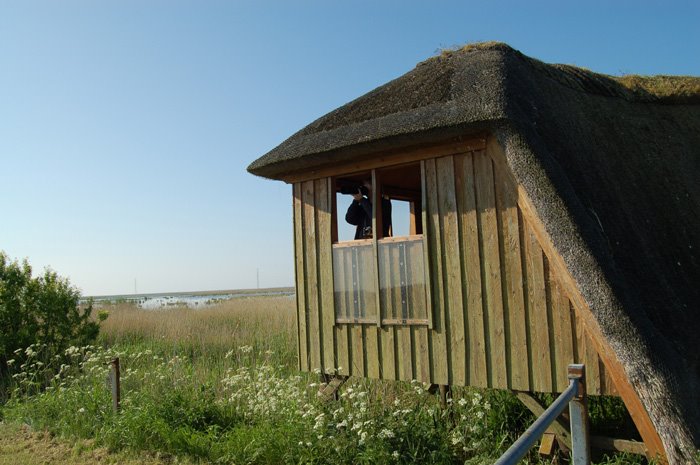
    Kærup Holme, a view from the tower

    Kærup Holme, a nice little family

    In spring come large populations of ducks if the waterlevels are ideal. Numerous are i.e. widgeon and teal. The pink-footed goose culminate in March, the same does the barnacle-goose. The spring migration guests arrive at the same time, Eurasian spoonbill, Common Crane, Black-tailed godwit and Pied Avocet. The wading birds' spring migration are dominated by various sandpipers, Eurasian golden plover, ruffs. Temminck's stint has one of the best localities in Vejlerne. As for breeding birds Vejlerne is unique, since the area has some of the most important populations of Eurasian bittern, greylag goose, spotted crake, common dunlin, black-tailed godwit, pied avocet, ruff, and black Tern. Little gull breeds occassionally.


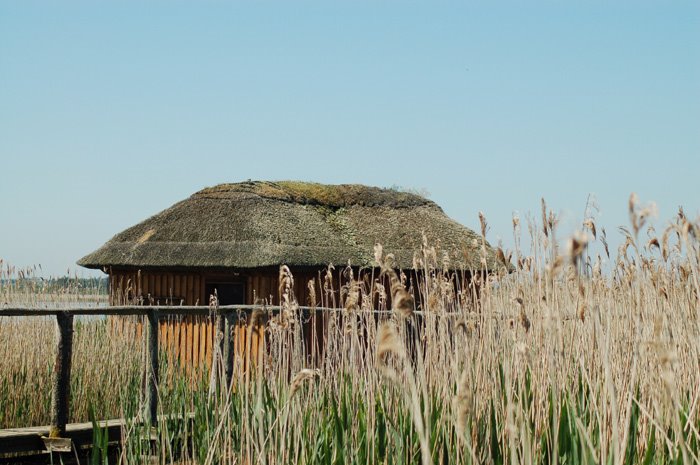
    Bygholm Vejle, a popular place for bird watching.


    Bygholm Vejle, two towers connected


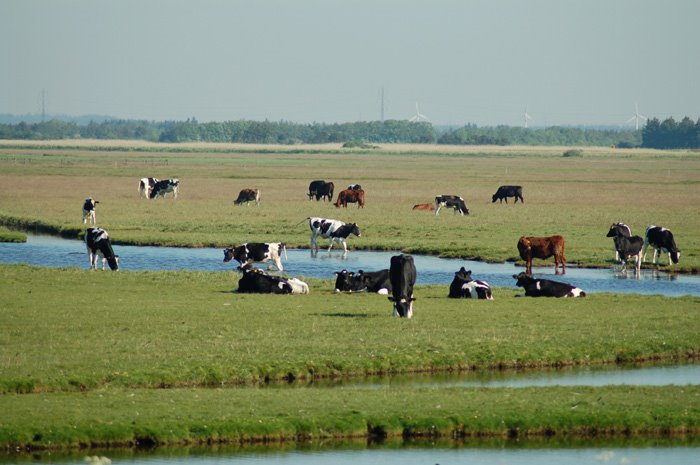
    Bygholm Vejle, cattle-grazing


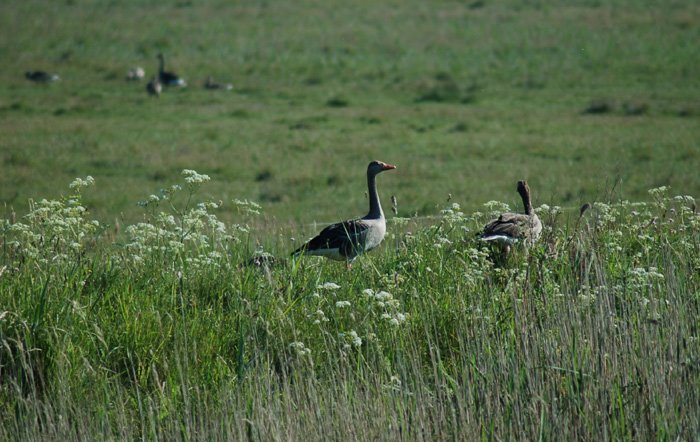
    Bygholm Vejle, geese

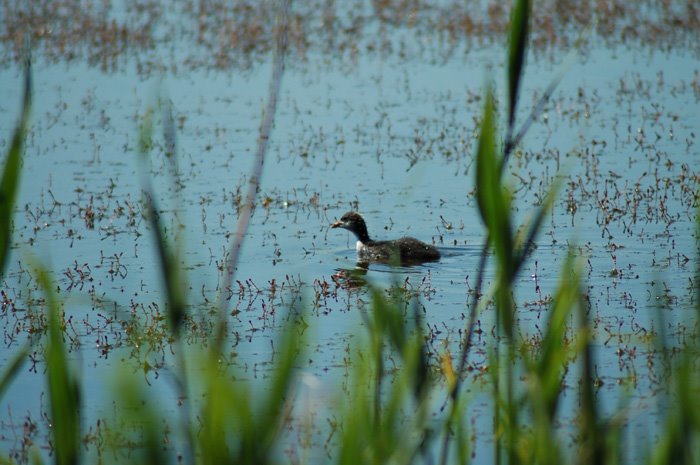
    Bygholm Vejle, Mute swan

    During summer the birds are dominated by wading birds, common shelduck, and usually seen little egret, great egret, Caspian tern etc. At the same time the Eurasian spoonbills arrive from the breeding place in Nibe bredning and gather at the meadow in Bygholm Vejle with their young ones. More than 100 birds at the same time (200/ 162). Little gulls are often numerous in Kærup Holme area. Late summer come more and more cranes and they culminate usually in the end of September or start of October with up till 121 birds (in 2006). The cranes are easiest to see from the Kraptårnet, where they come flying across the Bygholm meadow for overnighting or fouraging in the fields east of Vejlerne. Autumn is like spring, but often the populations are much larger, i.e. up till 40.000 ducks, 13.000 greylag geese and 18.000 golden plovers. Peregrine falcon is seen regularly and up till nine have been seen at the same time on a September's day. In September and October are large numbers of bearded tits with their characteristic flying up and down.

    Over 300 various bird species are seen in Vejlerne, the list of accidental guests is very long. American bittern, black-crowned night heron, purple heron, glossy ibis, red-breasted goose, blue-winged teal, Braillon's crake, Demoiselle crane, black-necked stilt, collared pratincole, black-winged pratincole, American golden plover, white-tailed lapwing, stilt sandpiper, lesser yellowleg, long-billed dowitcher, whiskered tern, snowy owl, red-rumped swallow, Blyth's pipit, citrine wagtail , Siberian stonechat, White's thrush, Pallas's warbler, lesser grey shrike, rosy starling, rustic bunting, little bunting - just to mention a few.

    photo
    Vejlerne: grethe bachmann