By people in the Frankish kingdom and on the British Isles the
Danes were first of all considered Vikings. Danish attackers, conquerors and
colonists played an important role in the remake of western Europe, but
they also had a strong influence in their own country.
Some Viking
chiefs, who had won riches, power and glory came home to Denmark and
tried to usurp royal power. King Horik and most of his family were
killed in such a power feud in 854. The old branch of the royal family
gained footfold , but other homecoming Viking chiefs - some from the
east - were more lucky in their fight about the throne. The fortification moats in Aarhus might have been built during that
period.
The diplomatic connections between the Danish kings and the Frank and
German rulers brought foreign influences to Denmark. King Harald was
baptized in Mainz in 826, and he was not the only Dane, who experienced
and was impressed by the court ceremoniel of the Franks. Maybe this
infected the life in the Danish royal castle in the 800s, but as for the
900s the big Jelling stone and the cross-marked coins show that Harald
Bluetooth fully understood the value of demonstrating his royal dignity.
The Jelling church was probably bigger than many other Danish
buildings, and its basic plan was inspired by the German churches.
The Franks and the Germans did not only affect their Danish
neighbours - they also wanted to have power over them, but they did not
succeed. The Danes could retriet from Jutland to security on the Danish Isles and
gather new strenght while the peninsula Jutland was attacked - and the Saxon hertug
Bruno and his army had to learn this in 880......the only Danish king
who in the 800s had to acknowledge the supremacy of the Franks was
Harald Klak, and he was deposed and driven into exile .
The feud between the various throne pretenders weakened seriously
the power of the Danish kings, and in 934 the Danes could not resist an
attack in southern Norway from the German army. The Danish supremacy broke down
and Harald Fairhairwas able to expand his Norwegian power while local rulers in the districts east of Storebælt (Danernes Mark) enjoyed a great independency.
Fyrkat , Jutland, photo:GB
Later the German king Henrik 1 forced the Danes to pay taxes, and two
generations later the Germans ruled in Sønderjylland (South Jutland) for a
short number of years (974-983). Nothing indicates that Harald Bluetooth
ever acknowledged German rulers as his overlords - but after 983 and in
the following century the Germans were too busy feuding their Slavic
neighbours to care about Denmark. Undoubtly it was the German occupation of Sønderjylland which
made Harald build the complicated system of fortifications and
roads which gave a clear expression of his power and talent of
organisation. In order to build the fortifications Trelleborg ,
Nonnebakken; Fyrkat and Aggersborg and the great bridges - which were
all
built at the same time - the king had to exploit his right to recruit
labor and demand other necessary services from the Danish population .
Most probably these heavy burdens made him unpopular among the Danes and
led to the rebellion which drove him into exile and death.
Runic inscriptions mention two earlier rulers at Funen, Roulv and
Alle. The Glavendrupstone was raised in the memory of Alle by his widow
Ragnhild and his sons. Ragnhild had the Danish rune-
master to carve the
inscription upon the runestone in Tryggevælde at Zealand
Glavendrupstone
for the
memory of her second husband, Gunulv, about whom it
was said that "few are born better than he". It is not known which stone
was raised first, but these men must have been contemporary to king Harald,
and they might even have been local chiefs, who by acknowledging Harald
as their king, took part in making it possible for him to announce that he
had "won himself all Denmark. "
Harald's kingdom was exposed for disturbances from Viking fleets. As the leader of the expeditions to the west Sweyn Forkbeardsaw
to that his men were awarded like other men of the Viking chiefs.
Torkel's fleet represented the biggest threat however. He was now in the service
of the English king, but it was Sweyn who in 1013 seized the English
throne and thereby got access to the rich sources in England.
The
riches of Englands made Cnut the Great able to realise the Danish
demand on the supremacy of a large part of Scandinavia, much more than
his predecessors had ever been able to. Still before Cnut drove the
Norse king Olav into exile he demanded to be king of the Norwegians -
and at the same time he declared he was king of a part of the Swedes. It
is not known what he actually meant - he might have thought of the
West Goths, whose access to the sea went through Danish territory, but
it was more probable that he considered himself as the overlord of the
Swedes who had been warriors in his army. As king of England Cnut
advised one of the most advanced and
effective Governments of Europe - and it did not last long before
this English influence was evident in Denmark. The attempts to establish
a
well-functioning coin was finally successfull and much was done
to promote the development of cities which became metropols for the
royal power. In some cities were established bishoprics - and the
bishops were
fetched from England or at least educated there. Cnut's great kingdom
sank
into the gravel after his death but the changes he had started were
continued by his successors and long after the separation of Denmark and
England the
English influence was noticed in the Danish church.
Merchants, wandering craftsmen, Christian missionaires, diplomats and
the Vikings themselves were all the cause of influences from abroad in
Denmark. The Danes connected more and more to the outside world during
the Viking period than ever before and the consequences began to show in
the beginning of the 1000s - cities were founded, bishoprics and a
royal coinage were established. It is clear via archaeology that all
parts of society were affected by the contact to the outside world. In
each archaeologically examined village from the Viking period are rests
of mill stones from the Rhine district and soapstone-vessels and
grindstones from the northern Scandinavia. In Jutland are found western
European ceramics - and Slavic clay ware or Danish copies are found in
the eastern part of Denmark . More perishable goods like clothes and
wine were probably also widespread. The imported goods were spread all
over Denmark - but they were not for free. Wealthy Danes who lived in
the 1000s were capable of paying their shopping with coins and other
silver - but the import was through the whole period generally paid
with Danish export products or with services and catering to the foreign
merchants who visited the Danish harbours on their tour between the
Baltics and Western Europe. Cattle was one of the most important export
products
Highland cattle, foto:GB
. An early phase of this traffic is proved by the archaeological
find of a large heap of cow dung which had accumulated in the town of
Ribe. This indicates that cattle was gathered here, probably in order
to transport them by sea.
Ansgar
village and church, Hjerl hede, foto:GB
Except from Willibrord's visit in the beginning of the
700s the Christian mission began in 823 among the Danes when archbishop
Ebbo baptized a great number of Danes. Ebbo's, Ansgar's and the preaching
of their successors might have convinced many that the Christian God
was a mighty God, but it was not until king Harald's conversion 150
years later that Christianity became the only legal religion. The
Christian message was being preached by missionary bishops. In the
beginning of the 1000s were established bishpoprics, and in the middle
of the same century were churches built all over Denmark. In most regions of
Denmark church services and new rituals were provided in a foreign
language by men who rarely had any education. Gradually the church
seized several areas of daily life, also the marriage - and eventually
the top officials of the Danish church were incorporated in the elite of
the Holy Church. Several rituals, like cremation and eating horsemeat
were quickly submitted, while other rituals like some fertility rituals
lived on in a Christian disguise.
During
the reign of Sven Estridsen the church began receiving estates as gift
or inheritance, which had great consequences gradually, when large areas
were added to the church. The Christian doctrine brought a still more
perceptible change, namely the abolition of the old custom to expose
infants. The restriction in this form of child restraint reulted in an
increase of population - and new settlements occurred.
Hedeby trading center
Archaeological
finds show that the Danes in the Viking period were relatively wealthy.
The farmers in the wellknown settlement Vorbasse did generally not own
their land, but they had much cattle, and their descendants in the 1000s
had even more. The houses in Vorbasse were large and spacious. Houses
of the Trelleborg-type which were built in the 1000s were larger and
free inside .Another change was that the stables were now in separate
buildings in an appropriate distance from the houses.
Trelleborg, house, foto:GB
Excavations
in other places also indicate that the Danish farmers were really well
in the Viking period - also the landlords who received various benefits
from the farmers. The king was the greatest landlord - and when Harald
Bluetooth won all Denmark he must have expanded the royal estate
enormously. His son and grandson increased also the royal riches when
they conquered England. The Crown Land also grew when farms were given
to the king as a fine for manslaughter. Several farms which Cnut the
Holy in 1085 gave to the cathedral in Lund were acquired by him or his
predecessors in this way.
Detail, Ravning bridge, foto:GB
The realm of gravity up till Harald's rule was in Jutland - usually the
king was able to keep the peace which gave the Danes and the visiting
merchants a reasonable security both in Jutland and on the Isles. In
the 800s and maybe before some Danish kings extended their power to the
island east of Storebælt and up into the southern part of Norway. In
these districts the king was probably the overlord of the
local potentates while they in Jutland were directly regents. A supremacy
like this had to be maintained by force or with the threat of the use
of force and the power of a king depended on the fidelity and skill of
his warriors (his lid).
Northern Empire, 1000s, wikipedia
The procedures of the government were also in the 1000s primitive and
severe - as Cnut the Great did show, when he commanded his regent in England , Thorkel, to defure evildoers who else could not be prosecuted. Harald
Bluetooth's rulership in the eastern part of Denmark probably had the
same reprisals like Godfred had 150 years before, but Harald showed that
he was able to mobilize many good forces at Zealand and Funen and in
Jutland so he could build his big fortifications and roads and bridges.
It might be Harald who initiated the conversion of the townships into
administration units which made it easier to collect taxes and other
benefits. .
Sweyn, wikipedia
Twice in the 900s it was clear how vulnerable Jutland was to German attacks, and Harald Bluetooth might have seen that the countries east of Storebælt provided the highest security against the threat from these mighty neighbours. It was not until the rule of Sweyn Forkbeard that the gravity of the kingdom moved east to the districts around Øresund. King Sweyn founded the towns Roskilde and Lund. The Danish king now wanted to be overlord of the whole country - and "landefreden" ( the peace of the country) spread along the coasts of Øresund. Piracy was still a nuisance, but inspite of Adam of Bremen's assertion that both Storebælt and Øreasund were harrassed by pirates, the traffic through Øresund was probably not suffering from great hindrances, when the travelling merchants were on their way to the Baltic Sea. They had been proned to follow the coast of Jutland in order to get the protection which the Danish king provided. Now they were guaranteed the same security if they chose the direct way through Øresund, which now became the gateway to the Baltic Sea and the key to the power of the North.
The Danish royal power originated in its time in Jutland, and in the first centuries of the kingdom Jutland was kernelandet (the core country). When the scalds still celebrated Cnut the Great as Jótlands jøfurr (Jyllands høvding) it was a memory about that time. But by supplying their Jutland power with a firm grip of the regime of the Danish Isles and Scania - the large area, which until then were considered the outer districts of the kingdom ( danernes mark), the last great Viking kings, Harald, Sweyn and Cnut had created a strong and viable unit in Denmark with a future.
The big Jelling stone , photo:GB
Source: "Da Danmark blev Danmark" (700-1050) by Peter Sawyer, Gyldendal og Politikens Danmarkshistorie bd 3.
photo: Grethe Bachmann and photocopies:: wikipedia.
On an excavation by the Viking fortress Fyrkat
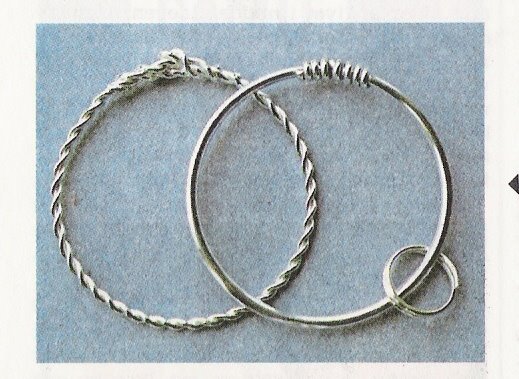
by Hobro (East Jutland) were in the early 1950s found two silver
bracelets about the same size, but of a different shape, one twisted,
the other smooth with a little jingling pendant. The twisted bracelet
was found 1952, when a stolp hole was being emptied in one of the big
curved-wall longhouses. Since it was late season the hole was first
digged out fully the next year - and thirteen centimeter deeper was
found the smooth ring with the little pendant. In the stolp hole had
once been two uprights, and the bracelets were squeezed between those.
There is no doubt that they were hidden in a space in the wall. Why?
This can only be a guess.
Bracelets like these were modern in the
period of Gorm the Old, Harald Bluetooth and Sweyn Forkbeard. The smooth
bracelet is made of heavy silver thread, which gets a little narrower
in the ends, the twisted made of two silverthreads and twisted together.
The closing plait is rather different, but the size of the bracelets is
approximately the same, a little more than 6 cm, which is what we today
regard as a normal size. Their owner was undoubtedly a woman. A tough
viking would hardly be able to wear them.Besides the closings and the
pendant there are no frills on the bracelets, they were actually applied
art.
Viking house Fyrkat
In the finds at Fyrkat were coins, but a real monetary
system was not yet known, people paid with silver after weight, whether
it was marked or not. A little ring like the pendant was a suitable
change, but it often happens that jewelry is found cut into pieces. The
silver jewelry from the viking period can be regarded as decorative
cheque books.
The twisted parts in both bracelets are made in a
way which is a little awkward, though natural for a left-handed person;
they are possibly made by the same silversmith. He might have worked in
the viking fortress itself, where craftsmen lived and worked with
precious metals.
(source: Skalk 5/1976)
In the fields of Vallø Stift (district) west of the town Køge archaeologists have uncovered the traces of a circular castle with earth banks. The circular castle bank is similar to the famous Trelleborgs which were built by Harald Blåtand (Bluetooth) around year 980.
The museums inspector and archaeologist connected to Danmarks Borgcenter, Nanna Holm, says that it is the first time in 60 years that a new ring castle from the Viking period is found in Denmark. Her colleague, professor in medieval archaeology at Aarhus University, Søren Sindbæk, says that the discovery of the new Viking castle is a unique opportunity to get new knowledge about the fights and the conflicts of the Viking period. There is now a new chance to examine the most famous buildings of the Vikings.
New exact laser-measurements of the landscape led to the traces of the castle which was an almost leveled castle bank in the field of Vallø district - it showed to have a clear circular area. An expert in archaeological geophysics from the University of York in England was summoned.
By measuring small disturbances in the magnetism of the earth it is possible to identify old excavations or banks without destroying anything. In this way an amazing detailled shadow picture of the castle was achieved. After this it was known precisely where to start the excavation to get as much knowledge as possible about the castle.
Fyrkat, wikipedia
Nanna Holm emphasizes that this castle was a reel military plan and there might have been a fight. There is no doubt that the castle is from the Viking period.
Castles like this are only known from the Viking period. The burnt wood in the gates make it possible to verify the age of the wood by radiocarbon-dating and dendrochronology. The result of the analysis will be ready in late September, first October ( 2014) . It is possible to find out exact when the castle was built and maybe get a better understanding of the historic events connected to these ring castles.
The find might show to become an important factor in the understanding of the Danish history The archaeologists are excited to confirm if the castle is from Harald Bluetooth's time or maybe from the time of an earlier king. A military fortification from the Viking period can enlighten how Sjælland's connection was to the oldest part of Denmark and to the Jelling dynasty, and at the same time bring new knowledge to the understanding of the time when Denmark became Denmark
Trelleborg, wikipedia
Until now only small parts of the ring castle are excavated, but the list of unsolved questions is long. The excavations have confirmed much more than hoped, but there is still much to be found. The next big question is if there were buildings inside the ring like in the wellknown Trelleborgs. At the same time there is another question: Are there more ring castles like this hidden somewhere in the Danish landscape?
Source: Danmarks Borgcenter, Aarhus University. photo ring castles: wikipedia photo Viking house: grethe bachmann 2010.
Viking house, Fyrkat, photo: gb 2010
Ring castles in Denmark:
Aggersborg, North Jutland
Fyrkat, East Jutland
Trelleborg, Sjælland
Nonnebakken, Odense; Funen
A special class of monuments from the Viking Age are four ring castles or military camps in Denmark The earliest found is Trelleborg at Sjælland (Zealand). It lies in the western part of Sjælland ab. 4 km west of the town Slagelse, between this and Storebælt, where two rivers meet - and from here they are running as one river out into the sea north of the town Korsør. The Viking ring castles are colloquially known as"Trelleborge". The ring castle Trelleborg at Sjælland was placed upon the land between two rivers in the late Viking period, the excavations showed that it probably was built upon an ancient blót-place, which was seen from several sacrifice pits and from some house-rests. After comprehensive fill- and levelling work the castle was built, according to a thoroughly worked-out project, which by skilled engineers were laid out in the field with extraordinary mathematical precision. The ring castle consisted of two components: a main castle and a front castle.
map from wikipedia
The main castle is a circular place, surrounded by a strong and still existing ring bank, which towards the land side (south and east) is further strengthened by a curved broad and deep moat. This ring bank had four gates, one to each corner of the world, and these gates were interconnected two and two (crosslike) with wooden streets crossing in the center of the place and dividing it in four equal sized sections. In each section were 4 equal size houses, arranged in blocks, a total of 16 houses. With their curved long walls and their straight cut ends these houses looked like ships with cut bows. Each house was divided in 3 rooms, one smaller in each end and a large mid-room, 18 meter long. The planks of the houses have disappeared, but have left marks in the earth in several places, which show the plan and the contour of the buildings.
A few lesser houses were noticed, partly guard houses at two gates, partly chief houses in the middle of two blocks, and finally a ship-shaped house in smaller dimensions north of the northeastern block. It seems furthermore that inside, along the ring bank, was a ring street. The ring bank had palisades on both sides and was in several places strengthened with an inside timber reinforcement. The 4 gates, which behind the palisades had strong stone packings, were covered by a timber loft and worked as tunnels. Outside they could be closed by a couple of gate wings (iron rings and big keys were found by the entrances). Outside, towards the landside, the ring bank was dressed with a mantle of stiff clay, held together by wooden sticks and branches. Towards the meadows, to the northwest and southwest, the bank rested upon a foot of stone and post work and was higher up covered by vertical palisades.
Trelleborg, the castle site, wikipedia
The second component of the castle was a reinforcement belt towards the landside = a front castle. This belt, which was curved to the south like the curve of the main castle, but square to the north, was fortificated with a low bank and a flat moat. Upon the curved section was built in a radial construction: total 13 elliptic longhouses in the same shape as the 16 block houses of the main castle, but of a little smaller size. Upon the square section of the belt were near the castle (outside its eastern gate) two similar houses placed parallelly; and further to the east was the castle's burial site with ab. 150 graves, probably following the ancient sacrifice place, which before Trelleborg's building belonged to the sacrifice place out on the isthmus. The entrance to main castle and front castle were both from the south.
Trelleborg, photo H. Stiesdal 1948/ Johannes Brøndsted, Vikingerne, Gyldendal 1960
An impressive plan like Trelleborg was made by engineers. The used unit of measure is an
approximated Roman foot (Roman normal foot: 29,57 cm - the calculated
medium size of the Trelleborg foot is 29.33 cm ), which is shown in all
the main measures of the castle. The block houses are 100 feet long, the
front castle houses 90 feet, the ring bank is 60 feet broad, the small
houses in the middle of the two blocks are 30 x 15 feet. Radius from the center to the inner edge of the ring bank is 234 feet, the distance between the two moats is also 234 feet, while the distance from the center to the nearest gables of the front castle houses has the double measure = 468 feet. In the construction the center was chosen first, from where the circular curves were marked which limit the banks and moats; the same center is also the cutting point of the two mutually perpendicular main axis, which divide the main castle area in four equal large sections, which continue through the four gates. All over the constructors have used extremely care and precision.The whole building plan inside the ring is constructed in squares.
Example of house at Fyrkat/ photo grethe bachmann
Example of house at Fyrkat: photo: grethe bachmann 2010
Trelleborg has a splendid location in the large meadows with its back to the higher mainland. The holes in the underground from the houses are marked in the grass by cement - the ring banks and the moats are partly rebuilt, and the visitors will get a stunning impression of how a Viking garrison looked in the Viking period. The National Museum has constructed a modelhouse in full size, it's like one of the front castle houses. It was placed upon the site in a short distance from the castle. The modelhouse is built in wand construction with walls of broad vertical planks. The roof is constructed above cross beams where stand vertical short posts, it has a length-curved ridge and is thatched with wood chippings. Outside along the longwalls run a low gallery with its own roof; its purpose might have been to guard the longwall against rain and snow. A house had usually door in both gables and in both cross walls, and there were two side-doors in the long mid-room, one placed in each longside and always counterposed diagonally. The gable rooms had sometimes digged cellars ( maybe storerooms for food or waste pits or even dungeons). In the large mid-room was a plank or clay floor and a fireplace in the middle, and at the sides were probably broad sitting- and lying benches. In the roof probably an air hole (a lyre). The Trelleborg house is like this description. It is not certain and can never be if this house is exactly like it really was. The construction has been critizised and there have been suggestions about other Trelleborg houses. The Fyrkat houses can tell us more ( see the coming article about Fyrkat). The Trelleborg house was renovated in the 1980s.
Trelleborg, common burial, photo 1948 NN/ Johannes Brøndsted, Vikingerne, Gyldendal 1960.
The burial site of Trelleborg tells us as expected that the main part of the buried were young or younger men (20-40 years); but there were also several women, a few children and some old people. The gifts in the graves were relatively few. Nothing indicates Christianity, unburnt burials with the body placed east-west were known in Denmark before Christianity arrived and marked the burial customs. Three graves were common graves, the largest with ten burials. The grave gifts included only few weapons ( most remarkable was an unusually broad-edged, but also narrow-bladed silverplated war axe ) - there were several tools, like blacksmith tools and agricultural tools (scythe blades and a ploughshare). And furthermore jewelry, claypots and things for spinning and weaving. These things give Trelleborg a safe dating: namely to the last part of the 10th century and the first half of the 11th (ab. 975-1050). The life of the castle was not long, but obviously it did exist, when Sven Tveskæg conquered England and when Cnut the Great fought the Three King Battle at Helgeaa.
Trelleborg, silverchain with Thor-hammer, Danish/ Johannes Brøndsted, Vikingerne, Gyldendal 1960.
It is also obvious that Trelleborg was a military camp and a naval base. The location is classic with an easy access to the sea and however with protection and shelter from assault and floods. Ship could supposedly be trailed up the river stream to the castle, and each ship-shaped blockhouse housed a ship's crew. The contents of the graves (as for agricultural tools) indicate that the people of the castle had to provide supplies so they did not have to rob the farmers from the neighbourhood.
Trelleborg gives witness about a strong organizing power. This can only be a king, who was able to build such great plans. There are no supporting points, which indicate that a hostile power was stuck in Denmark. The archeaological finds do not tell about this - and not history either. But history tells another story: that this period was marked by a Danish display of power. Trelleborg had room for 1200 men. It is not known when the Trelleborg camp went out of use. There are no traces after a finishing fire.
Information from Slagelse Municipality 2013:
Trelleborg is a fantastic piece of cultural heritage from
the Viking period and the best and best preserved of the three circular
castles Fyrkat, Trelleborg and Aggersborg. Together with among fx the
Jelling monuments and Dannevirke the ring castles tell us about a very
exiting and crucial time in Danish an European history.
The
location Trelleborg was never forgotten, the main part of the earth
banks were directly visible right up to the beginning of the excavation -
and the circular inner bank is seen clearly upon maps from the 1600s
and onward, but the character of the installations was first known as a
Viking fortification when the National Museum started the excavations in
1934 under the leadership of archaeolog Poul Nørlund. The excavation
was provoked by a local motorcycle club who had rented the area in 1933
for the purpose of converting it into a motocross track. (Source: Slagelse Kommunes hjemmeside. )
Other Informations (Source: wikipedia):
Trelleborg was the first discovery of a circular castle in Denmark.
The Trelleborg area is about 6 ha = 12 football fields. F
The excavation, the registration of findings and the reconstruction of building works were published in 1948 in a scientific paper written by Poul Nørlund.
In 1979 it was succeeded to do a dendrochronological dating of wooden pieces from Trelleborg, and it was detected that the trees were felled in June or July 980.
For the building of Trelleborg was felled half of the oak woods which existed at Sjælland.
Already in Poul Nørlund's paper the building master was identified as either Harald Blåtand or Sven Tveskæg, mostly all scholars,who have commented this question, agree that it must be the same person, who was the building master of these castles. One of the essential arguments is the precise geometry in the main line of the plan and the common characteristics in the craftmanship. Another argument is the great similarities in the design of the plans. The dendrochronological datings from Trelleborg points at Harald Blåtand as the building master and because of the dating the historians now mostly agree to point at Harald.
There are no written sources which mention the ring castles in a direct way. The known Scriptures close to the events are the chronicle by bishop Thietmar of Merseburg, written 1013-18, and an unnamed monk of St. Omer's tribute to Cnut the Great's widow, written about 1040. Here is a possible reference to the Trelleborgs, since it is told that Sven Tveskæg fortified his kingdom with castles, which had to be a protection against the enemies who had invaded and occupied the country.
Adam of Bremen's work from ab. 1070, descriptio insularum Aquilonis, illustrated a number of factors related to the Danish Viking period , but there has not been identified any mention of the ring castles. The Danish chronicles from the Middle Ages (Aggesen and Saxo) have no direct references either. It is remarkable that the ring castles are not mentioned, and it seems that the writers did not know the existence of the castles - and this is an indirect evidence of the short lifetime of these castles.
Latest info:
Wooden shield from Trelleborg, exhibition Moesgård Museum Århus
In September 2008 archaeologists from Sydvestsjællands Museum and from Moesgård Museum (Århus) found a wooden shield during an excavation at Trelleborg. It is the first time a wooden shield was found in Denmark. The shield is about 80 cm diameter with a characteristic hole in the middle for the shield boss. The shield is dated to the Viking period and to the castle's usage period in the end of the 900s.
Anders Dorset, one of the leading archaeologist at the excavations, also considers that the examination shows evidence of that Trelleborg had a clear maritime significance.
The Viking expeditions are grand. They include all of Europe, to the east along the large river-roads through Russia, to the Caspian Sea and the Black Sea, to the west along the Atlantic coasts down past Arab Spain through the strait of Gibraltar and the Mediterranean. But they also include the wild unknown North Atlantic with the Faroe Islands, Iceland and Greenland, even America.
The three Scandinavian countries had each their own geographic profile externally, and their own political interests. The names Sverige, Norge and Danmark show that each country had memories of old historic life. The name Sverige (Svearike) is the rige of the Swedes, a rige meant in that period a land where a king was the ruler (= English: a kingdom). It is not a coincidence that the name of the land of the Swedes pointed to the authority and power of a king. The Swedish kingdom existed long before the Viking-period.
map from 1539 with Danevirke
Danmark means the mark (land/field) of the Danes. The old meaning of the name "marc" = uninhabited borderland.The Mark must in this connection be the land at the south of Jutland's foot, the wild land south of Danevirke, which divided the Danes from the Saxons to the southwest and from the Slavic people to the southeast.The name Danernes mark = Danmark was gradually used in general already before year 900. The Anglo-Saxon king Alfred the Great wrote Denemearcan in his foreword to Orosius' world history, and this is the first time the name Danmark is mentioned in the world literature.
The name Norge has an old root, but in a different way from the Danish and Swedish. Norge was also a collected kingdom under Harald Fairhair, but much later than what happened similarly in Denmark and Sweden. The name Norge has a commercial historical meaning. It means "den nordlige vej" (the northern road) or Nordvejen ( the Northroad), an appellation of commercial historical origin. This road was the trade route along the long, long coast of Norway, from south to north and back, a route which is described in the before mentioned king Alfred's document from the late 900s. It was a sea route from the trade center Skiringstal at the Oslofjord, via the seas of Kattegat, Skagerak and the North Sea up to the White Sea, where they fetched sealskin, polarbear skin and walrus-tooth.
Sea Stallion model of Viking ship on its first voyage Denmark-Ireland.
The face of Norway turned west, towards the great oceans and their islands. It was mostly the Norsemen, who before and during the Viking period braved the immense, icegrey, stormy North Atlantic - and they started their voyage with no knowledge of, what they might meet or find. The Norwegian interest was split in two, the first one expeditons/raids to the southern, starting by a north-Scottish island, which was inhabited by Norsemen at the very first beginning of the Viking period; from here to the coast of Scotland, to Ireland, to the Isle of Man, to all Irish and English coasts around the Irish Sea - from here the Norse expeditions went deep into England from northwest, where they were fighting and competing with the Danes, but the Norse went still farther away, to the northern and southern France and into the Mediterranean - the French part of the expeditions is the same for Norsemen and Danes. The Norsemen's second interest, the northern expeditions went to the Faroe Islands, Iceland and Greenland. These expeditions were probably due to the pressure, which king Harald Fairhair put on the Norse earls and free farmers, when he roughly forced them to accept Norway under one Crown in the end of the 9th century. These later Norwegian expeditions across the Atlantic were not raids or piracy, they were more colonization of desolate areas.
Sweden looked to the east. The Swedish expansion had started already in the 8th century (across the Baltic Sea). The mighty Swedish trade developed and branched in a grand manner southwards through Russia to the southern states. The Baltic Sea was considered common area for Swedes and Danes.
Thousand years ago the Viking Ingvar Vidfarne went towards the east. In 2004 a Swedish expedition revived his tour from the Black Sea to the Caspian Sea, a a wearing tour across sea, mountains and along tortuous roads. The magazine Illustreret Videnskab was onboard on the almost ten meter long Himingläva.
The Fyrkat house, copy of Viking stone (London stone)
And south of the Scandinavian peninsula was Denmark with lots of islands and the peninsula Jutland, the main land. Jutland had its foot upon the Central European continent, but this did not mean a connection between Denmark and the countries south of the border. On the contrary was Jutland and thereby Denmark withdrawn from their southern neighbours, the German Saxons to the southwest and the Slavic Obodrits and Wends to the southeast. The Vikings preferred to use the water routes on the sea and the rivers. The Danish interest went therefore not directly to the south, but to the southwest along the Frisian and Frankish coast and towards west to England. To the east was the western part of the Baltic Sea. To the southwest were all the coasts and rivers of the northern France deep into the Danish field - but the Danes did not stop here - they went farther away and came to the Mediterranean together with Norsemen and Swedes.
Fyrkat, reconstruction of longhouse Fyrkat is situated in Jutland in the district of Himmerland west of the town Hobro.
Fyrkat, reconstruction of longhouse
A magnificent stone was found and the king of Denmark and Norway , Harald Gormsen - also known as Harald Bluetooth proudly told the stone mason to write the famous words: "Harald who won all Denmark and Norway and christened the Danes........ " The proud king left us more than the Jelling stone, Denmark's birth certificate, he also left us the Viking ring castles and bridges, spread out in the country. The Jelling stone still stands with the impressive words as they were made a thousand years ago, but the Viking fortifications had to be excavated and researched. Our knowledge have changed by the excavations of the royal fortifications, especially at Trelleborg and Fyrkat and the 5 Viking ships from Roskilde Fjord. The castles and bridges were found by coincidence, and there might be more discoveries like that in the future.
Fyrkat, inside the ring bank, 16 longhouses were placed here
Fyrkat, the house sites are marked with poles
Trelleborg near the town Slagelse at Zealand is one of the socalled ring castles from the Viking period. It is dated to 980 A.C. and probably built by Harald Bluetooth. It is one of four known ring castles unique of the Danish area. They are all built from a strict geometric ground plan with a circular bank and large houses inside the bank. Although the houses probably were built by people who only partly - or not at all - were professionals, they were managed by very skilled building masters. Outside the banks of Trelleborg were found burials of more than 150 Vikings and also some regular mass-graves. Trelleborg was the first excavated Danish ring castle - and the other following castles and houses were given a common name "Trelleborgene" and "Trelleborghusene". Although they are different, the fortifications all have the same general plan and an almost identical arrangement of the castle site. The Danish Viking fortifications are Trelleborg at Zealand, Fyrkat in East Jutland (Himmerland), Aggersborg in North Jutland (Vendsyssel) and Nonnebakken in Odense (Funen).
Trelleborg, reconstruction of longhouse(notice vertical uprights)
Fyrkat, the strong oblique oak uprights
As a building tradition the "Trelleborghus" belongs to the Viking period's common farm house. This common type, the longhouse, was used in northwestern Europe for many years. People and livestock lived under the same roof. Trelleborg was built ab. 981 and Fyrkat almost at the same time and with almost identical houses. The oak for the houses was cut down in the winter 980-81. Outside the ring bank at Fyrkat is a reconstruction of one of the large longhouses in the castle site. 16 houses like this were placed inside the ring bank. The Fyrkat-house is 210 m2 and built in 300 m3 rough oak timber.It is 28,5 m long and the curved walls give 7,4 m at the broadest place and 5 m at the gables. The roof is supported outside by oblique uprights, which made it possible to avoid or use fewer uprights inside the large common room.
Fyrkat, the longhouse inside
Fyrkat, at the entrance young swallows and a Viking pattern
The longhouse is divided inside in 3 rooms with a large room in the middle and 2 gable rooms. In some of the houses at Fyrkat were found traces of broad benches along the wall. It is estimated that 32 persons could sleep comfortably in a hall like this. There are few furniture findings from the Viking period. Only the richest people could i.e. afford a free-standing beds like in the ship burial at Oseberg (Norway). Or a throne. This was a sign of high status. Chairs are rare, but footstools and milking stools are not unusual.
Fyrkat, impressive oak Hørdum church, North Jutland, runestone,Thors fight with the big snake (click to enlarge)
In rich peoples' houses the walls might be covered in painted or carved panels or in wall carpets. In the Oseberg-burial was an artificial tapestry depicting some history of that time. An occassional poem from a wedding in the late 900s displays mythological scenes carved in the panels of a large house in Hjardalid at Iceland, where the feast was celebrated. One of the themes was Thor's fight with the Midgårdsorm (mythological snake) - a popular theme in Nordic art.
Vejle Ådal (river valley), the Ravning bridge
The most advanced fortifications in the Viking period was at Trelleborg, Fyrkat, Aggersborg and Nonnebakken. The bridge in Ravning is contemporary to these castles and at almost the same time were several smaller bridges built all over the country. The contemporary time between the castles and some of the bridges indicates they were the part of an overall plan. Already from the 700s people in England were obliged to take part in fortification and bridge-building and in military service. The Danish Viking fortifications were built during the German occupation of Sønderjylland and probably meant to be a response to the German threat. The castles and bridges were seemingly designed to enable a quick mobilization of warriors and provisions. A system like this was used by the Romans already in the 300s-400s and exactly the same in the 800s by the Franks and the English.
Fyrkat , area downside the ring bank with the western corner of a newly re-established lake
Fyrkat, the restaurant and angelica, a typical plant for a viking site like this.
replica in Sterling silver of Viking jewelry Two bracelets found at Fyrkat, put down by an upright. Small rings were attached to the bracelets , they were used for payment. The pendant is the famous Dragon-Brosche found at Zealand. (The jewelry is my own, but I have borrowed the bracelet-photo from Skalk Magazine. Replicas of various Viking jewelry are sold from i.e. Museum shops or special jewellers. )
A woman's grave at Fyrkat:
There were many similar graves at Fyrkat. This woman was buried in a wooden body of carriage. She had been given a rich equipment, cloth, pearls, silver jewelry, knives, a whetstone, a spinning stone in burnt clay, a pair of scissors for fabrics and several boxes, among this a sewing box with sewing materials. Her dress was unusual, she had rings on her toes and much fine jewelry, i.e. a Gotland buckle and a pendant, which possibly origins from the northern Russia. These exotic findings indicate that she or someone close to her had travelled wide and far. Nothing suggests that the burial place is younger than the castle, and the woman was probably buried at least 15 years after king Harald's official transition to Christianity. The heathen burial customs had not changed at Fyrkat, and this grave contained several things with magical or supernatural importance. The pendant might symbolize a pagan god- and some of her magical things were seeds of henbane, a piece of jawbone from a pig and a pellet.
Jelling, the Jelling stone, Denmark's birth certificate
Harald's conversion meant abolition of the heathen cult celebrations, but the church had to compromise to hold on to the newly converted. It was especially difficult at Iceland, where the Icelanders accepted to take Christianity as an official belief, if they were allowed to follow their ancient customs like eating horse meat, to blote (sacrifice) to the ancient gods in their home and to expose babies. Many Danes probably also worshipped the ancient gods and sacrificed to them in the traditional way long after Harald's conversion. Towards the late 900s it seems that the Danes stopped eating horse meat. New habits developed slowly and it took a long time, before Christianity achieved any power on peoples' minds. The heathen burial customs were not abandoned until the final of the 900s. The transition period is clearly seen in the findings from the burial places at Fyrkat, which was built at least 15 years after Harald's conversion.
Harald's organization was never put to the test, and both fortifications and bridges were not repaired. They fell quickly into decay. The fortifications were used for various reasons for some time, probably as a residence for a local king or official - but they gradually fell into ruins. The bridges needed constant repair, and they were replaced by stone edged fords. Harald died between 985-987 and his son Svend was now king. Harald had become very unpopular caused by the ambitious and expensive ring castles and bridges. The whole plan was an economic burden to the Danish people, and Svend did not spend money to repair the fortifications or the bridges. The Germans were now occupied in feuds with their Slavic neighbours - and Svend 1. Haraldsen had other ambitious plans.
Source:
Politikens Danmarkshistorie bd. 3, "Da Danmark blev Danmark", 700-1050,Peter Sawyer, 1988.
photo Fyrkat July 2010: grethe bachmann & stig bachmann nielsen, Naturplan Foto photo Trelleborg, Hørdum church 2003/2007: grethe bachmann


 The Franks and the Germans did not only affect their Danish
neighbours - they also wanted to have power over them, but they did not
succeed. The Danes could retriet from Jutland to security on the Danish Isles and
gather new strenght while the peninsula Jutland was attacked - and the Saxon hertug
Bruno and his army had to learn this in 880......the only Danish king
who in the 800s had to acknowledge the supremacy of the Franks was
Harald Klak, and he was deposed and driven into exile .
The Franks and the Germans did not only affect their Danish
neighbours - they also wanted to have power over them, but they did not
succeed. The Danes could retriet from Jutland to security on the Danish Isles and
gather new strenght while the peninsula Jutland was attacked - and the Saxon hertug
Bruno and his army had to learn this in 880......the only Danish king
who in the 800s had to acknowledge the supremacy of the Franks was
Harald Klak, and he was deposed and driven into exile .


 Harald's kingdom was exposed for disturbances from Viking fleets. As the leader of the expeditions to the west Sweyn Forkbeard saw
to that his men were awarded like other men of the Viking chiefs.
Torkel's fleet represented the biggest threat however. He was now in the service
of the English king, but it was Sweyn who in 1013 seized the English
throne and thereby got access to the rich sources in England.
Harald's kingdom was exposed for disturbances from Viking fleets. As the leader of the expeditions to the west Sweyn Forkbeard saw
to that his men were awarded like other men of the Viking chiefs.
Torkel's fleet represented the biggest threat however. He was now in the service
of the English king, but it was Sweyn who in 1013 seized the English
throne and thereby got access to the rich sources in England.
 Merchants, wandering craftsmen, Christian missionaires, diplomats and
the Vikings themselves were all the cause of influences from abroad in
Denmark. The Danes connected more and more to the outside world during
the Viking period than ever before and the consequences began to show in
the beginning of the 1000s - cities were founded, bishoprics and a
royal coinage were established. It is clear via archaeology that all
parts of society were affected by the contact to the outside world. In
each archaeologically examined village from the Viking period are rests
of mill stones from the Rhine district and soapstone-vessels and
grindstones from the northern Scandinavia. In Jutland are found western
European ceramics - and Slavic clay ware or Danish copies are found in
the eastern part of Denmark . More perishable goods like clothes and
wine were probably also widespread. The imported goods were spread all
over Denmark - but they were not for free. Wealthy Danes who lived in
the 1000s were capable of paying their shopping with coins and other
silver - but the import was through the whole period generally paid
with Danish export products or with services and catering to the foreign
merchants who visited the Danish harbours on their tour between the
Baltics and Western Europe. Cattle was one of the most important export
products
Merchants, wandering craftsmen, Christian missionaires, diplomats and
the Vikings themselves were all the cause of influences from abroad in
Denmark. The Danes connected more and more to the outside world during
the Viking period than ever before and the consequences began to show in
the beginning of the 1000s - cities were founded, bishoprics and a
royal coinage were established. It is clear via archaeology that all
parts of society were affected by the contact to the outside world. In
each archaeologically examined village from the Viking period are rests
of mill stones from the Rhine district and soapstone-vessels and
grindstones from the northern Scandinavia. In Jutland are found western
European ceramics - and Slavic clay ware or Danish copies are found in
the eastern part of Denmark . More perishable goods like clothes and
wine were probably also widespread. The imported goods were spread all
over Denmark - but they were not for free. Wealthy Danes who lived in
the 1000s were capable of paying their shopping with coins and other
silver - but the import was through the whole period generally paid
with Danish export products or with services and catering to the foreign
merchants who visited the Danish harbours on their tour between the
Baltics and Western Europe. Cattle was one of the most important export
products




.jpg)
