Three Norwegian Viking Ships
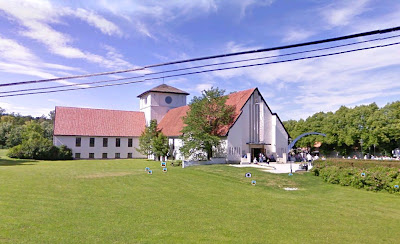 |
| Vikingeskibsmuseet Bygdøy, Oslo, (foto: Google) |

We face the technical skill and knowledge of the Viking in their ships - the ship is the finest they have achieved in the material culture. They developed the best ships of their time, ships which were a precondition for their journeys around the world. The ship
was his instrument of power, his joy, his dearest possession -
whether the ship slipped quietly from land on its splendid keel or it was figthing the waves with its ornamented stem - the ship was his favourite child, created by his
skilled hand and spoken of in affectionate words in songs and poetry of the scald.
In spite of the indissoluble connection of the Viking and his ship only few ship wrecks have been found, compared to the number of ships the Vikings had according to contemporary sources.Three of the most remarkable ships from the Viking Age rest together
in the Viking Ship Museum at Bygdøy, Oslo, in Norway. They were discovered and excavated separately between
1867 and 1904, and they all date from the
ninth century AD. All were used as burials of important people from the Viking Age. Each of the three ships — the
Tune, the Gokstad and the Oseberg - was hermetically sealed and, thus, preserved by the blue clay, stones
and turf which covered them. Mounds were then built over the ship
burial. The Tune, the Gokstad and the Oseberg ship have all the attributes of the longship: the mast can be laid down and the ship can be rowed, but they are not made just because of the speed - spaciousness and good seamanship were also a priority.
The Viking ships were famous for their construction.
During the Viking period there was no ship, which could be compared to a Viking ship. It was so superior to other ships that the equipment was copied by ship-builders all over Europe. The Viking ships were clinker-built, which means that the planks were not placed upon each other, but were overlapping. In contrast to ship-constructions from earlier times the Viking ships were equipped with a keel. The keel caused that the Vikings had benefit from the square sails and made it possible to cross against the wind. Now it was also possible to develope trading ships, since there was no need for a big crew - and the ships could travel over greater distances, since they were not dependent on rowers all the time. The trading ships were short, broad and deep, with a deck front and back, and midship was the open store room. They were stable ships and they made a moderate headway.

The war ships were long and slender, and they had a shallow draught, and they could be driven both with sails and oars. They were ideal for a quick assault on klosters and fragile towns along the coast. The war ships were extremely fast, and because of the shallow draught they could be sailed almost up upon the beach, and the Vikings could just walk ashore and start an attack, before the poor inhabitants were able to escape or organize a defense. But there were other types of ships - like the Oseberg ship, which might be described as a luxury ship. It was incredibly beautifully shaped, but not fit to operate in the open sea. A ship like that must have made a great impression, when it was sailing into a Norse fjord on a pretty summer's day.
There was not much comfort upon a Viking ship. There were no cabins, and the Vikings were sitting, eating and sleeping under the open sky. It was not a problem while sailing between local districts, but worse if the journey went to Greenland in biting cold and terrible storm. But the journeys were made - both to Iceland, Greenland and all the way to America. Thanks to their ships the Viking went far and wide. The ships could sail into almost every river, they could handle the tough sea in the Atlantic, and they were not more heavy than they could be carried across land by the crew, if this was necessary on a short stretch.
In the European ship-history the
Nordic ships from the Viking period are not in a starting position, but a final position. They mark the end of a century and the long development of the clinker-built
rowing boat, which gradually gets a keel, a mast and a sail. Through the
Viking period these longships were enlarged, Cnut the Greats largest
ships were possibly twice as large as the Gokstad ship. But it was still
the same type: a ship which might be used both in battle and in
mercantile transport. The Baeyux-tapestry from the late Viking
period shows the same type of war ship in all situations. But from
the end of the Viking period and forward two main accounts were
taken, speed and movement in war and broadth and space in peace.
The war fleet continued to be built after the same schedule, long
narrow ships with appromixately equal use of oars and sail, pointed in
front and stern and with both bows a little above midships. This was the
ship of magnates and kings, while the
private conscripted war ships might have been shorter and broader. The
trade ships were a new development in the beginning - they became broader and
more round in order to load more, and they went deeper into the water,
the front and the back were higher, where the crew and the rowers were,
while the low midship was used for storing wares high up along the mast. A
trade ship like this was probably the so-called
knarr, which went from Norway to Greenland and Iceland, while the word
byrding was used for a
short, broad transport ship, used as a provisioning ship in larger fleets.
 |
| Viking ship decoration in Fåborg, Funen |
The real development speeded up among the early Hanseatics, with the Frisians
beginning already in the Viking period. A new type of ship was the
koggen, which is completely without oars. The
kogge was a ship, which
could carry a heavy load, it was big and clumpsy and with emphasiz upon a
high up-building in the ends of the ship, front and back. The
kogge was
dependent on the wind, in return there was no need of the rowers, and
more load could be taken. The longship of the Viking
period is the extended and the enlarged clinky built boat. A boat like
the leather boat and the tribe boat were also used in the homelands of
the Viking, the leather boat at sea and the tribe boat in the quiet
lakes and the calm river streams.
Until the findings of the Danish Viking ships, the knowledge about
Viking ships in general came from especially the three Norwegian ships:
Tune, Gokstad and Oseberg.
All three findings were burials. Common to all three is that they were
reasonably well-preserved. They are three different types of ship - and they show the development
from Iron Age ship to Viking ship. The first achievement in this period
was the introduction of the keel. The Norwegian findings are from the
beginning of the Viking period, and the
Skuldelev findings (from
Denmark) are from the late Viking period. This means there are now
ship-examples from the whole period, and it has been possible to
identify the development in the ship-building history from Iron Age over
Viking period till the Middle Ages.
The Norwegian Viking Ships
(on exhibition at the Viking Ship Museum, Bygdøy, Oslo)
 |
| The Tune ship, Bygdøy |
1) The Tune ship was dug out in
1867 from a gigantic gravehill, it had been placed down in stiff blue clay which
had preserved the wood. A burial chamber was placed across the stern, built in oak with a flat roof. The burial chamber had already been
plundered in ancient times. In the chamber were some burnt bones from a
man and a horse, (the horse had been buried standing). There was only little left from the equipment, like a wooden spade, some carved wood
pieces, pieces of clothing, rests of weapons, a few pearls etc. The
ship itself is rather incomplete, but it was originally ab. 20 m
long and ab. 4,35 m broad in midship, and ab. 1,20 m deep from rail to
the lower edge of the keel. It is built in oak, the rudder is fir. The
ship was placed in the mound with an upright mast. It had 11 pairs of
oars, but they had been removed before the burial. The ship is
characterized as a good solid ship for practical use without any
decorations. It lay low on the water, obviously adapted to low land
waters, like the mouth of a river.
In 1993 was made dendrochronological examinations of the oak of the Tune ship and of the rests of the burial chamber, which was also built in oak. Samples were taken from the ship, where one sample still had the sapwood. The result of the examinations dated the wood - which was used for the ship-building - and it showed that it was felled ab. 910 AD. The Viking ships were built of fresh wood, therefore the building time of the ship is 910 AD. Two samples were taken from the timber of the burial chamber, but here was no sapwood. The samples showed that the wood of the chamber might have been felled earliest 910 AD. The burial took probably place, when the ship was 10-15 years old , ab. 920-925 AD. The ship was relatively new, when it was used as a burial ship, which is the same for the other burial ships, the Gokstad and the Oseberg ship. In all three cases the ships were no more than 10-15 years old, when they were placed in the mounds.
 |
| The Gokstad ship |
2) The Gokstad ship was dug
out from a 50 m broad and 5 m high earth bank upon an underground of
blue clay. The ship had been placed rather deep in the well-preserving
clay with the bow towards the sea. The mast was upright, but cut off in
height with the roof of the timbered burial chamber in the sternpost.
This chamber had also been plundered. A chief was buried here, lying in
his bed in a pretty dress with his weapons; according to the skeleton a
heavily build man, 1,78 m tall. He had plentiful
equipment with him in his grave. In the front of the ship were 3
rowboats, 5 beds, in midship some kitchen utensils, kettles in bronze
and iron, plates, cups, candlesticks, barrels and wooden spades, and
also a gameboard and a sleigh with carved decorations. In the chamber
were pieces of woolen clothing and silk with goldimpact, rests of a
leather purse, an axe and a belt buckle in iron and strap fittings in
lead and gilt bronze. Outside the chamber were bones of a peacock. Close outside the ship were 18 killed animals, 12 horses and 6 dogs.
This grave at the Gokstad ship dates back to ab. 900. Dendrochronological dating suggests that the ship was built of timber that was felled around 890 AD.
The
Gokstad ship itself is well-preserved, built completely of oak, it is
about 23,30 m long from stem to stem, 5,25 m broad in the middle, ab.
1,95 m deep from rail to the lower edge of the keel. The weight is
calculated to be ab. 20,2 tons. In 1893 a copy was built which crossed the Atlantic successfully. Compared to earlier ships from
Nordic Iron Age the Viking period ship shows a progress: the flat
bottom planks are replaced by a real keel, which is the backbone of the
ship and at the same time gives it strenght enough to resist the water
pressure from outside. The keel and each stem of the Gokstad ship are
made from one piece of oak. The joining technique was clinching and
sealing with tarred woolen cords. The ship
had besides mast and sail 16 pairs of oars. When it stood in the mound
it had along each rail 32 shields at each side; two in each oar-hole, the shields - painted black and yellow - formed a coherent set from
front to back. This was meant for decoration when the ship was in port, not when it was out. The rudder had the shape as a large oar-blade
cut in one piece of oak, 3,30 m long and placed outside on starbord
side. The captain who sailed the copy of the Gokstad ship said that "the
rudder was one of the evidences of the insight and experience of the Viking ship-building and seamanship. The rudder is ingenious," he said.
"without any inconvenience a man could be steering the tiller in all kinds of
weather and in the roughest sailing".
The mast was
made of fir and was about 13 m high. The sail was probably a large
square sail. The Sagas and other literature mention blue and redstriped
sails or completely red. The Gotland picture stones often show
diamond patterned-sails. In the front of the Gokstad ship was the iron anchor. Here were the oars too, made of fir and with a lenght
of 5,30 - 5,85 m, the oar-blades were small and lancet-shaped, the
level of the oars was 0,48 above water level midship and a little more
towards the ends of the ship. There wasn't any seats for the rowers,
neither in the Gokstad or the Oseberg ship, maybe the rowers in Viking
period used some loose ship-chests, a part of their own private equipment, as a seat.
 |
| The Gokstad ship |
The gangway plank was found too, it was a
7,40 m long and narrow pine plank. Besides were found four heavy
planks, which ended in carved animal heads, probably rests of planks from a
tent, meant to be used upon land, while the ship was anchored. The animal
heads were not only a decoration, but also meant as a threat
against everything evil. The buried chief in the Gokstad ship had not
less than eight beds, among these two magnificent beds with carved
animal heads, meant as a guardian for the sleeping - these two beds probably
belonged to the land tent. Besides were rests of duvets and blankets,
the colour rests showed black and yellow as the dominating colours, but
also red. The prominent properties of the Gokstad ship show according
to experts a solidity and complete care in every detail.
Replicas of the Gokstad ship: The Viking, an exact replica of the Gokstad ship, crossed the Atlantic ocean from Bergen, Norway, to be exhibited at the world's Columbian Exposition in Chicago during 1893. Other replicas include the Gaia, which currently has Sandefjord as its home port, the Munin, (a half scale replica) located in Vancouver, B.C., the "Islendingur" in the Viking World Museum in Iceland, the Hugin in Kent, England and the replica housed at the Hjemkost Museum in Moorhead, MN.
 |
| The Oseberg ship |
3) The Oseberg ship , the famous elegant revelation of a Viking ship. This ship is widely celebrated and has been called one of the finest finds to have survived the Viking Age. The ship and some of its contents are displayed at theViking Ship Museum in Bygdøy. It
was found in 1903 and was dug out the next year from a 6,50 m high and 40 m
broad peat-mound. The peat in connection to the blue
clay of the underground created the preservative elements, which kept
the magnificent carvings of the Oseberg ship. The ship was placed like the
two others, north-south with the front to the south, towards the sea.
Sinkings and pressure had damaged the ship, and disturbances like
grave robbery had occurred once upon a time. The ship had been tied by a
big stone in the hill itself, and behind the mast was a timbered burial
chamber. Here were the burials of two women. One young 25-30 years, from
her skeleton was only left little in the chamber, but more outside, ( the
grave robbers had obviously wanted to removed her body). The other
woman was older, 60-70 years and strongly marked by bone diseases,
arthritis and stiffness of the spine.
It is not clear which
one was the more important in life or whether one was sacrificed to
accompany the other in death.
The opulence of the burial rite and the grave-goods suggests that this
was a burial of very high status. One woman wore a very fine red wool
dress with a lozenge twill pattern (a luxury commodity), and a fine
white linen veil in a gauze weave, while the other wore plainer blue
wool dress with a wool veil, showing some stratification in their social
status. Neither woman wore anything entirely made of silk, although
small silk strips were appliqued onto a tunic worn under the red dress. Dendrochronological analysis of timbers in the grave chamber dates the burial to the autumn
of 834. Although the high-ranking woman's identity is unknown, it has
been suggested that it is the burial of queen Åsa of the Yngling clan, mother of Halfdan the Black (Halvdan Svarte) and grandmother of Harald Fairhair (Harald Hårfager). Recent tests of the women's remains suggest that they lived in Agder in Norway, just as queen Åsa of the Yngling clan. This theory has been challenged, and some think that she may have been a völva.

Already in 1960 the Norwegian archaeologist A.W.Brøgger put forward the theory that the Oseberg-princess was queen Åsa, which did fit well with the dating, and according to the finding of plant rests the burial must have taken place in August-September. .
There were also the skeletal remains of 14 horses, an ox and three dogs found on the ship. Examinations of fragments of the skeletons have provided more insight
into their lives. The younger woman had a broken collarbone, initially
thought to be evidence that she was a human sacrifice, but a closer
examination showed that the bone had been healing for some time. Her
teeth also showed signs she used a metal toothpick, a rare 9th century
luxury. Both women had a diet composed mainly of meat, another luxury
when most Vikings ate fish. However, there was not enough DNA to tell if
they were related, for instance a queen and her daughter.
 |
| Oseberg waggon |
The two women had a rich
equipment in the chamber: beds with duvets, blankets, pillows, several
chests and bins, one with wild apples, four magnificent carved animal
head posts, a woven frieze for wall decoration, two weave-stools, iron rattles, the rattles were like the animal heads
made for scaring evil powers away. The grave robbers had entered the mound from the south, they had cleared a 3 m broad tunnel to the front of
the ship, and they finally reached the burial chamber and broke a hole in the
roof. In the front of the ship were many things of greatest historical
significance and value. First of all a four-wheeled decorated waggon and 4 sleighs, these sleighs were decorated with carvings in
a magnificent way; 2 land-tents, 3 beds, a stool, a hand-loom, a round stick with runes, three wooden bins, several wooden
ribs, many oars, a big bailer, an anchor-stick, wooden tubs, gangway
planks and much more. In the back of the ship was kitchen utensils: axes
with handles, iron knives, wooden plates and spoons, two iron kettles, a
kettle-rack, a hand grinder, etc. Upon a couple of oak planks were an
oxe. Here and there upon the ship were found fruits, corn and seeds
from plants, two kinds of apples, walnuts, hazelnuts, wheat, cress and
the blue-dye plant vaid.
 |
| Oseberg sleigh |

The so-called "Buddha bucket" (
Buddha-bøtte), brass and cloisonné enamel
ornament of a bucket (pail) handle in the shape of a figure sitting
with crossed legs. The bucket is made from yew wood, held together with
brass strips, and the handle is attached to two anthropomorphic figures
compared to depictions of the Buddha in lotus posture,
although any connection is most uncertain. More relevant is the
connection between the patterned enamel torso and similar human figures
in the Gospel books of the Insular art of the British Isles, such as Book of Durrow.
More mundane items such as agricultural and household tools were also
found. A series of textiles included woolen garments, imported silks and narrow tapestries.
The Oseberg burial is one of the few sources of Viking Age textiles,
and the wooden cart is the only complete Viking age cart found so far. A
bedpost shows one of the few period examples of the use of what has
been dubbed the valknut symbol.

The Oseberg ship itself was
well-preserved and built completely of oak, except part of the
rail, which is beech. It is ab. 21.45 long from stem to stem, 5,10 m
broad in the middle, ab. 1,60 m deep from rail to under the edge of the
keel. Although the Oseberg ship is constructed and built according to the same schedule as the other two burial ships, it is
obvious that it was more slender and weaker than these. It has few
rooms inside ship for provisions, and the oar-holes were not made to be closed from outside, which is necessary in high seas. The oars, 15
couple, were short 3.70- 4 m - they were elegant and decorated, made of fir and all
quite new; they were obviously made for the burial. The rudder seemed also
new and not very practical in use, the same for the mast. So the
experts believe that the Oseberg ship at the time of the burial was a put away ship, which now had to be completed for its last use.
But
even when the Oseberg ship was new, it was not meant for rough long
voyages or hard use. It was a luxury ship and built like a luxury ship
from the beginning. The Oseberg ship is captivating with its grace and purity and with
its magnificent and wellkept ornamental decoration. The
shape is absolutely perfect, the front of the ship is on both sides
decorated with a pretty upwards rising frieze in elegant shaped
ornaments, the friezes look like plant vines, but they are not vegetarian
elements, they are genuine old Norse animal ornamentation as it looked like around year 800, a free and yet scholarly academic drawing,
an old ornamental art and never failing, like the almost
threehundred-year old Nordic animal ornamenation in the beginning of the
Viking period, when it was done by a master's hand.

Another
ornamentation at the Oseberg ship is also in animal style, but of
another character. Its animals are Baroque heavy plastic creatures, they are not gracious, on the contrary they are ugly and
with a robust humour. They form a new style in the young Viking
period, probably inspired by a fresh unconventional Viking perception
from Frankish, Carolingish decorative classical lion-images, they have
amused the Vikings and were re-shaped into
unprecedented tumbling clown animals and foolish creatures, the
socalled "gripping beasts"
(gribedyr). The bow and stern
of the ship are elaborately decorated with complex woodcarvings with those
characteristic "gripping beasts". The stem o f the Oseberg ship ends in a high spiral with a snake's head, the upper section of the sternpost is missing, but it might have been shaped as the snake's tail. The ship appeared as a fabulous
beast with a shining head and tail and with a broad stomach filled with
humans, plowing the waves.
Main source: Johannes Brøndsted, Vikingerne, Gyldendals Forlag 1960.
Other sources: Vikingaskeppet Oseberg - Sverre Kruger, Dronning Åsa av Oseberg - Per Holck, The Oseberg Ship Burial - Norwegian National League - Vikingeskibsmuseet, Oslo - Vikingeskibsmuseet, Roskilde - Wikipedia.
photo: grethe bachmann and photocopy from Johannes Brøndsted: Vikingerne.
photocopy from wikipedia.
Later: 2) The Viking and his Ship:The Danish Viking ships.


 Pentecost was an ecclesial spring feast, marked by numerous feast customs, borrowed from many places - and they fitted perfectly well in the North, where no one asked from where they came. On Pentecost morning the sun was dancing like on Easter Saturday. The morning dew of Pentecost inherited the miracolous power of the May-day. At the high mass the church was decorated like in the homes on Valpurgis day. The May-countess and the street lamb became a Pentecost bride. In the Catholic period the church had observed in a tolerant way that the parrot king or the May-count on Pentecost day came to the church to be sprinkled with holy water or bring a sacrifice.


