The landmark before we arrive at the Mols peninsula is the castle ruin of Kalø. The rest of the medieval castle is now only a small tower, the castle was broken down in the 1600s and the materials were brought to Copenhagen and used for a city-palace there. It's a lovely place to visit and it gives you a good walk around the castle on the small island, ( a good place to collect a herb like wormwood now) - but we'll continue to Mols Bjerge. I have once told you about these socalled mountains. People who live in a mountain area will laugh their heads off, when they see our mountains like Mols Bjerge and Himmelbjerget! They believe we've got megalomania! At least we've got a strange sense of humour. At the south of the island Funen you'll see the Alps of Funen. Yes, the Alps! But it is a wonderful place with beautiful hills - and so is Mols Bjerge.
 |
| Hoary cress |
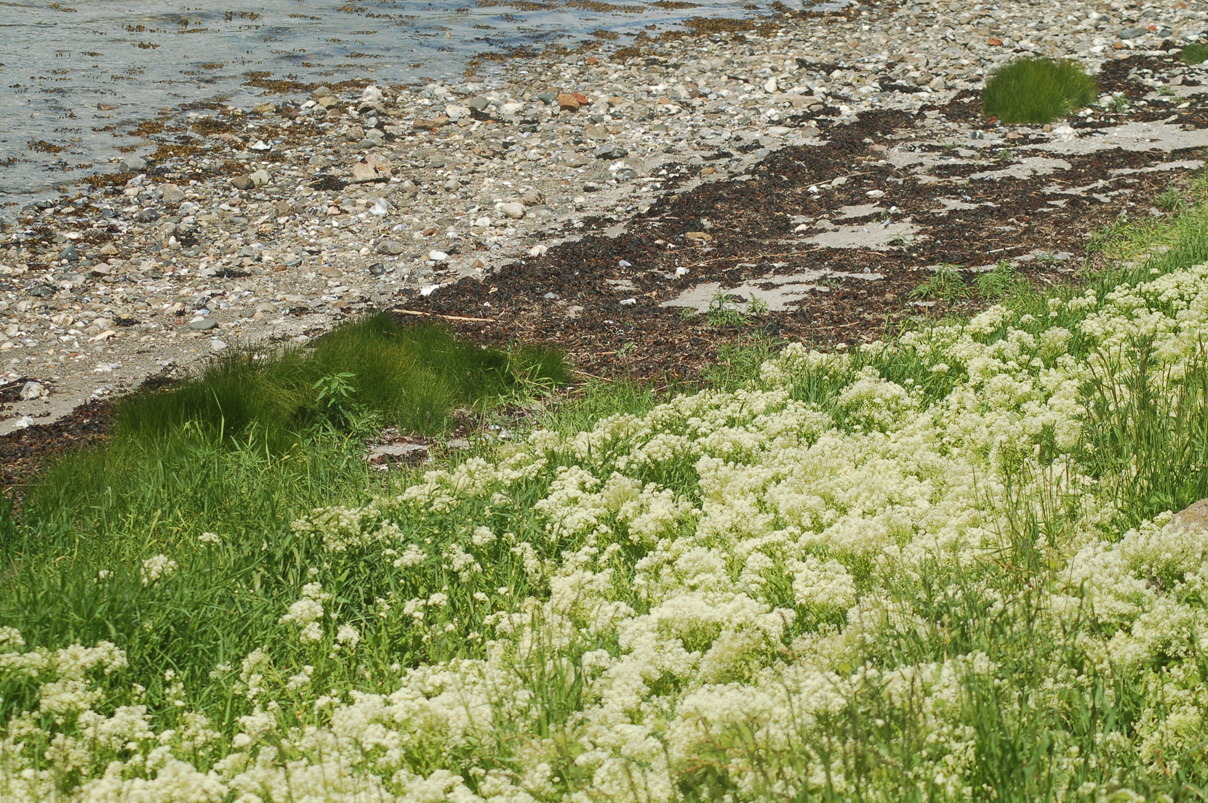
A short pause by the beach - to breathe the fresh air - it's not a heat wave! It is cold today with some dusty rain , but maybe we'll not meet the predicted heavy rain until late afternoon. All along the shore upon a long low bank grow lots of Hoary cress, and it's actually an exotic plant in Denmark. It comes from the Mediterranean and the Middle East, but it has spread as a weed. The species might have survived in some places since the time of the sailing ships, or it has come to later with corn sacks. The Hoary cress has also spread along railroads, where it probably came during WWII and spread with transports of corn and food for the military.
I couldn't help "shoot" this bull who stood there looking yearningly
across the road to his cattle friends. He was quite alone. Maybe he had
behaved badly?

The clouds are drifting fast across the sky making shadows upon the earth, an old windmill on the thill still stands there year after year when we pass by.


 |
| Agri village and church |
And here is the idyllic village I simply love with a church and a village pond and some fine houses and farms around the pond. A ghost story is connected to this church. Many have experienced this. A Norwegian family, parents and two teenage girls visited Denmark and came to Agri church on their way to the town Ebeltoft. They had enjoyed their tour in a lovely weather and took a break, drove up to the parking place at Agri church, went out to get some fresh air before driving on to Ebeltoft. It was ten in the evening and it was growing a little darker. They saw two figures emerge at the church, dressed in long dark robes, like monks, they talked and then disappeared around the corner of the tower. Another person came walking from the other side of the church, and when he passed the tower, the two figures jumped out and attacked him. The family watched paralysed, while he was beaten with heavy sticks - and while he lay on the ground, the two dark attackers bent over him and removed something from his clothes. The family discovered that the attack had taken place
without a sound - in spite of the quiet evening and in spite of that
they stood less than 100 meter from the dramatic scenery. They saw
that the two attackers left their victim and almost melted
together with the darkness on the other side of the church. The family
finally came out of their paralysis - and they all run up to the victim
on the ground. There was no trace of anything at all - no victim, no
blood, nothing. "We just run to the car an drove all we could to our
hotel in Ebeltoft", the mother told. "we almost did not talk about it,
and the next days we kept a nervous eye on newspapers and TV-news, but
we never saw or heard anything about a robbery at Agri church. We don't
like to talk about it. I think we are all trying to forget it."
In spite of several attempts no one have succeeded in finding out, if an attack like this has taken place by Agri church .. . .

 |
| there were lots of scented chervil .... |
 |
| A corner of Strandkær |
Just before Agri we've passed the sign Nationalpark Mols Bjerge, and we'll now drive on a narrow gravel road up in the large hilly area. The hills have been cleared of some growth and now stand fine and round with trees and bushes and grazing cattle and horses. We reach Strandkær, the Mols Laboratory, owned by Naturhistorisk Museum in Århus - here is a large nature area in Mols bjerge. Researchers from Denmark and abroad come here to examine the special nature of the area. Here are two long and winding and sometimes steep paths (also for the public) "The Italian path" and the "Strandkærstien". They are worth a visit at all times of the year, although the Italian path can be dangerous in winter, either waterfilled or a place for ice skating! But we are here in summer, yes, it
is summer, isn't it, and although it is a cold day and there are no butterflies to see, there are still many plants. This day we found the Sticky catchfly and the Common bugloss - and a plant I haven't noticed before, in Danish called
Nikkende Limurt , the syllable
Lim means glue, in English this herb is called the Nottingham catchfly.
 |
| Sticky catchfly |
Sticky Catchfly/Tjærenellike is a very attractive plant with dark pink
flowers on a tall stem, which is sticky just below each pair of leaves.
The plant is said to increase the disease resistance of surrounding
plants.If you pluck it, your fingers almost fasten in the tar-like paste on
the stem, and if you look closely you'll see little dead and half-dead
insects in the paste. The English name sticky catcfly is well-chosen.
It is not a carnivorous plant though - on the contrary it has lots of
nectar for bees and butterflies. In fact it is one of the best nectar
plants in Denmark. On the other hand the plant wages war on the insects
that try to steal the nectar, the so-called nectar robbers, fx ants.
They empty the flowers of nectar without pollinating them , and insects
on their way up fasten helplessly in the paste on the stem. Mother
Nature is really smart.
 |
| Common bugloss |
Common bugloss /Læge-oksetunge is an old medicinal herb and it was used against melancholia. It was also said to be cardiovascular and good against cough and healing wounds. The red colouring of the root was already in the Roman period used for makeup. Today the colour is used for dyeing cloth.
 |
| Nottingham catchfly |
I've researched the
Nottingham catchfly. (Danish: Nikkende Limurt). Wikipedia says that the common name
Nottingham Catchfly commemorates the former occurrence of
Silene nutans on the walls of Nottingham castle, and the species was chosen to represent the unitary authority of Nottingham as its county flower. Despite this association, Nottingham Catchflies no longer occur in either the city of Nottingham
or the wider county of Nottinghamshire. So much for that, this herb is actually widespread in the world, and in North America it is called the Eurasian catchfly. The plant flowers during the night and produces a strong floral scent to attract its pollinators, which are mostly night-flying moths (well, then I don't need to look for a butterfly here!)
 |
| Small Blue |
But then we met a little butterfly, the only butterfly we saw that day, a little blue one of the Blues, it was the The
Small Blue (
Cupido minimus).
It is found in both Europe and Asia, it is known by its small size (wing span 18-24 mm). It might sometimes be confused with the Holly Blue. In Denmark it is only seen in some limited areas in North and Mid Jutland and Funen and Zealand. Its habitat is dunes, banks with a thin earth layer and gravel pits. On the continent both larvae and pupae are tended by ants, but there is little evidence of this occurring in the UK. It is the smallest resident butterfly in Britain.
 |
| Galloway |

The broom is in flower and there were flocks of brooms along the forest glades. There were also thousands and thousands of chervil sending out a fine summerly scent. The Strandkær center has got some livestock, the Galloways, which takes care of itself in a big field and forest area inside the Strandkær area. The Galloways are not curious. They do not come up to you to "have a little talk." The Galloway cattle is from southwest Scotland. It is the oldest British cattle race and the world's oldest hornless meat-cattlerace. It is supposed that the Galloway origins from the hornles cattle of the Scythians (year 485-425 bc). I think this is fantastic. Such an old race. The Galloway can survive in poor pastures, like heaths, and the cows can raise their calves even under bad conditions. It's like the Highland cattle, they can also give birth and take care of their calves themselves, but there is a difference, the owners of the Highland cattle keep a close eye to their valuable Higlanders. I suppose the people at Strandkær also keep an eye on the Galloway after all! And of course the water supply is taken care of by humans in both cases. In Denmark the Galloway cattle is used for nature conservation. There are several types Galloway, also a miniature Galloway and a belted Galloway. And they are absolutely cute.

They are so calm these nice animals and they look friendly, but it is not advisable to enter the fence while they've got calves, naturellement!
Around the National Park's pastures and banks, sheep, goats, cows and horses are grazing. It is an important goal of preservation in Mols bjerge to keep the open landscapes, and to reach this goal they use the animals for nature conservation, since the heath, the pastures and the meadows have come to by the human use of the areas. When the animals are grazing they contribute to keep the original look and character of the National park, because the various animals eat various plant species, which else would threaten to take the power. Cattle is well suited for nature conservation, they eat grass and do not care for bitter flowers with bitter taste like the buttercup, and they don't graze close to the cow dungs, where the plants growing there contribute to benefit the flowers and bees.
 |
| mixed race |
The mixed lightbrown cattle is a special developed forest race, a cross between two Danish milk races and nine various meat-cattle races. This has created some tough animals, well suited for grazing on the nature inspired land all year. They have got the same properties as the Galloways at Strandkær. In several places graze milk goats and Gute-sheep, a tough Viking race with horn, they like to eat broom. In other places in Mols bjerge are horses, they are better when it is

about eating the Wavy hair-grass, the most common grass in the open hills.
The
National Park Mols Bjerge contains much more (link in English)
I love to visit Mols bjerge. There are so many various places to see, and it is difficult to choose sometimes what to see. I like to visit the archaological sites, like Poskær stenhus and the other dolmens, the beaches, the marinas, the forests and a town like Ebeltoft, which is the most idyllic town with a special little town-hall and old-fashioned gardens and a magnificent glass museum. And the pretty frigate Jutland in the harbour. Outside Ebeltoft the fantastic Safari park, Ree Park, with cheetas and other exiting animals, living in good environments. And in Ebeltoft is also the film-institute, where many wellknown film-people were educated, like the instructors of Borgen and other wellknown TV-series. Mols is a multicoloured place, like a painter's palette.
 |
| dark clouds coming......... |
But now the rain is coming, dark clouds are gathering, and we'll have to go home. It seems that we are always chasen home by rain. Well, we've just had some good hours in Mols bjerge, the Danish mountains! . See you later!
On our way home we saw some Thunderbirds. In the summer season are many veteran-car meetings at Mols and in this week-end the Thunderbirds. Maybe Ferrari next week!
Steve has just told me that they are Ford Mustangs and not Thunderbids!!