Showing posts with label cattle. Show all posts

Friday, October 23, 2015

Grazing with Cattle, Sheep and Horses in Mols Bjerge


So- called half-cultural areas like meadows, heaths and pastures can today - as a part of nature conservation - be preserved by grazing with cattle, sheep and horses.


Cattle 
Cattle is ideal for nature conservation . They eat the grass and don't like the bitter tasting flowers like buttercups. Furthermore they do not graze by the cow dungs. In this way several plants will be allowed to flourish for the benefit of the propagation of flowers and insects.

In public areas a specially developed forest breed is used, which is a crossbreed between 2 Danish dairy breeds and 9 various beef breeds. They are though animals , adapted for grazing in nature land all year.

At the Mols laboratory small longhaired cattle of the Galloway race is used. They are imported from Scotland and have the same properties as the breeds mentioned above.


.

A cute Galloway calf - just look at those eyelashes!


Sheep 
Sheep are especially good for nursing the archaeological sites, the slopes and other vulnerable places. Sheep are better than cattle to keep trees and bushes down, but their grazing results in a more flower-poor cover of plants. Icelandic sheep are used at the land of the Mols laboratory.


Horses.
Horses are used in a few places in Mols Bjerge for nature conservation. Horses are better than cattle and sheep to eat the wavy hair grass, which is the most common grass in the open fields. Unfortunately the horses are not well-suited where the public is allowed to go because of their curious and restless behaviour.   


a small part of Øvre Strandkær's buildings


Mols Laboratory is owned by Naturhistorisk Museum in Aarhus. It is used as a field lab by scientists and students from universities and colleges.

Øvre Strandkær is a property of Miljøministeriet (Ministry of Environment). Here is an exhibition and from here is managed the forest-district's cattle-herd , ab. 200 animals, which are used for nature conservation. at Mols and Helgenæs. They are peaceful animals, which thrive in the nature land all year.

photo: grethe bachmann. 
source: Aarhus Amtskommune Naturafdelingen. 


Wednesday, September 16, 2015

My Garden and Mols Bjerge in September .....


Louise Odier on  16 September


 My Garden:
Now it is September and summer has gone too, too fast, it was not one of the hot summers, neither one of the long summers. Maybe it will be better next year !

Red Admiral, 16 September
Coral Dawn , 16 September


Autumn is near, the garden already looks a little autum-like, although some lovely roses are blooming again. The daily temperature is still fine, today up tp 20 degrees, the butterflies are still whirling around. Temperature at night is 15-18 degrees Celsius in this week.

When the frost arrives I'll have to take care of some plants which cannot endure the cold. It's the first time for many years I've got a garden to take care of  - and I'll have to refresh everything.there'll be much to do!


Although my "new" garden is about 20 years old it needs really to look better! The people who lived here before were not interested in garden work. Through the last year I have really worked hard to make the garden look  pretty. I love the English gardens and I'm working in that direction. My garden will be  different from the gardens of my neighbours. It will look more wild - and romantic! 

Nasturtium along the edge of the rocks in the front garden. 16 September


 I love roses, and I've already got some , both bushes and climbing roses. Then here is honeysuckle rose and hop plant climbing up a dead tree, a new climbing hortensia on the house wall, (no flowers yet in that ), a, dark blue Clematis by the front door,  a Jasmine bush, an Aronia,  a Chaenomeles, (it is a Japan quince, but I could not find other names), two Buddleias, one in the front and one in the back garden( I want to attract butterflies, also with my purple echinacea etc) -  and there are rows of  lavenders and lots of spice herbs like thyme, mint, lemon myrtle, sage.


In October I want to plant a red hawthorn and a Japan cherry - and I'm writing a memo-list of perrenial herbs.

Well, I think  have been babbling a little too much about my garden. I hope you have been patient? 


Mols Bjerge
Cattle and a wild apple tree in Mols Bjerge
Cattle and a beautiful tree in Mols Bjerge

Mols Bjerge (Goldenrod in front)
Well, Saturday I was in the National Park Mols Bjerge. In here is also  a section called Strandkær with laboraotires and houses for scientists and students. (belongs to Århus University). It's a wonderful area to take a walk. There is also a lovely hilly path called the Italian Path. I love to look at the cattle which is grazing in the lovely scenery in the hills. When the hills in Mols Bjerge  were being cleared some years ago, the landscape architects saw to that trees and growth worth of preservation were kept in the hills. I love those beautiful trees and I think the result of the clearing is wonderful.
I did not see any Icelandic horses this time but the field areas are big, so they might have been grazing in a far away field. Although most of the summer flowers have gone there is still some beauty in the hills. The goldenrod (Solidago) spreads its golden shine all over some of the hills.

Goldenrod, Mols Bjerge

 The national park is not just nature area -  here are also farms and cornfields:The fields are mainly harvested now and other fields are ready for the winter seed.


cattle Mols Bjerge
text and photo September 2015: grethe bachmann


Tuesday, May 13, 2014

Month of May - Sweet and Mild


The month of May is sweet and mild with soft green hills and light green leaves,
sparkling yellow in the sunlight.


"Bright coinage by the generous sun
Down flung and scattered one by one..."

says a poem by Andrew Downing.¨¨


Horse and cattle are out in the fields again, enjoying the good weather I suppose. They almost alway join each other in a flock -  they are social  animals. I feel so sorry for a lonely horse in a field.

These horses are grazing in a beautiful place. I wonder if they do observe that?


Three photos from Nationalpark Mols Bjerge


Just take a look at this lovely thick wool of the Galloway cow.


The Galloway cattle is grazing the area of the Molslaboratoriet, owned by Naturhistorisk Museum in Aarhus and a part of the Nationalpark Mols Bjerge.


A sweet little Galloway calf. The Galloway cattle is very peaceful and calm, in fact reserved, they are not interested in us humans, no matter how much we want to "talk with them" - which might be a good thing! They are not curious, they keep away from us, which might prevent some bad experiences,  when we are walking in their fields.


So sweet. What fine eyelashes!


Den italienske sti (The Italian path). Each year I long for a walk along this path, it's a place with lots of plants and animal life, especially many butterflies in summer, but today is still too early. BUT it is a lovely spring day, and the sun is warming my old wintercold bones!


A brimstone in a dandelion


Have you walked beneath the blossoms in the spring?
In the spring
Beneath the apple blossoms in the spring
When the pink cascades are falling
And the silver brooklets brawling
And the cuckoo bird is calling
In the spring

from poem by William Wilsey Martin.


Walking along the Italian Path gives me the feeling that I want this moment to last.....


.....but we drive on and down to the beach  - and we pass one of the pretty buildings, belonging to the Mols Laboratory.


Down by the beach and the clouds and the blue, blue sea........


This cloud is either a duck or a dachshound being chased by a big fish!


A white wagtail playing by the beach...


Genista anglica ( Engelsk Visse) here growing by the coast of East Jutland, common in Mid- and West Jutland (in Denmark).

English names are petty whin, needle furze, needle whin. It is a shrubby flowering plant of the family Fabacea, which can be found growing in Cornwall, Wales and eastern Scotland.


Goodbye to Mols Bjerge and The Italian Path and the Galloway calf for this time..............


photo Mols/Strandkær 10 May 2014: grethe bachmann 


Sunday, October 21, 2012

Those lovely Cows ..... a little about the Jersey's


jersey cows and apple trees in May

I love cows, those gentle peaceful animals with the lovely, friendly eyes. It's a long time since I had some photos of cows here on the blog, but here are some pretty jersey calves and some cows for you, all from the month of May. The jersey cattle are so pretty with the finest light yellow-brown colour, they look like they have been fed up with butter. I don't see the jersey's in the fields as frequently any more.

 
The jersey cow is small. The jersey cattle origin from the island Jersey in the British channel, and the only cattle race on the island are the jersey cattle, there has been a prohibition towards import of other cattle races for the last 150 years. Supposedly the jersey cattle existed in England since 1741, under the name alderney's. The jersey cattle came to Denmark in 1896.


When I - as a child - was on vacation at my grandmother's out in the country, both in the school and winter holidays, I fetched jersey milk for her sometimes from a farmer not far away. It was a very "thick" milk. There was a lot of cream to take from it for whipped cream - and it was almost yellow. I thought it was too fat, but it was healthy, said my grandmother- so I had apple pie with whipped jersey cream - having round cheeks when I came home to mom and dad in the city..

I see now - in the informations - that the milk actually contains more fat and more protein compared to other cattle races and more minerals and vitamins - also more than other cattle races, so my grandmother was right although she never knew Google. And the milk is good for making cheese too. What kind of cheese I wonder?


If you are more interested in the jerseys then here's a link:

Jersey cattle


photo: the calves are from south of Vejle, the cows from Borremose, Himmerland: grethe bachmann


Friday, August 17, 2012

Fine-Leaved Water Dropwort / Billebo Klaseskærm

Oenanthe aquatica

Previous names: Oenanthe phellandrium / Phellandrium aquaticum


Status:  poisonous.
 Most other species of Oenanthe are poisonous.

Oenanthe is from Greek and means honey-wine flower. The English name Water Dropwort: swollen tubers resemble drops, a signature in medieval times that it opened blocked urinary tracks drop by drop. Other English names are Water Fennel and Horsebane. The Danish name Billebo ( = a beettle's house). When the  plant has died the hollow stems are floating upon the surface of the water and little water insects like beetles like to use them as a getaway.
 
The plant is native to Europe and western Asia. It is biennial and flowering (white flowers)  in July - September in its second year of growth.  Its habitai is at the edge of lakes, rivers and ponds -in mineral-rich soil and slowly flowing water. It has a very distinct smell of parsley, which os useful when it has to be identified. The plant is quite characteristic with its strongly divided stem and garlands of thick roots at the bottom. The fruits are spread by water. 


foto: stig bachmann nielsen, naturplan.dk
Medicinal use /Folk medicine:
The fruits have been used in chronic pectoral affections like bronchitis, pulmonary consumption and asthma, also in dyspepsia, obstinate ulcers etc. An alcoholic extract and essence of the fruits has also been recommended as a valuable remedy in the relief of consumption and bronchitis.

The root has sometimes been used as a local remedy in piles. When eaten in mistake the results have sometimes proved fatal. The symptoms produced are those of irritation of the stomach, failure of circulation and great cerebral disturbance, indicated by giddiness, convulsions and coma.

Medicinal use today:
Homeopathy only.


Cattle:
The fresh leaves are injurious to cattle, producing a kind of paralysis when eaten. When dried they lose their deleterious properties.


Poisoning:
depressive, death from paralysis. Overdose of fruits causes vertigo, intoxication. Symptoms: irritation of stomach, failure of circulation, cerebral disturbance, giddiness, convulsions, coma


foto: stig bachmann nielsen, naturplan.dk


Story from the 17th century:

Case recorded by John Ray 17th century: quoting letter from Irish physician Dr. Francis Vaughan: "8 boys went fishing in Clonmell, Tiperary. They mistook Oneanthe aquaticum for Sium aquaticum and ate the roots. 4-5 hours after arriving home they had fits, 4 died, the other 3 ran stark mad, but came to reason, another's hairs and nails fell out. All had their speech paralysed.

NB:
The Water Dropwort /Billebo is from the umbelliferae or apiacea family. It's a relative to Carrot, Fennel, Dill, Anise, Caraway, Angelica and other plants with clusters or umbels of flowers and fine feathery leaves, plants and herbs we know so well and use in the kitchen, but there are among the umbelliferaes also some extremely poisonous plants like the Cowbane and the Poison Hemlock and the above mentioned Water Dropwort, and they can be difficult to identify.


Source: Danmarks Natur, Felthåndbogen; Fugle og Natur; Herbs Treat-and Taste; A Modern Herbal.
Photo Vejlbo Mose: grethe bachmann nielsen
Photo Moesgård: stig bachmann nielsen, naturplan .dk . 

Tuesday, June 12, 2012

Mols Bjerge and mysteries and cattle and plants and Thunderbirds....


The landmark before we arrive at the Mols peninsula is the castle ruin of Kalø. The rest of the medieval castle is now only a small tower, the castle was broken down in the 1600s and the materials were brought to Copenhagen and used for a city-palace there. It's a lovely place to visit and it gives you a good walk around the castle on the small island, ( a good place to collect a herb like wormwood now) -  but we'll continue to Mols Bjerge. I have once told you about these socalled mountains. People who live in a mountain area will laugh their heads off, when they see our mountains like Mols Bjerge and Himmelbjerget! They believe we've got megalomania! At least we've got a strange sense of humour. At the south of the island Funen you'll see the Alps of Funen. Yes, the Alps! But it is a wonderful place with beautiful hills - and so is Mols Bjerge. 
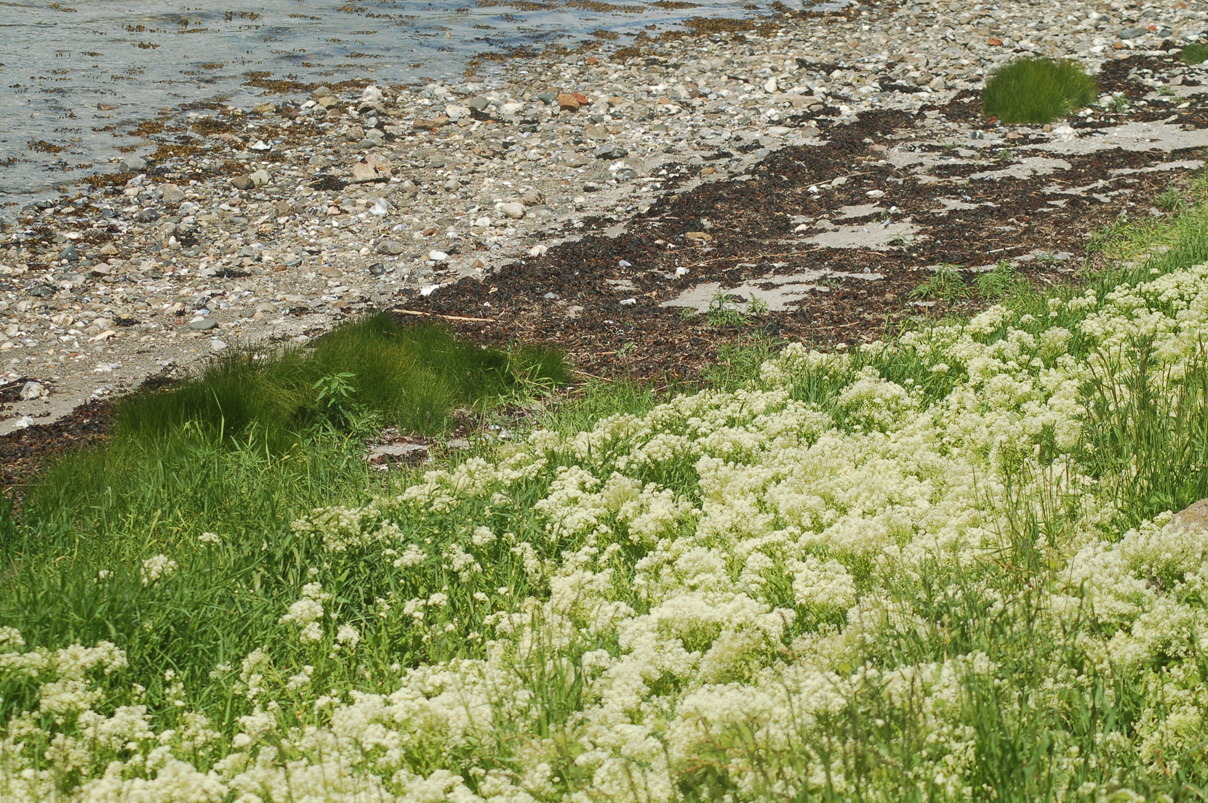
Hoary cress
A short pause by the beach  -  to breathe the fresh air - it's not a heat wave! It is cold today with some dusty rain , but maybe we'll not meet the predicted heavy rain until late afternoon. All along the shore upon a long low bank grow lots of Hoary cress, and it's actually an exotic plant in Denmark. It comes from the Mediterranean and the Middle East, but it has spread as a weed. The species might have survived in some places since the time of the sailing ships, or it has come to later with corn sacks. The Hoary cress has also spread along railroads, where it probably came during WWII and spread with transports of corn and food for the military.


I couldn't help "shoot" this bull who stood there looking yearningly across the road to his cattle friends. He was quite alone. Maybe he had behaved badly? The clouds are drifting fast across the sky making shadows upon the earth, an old windmill on the thill still stands there year after year when we pass by. 


Agri village and church


And here is the idyllic village I simply love with a church and a village pond and some fine houses and farms around the pond. A ghost story is connected to this church. Many have experienced this. A Norwegian family, parents and two teenage girls visited Denmark and came to Agri church on their way to the town Ebeltoft. They had enjoyed their tour in a lovely weather and took a break, drove up to the parking place at Agri church, went out to get some fresh air before driving on to Ebeltoft. It was ten in the evening and it was growing a little darker. They saw two figures emerge at the church, dressed in long dark robes, like monks, they talked and then disappeared around the corner of the tower. Another person came walking from the other side of the church, and when he passed the tower, the two figures jumped out and attacked him. The family watched paralysed, while he was beaten with heavy sticks - and while he lay on the ground, the two dark attackers bent over him and removed something from his clothes. The family discovered that the attack had taken place without a sound - in spite of the quiet evening and in spite of that they stood less than 100 meter from the dramatic scenery. They saw that the two attackers left their victim and almost melted together with the darkness on the other side of the church. The family finally came out of their paralysis - and they all run up to the victim on the ground. There was no trace of anything at all  - no victim, no blood, nothing.  "We just run to the car an drove all we could to our hotel in Ebeltoft", the mother told. "we almost did not talk about it, and the next days we kept a nervous eye on newspapers and TV-news, but we never saw or heard anything about a robbery at Agri church. We don't like to talk about it. I think we are all trying to forget it."       
In spite of several attempts no one have succeeded in finding out, if an attack like this has taken place by Agri church .. .  .


there were lots of scented chervil ....
A corner of Strandkær
Just before Agri we've passed the sign Nationalpark Mols Bjerge, and we'll now drive on a narrow gravel road up in the large hilly area. The hills have been cleared of some growth and now stand fine and round with trees and bushes and grazing cattle and horses. We reach Strandkær, the Mols Laboratory, owned by Naturhistorisk Museum in Århus - here is a large nature area in Mols bjerge. Researchers from Denmark and abroad come here to examine the special nature of the area. Here are two long and winding and sometimes steep paths (also for the public) "The Italian path" and the "Strandkærstien". They are worth a visit at all times of the year, although the Italian path can be dangerous in winter, either waterfilled or a place for ice skating! But we are here in summer, yes, it is summer, isn't it, and although it is a cold day and there are no butterflies to see, there are still many plants. This day we found the Sticky catchfly and the Common bugloss - and a plant I haven't noticed before, in Danish called Nikkende Limurt , the syllable Lim means glue, in English this herb is called the Nottingham catchfly.

Sticky catchfly
Sticky Catchfly/Tjærenellike is a very attractive plant with dark pink flowers on a tall stem, which is sticky just below each pair of leaves. The plant is said to increase the disease resistance of surrounding plants.If you pluck it, your fingers almost fasten in the tar-like paste on the stem, and if you look closely you'll see little dead and half-dead insects in the paste. The English name sticky catcfly is well-chosen. It is not a carnivorous plant though - on the contrary it has lots of nectar for bees and butterflies. In fact it is one of the best nectar plants in Denmark. On the other hand the plant wages war on the insects that try to steal the nectar, the so-called nectar robbers, fx ants. They empty the flowers of nectar without pollinating them , and insects on their way up fasten helplessly in the paste on the stem. Mother Nature is really smart.

Common bugloss
Common bugloss /Læge-oksetunge is an old medicinal herb and it was used against melancholia. It was also said to be cardiovascular and good against cough and healing wounds. The red colouring of the root was already in the Roman period used for makeup. Today the colour is used for dyeing cloth.
Nottingham catchfly
I've researched the Nottingham catchfly. (Danish: Nikkende Limurt). Wikipedia says that  the common name Nottingham Catchfly commemorates the former occurrence of Silene nutans on the walls of Nottingham castle, and the species was chosen to represent the unitary authority of Nottingham as its county flower. Despite this association, Nottingham Catchflies no longer occur in either the city of Nottingham or the wider county of Nottinghamshire. So much for that,  this herb is actually widespread in the world, and in North America it is called the Eurasian catchfly. The plant flowers during the night and produces a strong floral scent to attract its pollinators, which are mostly night-flying moths (well, then I don't need to look for a butterfly here!) 


Small Blue
But then we met a little butterfly, the only butterfly we saw that day, a little blue one of the Blues, it was the The Small Blue (Cupido minimus). It is found in both Europe and Asia,  it is known by its small size (wing span 18-24 mm).  It might sometimes be confused with the Holly Blue. In Denmark it is only seen in some limited areas in North and Mid Jutland and Funen and Zealand. Its habitat is dunes, banks with a thin earth layer and gravel pits. On the continent both larvae and pupae are tended by ants, but there is little evidence of this occurring in the UK. It is the smallest resident butterfly in Britain.

Galloway
The broom is in flower and there were flocks of brooms along the forest glades. There were also thousands and thousands of chervil sending out a fine summerly scent. The Strandkær center has got some livestock, the Galloways, which takes care of itself in a big field and forest area inside the Strandkær area. The Galloways are not curious. They do not come up to you to "have a little talk." The Galloway cattle is from southwest Scotland. It is the oldest British cattle race and the world's oldest hornless meat-cattlerace. It is supposed that the Galloway origins from the hornles cattle of the Scythians (year 485-425 bc). I think this is fantastic. Such an old race. The Galloway can survive in poor pastures, like heaths, and  the cows can raise their calves even under bad conditions. It's like the Highland cattle, they can also give birth and take care of their calves themselves, but there is a difference, the owners of the Highland cattle keep a close eye to their valuable Higlanders. I suppose the people at Strandkær also keep an eye on the Galloway after all! And of course the water supply is taken care of by humans in both cases. In Denmark the Galloway cattle is used for nature conservation. There are several types Galloway, also a miniature Galloway and a belted Galloway. And they are absolutely cute.
They are so calm these nice animals and they look friendly, but it is not advisable to enter the fence while they've got calves, naturellement!


Around the National Park's pastures and banks, sheep, goats, cows and horses are grazing. It is an important goal of preservation in Mols bjerge to keep the open landscapes, and  to reach this goal they use the animals for nature conservation, since the heath, the pastures and the meadows have come to by the human use of the areas. When the animals are grazing they contribute to keep the original look and character of the National park, because the various animals eat various plant species, which else would threaten to take the power. Cattle is well suited for nature conservation, they eat grass and do not care for bitter flowers with bitter taste like the buttercup, and they don't graze close to the cow dungs, where the plants growing there contribute to benefit the flowers and bees.

mixed race
The mixed lightbrown cattle is a special developed forest race, a cross between two Danish milk races and nine various meat-cattle races. This has created some tough animals, well suited for grazing on the nature inspired land all year. They have got the same properties as the Galloways at Strandkær. In several places graze milk goats and Gute-sheep, a tough Viking race with horn, they like to eat broom. In other places in Mols bjerge are horses, they are better when it is about eating the Wavy hair-grass, the most common grass in the open hills.

The National Park Mols Bjerge contains much more (link in English)


I love to visit Mols bjerge. There are so many various places to see, and it is difficult to choose sometimes what to see. I like to visit the archaological sites, like Poskær stenhus and the other dolmens, the beaches, the marinas, the forests and a town like Ebeltoft, which is the most idyllic town with a special little town-hall and old-fashioned gardens and a magnificent glass museum. And the pretty frigate Jutland in the harbour. Outside Ebeltoft the fantastic Safari park, Ree  Park, with cheetas and other exiting animals, living in good environments. And in Ebeltoft is also the film-institute, where many wellknown film-people were educated, like the instructors of Borgen and other wellknown TV-series.  Mols is a multicoloured place, like a painter's palette.   


dark clouds coming.........

But now the rain is coming, dark clouds are gathering, and we'll have to go home. It seems that we are always chasen home by rain. Well, we've just had some good hours in Mols bjerge, the Danish mountains! . See you later!

On our way home we saw some Thunderbirds. In the summer season are many veteran-car meetings at Mols and in this week-end the Thunderbirds. Maybe Ferrari next week!


Steve has just told me that they are Ford Mustangs and not Thunderbids!!