Tuesday, April 24, 2012

The Viking - his Pride and Joy , the Sword and the Axe.


1. Viking picture stone, Gotland


A Nordic Viking's full weaponry were sword, axe, spear, bow and arrow. The noblest weapons among these were the sword and the axe. A Viking with esteem for himself wore them permanently. A real Viking loved luxury, colours and riches in his weaponry, his riding equipment and his clothes.

The Sword
2. Danish sword
The sword is known from several finds in Scandinavia, mostly from burials, but after Christianity arrived it was forbidden to put weapons or other things with the dead Viking. In a Viking warrior's grave were usually only one or two weapons, sword or sword and axe. In return there might in some graves be more than one of each. The long sword seems to occupy the first place among the attack weapons.The new feature about the new Viking sword is the Hialte, the crossbar between the blade and the handle, which meant to protect the warrior's hand. The Hialte did however not give a real protection to the hand, and it is unlikely if the sword was often used as a stabbing weapon.


The Viking's main weapon was probably the sword. The single-edged sword from before the Viking-period was replaced by the long, often broad, double-edged sword with a four-divided hilt.The blade might be Damascened and inlaid, and the hilt was often richly decorated with chase and gilt and with inlaids of gold, copper, silver or niello (a mixture), making the sword into a splendid weapon. The scabbard of the sword is usually not kept or found, but the bronze-"shoe", which forms the finish of the scabbard was sometimes found. It is triangular and often shows animals ornaments in openwork.

3. Swedish swords
Nordic archaeologists have divided the sword material into 20 mutually various groups , Norwegian, Swedish, Danish and common, older and younger. Several Viking swords were found in the interest-sphere in England, Ireland, France, Russia etc. The swords were probably made both in the North and abroad, some swords produced in the Viking's homeland and others imported.

4. Frankish sword, Hedeby


A sword is a complicated thing to create, and the whole working process is not made by the same man. The blade is made by one, the hilt by another, the joining by a third. A hilt might be decorated in a special Nordic ornamentation with a "gripping beast" or in the Jelling style. A sword like that was produced in the North. A blade with a signature like Ulfberth was undoubtedly welded abroad, probably in France. Usually there was enough technical skill in the North to produce a sword. The finds of iron and blacksmith-tools in the Scandinavian Viking finds are a witness of the important role of the Viking-blacksmith. There was a question. Who made the best swords? The answer: Undoubtedly the Franks. This is known from literary sources. And the Franks forbid export of their valuable swords. Charlemagne forbid, Charles the Bald forbid, the last even forbid on penalty of death. Charlemagne's embargo was aimed both to the East and to the North, the clerics were especially impressed to conform to this. This indicates that weapons were often processed in the closter-smithy. The embargo of Charles the Bald was firstly aimed to the Nordic Viking-emporium. He did not wish to equip the bloodthirsty Vikings from the North with the best weapons in the world. And the Frankish swords were considered the best in the world.


5. Charlemagne, A Dürer.
It seems that the Rhine district and especially Cologne was an important center of weapon fabrication. Another sign of the brilliance of the Frankish swords was told in a story in the Gesta Caroli Magni (Story of Charlemagne) about Louis le Gros, who, sitting upon his throne, received swords as gifts from the Norman kings, also Nordic swords, which quality he wanted to test. He tested each sword. The result was that only one sword passed the examination. It might be a fictional anecdote, but it shows the tendency however, the emphasis that the Nordic swords were inferior to the Frankish swords.

A Viking period-find by Swedish archaeologists from Øland in the Baltic sea were five Damascene sword blades with fabrication-signature, probably Ulfberth-blades from the Franks, imported to Sweden to have  bronze-hilts attached. The Nordic craftsmen were from tradition masters in producing the bronze hilts with inlaids and chase. But the blades had to be Frankish.


Legendary Swords
There are many named swords in the legendary literature, and although there might be no reality behind the stories they reflect anyway the importance of the swords - both symbolic and practical. The legendary hero Roland's sword Durendal, king Arthur's Excalibur and Sigurd Fafnersbane's sword Gram are wellknown examples.

Uffe and the Sword Skræp (Offa of Angel)
6. Uffe hin Spage,  Lorenz Frölich
The legend about king Vermund and Uffe belongs to Saxo's Danmarkskrønike. The Saxon king had treacherously challenged the old king Vermund, whose mute son Uffe regained his voice and, unexpectedly to his father, proved to be a strong guy. So big and powerful that every chain mail broke when he got it on. At last he got his father's chain mail which was split up in the side, which was protected by the shield. But no sword was good enough for Uffe, they all skipped into pieces when he swung them, or they could only take one cut. The blind king Vermund then lead his people to a place in the meadow, where he secretly had buried the special sword Skræp, when he thought his son was unfit for anything. Skræp was unusually sharp and could split whatever it hit, nothing could withstand this sword.
The combat took place on an island in the river Eider, and the blind old king wished to sit upon a wharf close to the edge, so he could throw himself into the water if Uffe lost the combat. The sword looked brittle and rusty, but it passed the test. Vermund was blind, but not deaf. When Uffe first chopped one, then the other opponent, both in one single cut, his father recognized the sound of Skræp from the old days. His chair was pulled back from the edge, the king regained his love of life, and the Saxons had to go shameful away. In this way the kingdom of Saxon came in Danish hands, and this sword really deserved a special name.


Sigurd Fafnersbane and the Sword Gram 

7. Fafnerdrabet, Eskilstuna
8. sketch from the Fafnerdrab
A picture and a runic inscription are carved in a rock wall at Eskilstuna in Sweden. It illustrates the legend about Sigurd Fafnersbane. The blacksmith Regin incites Sigurd to kill the dragon Fafner, and he gives him the sword Gram ,which he has welded. Sigurd rides out on his horse Grane and kills the dragon, but when he roasts the dragon's heart on the fire, he is burned, and when he puts his finger in the mouth to ease the pain, he gets the dragon's blood on his tongue, and now he understands the voices of the birds. They tell him about Regin's treachery, and he kills the blacksmith. The whole story is told in one picture. Between Sigurd and the decapitated blacksmith, the tools are seen

Beowulf
The hero Beowulf can only get rid of the troll's mother by using a sword which hangs in the underwater cave where she lives. The Sagas make these swords supernatural, they were not of course, but it is obvious that a good and precious sword was treated with care. Famous swords were inherited through several generations. 


The Axe
9. Axe, Trelleborg
The sword was an international weapon in the Viking period, but the axe was a Nordic weapon. Through the millenias of the Nordic prehistory the axe is much older than the sword. The sword first arrived when man during his cultural development finds a material, which allows to prepare a product like a sword; the metal: first the bronze, then the iron. But the axe had existed in milleniums when the sword arrived. In the Viking period the war axe out in Europe was not out of use, but it was considered an outdated weapon. In the North the war axe had a Renaissance in the Viking period. The haunted western European populations knew their enemy when they saw the long-handled axe, the special sign of a Viking. Upon the Lindisfarne stone the Vikings carry two weapons above their heads, the axe and the sword. The Viking's war axe is  varied in design, but in two main types: an older called the skægøksen (beard axe), which edge is drawn down like a chin beard, and the broad axe with outswayed edge-corners which came around year 1000. Both axes might be decorated with exquisite silver inlaids. A very fine silver inlaid broad axe came up in the excavation of the Danish Viking fortification Trelleborg. 

The Cross in the Axe
10. cross in axe.
In the exhibition of Silkeborg Museum in Mid Jutland is a splendid war axe, a special example of the broad axe, also called The Danish Axe. With its unique decoration it is a bridge between two elements: the life of a warrior and the new faith. The axe is special in its unique design; the blade is openwork, and from the back of the edge-section is seen a little cross. The axe came from a private collection so nothing is known of where it was found. The magnate, who was once the owner of this axe, was surely a Christian. He might have had a connection to the first clerical circles in Denmark, eventually as a protector or a life guard. It is obvious that a Viking remained a Viking, no matter how much he had converted himself to Christianity.


The Spear
11. spearheads, arrows, axe
The spear was widely known and used in the Viking period, it was called the third main weapon of the Viking. The shaft was never found preserved, only the iron spearhead, which has a very elegant shape. A long slender blade with a sharp middle rib. Some spearheads have socalled wings. They are undoubtedly of Frankish origin. In late Viking period are often found a rich silver inlaid in exquisite geometric patterns, such spears were splendid weapons, which no doubt were brought back to their owners after combat- if it was possible!

Bow and Arrow
This ancient weapon was important to the Vikings. This is often told in the Sagas. The bows are gone(they were probably just simple longbows) and the arrow shafts also. But the iron arrowheads are often found in the graves, sometimes also in women's graves. They are heavy, dangerous arrowheads, and sent from a strong bow they must have had a significant impact. They have been found in graves, assembled in bunches or in a bundle of 40 pieces.They were carried in a round quiver.

The Knife.
The iron knife is also a weapon, both a weapon and a tool. The simple one-edged iron knife with a wooden or bone shaft was carried by men at their belt, and  by women in a chain on their breast. In women's graves from the Viking period it is common to find the blade of an iron knife at the woman's breast or at her belt.


The Protection
12. Gokstadship, sketch with shields

13. Viking helmet
The most important protection devices of the Viking were the wooden shield, the iron chain mail and the iron or leather helmet. All three parts are rare to find in excavations, but they are known from depictions and from literary references. The shield was round, flat and rather thin, often painted and with a central round iron boss. On the famous Norwegian Viking ship at Gokstad the shields hang in a row along the railing  The chain mail and the helmet were rare and distinguished protection weapons, carried by chiefs.  They are only known in rests from the finds, but sometimes from depictions or from statuettes, where the helmet is formed like a pointed Monkshood, probably in leather; this pointed hat was possibly a loan from Oriental equipment. Woven depictions from the Norwegian Oseberg ship show whitepainted chain mails, which cover the whole body and with a hood up over the head.


The Berserks. 
Hagar the Horrible

 In connection to the mention of the Viking weapons there existed a strange subspecies of the Viking warriors, called bersærker (berserks); they were raging, half insane brawlers, who were gripped by the intoxication of war, and when the rampage (bersærkergang) came upon them, they had terrible powers, but afterwards they fell into daze and helplessness. Snorre Sturlasson tells in his favorite Saga about those warriors "filled with Odin's rage". Odin could make his battle-enemies become blind, deaf or scared witless, and their weapons did not bite more than a stick. But his own men walked around without chain mail and were like mad dogs or wolves; they bit in their shields and were strong as bears or bulls. They knocked  down enemy warriors like they were flies, and neither fire or iron could fight them. These berserks are often mentioned in the Norse literature; a researcher is of the opinion that they should be considered a species psychopaths, elected for their special powers and brutality and actually organized in teams for kings and chiefs; they were during the battle able to inflame each other until the insanity.

Grethe Bachmann

Source: Johannes Brøndsted: Vikingerne, Materiel kultur, Våben, Gyldendal 1960; Skalk: Smeden, nr. 1, 1963; Skalk: Ole Shiørring, Korset i Øksen, nr. 6, 1978; Skalk: Christian Adamsen, De sagnomspundne, nr. 2, 2011.

 
Images:
1.  Viking picture stone, Gotland, Sweden,
2, 3, Danish sword; Swedish swords; Johannes Brøndsted, Vikingerne. 
4. Frankish sword, found in Hedeby(Haithabu) , Gyldendal og Politikens  Danmarkshistorie, 
bd.3.      
5. Charlemagne, painting by Albrecht Dürer, 1600, Buch: Kunsthistorisches Museunm, Wien.
6. Uffe hin Spage, drawing by Lorenz Frölich.  
7. picture and runes of the Fafnerdrabet upon at Ramsundsberget in Eskilstuna, Johs. Brøndsted, Vikingerne.
8. sketch of the Fafnerpicture, by J. Aarup Jensen, Skalk 1963.
9. Silver-inlaid war axe, found in the Viking fortification, Trelleborg, Sjælland ; Johs. Brøndsted, Vikingerne. 
10. Viking axe with cross, Silkeborg Museum, Jutland, Skalk 1978 .
11. Viking spearheads, arrows, axe, Johs. Brøndsted, Vikingerne.  
12. The Gokstadship (Norway) with shields, drawing from book by N. Nicolaysen about the Gokstad ship. 
13. Viking helmet, 7-9 century.
14: Hagar!


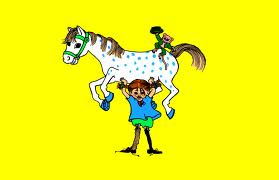
Pippi Longstocking's Horse


"Pippi-horse"
The other day I saw one of those horses we in Scandinavia call a Pippi Langstrømpe-hest. Pippi had this white horse with a lot of spots and she was able to lift it one-handed.  The books about Pippi are loved by every child in Sweden and the rest of Scandinavia.


I guess that most of you know Pippi (Peppi) Longstocking. Astrid Lindgrens books are translated into 64 languages. 

Astrid Lindgren's first three Pippi-books were published from 1945-48. Pippi was named by Astrid Lindgren's then nine-year-old daughter Karin. Pippi is unconventional and has superhuman strenght, she is able to lift her horse, she mocks and and dupes adults, but she reserves her worst behaviour for her most pompous and condescending of adults. Her anger is reserved for the most extreme cases, such as when a man ill-treats her horse, Like Peter Pan Pippi does not want to grow up.

Pippi claims her full name is Pippilotta Delicatessa Windowshade Mackrelmint Ephraim's Daughter Longstocking (Swedish: Pippilotta Viktualia Rullgardina Krusmynta Efraimsdotter Långstrump). Her fiery red hair is worn in pigtails, so tightly wound that they stick out sideways from her head.
Pippi lives in a small Swedish village, in an exciting house Villa Villekulla with her monkey hr. Nilsson and her horse, but no adults or relatives. She's got two friends Tommy and Annika, two children who live next door. Pippi's two main possessions are a suitcase full of gold coins (which she used to buy her horse) and a large chest of drawers containing various small treasures.
Pippi is the daughter of seafarer Ephraim Longstocking, captain of the sailing ship  Hoptoad (Hoppetossa in Swedish), from whom Pippi inherited her common sense and incredible strength. Captain Longstocking is the only person known who can match Pippi in physical ability. He originally bought Villa Villekulla to give his daughter a more stable home life than that onboard the ship, although Pippi loves the seafaring life and is a better sailor and helmsman than most of her father's crew.

Villa Villekulla
The story goes on and on with Pippi  and Tommy and Annnika, and Astrid Lindgren is one of the most loved authors of children books. She is the world's 18th most translated author and has sold roughly 145 million copies worldwide.The best-known books by Astrid Lindgren: The Pippi Longstocking series, Karlsson-on-the roof-series, Emil of Lönneberga, The Bill Bergson series, Madicken, Ronia the Robber's Daughter, Seacrow Island, The Six Bullerby Children, Mio, my Mio, The Brothers Lionheart.(some of the books are on film and TV).

Astrid Lindgreen died in 2002, 94 years of age.


Sunday, April 22, 2012

Boosting Your Burning..........

.......... with 5 healthy things.


In  my weekly magazine were 12 pages, a whole section, with advice for health and beauty, one better than the other and one more forgetfull and expensive than the other . But there was a good little page with 5 healthy things which would be easy to remember. And not only if you want a weight loss but just want to treat your body in a good way.

Green Tea.
Most people know green tea. It promotes the combustion, it reduces the bad cholesterol and reduces the fat depots. Studies have shown that green tea inhibits the ensyme lipase, which deplete the fat in the food, and therefore lesser fat is absorbed. Green tea also stimulates the thermogenesis, (which promotes the calorie burning). Green tea reduces the speed, and thereby carbohydrates are taken into the bloodstream.

Chili.
New studies show that special natural plant-substances like capsaicin and epigallocatechin gallate affect the food-caused stimulation of the compustion. Both substances are in chili. Strong spices boot the system and give you warmth -  and at the same time they boot the socalled food-induced compustion - daily just called compustion or burning - and this burns off your calories.

Apple Cider Vinegar
Apple cider vinegar alone does not give you a weight loss, but together with a sensible food it supports the weight loss immensely and counteracts the side effects in a food, which contains lesser calories than you burn.


Grapefruit     
It has been shown that plant chemicals in grapefruit can contribute to reduce the insuline level in the body and thereby the amount of the energy from the meal, which is transformed into fat.


All Vitamins and Minerals
And then it is important to be supplied with all essential vitamins, minerals and fats daily - especially if you want a weight loss. 


Source: Caroline Fibæk,  Femina, nr. 16, 19. April 2012, Aller Media A/S , Havneholmen, København.

photos: copies

Friday, April 20, 2012

The Cherry Blossoms in Japan


Mindeparken, April 2012.


The Cherry Trees in Mindeparken, Århus 
In 1988 the Japanese Sakura foundation gave 300 Japan cherry trees to Århus as a gift from the Japanese people to the Danish people. The purpose was to establish a forest of cherry trees and after an acclimatization in a gardening 146 of those trees were plant in the upper area of Mindeparken. They are of different varieties and they flower from early spring till June.

There is one tree I especially notice each year, it sometimes flowers very early, I have a photo from a year, where the first little flowers came in February. The cherry trees in Mindeparken are now big and beautiful and a joy to everyone, who come here to admire those wonderful flowers. I can imagine it must be a fabulous sight to see 1.000 flowering cherry trees in the park in Tokyo. And when the flowers begin to fall down they cover the earth with a beautiful pink carpet.  


History in short. 
The beautiful cherry flowers, called Sakura, are a symbol of Japan. To do Hanami is to go viewing the flowers. "Hanami" is the centuries-old practice of picnicking under a blooming sakura or ume tree. The custom is said to have started in the 7th century, when it was ume blossoms that people admired in the beginning. But from the 800-1185s cherry blossoms attracted more attention and hanami was synonymous with sakura. From then on "flowers" meant "sakura." The custom was originally limited to the elite of the Imperial Court, but soon spread to samuari society and, later to the common people as well.  Under the sakura trees, people had lunch and drank sake in cheerful feasts.


pink cherry blossoms and a blue sky, April 2012


The Festivals
Hanami is still an important Japanese custom and is held all over Japan in spring.  Every year the Japanese Meteorological Agency and the public track the cherry blossom front as it moves northward up the archipelago with the approach of warmer weather via nightly forecasts following the weather segment of news programs. Japanese pay close attention to these forecasts and turn out in large numbers at parks, shrines, and temples with family and friends to hold flower-viewing parties. Hanami festivals celebrate the beauty of the cherry blossom and for many are a chance to relax and enjoy the beautiful view.  People in Japan have fun viewing cherry blossoms, drinking and eating. It is like a picnic under the trees. In Tokyo is Ueno Park one of the most popular places for hanami, there are more than 1.000 cherry trees near the National Museum, and in another park Shinjuky Gyuen are also over 1.000 cherry trees, in various species, so the season of the hanami is long.

The most popular kind of Japanese cherry (sakura) tree which can be found everywhere in Japan is somei-yoshino (Yedoensis). Sakura trees bloom at different times throughout Japan. Cherry blossom festivals take place all over the country. Most of them are held between March to May, though other regions have them in January, February, and June, based on their location. Festival dates are usually determined with reference to cherry blossom forecasts and vary from year to year.  The gorgeous flowers are main attractions of the festivals, but there is also a variety of traditional Japanese performing arts presented in many festivals. Joining tea ceremonies held under cherry trees, various food and souvenirs, including regional crafts and speciality food in the region. Many cherry blossom festivals hold light-up events in the evening.

training under the cherry trees, April 2012


Symbolism.
The cherry blossoms in Japan also symbolize clouds due to their nature of blooming en masse, besides being a metaphor for the nature of life, an aspect of Japanese cultural tradition that is often associated with Buddhistic influence. The transience of the blossoms, the extreme beauty and quick death, has often been associated with mortality; for this reason, cherry blossoms are richly symbolic, and have been utilized often in Japanese art, mange, anime, and film, as well as at musical performances for ambient effect. There is at least one popular folk song, titled Sakura, and several pop songs. The flower is also represented on all manner of consumer goods in Japan, including kimono and dishware. Cherry blossoms are a prevalent symbol in Irezumi, the traditional art of Japanese tattoos. In tattoo art, cherry blossoms are often combined with other classic Japanese symbols like koi fish, dragons or tigers.


photo Mindeparken, Århus, 12 April 2012: grethe bachmann


Sunday, April 15, 2012

I met a Red Kite Yesterday.....


Red Kite


by Allen Willianms from Bridgend about a Red Kite in Mid Wales.

What are you thinking my wild friend
As you claim supremacy of the summer sky?
What magic holds you there without a single flap
Of your gorgeous wings?


Who dresssed you today wondrous one
In a rust coloured waistcoat and a starched white shirt?
Your taloned wings outstretched embrace the sky
You truly are God's work.


Who are you nagging with that fishwife song?
They can hear you from Garreg Dan to Caban Coch
Keep on calling my brave beloved, someone will come,
You cannot be the last Red Kite.


Written by Allen Williams 1972. 


photo Djursland 14. April 2012: grethe bachmann


Sunday, April 08, 2012

Pulsatilla/Pasque Flower - Easter flower

Pulsatilla - Pasque Flower (Easter Flower) - Kobjælde

Pulsatilla pratensis, Pasque flower, Nikkende kobjælde: The 6 purple flower heads are silky haired and longer than the many yellow stamens. The fruit stand is easy to recognize. It looks like a powder puff, the seeds are hairy and has a 5-6 cm long griffel. The fruit stand is not nodding like the flower is, but upright. The flower is rarely yellow-green or white. It can make hybrids with Pulsatilla vulgaris, but this is very rare.

The pratensis can be mistaken for the vulgaris, but the vulgaris is upright while flowering, and it is more bluish purple than the pratensis. The pratensis has a massive stem, filled with marrow, while the vulgaris has a hollow stem.It flowers in April-May (in DK) here and there on sunny hills, especially in North Jutland and upon the Isles. It grows in open calcium-rich sand- or gravel soil and is especially known from pastures, hills and banks.

Pulsatilla pratensis is relatively rare in Denmark.


The Pulsatilla pratensis is vaguely poisonous and with a sharp taste of the substance anemonol - and it is avoided by grazing animals. The Danish name Nikkende Kobjælde means nodding cowbell, and the nodding flowers look like the bells around the cow's neck in Norway and the Alps - but the name might also have a relation to its habitat and to the flowering, which is when the cows come out on grass in spring. Like many other flowers it had many nicknames in the old days: fluffy boys, cowbell, ox-ear, king's bell , boy's shaving brush. People appreciated it because it was one of the finest spring flowers and the very first which like a little bell was being moved here and there by the wind, like it was ringing people and cattle to dinner. It was swept in the finest fur and the fluffy flowerbuds looked like little feathered baby birds in a nest. "It appears like a small fluffy troll in his tight white fur". "It looks like a little harefoot springing up from the sand".
There were many sayings about this little Easter flower.


Pulsatilla vulgaris/ Common Pasque flower/Opret Kobjælde
Pulsatilla vulgaris, Common Pasque Flower, Dane's blood /Opret Kobjælde appears with the bell-shaped flower in early spring. It grows here and there in Jutland. It has purple flowers, but there are white and light red sorts. Its habitat is pastures or banks with a calcium-rich gravel soil. It is dependent on that grass and other aggresive herbaceous plants are being grazed or cut. Upon the grazed areas the plant is favored by that the cattle avoid it because of its toxicity. In Cotswold in England is a large colony of Pulsatilla vulgaris.


The Pulsatilla vulgaris is the most important ingredience in the French tonic hépatotum, taken for the liver (Crise de foie) and for the production of gall.  It has some old nicknames too, like blue weather herb and cow ball.

Pulsatilla vulgaris is rare in Denmark and should not be plucked in nature.


The Pulsatilla vernalis , Spring Pasque Flower/ Vår-Kobjælde), is a very low plant, with redbrown or purple, silky haired flower head. It grows in a few places in Jutland. Large bell-shaped, first nodding, then upright flowers - and the vernalis cannot be mistaken for any other flower plant in Denmark. After flowering a large tuft of light seed-wool is formed. The vernalis flowers in April-May-June on dry, poor soil in heaths in Jutland. The fresh plant is poisonous. It was used as a medical herb in various diseases. It was latest seen in Denmark 10 april 2009 in Ulfborg statssskovdistrikt. The Pulsatilla vernalis is the county flower of Oppland, Norway and is depicted in the county coat of arms.

Pulsatilla vernalis is very rare in Denmark , and it is totally listed. 

Pulsatilla in general:
Folk Medicine:
1546: a wine decoct from root or seeds to drink in order to drive out bladder stones and menses; the herb or destilled water from the herb to cleanse bad wounds, remove dead meat.

1648: the crushed plant placed as a compress upon the wrist against coldfever (malaria); the juice rubbed upon warts; the dried and pulverized root provokes sneeze like snuff.

1688: the flower used as a compress on a fever pulse; a tea from the plant was drunk against gouts. The herb was sold in pharmacies.
 
Other Use:
copy from Inks and pens.
Children made the fruitstand wet and combed back "the hair" and braided blades of grass into it;  they tickle each other with this "hairy brush" under the nose and said: " Do you wish to smell this hairy boy?" The stiff stalk with the fruit stand is called the boys' shaving brush.

1761: From the flower juice was produced green ink. Easter eggs were coloured green with the flowers in the boiling water.

In WWII  it was recommended to use the roots, which contains saponin as a surrogate for soap bark for  delicate wash.

Source: V. J Brøndegaard, folk og flora, bd. 2 Dansk Etnobotanik,  Rosenkilde og Bagger; Danmarks fugle og Natur, Felthåndbogen, april 2012. 

Photo, Bjerre, Thy: stig bachmann nielsen, Naturplan.dk 


Sunday, April 01, 2012

Moesgård Park and Skovmøllen...........


south wing corner of Moesgård.


The large area around Moesgård and Skovmøllen is one of the most popular places to go in the Århus district. Here is the high beech forest, the beach, the park with lots of birds, here is the popular prehistoric museum.  They are now building a new museum upon a piece of land north of the old buildings. They need more space.

old avenue
The park is still the same with the same lovely old trees, the small lakes, the birds, the old houses, the old orchards.  It's a place where I have come very often. This day was a rather cold day, the warmth from last week had disappeared to a place I don't know where, and the north wind was sweeping around the face and through the bones. The winter clothes were in use again.


When we came to the old avenue in the park, two great tits were fighting violently, while a third was watching them. It really looked serious. They can kill each other, but when we approached they discovered us and flew up in the tree tops. I hope they forgot what they were doing and didn't start the fight again.


This is the time for frogs. In one of the small lakes were lots of frogs, and this was the common frog. (European Common Frog). They make a strange sound, such a deep roar - first I thought it was a faraway train I could hear, but it was the frogs. All those thousands of eggs! When the tadpoles come out most of them are eaten by fish, dragonfly larvae and birds, so most tadpoles will disappear I guess - or else the park would be swarming with frogs in summer! The number of frogs are being kept at a level, they are eaten by birds of prey, crows, ducks, herons etc.. Nature is smart.
frog eggs

bark of the biggest oak


At the corner just before we reach the Iron Age house are a couple of old oaks, one of the side-branches has been cut off, probably because it was broken by itself, and we counted the year rings. 150 years. The trunk itself is much thicker. The trees are probably 3-400 years old. Lovely old trees. Their old trunk is like stone. 


The Iron Age house lies on the socalled prehistoric hiking path, which is a part of the prehistoric museum of Moesgård. I usually don't think much about it, I have been here so often, but it's actually a 4 km hiking path, which tells a lot about prehistoric history. I'm sure you know this. If you live in a place with something special, it has become just a part of what you see.

The hiking path goes through the manor park, down across open pastures, through a high forest and swamps along the river Giberå down to Moesgård beach and back to the manor Moesgård through an evocative forest. On the path people will be passing  Skovmøllen, and some reconstructed prehistoric houses, memorials and dolmens. The tour ends at the reconstructed Viking church.


And here is the Iron Age house, which is reconstructed from a settlement in southern Schleswig. The house shows how people and cattle lived under the same roof. In the west-end lived the family around the fire place, and the east-end was for the livestock, they stood in boxes divided by intertwined walls. During the excavation of the house in Schleswig was found a wooden trough with the skeleton of a 10 months old baby. The settlement in Schleswig was developed ab. 100 A.C. and inhabited through 4-500 years.   

Opposite is a field I call  "Hestemarken",  the horse field, there are always some sweet Icelandic ponies here,  they are so friendly, and they love a little talk. I only saw two horses today, and they were in the other part of the field. It's freezing cold, but they've got a thick woolen fur, those cute Icelanders. Nature is smart!! ´ )


The Giberå river runs through the forest on this part of the hiking path, and here lies Skovmøllen, also a popular place for people to go. Here's a cosy restaurant decorated with old Danish antiques, and I love to go here and have hot cocoa and buns with butter. What you see on the photo is the mill itself, where we can buy flour. The restaurant is to the left and behind.


old orchard
I was not interested in walking further down to the beach, it was so cold, and my left knee was feeling bad.  So we turned and went back up along the road to the park, beside the park is a big field with lots of sheep. They looked like they had a conference on top of the hill. In the park is an old orchard from the time when a family lived on the manor. Still apples in autumn, they are sour, but they can be used in an apple cake with extra sugar! In a fine glade with a flowering mirabelle stands the pretty Thai house.

The rests of trees and branches are left all over the park, they form good places for birds, insects and reptiles.


The Thai house came to Denmark as a gift from the Thailand state in 1975 in connection to a great exhibition about Thailand. It's about 100 years old and stood originally in Siam's old capital Ayutthaya ab. 200 km north of Bangkok. You'll enter the house by using a staircase up to the veranda in front of the house. The inhabitants probably used a ladder, which could be drawn up at night and prevent intruders from entering. Upon the veranda was kitchen and fireplace, and the family stayed here most of the time. The higher placed main room with sleeping places, storage furniture and altar was their private area.

Under the house the family stored various large tools like plough, rice grinder and fish traps. There was a fireplace too, and the place was especially used as a workshop. But when the monsun rain came from July till September, they had to clear the place and move the things elsewhere. 

Too cold for comfort. I feel like an icicle. Now it's back home................

the narrow road...


Spring signs:

buds on chestnut

yellow anemones


forsythia


photo Moesgård 31 March 2012: grethe bachmann

The Sun was warm but the Wind was chill...........


The sun was warm but the wind was chill.
You know how it is with an April day
When the sun is out and the wind is still,
You're one month on in the middle of May.
But if you so much as dare to speak,
A cloud comes over the sunlit arch,
A wind comes off a frozen peak,
And you're two months back in the middle of March.

Robert Frost


photo Moesgård, 31. March 2012, Thaihouse and a Mirabelle: gb