Showing posts with label silver treasure. Show all posts

Wednesday, May 11, 2016

The Silver Fyrkat-Bracelets from the Viking Period


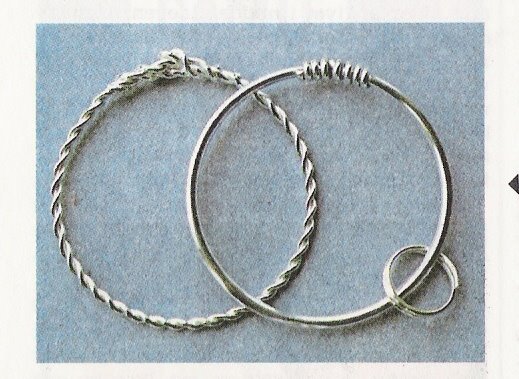
photo: Replicas of the Fyrkat-bracelets.

On an excavation by the Viking fortress Fyrkat by Hobro (East Jutland) were in the early 1950s found two silver bracelets about the same size, but of a different shape, one twisted, the other smooth with a little jingling pendant. The twisted bracelet was found 1952, when a stolp hole was being emptied in one of the big curved-wall longhouses. Since it was late season the hole was first digged out fully the next year - and thirteen centimeter deeper was found the smooth ring with the little pendant. In the stolp hole had once been two uprights, and the bracelets were squeezed between those. There is no doubt that they were hidden in a space in the wall. Why? This can only be a guess.

Bracelets like these were modern in the period of Gorm the Old, Harald Bluetooth and Sweyn Forkbeard. The smooth bracelet is made of heavy silver thread, which gets a little narrower in the ends, the twisted made of two silverthreads and twisted together. The closing plait is rather different, but the size of the bracelets is approximately the same, a little more than 6 cm, which is what we today regard as a normal size. Their owner was undoubtedly a woman. A tough viking would hardly be able to wear them.Besides the closings and the pendant there are no frills on the bracelets, they were actually applied art.
Viking house Fyrkat
In the finds at Fyrkat were coins, but a real monetary system was not yet known, people paid with silver after weight, whether it was marked or not. A little ring like the pendant was a suitable change, but it often happens that jewelry is found cut into pieces. The silver jewelry from the viking period can be regarded as decorative cheque books.


The twisted parts in both bracelets are made in a way which is a little awkward, though natural for a left-handed person; they are possibly made by the same silversmith. He might have worked in the viking fortress itself, where craftsmen lived and worked with precious metals.
(source: Skalk 5/1976)


photo: grethe bachmann

Wednesday, May 30, 2012

Rosenborg Castle - The Silver Lions and the Throne.


 Riddersalen, Rosenborg slot

The three silver lions were made in Copenhagen 1665-70 by Ferdinand Küblich. They had - like the monarch's throne - their model in the old Testament's story about the wise king Solomon which throne was protected by 12 golden lions.The silver lions were used in offical events like fx anointments and they are still used today in the royal family at the "Castrum Doloris".  At the monarch's death the coffin is publicly accessible for a few days, and during this period the lions guard the king or the queen. 

The silver lions stand in the Great Hall (Riddersalen)  at Rosenborg castle. In the great hall is also a fine collection of silver furniture, mainly from the 1700s.


The silver-clad throne, ( used for audience) made by A.F. Holling in Copenhagen for Christian 6.'s Audience Chamber at Christiansborg castle.  Silver furniture symbolized greatness and power, and they were indispensable requisites in a princely residence of the Baroque. The main part of the exhibited furniture was made at Christianborg, which was the absolute monarchy's new residence. It was finished in 1740, but when the new castle burnt down in 1794, the furniture was saved and found a place at Rosenborg. Several pieces of furniture at Rosenborg origin from Christian 6.'s Audience Chamber.

The anointment throne (to the left)  was used for the Danish kings from 1671-1840. Frederik III ordered in the 1660s a throne - and this throne was made even more legendary when it was told that it was made from the horn of a unicorn. The throne is actually made from narwhal tusk, which the king possessed because of his supremacy of the Faroes and Iceland. The throne is made by Bendix Grodtschilling and was used for the first time at Christian 5.'s anointment in 1671. The crowning of Christian 8. in 1840 was however the last use of the throne, since it was also the last coronation upon Danish ground. In 1848 Frederik 7.. became king and signed the first Danish constitution in the start of his rule, in 1849. Since regents are not crowned in Denmark anymore, the next regent is proclaimed at the same time as the prime minister proclaims the old regent's death from the balcony at Christiansborg castle.  
.
photo september 2008: grethe bachmann