Showing posts with label Hans Christian Andersen. Show all posts

Monday, October 17, 2016

Petasites / Common Butterbur, DK: Rød Hestehov

Petasites hybridus/photo grethe bachmann
Petasites hybridus

Butterbur / Rød Hestehov is in English also called  Pestilence wort, Bogs Rhubarb or Devil's Hat, in Danish Pestilensurt or Tordenskræppe. It is a herbaceous perennial flowering plant in the daisy family Asteraceae, native to Europe and northern Asia. The preferred habitats are moist, fertile soils, often by rivers, streams and in wet meadows. Synonyms include P. officinalis, P. ovatus, P. vulgaris and Tussilago petasite.

Another name is Sweet Coltsfoot. The Latin Petasides is derived from petasos, the Greek word for the felt hats worn by shepherds with reference to the large size of the leaves. The Danish name Hestehov means Horse's Hoof , also a reference to the large leaves. The English name Butterbur is supposed to have been given it because formerly the large leaves were used to wrap butter in during hot weather.
In the Middle Ages it was called Pestilensurt in Denmark, an indication of its value in time of the plague. The 'plague-flower' gained a succesful reputation among the few remedies during the time of the Black Death. It was used as a remedy against the plague by the monks in Denmark during the 1300s.

The flowers are produced in the early spring, before the leaves appear. They are pale pink, with sev
eral inflorescenes clustered on a 5–20 cm stem. The leaves are large, on stout 80–120 cm tall stems, round, with a diameter of 40–70 cm with petioles up to 1.5 m. Butterbur has special value for the bees because of the early flowering. In some districts the plant is considered  a landscape-weed, since it is able to spread heavily in optimal conditions.


Helix pomatia/ photo grethe bachmann
Red Hestehov was originally introduced in Denmark as a medical plant, maybe during the black death. It now grows wild from earlier cultivation by castles, manors, klosters and ruins. The plant is a characteristic mark for the gardens of these places, often together with the Helix pomatia (Burgundy snail), probably brought to Denmark by the monks in the Middle Ages. A snail dish was a favorite meal in the klosters


Hans Christian Andersen wrote about the huge leaves of Hestehov in the fairy tale "The Ugly Duckling":"In the midst of the sunshine there stood an old manor house that had a deep moat around it. From the walls of the manor right down to the water's edge great burdock leaves grew, and there were some so tall that little children could stand upright beneath the biggest of them. In this wilderness of leaves, which was as dense as the forests itself, a duck sat on her nest, hatching her ducklings. She was becoming somewhat weary, because sitting is such a dull business and scarcely anyone came to see her. The other ducks would much rather swim in the moat than waddle out and squat under the burdock leaf to gossip with her......."


Petasites hybridus/ wikipedia

The Danish name Hestehov refers to the leaves = like the hoof of a horse. Actually it was originally referring to a colts foot. Another Danish name is Tordenskræppe ("Thunder rumex"). The thunder name might be because the leaves were used as a protection in a thunderstorm -  or it was  referring to the flowering in the month of March, the month of the Thundergod, Thor. It might also refer to the size of the leaves and the rumble from heavy rain upon them.


In the Middle Ages it was known as Niels Bugge's Blood and Niels Bugge's Roses after king Valdemar's most dangerous opponent, the magnate Niels Bugge of Hald was murdered in the town Middelfart in 1359. This indicates that the plant was introduced in Denmark around that time. After hostile negotiations with king Valdemar Atterdag the Jutland magnate Niels Bugge of Hald was killed by fishermen at Middelfart, supposedly on the king's orders - according to the legend at a place near the king's castle where now grow many butterburs. The commoners believed that Niels Bugge's blood fled over the leaves, leaving the dark spots,  and the plant could never be destroyed. Three houses in the street were forever fined, the socalled Buggesmoney, which the town Middelfart paid right up to 1874, where the Danish parliament abolished the unusual punishment 

Petasites hybridus/photo grethe bachmann
In Denmark grow 5 species of Hestehov, most of them considered as introduced. Especially the Red Hestehov (P. hybridus) causes problems, among other places by water streams. Locally the Japansk Hestehov (P. japonicus) can also be very spread, while the White Hestehov (P. albus) is less common.Red Hestehov is considered invasive and can be defeated by mowing and grazing. When Red Hestehov withers in the autumn, the soil gets exposed, and when the plant grows along water streams this exposure of the soil might create erosion along the water in winter, due to that there are no plants to protect the banks and to hold on to the soil. Still in only few places the Red Hestehov is considered serious landscape-weed. In several communes the plant is not existent or very few.
Five Petasites in Denmark:
Petasites albus = White Hestehov
Petasites hybridus = Red Hestehov
Petasites japonicus = Japansk Hestehov
Petasites fragrans = Vellugtende Hestehov
Petasites spurius = Filtet Hestehov 

Black Death/wikipedia
Folk Medicine: The plant came originally to Denmark as a medical plant in the Middle Ages. It is known from the Viking period in the Aarhus-area. The crushed leaves were used against plague-abscesses and wounds in the Middle Ages, later the plant was/is used against cough, cramps and pain in stomach and  abdomen. Beer-essence from the roots was drunk against gout
Simon Pauli 1648: "Butterbur  has a special hidden power to resist the infection from plague". At the pharmacies was made an essence from the root, which was taken in together with  hartshorn jelly. This medicine was better than the pulverized root or a decoct of it. The extract could also be used against malaria.  

Hartshorn jelly or a decoction of burnt hartshorn in water was used to treat diarrhea. Hartshorn was used to treat insect bites, sunstroke, stye  and snakebites. When people went outdoors they chew the root as a protection against infections, especially in the days of the black death. From the plant oil was made a balm which was placed into a container, which delivered a good scent in times of the plague  - or people rubbed their nostrils and temples with the balm as a protection.The leaves were bound around the legs in order to remove dropsy. The root of Petasites was written into the pharmacopoeia in 1772. Tea of Petasites was sold at the Danish pharmacies still in 1946.
Livestock: The root was used against liver and lungdisease of horse. A part of vinegar and beer decoct against the swine disease in 1600-1700. The leaves were also used as cattle fodder, evt. mixed into the hay. 
Play: Children used the big leaves as an umbrella or as a an apron.

Gerard writes of the Butterbur:
'The roots dried and beaten to powder and drunke in wine is a soveraigne medicine against the plague and pestilent fevers, because it provoketh sweat and driveth from the heart all venim and evill heate; it killeth worms. The powder of the roots cureth all naughty filthy ulcers, if it be strewed therein.'

Culpepper says:
'"t is a great strengthener of the heart and cheerer of the vital spirits: . . . if the powder thereof be taken in wine, it also resisteth the force of any other poison . . . the decoction of the root in wine is singularly good for those that wheeze much or are shortwinded.... The powder of the root taketh away all spots and blemishes of the skin. " Another species are known as the Winter Heliotrope, or Sweet-scented Coltsfoot (P. fragrans)

Potential medicinal uses (see wikipedia for more info)

Preliminary trials have shown a preparation of Butterbur root to be effective in reducing the frequency and severity of migraine attacks. A commercial extract Petasol butenoate complex
ZE 339) has proved helpful for allergic rhinitis An evidence-based 2005 systematic review including written and statistical analysis of scientific literature, expert opinion, folkloric precedent, history, pharmacology, kinetics/dynamics, interactions, adverse effects, toxicology, and dosing is available
from the Natural Standard Research CollaborationButterbur extracts may contain harmful alkaloids if the preparations are not carefully and fully purified. These chemicals are toxic to the liver and may cause cancers. Thus, due to the potential for contamination, taking butterbur supplements is not recommended during pregnancy or breastfeeding. It is safe practice to consume butterbur extract that has been prepared by a reputable laboratory.Long-term health effects and interaction of butterbur with other drugs have not been well documented. (Please read further information in wikipedia about Butterbur)


Source: Brøndegaard, Folk og flora, Dansk etnobotanik.

photo grethe bachmann
photo from wikipedia 

Friday, September 16, 2011

Paying H.C. Andersen a Little Visit....

                                                                                                                                                                "My life is a fairy tale", said H.C.Andersen. " So rich, so blissfull!"  H.C. Andersen was a multitalent. He wrote his famous fairy tales and his wonderful descriptions about his journeys and his fantastic life, but he also made paper-clips and drawings. His paper clips are funny and odd,  but they also bring some idea about the poet's social and private life. "To clip, this is the first beginning of poetry", he wrote to his friend Dorothea Melcior in 1867. The paper-clips show us his vivid imagination. He was in many ways ahead of his time as a poet and visual artist. He made collages before the idea was invented and experimented with materials like he was experimenting with words. He was able to remember details with an astonishing accuracy, he had a sense of proportions and details, and his literary works make their mark by the very strong formation of pictures, which is why his fairy tales have such a rich history of illustration. All through his life H.C. Andersen had a colossal imagination, he considered it both as a gift of spirit and a disease of the soul.
window mirror


Chinese tourist
He would probably be astonished, if he visited his home and the streets of his childhood today.  He would say: "How pretty! How nice! It's like a fairy tale!".When he was a child, it was actually a slum and not a good place to live in. Today the houses are well-kept and in matched colours, the streets have kept their old pavements and the windows in the pretty houses are decorated in the most delicate way with china and flowers. I would certainly also keep my windows in order, if I lived in that street! Some ourists consider the whole street an exhibition and stare into the windows! Well, only a few. It was not the Chinese family we saw that day. Don't wear high heels. The pavement is a high-heel-killer. But the whole little quarter in the city of Odense is a pretty harmonious place, it's like you're walking in a "time-pocket." Cars are forbidden, you can easily imagine that you are walking in a car-less time!    


alleyway
In H.C.Andersens hus is a museum and also an exhibition of his paper-clips, drawings and collages.

H.C.Andersen Museum

photo Odense 10. September 2011: grethe bachmann

Wednesday, July 13, 2011

Folklore - Mermaids and Mermen and the North Sea,

They lived in the deep blue sea, in magnificent homes, they lived a life almost like humans on earth.

The most famous and popular was the mermaid, also known from H.C.Andersen's fairy tale about the little mermaid with the tragic life. The mermaid appears in various connections, often as the beautiful elf-maiden with long hair, or equipped with a fish-tail - or only her feet looking like fish-tails, while the rest of her body is human like in the fairy tale. One of her baits is her voice. She's able to stand in the water and sing as lovely as any elf-maiden.

She comes up from the waves and try to lure the fishermen and the sailors to sail longer out into the sea. They lose landfall and end down in the depth together with her, like the in the similar tale about the elf-maiden in the moor. The mermaid does not mean any harm, she has followed a fisherman on his lonesome sailings, she has fallen in love with him and wants to live with him forever. She is also able to catch a farmer on the beach. The result of a romance like this was the island Bornholm's protection figure Bonavedda, a vætte (a spirit), who had inherited the mer-people's psychic talents from his mother.

Ship in the waters by Ærø
The legends describe the mermaid with sympathy. There was a secret understanding between her and the sailors, because she knew the mood of the ocean better than they did - and she could warn them, when a storm was on its way. Upon the island of Ærø is a big stone on the beach, named Havfruestenen (the Mermaid Stone). The sailors and captains of Ærø went to this stone, where a mermaid gave them advice before they went to sea. If a mermaid showed in front of a ship, she was the cause of alarm. The sailors considered this as an omen of bad weather. Women did not like the mermaid. A woman in the fishing village Harboøre in West Jutland complained that a mermaid was in bed with her and her husband each night.


Although people usually considered the mermaid sympathetic, she had one fault - and this was a big one in those days. She was not a Christian, she belonged to the people of the vætter (spirits).  But maybe the clerics were most troubled by that?

Mermen hated priests, and they tried to drown them. Maybe that's why sailors do not like to have clerics onboard.

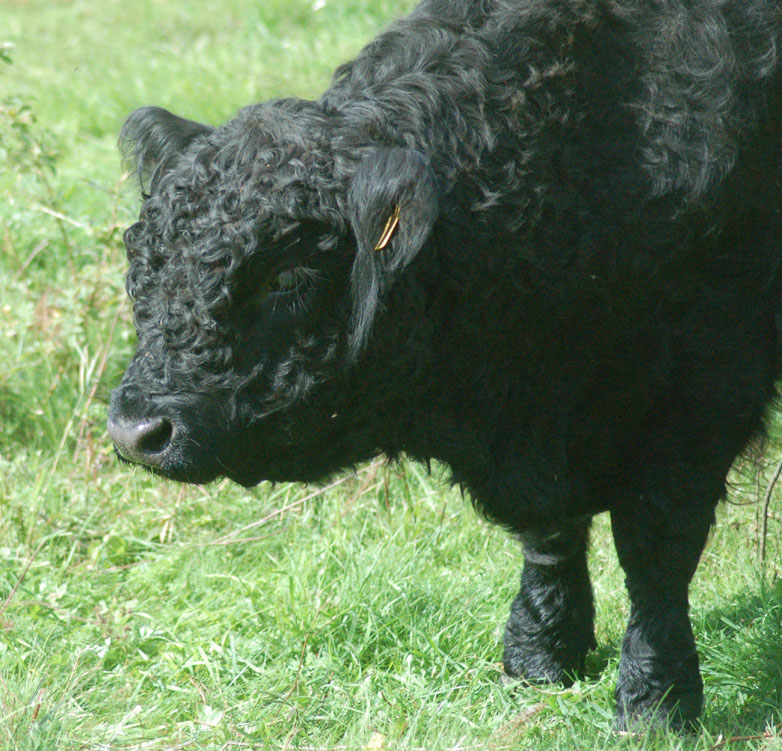
Galloway bull at Strandkær
The mermaids could defend themselves if they were offended. A mermaid drove her cattle up upon the beach at Tisvilde (Sjælland) and let it graze on the Tibirke field. The stingy farmers drove her cattle into a pen  and would not give it back to her, unless she gave them her shining belt. She did, and she got back her cattle and drove it towards the beach. She told her mer-bull: "Muddle up now!" And the bull muddled up earth and sand from the beach with its mighty horns, and the north wind blew up, and the town and its fields were buried in sand.

The merman was not as popular as the mermaid. He could be both evil and dangerous. A merman once kidnapped a beautiful fisher's daughter, Gertrud, on the beach outside Lindeskovgård's field. Her boy-friend Eskil took a terrible revenge. He sailed out in his boat, covered his head in a horse-tail and began playing music. The merman appeared from the water, lured by the music. Eskil grabbed hold of his hair and cut it off and threw a spear at him. Since then the merman was never heard of again.  But a few years later Gertrud's brother Thorvald was enchanted by a singing mermaid; he changed his behaviour, he was no longer as he used to be - or else he was the most sought after bachelor in town. One evening he sailed out in a quiet weather to do some fishing - and he never came back. His body was found later. The mermaid had taken him.


A legend from Husby.
The body of a man drove in at the beach of Husby in the western coast of Jutland. He was sucking his thumb, and he put it back into his mouth, when people tried to pull it out. He was buried in the church yard, but a violent sand-drift began. A wise man said that the buried man must be a merman -  he was then un-buried, and they saw that he was still quite fresh, so he was really a merman. They brought him back to the dunes, and the sand-drift stopped.  Since then all washed-ashore bodies were buried in the dunes.

It was common belief that there was magic in the air if a body had not decomposed. The detail about sucking the thumb might origin from an Irish myth about the god Finn. He was given a holy salmon, full of wisdom, and as he pressed his thumb upon the fish, he burnt himself. He put his finger upon the tooth in the back of his mouth - and he had now the wisdom transferred from the salmon. Everything was clear to him after that. Maybe the expression "wisdom-tooth" origins from that.

The motif with the finger in the mouth is also known from the Swedish runestone at Eskilstuna, where the hero Sigurd burns his thumb, puts it into his mouth and is able to interprete the bird-song.  


The North Sea at Ferring in a storm

The North Sea is not just a sea. It was a mighty personal power in the old days. It is not idyllic and friendly, although it might look like that on a sunny summer's day.


There is a deep respect among people for the immense powers of this wonderful ocean, for its capricious moods, for its greatness and for its wild beauty. There are legends of yearly human sacrifices to the North Sea in order to ease its mind.


Each Easter morning the fishermen at Ferring had a custom to walk down to the North Sea at Bovbjerg before sunrise. They were of the opinion that they were able to see, how they would manage in the year to come. Their experience showed that the omen was true. In the old days was said in Ferring that the North Sea claimed a human life each year. In return the sea would not break into land. A small child was therefore sacrificed each year. The child was put out into the sea in a barrel - or else would the sea cause a terrible damage.

Skarre Klit, Bulbjerg
The god Ran, Ægir's daughter, ruled the oceans, claiming sacrifices in the form of drowned sailors. In the magnificent Icelandic drama "The Loss of His son", we meet Egil Skallagrimson, where his son has drowned; we meet his deep hatred towards the god, who took his most precious possession, but we also meet his despaired powerlessness towards the enormous powers, he is facing. All his bravery is worth nothing, for he is not able to take revenge.


Source: Mads Lidegaard, Danske søer og vandløb fra sagn og tro, Nyt Nordisk Forlag, Arnold Busck,1999

photo: grethe bachmann

Monday, January 17, 2011

Christmas - The Nordic Pixy/Den Nordiske Nisse


The Nordic pixy (nisse) is a house-god from Denmark, Scania and Norway, he reminds about the Roman lares. Sweden has a similar character, named Tomte. The Nisse has got his name from the old Danish name Nis or Niels. He is known as a creature from Nordic folk tales and fairy tales, often wearing a red cap. Today the nisse is primarily a symbol of Christmas, but from the earliest tales are both forest-nisse, church-nisse and farm-nisse.

He lives in houses, stables and barns and act as a protecting spirit of the farm and household. He takes care of the livestock , especially the horses, and he works at the farm, bringing luck to the farm-people. But the nisse was not always a good person. If he was treated bad, he might take a terrible revenge and even kill people. If he left the farm, he took the good luck with him. 

He liked to do some easy  teasing, and it was not difficult to keep on friendly terms with him. He only needed a bowl of porridge with a big lump of butter at festivals. If he was respected, he made an effort to help the farmer, he might even steal from neighbouring farms - and there were often fights among the nisse-guys. The nisse also loved to tease the farm-dog- No one understood why it barked so much - but the nisse made himself invisible and was able to change into an animal, like a goat, goose or horse.

In his human figure the Farm-Nisse was the size of a 10-year old child, he looked like an old man with a beard, with grey clothes and red cap. Beyond his duties at the farm he also played cards and smoked a pibe.The ordinary old farm-nisse was always alone.


The Christmas Nisse was invented in 1836, he is the only one with a family.

The Church Nisse is present in many fairy tales of Hans Christian Andersen. He lives in vicarages and churches, but he is not a part of Christianity. He did not like to hear God's name, and he left on Sundays, when the church bells were ringing. But he kept the church nice and clean.

The Forest Nisse is a new variation; he lives in nature , leaving mysterious traces, which cannot be explained. A forest-nisse is small, about 80 cm, he dresses in green and brown.

The Ship-Nisse is another variation, also named the Klabauterman. He can - if he is treated well - predict storms  - and it is wise to listen to his advice.

The Sætternisse = the Misprint Gremlin has existed since the introduction of typography. He loves to smuggle in misprint in books and magazines, and he is able to make them undiscovered in the proofreading. 

The Climbing Nisse is a new tradition, beginning in the 1940s.


There is an old saying that "the nisse is following you".  It is used on many occassions, like if you've got into some trouble - if you think you can just forget it or move away from it, then reemember that "the nisse is following you".  You cannot escape the problems.

He origins from various old tales. There is a tale of a man and his household, who were being teased so much  by their nisse that they had to move. After having loaded the wagon , drawn by oxes, the farmer let the coachman drive slowly ahead and went into the house to see if he had forgotten something. When he came out, he saw the wagon driving slowly down the road with the nisse on top of the load, laughing at him.


copyright grethe bachmann


Tuesday, November 02, 2010

Gold Fever in the Renaissance


The alchemists in their search for gold discovered many other things of greater value.

~Arthur Schopenhauer.

Alchemy is the dream of how to produce gold, but until it became known that gold had a permanent place in the system of the elements, it was not only a dream, it was also a serious belief. Learned men worked on proving this belief, supported by rich princes and aristocrats, who were often alchymists themselves. It was practised in ancient Egypt, in Mesopotamia (Iraque), India, Persia, China, Japan and in medieval Europe up till the 19th century. Alchemy is mostly known for the gold-aspect, but it was not only about gold, it was also about creating an elixir of life, it was about the four elements and the three principles. Up till the 1700s the penalty was death, if someone critized the learning about the elements and the principles.

In the Renaissance, about 300 years ago, a foreigner came to Copenhagen, and he was very well greeted by the Danish king, Frederik III. He was given residence at the castle, equipped with horses and carriage, with four servants and a nobleman for his attendance, with a weekly salary of 100 rigsdaler, which was an amount equal to the highest officials of the kingdom. The cause of this luxurial treatment was not just politeness - king Frederik III expected to get something in return: Gold. He needed money after two Swedish wars and maybe a third to come, and he was sure that this Italian, Francesco Borri, and his art work would deliver a magnificent result.


People in Frederik III's ruling period.

In the 1600s was imagined that gold could be produced via chemistry. Since the early Middle Ages experiments had been done about metal transformation, especially copper and silver. Those two metals were now meant to the base of the gold process, but one thing was missing. Lapis philosophorum (the philosopher's stone). Those three ingredients were the main content of the alchemy-process, the forerunner of modern science. Seriously working, learned men were engaged in it, and rich princes and aristocracy supported their experiments. A big bunch of charlatans lived in their shadows, taking part of the millions, which was the costy price of this golden dream.

Frederik III was not the only Danish king, who was interested in alchemy, but maybe the one, for whom the lesson cost him dearest. His determined speculations were probably the contribution to that others went out on the same dangerous road. One was the nobleman Valdemar Daa, who lost his two castles, Lerkenfeldt and Borreby. The Danish author H.C. Andersen wrote a fairy tale about the alchymist Valdemar Daa and his daughters.


Francesco Borri

The Italian, who came to Denmark , Francesco Borri, was 40 years old, when he began working for the Danish king. His past was colourful, he had to leave his homeland, banned and convicted of heresy, after a failed attempt of changing both the ecclesiastical and secular affairs. After years abroad he came to Holland, where he became a respected alchymist and made himself known by performing an eye operation, which was later revealed as a fraud. In Amsterdam he got aquainted with a Danish learned man, who probably arranged his connection with the royal Danish court.

He began at once to work at the laboratory at Copenhagen's castle, and a speciel oven was built for his experiments. The working conditions were not satisfying however, and a year later were the oven and the work house moved to a general's farm, leased by the king. No one knew about his working methods, but some lists reveal the used ingredients - salpeter, sulphur, wood and copper plates were some of the used materials. In the museum collections at Rosenborg castle is a small silver box with a lump of gold, which is said to belong to the alchemistic pieces produced in Frederik III's time.


Many have said of Alchemy, that it is for the making of gold and silver. For me such is not the aim, but to consider only what virtue and power may lie in medicines.

~Paracelsus.

Borris did not stay in Denmark for long. Frederik III died suddenly on 9. February 1670, and the crownprince , now Christian V, was of quite another opinion about alchemy, which Borri was fully aware of. He chose to clear out as quick as possible and went to Constantinople, but on his way south he was caught up by his past. He was taken prisoner in Austria and sent to Rome, where the Papal court of justice awaited him. He died in 1695 after 25 years of imprisonment.

Shortly after Borri's hasty departure Christian V let all traces of his work remove from the buildings, but the house was named "Guldhuset" (the Gold House) for more than 100 years - as a memory about the time, where the alchemy was a serious part of the finansial considerations by the leading men of the country.

But the history about alchemy is extremely comprehensive. This was just a small part about a Renaissance king, who needed gold, because he had been involved in wars and wanted to buy back some land he had lost.

Alchemy

Source: Skalk, archaeological magazine, nr. 6, 1967, Olaf Jørgensen

Friday, April 03, 2009

Mysteries - 4) Borreby Slot

"The Alchemist and the Doppelgänger"


When Valdemar Daa in the 1600s owned Borreby he had lots of trouble with his economy. Like so many others at that time he experimented with the alchemy in the hope that he could grow rich by making gold himself. Like so many others he did not succeed. He had to leave Borreby and died a ruined man in 1691.

Hans Christian Andersen wrote a compassionate fairy-tale " Vinden fortæller om Valdemar Daa og hans døtre". (translated by Jean Hersholt, see: Valdemar Daa ). Borreby slot is marked by the medieval history about Valdemar Daa. He is said to be walking restlessly in the cellars and corridors of Borreby, still thinking and experimenting, stubbornly trying to make gold.


Borreby was taken over by one of Valdemar Daa's neighbours, Ove Rand, and his lucky star wasn't shining either. People said he had sold his soul to the Devil in order to gain richness. He died in 1685 after having seen a big black dog in his study. The dog was staring at him with flaming eyes and then disappeared through the wall. People were convinced that the dog came for him when he died and brought him to a special hot place.


The dog is still at Borreby, but now outside. As late as in 2003 a bird-watcher , a banker , was visiting Borreby Mose close to Borreby Slot, a popular bird-locality. He was looking in his binoculars and accidentally discovered a black dog among the trees by the castle. At first he didn't wonder about this, but then the dog turned its head and stared directly at him although he was about 200-300 m away. He got so scared when he saw those shining eyes of the dog that he let go of the binocular. But then he tried to look again and the dog had disappeared. He hasn't seen it since although he often is visiting the place.

It can be scaring to visit Borreby at night. Sometimes screams are heard from the moat. It sounds as if someone has fallen into the water and is now is fighting for his life. People who wanted to rescue the drowning man, couldn't find anyone in distress. Is it the echo from a long time forgotten event..........?

One of the latest residents at Borreby was Frederik Berregård who died in1805. He had some trouble with the supernatural too, but it was his own abilities he couldn't control. He was a Doppelgänger. People saw him fx supervising in the field, and at the same time he was seen sitting by the window in his study. Belive it or not!

Borreby Castle is situated in Southwest Zealand 3 km south of Skælskør. Public access to the park in summer.

Next: 5) Koldinghus, "Cold in the Cellar and the Man with the Iron Hand."

Source:
"Det mystiske Danmark", en rejseguide til spøgelser, uhyrer og andre mærkværdigheder.
Lars Thomas, Aschehoug Dansk Forlag, 2005.

photo 2007: grethe bachmann, Borreby, Zealand

Tuesday, February 14, 2006

Liselund Slot at Møn and The White Lady

Liselund Slot.
The owner of Marienborg Manor on the western part of Møn, Antoine de Bosc de la Calmette, created around 1790 a lovely white summerhouse (Lystslot) for his beloved wife, Lise Iselin. The house was situated at the high part of Møn and surrounded by a piece of land, meant for an English garden, but the couple died both in a very young age and could not see, how the place grew into a beautiful park. It is said that Lise Calmette still walks around in the park as The White Lady and keeps an eye on the caretaking of the park and the buildings on it.

The Swiss Hut.

Hans Christian Andersen was often a guest at different manors , and he had also been a guest at Liselund, where he overnighted in the Swiss Hut. It is said that he from his window could see a big hollow stump of tree , which gave him the idea to his Fairy Tale: 'The Tinderbox'.
photo: grethe bachmann