Monday, April 19, 2010

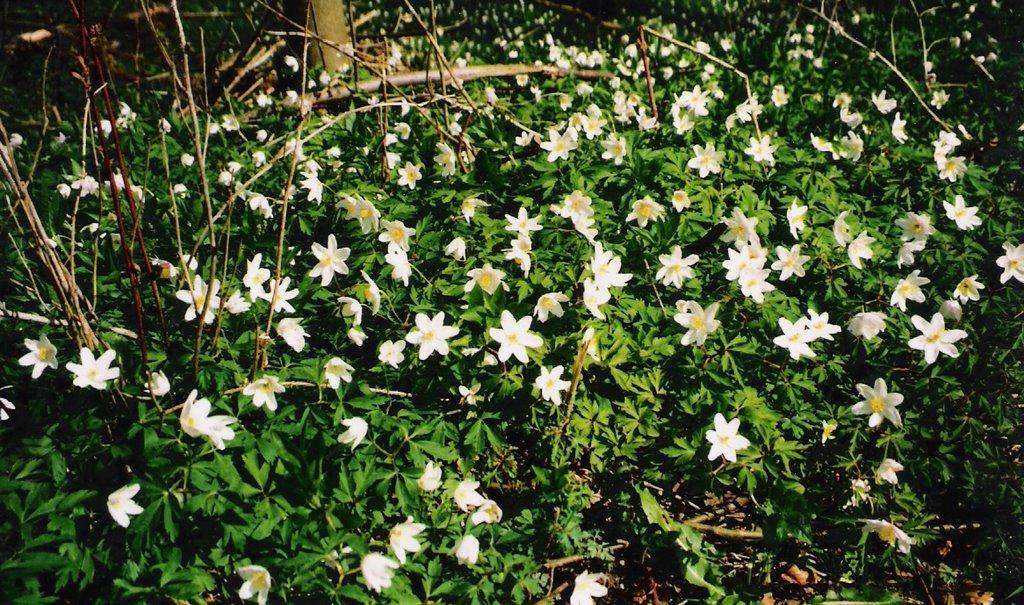
Anemone nemorosa


One of the first flowers of spring in the forest is the white anemone, spreading a lovely thick carpet of pure white flowers all over the forest floor, before the beeches come into leaf. The white anemone, Anemone nemorosa, is common in hardwoods. The name anemone origins from the Greek word anemos = wind. Denmark: Among many local names were feberurt (feverherb), spring lily and 'little white crow's feet'.The old herbalists called the Wood Anemone the Wood Crowfoot, because its leaves resemble in shape those of some species of Crowfoot. We also find it called Smell Fox. The specific name of nemorosa refers to its woodland habits.


In sunshine, the flower is expanded wide, but at the approach of night, it closes and droops its graceful head so that the dew may not settle on it and injure it. If rain threatens in the daytime, it does the same, receiving the drops upon its back, whence they trickle of harmlessly from the sepal tips. The way the sepals then fold over the mass of stamens and undeveloped seed-vessels in their centre has been likened to a tent, in which, as used fancifully to be said by country-folk, the fairies nestled for protection, having first pulled the curtains round them.


Folk medicine:
When the farmers in spring caught the sight of the first anemones, they eat at once three flowers as a protection against the dreaded cold fever (malaria) , and the flowers were also given to people, who already had this disease - and they were dried for use in winter. After having eaten the first three flowers , people had to say a magic verse and a prayer to God if he would protect them from the cold fever . White anemones crushed with egg white and salt were bound upon arteries against cold fever. Swelling feet had a bath in a decoction on white or blue anemone flowers. Only the flowers were used in folk medicine, since the juice from the plant was considered very poisonous. The plant was said to give the cattle bloody urine.Lineaeus says that cattle have been poisoned by eating it in the fresh state after having been underfed and kept on dry food during the winter, so that they were ready to browse on the first leaves they saw.


The Egyptians held the Anemone as the emblem of sickness, perhaps from the flush of colour upon the backs of the white sepals. The Chinese call it the 'Flower of Death.' In some European countries it is looked on by the peasants as a flower of ill-omen, though the reason of the superstition is obscure. The Romans plucked the first Anemones as a charm against fever, and in some remote districts this practice long survived, it being considered a certain cure to gather an Anemone saying, 'I gather this against all diseases,' and to tie it round the invalid's neck.
Greek legends say that Anemos, the Wind, sends his namesakes the Anemones, in the earliest spring days as the heralds of his coming. Pliny affirmed that they only open when the wind blows, hence their name of Windflower, and the unfolding of the blossoms in the rough, windy days of March has been the theme of many poets:
'Coy anemone that ne'er uncloses
Her lips until they're blown on by the wind.'
Culpepper also uses the word 'windflower.' In Greek mythology it sprang from the tears of Venus, as she wandered through the woodlands weeping for the death of Adonis -
'Where streams his blood there blushing springs a rose
And where a tear has dropped, a wind-flower blows.'


photo: grethe bachmann

Sunday, April 18, 2010

Vige, a Strange and Wise Dog


Dogs wearing names from ancient days are few, but one is mentioned in the Norse legend Heimskringla, written by the Icelandic Snorre Sturlasson ab. 1220. Olav Trygvasson is one of the kings in Snorre's tale who is most lifelike.

When he lived in England with his wife Gyda, who was the widow after an earl, he often went on Viking expeditions to Ireland. In such an expedition he achieved the dog Vige. Snorre says that they missed food on the ships, why it was necessary to do some poaching. His men went ashore and drove a great flock of cattle down to the beach. After the cattle followed a peasant, and he asked so urgently to have his cows back that Olaf allowed him to take them, if he could find them "But don't waste our time," he said to the peasant.

The peasant was followed by a large sheep dog, and he let it run into the cattle flock among hundreds of cows. The dog soon had gathered a flock, which were all marked in the same way, the same number the peasant had told Olaf. Everyone could see that this dog had done right and that it must really be a very wise dog. Olaf asked the peasant if he would give it to him. The peasant said yes and Olaf gave him a gold ring and promised him his friendship. The dog was named Vige and was the wisest among dogs.


The dog followed probably Olaf back to England. Shortly after was Olaf contacted by a man from Norway, Tore Klakke, who persuaded him to go to Norway to seek his fortune there. Olaf arrived in Norway at a time where the Norwegians were about to rebell the regent, Hakon Jarl. As a descendant of Harald Hårfager Olaf was received with open arms by the rebels. When Hakon Jarl had been defeated Olaf became king . He had some opponents, especially in the northernest part of Norway, in Hålogaland. Some chiefs had the power and will to oppose king Olaf, in his feud with one of those chiefs Olaf's dog played an important role.

A mighty peasant Red was very rich , and he had a good friend Tore. They were both great chiefs. They gathered an army when they heard that king Olaf would soon arrive with a large fleet. Red had a large dragonship with a golden head, also Tore had a large ship. They sailed south to meet king Olaf and a great battle arose with lots of slaughter. The chiefs from the north were not succesfull and Red rowed his dragonship out from the battle and sailed home.

Tore rowed his ships to the beach and he and his men went ashore. King Olaf followed them; he and his men went ashore too and persecuted the rebels and slashed them down. The king was in the front as always. He saw where Tore was running and Olaf run after him followed by his dog Vige. "Take the deer, Vige", cried the king. The dog run along after Tore and jumped at him. The king shot a spear towards him, just when Tore gave the dog a big wound with his sword. The spear hit Tore under the arm and went through his body. Tore died, but Vige was carried out to the ships. Vige is not mentioned anymore, so we don't know if it survived.

Many dog-skeletons found from Iron Age have traces from healed wounds and fractures. A dog who was worth a gold ring was probably given a good and considerate care.

Source: Archaeological Magazine "Skalk", February 2007, article by Eva Koch.


photo Moesgård Dec. 2008: grethe bachmann

Tuesday, April 13, 2010

The Jutland Horse/Den Jyske Hest


Kærup Holme, Vejlerne, North Jutland


We always say hello to this friendly Jutland in Vrads village, Mid Jutland


Christmas in Randers & the Jutland Horse in Randers by sculptor Helen Schou

The Jutland horse is a horse breed originating from Denmark. It can be traced back to the 12th century. From the ninth century images of Danish warriors show them riding horses with similar characteristics.

In 1843 fifty Yorkshire stallions were imported to the newly established stud farm at Koldinghus Castle. In the first generation they were excellent, but their good qualitities did not last. After a long struggle the breeders succeeded in putting in the rest of the pure-bred Jutland horse in a preservation-work which made the race recover its strength. In 1862 the horse dealer Louis Oppenheim sent a red Suffolk stallion with white fetlocks to Denmark. It was breeded with the Jutland, which it brought so much good that it saved the Jutland horse and gave it the character and look it has today.


A rare sight, a grey Jutland

Originally the Jutlands were grey, brown, black and chestnut, red with white man and fetlock. Today the red ones are dominating. The grey have almost disappeared and there are only few black Jutland left. In the 1950s there were several hundred thousand Jutlands in Denmark. Today there are about 1000 left.

The Jutland horse has been used by the Carlsberg brewery for pulling their drays since 1928. Today, Carlsberg’s horses are used solely as 'ambassadors': at festivals and fairs, on special occasions for customers, and as a subject for the world’s photographers.

photo 2006,2008, 2009, 2010: grethe bachman

The Jutland Horse/ Den Jyske Hest


Kærup Holme, Vejlerne, North Jutland


We always say hello to this friendly Jutland in Vrads village, Mid Jutland


Christmas in Randers & the Jutland Horse in Randers by sculptor Helen Schou

The Jutland horse is a horse breed originating from Denmark. It can be traced back to the 12th century. From the ninth century images of Danish warriors show them riding horses with similar characteristics.

In 1843 fifty Yorkshire stallions were imported to the newly established stud farm at Koldinghus Castle. In the first generation they were excellent, but their good qualitities did not last. After a long struggle the breeders succeeded in putting in the rest of the pure-bred Jutland horse in a preservation-work which made the race recover its strength. In 1862 the horse dealer Louis Oppenheim sent a red Suffolk stallion with white fetlocks to Denmark. It was breeded with the Jutland, which it brought so much good that it saved the Jutland horse and gave it the character and look it has today.


A rare sight, a grey Jutland

Originally the Jutlands were grey, brown, black and chestnut, red with white man and fetlock. Today the red ones are dominating. The grey have almost disappeared and there are only few black Jutland left. In the 1950s there were several hundred thousand Jutlands in Denmark. Today there are about 1000 left.

The Jutland horse has been used by the Carlsberg brewery for pulling their drays since 1928. Today, Carlsberg’s horses are used solely as 'ambassadors': at festivals and fairs, on special occasions for customers, and as a subject for the world’s photographers.

photo 2006,2008, 2009, 2010: grethe bachmann

Monday, April 12, 2010

Bulbjerg, North Jutland by the North Sea


Bulbjerg, like a lump of gold in the evening sun


Bulbjerg, ab. 20 km northwest of Fjerritslev.


Photographers at the cliff


Pretty black-legged Kitti-Wake and blue sky


The Kitti-Wakes on the cliff


A miracle that the nest is not falling down


Skarreklit - the rest of a high limestone knoll


The old sea bed behind Bulbjerg


It is difficult to handle the towel in the west wind.

The 47 m high limestone cliff lies close to the North Sea with a unique view from the top. The limestone was once used as a building material, i.e. for churches. The limestone was sawed out from the foot of the cliff and carried the long way up to the top by poor fishermen and peasants.

Bulbjerg is named Denmark's only bird cliff, the closest we can get to the combination of a steep cliff and open sea. Here breed ab. 450 couple rider and a few fulmars.

Up to WWII was a bathing hotel at the top of the cliff, but it was blown to pieces by the Germans, who made Bulbjerg a part of the Atlantic Wall with cannons and observation-posts from where the German soldiers could monitor ship- and air traffic. A couple of bunkers are furnished as toilets and nature-exhibitions.

Skarreklit was a high limestone/flint knold which would not let itself cow by the strong North Sea . Skarreklit stood in sun and storm for hundreds of years until it had to give up and tipped over in the sea in a storm in 1978.

Vestkyststien Agger - Bulbjerg is a hiking and cycling route of ab. 80 km. The route continues south to the border and north to Skagen. The hiking routes can be used in their full lenght or in etapes.

Bulbjerg has grown smaller this year. About two tons has slipped into the sea. It is the change of frost and thaw which gave crevices in the limestone. The slip cannot be seen from the top of the cliff. Skov og Naturstyrelsen warns that Bulbjerg might be in danger of slipping down. People should keep a good distance.


photo 2006/2007: grethe bachmann

Friday, April 02, 2010

The Honey Bee is in Danger.


Life has gradually become an obstacle race for insects like honey bees - they live by flying from flower to flower and return to their large family with pollen and nectar which they change into honey.

Poison, slurry and gigantic corn fields do not harmonize with the bees' need for a clean environment with lots of flowers, bushes, trees and various crops. The development of the industrial agriculture has created a visible distance between the flowers in the landscape, and the population of Danish bee-families have gone from ab. 200.000 in the years around 1950 till ab. 80.000 in these years. The work of honey bees from early spring till late autumn is of crucial importance for the diversity in the nature.

The honey bees are among the most important assistants for the fertility of the flora. Also for the hundreds of plant species which are used in farming, foresting and in the gardens are the bee- pollination of crucial importance. Crops like winter rape and clover are completely dependent on the bee-pollination. Also all plants which seed, like fruit trees, berry-bushes and other similar plants. Danmarks Jordbrugsforskning (research) has estimated that the Danish honey bee- pollination only in the agriculture and in fruit and berry-cultivation represents a value of at least 1 billion kroner. The EU-commission is more concrete in its evaluation of the good deeds of the bees when it's about money. According to EU the bees' work represents ab. three billion kroner a year. (in DK) At the same time is concluded that the value of the pollination of the bees and the following fertility is 30-50 times higher than the value of the honey-production which in Denmark is ab. 60 million kroner a year.

The industrial agriculture has meant that the fields grew larger and larger. Stone-fences, earth banks and lots of hedgerows disappeared, and the distance between the small uncultivated oases for the flowers and bees grew longer and longer.


The verges and ditch-edges were once a study in a diversity of flowers which were good for the honey bees and other pollinating insects. Today are only few plant-species in those places. The heaths are attractive for the bees, but they are now in a crisis, caused by nutrient-rich precipitation. The nitrogen gives several grass species good living conditions at the expense of the heather.

The honeybee and all other pollinating insects lost terrain when 117.000 hectare fallow fields were ploughed and cultivated in 2008 - an area the size of the island Lolland simply disappeared as a habitat for bees.

All in all - the honey bee, the bumblebee, the butterflies and other pollinating insects are in danger. Some species have already disappeared never to return. Fewer pollinating insects will effect us more than we imagine right now - also in our daily economy. Fewer vegetables, berries, fruit will empty our pockets! So it's best for all of us, if there are more uncultivated places for bees, butterflies and other pollinating insects.

Source: Natur og Miljø, Danmarks Naturfredningsforening, Nr. 1, Jan Skriver, Honningbien.

photo March 2010: stig bachmann nielsen, Naturplan Foto

The Honey Bee is in Danger


Life has gradually become an obstacle race for insects like honey bees - they live by flying from flower to flower and return to their large family with pollen and nectar which they change into honey.

Poison, slurry and gigantic corn fields do not harmonize with the bees' need for a clean environment with lots of flowers, bushes, trees and various crops. The development of the industrial agriculture has created a visible distance between the flowers in the landscape, and the population of Danish bee-families have gone from ab. 200.000 in the years around 1950 till ab. 80.000 in these years. The work of honey bees from early spring till late autumn is of crucial importance for the diversity in the nature.

The honey bees are among the most important assistants for the fertility of the flora. Also for the hundreds of plant species which are used in farming, foresting and in the gardens are the bee- pollination of crucial importance. Crops like winter rape and clover are completely dependent on the bee-pollination. Also all plants which seed, like fruit trees, berry-bushes and other similar plants. Danmarks Jordbrugsforskning (research) has estimated that the Danish honey bee- pollination only in the agriculture and in fruit and berry-cultivation represents a value of at least 1 billion kroner. The EU-commission is more concrete in its evaluation of the good deeds of the bees when it's about money. According to EU the bees' work represents ab. three billion kroner a year. (in DK) At the same time is concluded that the value of the pollination of the bees and the following fertility is 30-50 times higher than the value of the honey-production which in Denmark is ab. 60 million kroner a year.

The industrial agriculture has meant that the fields grew larger and larger. Stone-fences, earth banks and lots of hedgerows disappeared, and the distance between the small uncultivated oases for the flowers and bees grew longer and longer.


The verges and ditch-edges were once a study in a diversity of flowers which were good for the honey bees and other pollinating insects. Today are only few plant-species in those places. The heaths are attractive for the bees, but they are now in a crisis, caused by nutrient-rich precipitation. The nitrogen gives several grass species good living conditions at the expense of the heather.

The honeybee and all other pollinating insects lost terrain when 117.000 hectare fallow fields were ploughed and cultivated in 2008 - an area the size of the island Lolland simply disappeared as a habitat for bees.

All in all - the honey bee, the bumblebee, the butterflies and other pollinating insects are in danger. Some species have already disappeared never to return. Fewer pollinating insects will effect us more than we imagine right now - also in our daily economy. Fewer vegetables, berries, fruit will empty our pockets! So it's best for all of us, if there are more uncultivated places for bees, butterflies and other pollinating insects.

Source: Natur og Miljø, Danmarks Naturfredningsforening, Nr. 1, Jan Skriver, Honningbien.

photo March 2010: stig bachmann nielsen, Naturplan Foto

Wednesday, March 31, 2010

The Glass Museum in Ebeltoft, East Jutland


On the Ebeltoft Glasmuseum you can experience an acknowledged collection of modern international glass art. Besides are 6-9 special exhibitions each year , and most of the year the glassblowers are working in the workshop.


Peter Bremer, inspired by the icebergs at Antarctis and Greenland

The Glass Museum in Ebeltoft is Denmark's only museum of glass art. It is situated in the city Ebeltoft. It was established in 1986 by the artist-couple Finn Lynggård and Tchai Munch in Ebeltofts earlier custom house, which was built in 1921 by architect Hack Kampmann and Christian Kampmann. An extension was inaugurated in 2006, designed by 3XN and finansed by various fonds and the Ministry of Cultural Affairs and the Municipality of Ebeltoft. The collection has above 1500 works from all over the world, which are either gifts or loans to the museum.


Glasmuseet Ebeltoft's large collection of modern glass art was founded by the help of more than 600 known glass artists from all over the world. These artists have all generously either given or loaned works to the collection, which today includes more than 1500 works. The collection of works by glass artists are from these countries: Australia, Austria, Belgium, Bulgaria, Canada, Czech Republic, Slovakia, Denmark, Great Britain, Estonia, Finland, France, Germany, Greece, Hungary, Iceland, Israel, Italy, Japan, Kenya, Latvia, Lituania, Mexico, New Zealand, Norway, Poland, Belarus, Rumænia, Russia, Scotland, Slovenia, Spain, Sweden, Schwitzerland, Netherlands, Turkey, Ukraine, USA, Venezuela, Jugoslavia.


The purpose of the glass museum is to show the latest development in modern glass art, which means that if a glass artist creates a work, which is better or more different from the already loaned works in the collection of the museum, then he/she is welcome to exchange it or supplement the new work. This means that the museum will always be able to show up-to-date works and new flows inside glass art. The admission to the collection is decided with an invitation from the glass museum. The criterium is that the participants are professionals, (their main occupation must be class art).


The collection is represented in alternative thematized exhibitions with selected works. After a period individual works are exchanged with others, which still fits the chosen theme. In this way it is possible to show a larger number of works from the collection. On some occassions the whole exhibition-area will be used for special exhibitions, but the museum has in view that works from the colletion can be experienced all year.


In the workshop.


In the Giftshop

See list : The Artists


photo Ebeltoft Glass Museum 2005/2009: grethe bachmann