Showing posts with label Holy Grail. Show all posts

Thursday, August 14, 2014

The Legend of the Holy Grail in a Danish Church

Viking Age
Skibet Church, Vejle
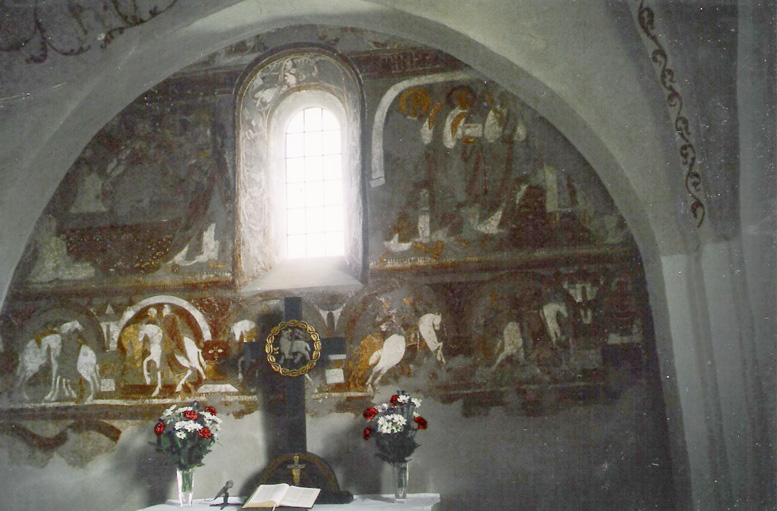

Skibet church, 'Rytterfrisen' (The Horsemen's Frieze') 1100s


(Above the Horsemen's frieze are two scenes from the New Testament, to the left Lazarus and to the right Christ and the disciples.)


During the ruling period of Valdemar Sejr and Valdemar the Great - between 1157 and 1241 - about 2000 stone churches were built inside the present borders of Denmark. (1700 old churches still exist.) The building activity was immense all over the country ; much influence and inspiration came from abroad, and some of it came from England. English master builders, stone masons and artists arrived - and they were responsible for some fine Anglo-Normannic inspired churches, especially in the north western part of Jutland.

One English artist might have travelled a little further down south - and he arrived to the location Skibet in the eastern part of Jutland, where a little stone church was built in the middle of the 1100s. Here he was possibly  the creator of some magnificent frescoes called 'Rytterfrisen' (The Horsemen's Frieze') , which is unprecedented in Denmark.


Skibet church. Two saddled horses and some horsemen riding slowly and with dignity to the north.
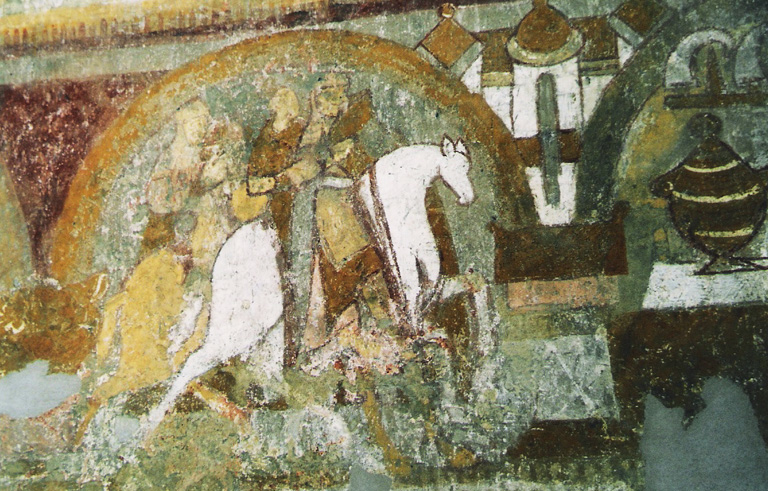

Skibet church. Some gallopping horsemen moving towards the jar, considered to be the key to the story. Behind is a city or a temple.

Hornslet Church, Aarhus
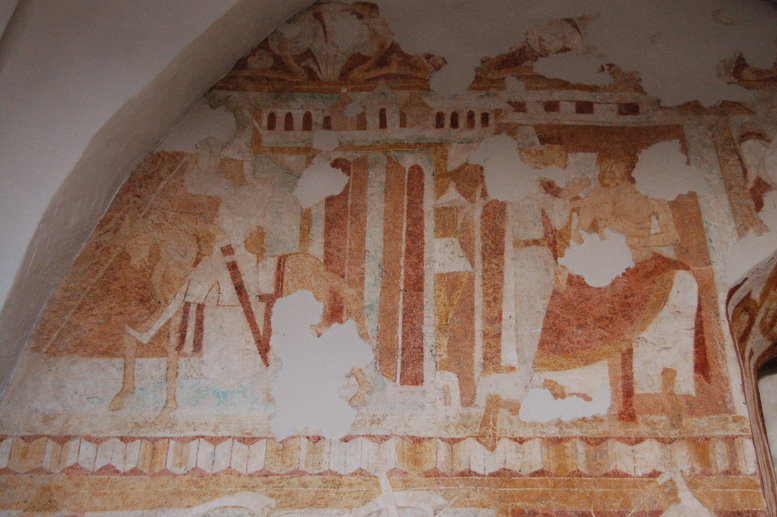

Hornslet church: A fully armed knight rides toward west, the crowned bedridden man recieves the Holy Communion from a cleric.

In Hornslet church north of Århus are frescoes from the first half of the 1200s, telling a similar story like in Skibet. It's a unique phenomenon that Jutland unlike the eastern part of Denmark is able to show those spectacular and dramatic scenes with horsemen.

The interpretation is open in both cases. Some have suggested that the story is from the colourful tale about the prophets - but both before and now it is believed that the frescoes are about the legend of the Holy Grail, which was known in Denmark already in the Viking period.
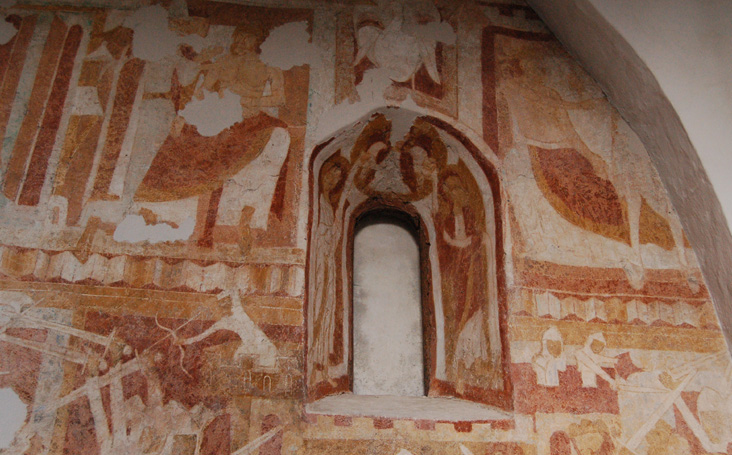

Hornslet church: A little angel in a medaillon above the window might represent the Grail with the blood of Christ, and the crowned man in the previous shown picture is the deadly sick king who can only survive in the virtue of the Holy Communion, and the knight to the left of the king is Percival riding out in search of the Grail. The war scene belov is one of the famous battle scenes from the legend's compulsory material.
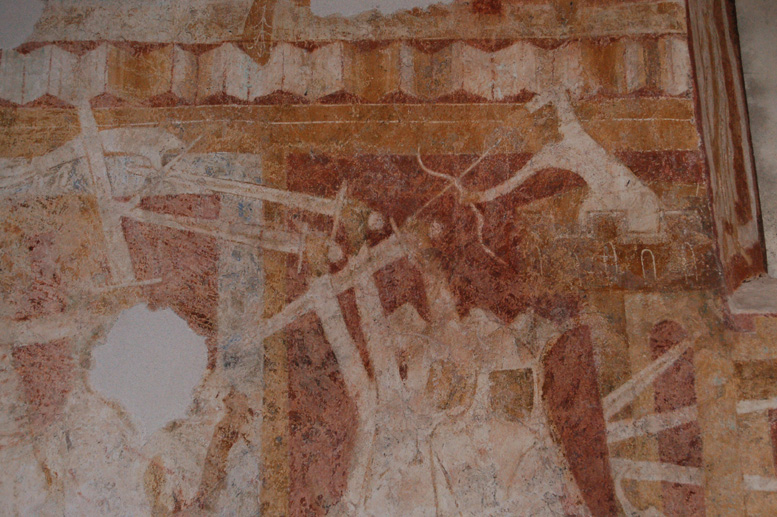

Hornslet church. A dramatic battle scene in front of a town wall or a castle. In one of the castle towers an archer is shooting an arrow with great power.


Hornslet church. A part of the battle scene.


What the fine English artist supposedly painted in a little newbuilt church in Jutland in the middle of the 1100s is now one of very few medieval representations of the Holy Grail on Danish ground.

photo Skibet church + Hornslet church 2003/2007: grethe bachmann 
Source:
Trap Danmark: Vejle amt
Gyldendal og Politikens Danmarkshistorie, bind 4
Gyldendals bog om Danmarks kirker.
Gyldendals bog om Danske kalkmalerier.

Thursday, March 22, 2012

Visiting a few Places in Vejle River Valley


The hilly valley along Vejle river is one of the prettiest in Jutland - and furthermore the district around Vejle has many famous historic places, one of the most wellknown is Jelling with the runestones and Gorm's and Thyra's hills. But this day the tour went first to Haraldskær, which lies close to the river, it's an old manor, known since the 1400s. Today it is a fine white hotel. Behind  Haraldskær upon a hill lies one of the first stone churches in Denmark, a small Romanesque church without a tower, named Skibet. Its name refers to that it was possible to sail up to this place in the early Middle Ages. In the church is a uniqe Romanesque frescoe-frieze with horsemen, which possiblty was painted by an English artist. It is one of very few representations of the legend about the Holy Grail in Denmark. The landscape by Skibet  is often referred to as a Viking period- landscape, a fine hilly landscape, formed by Vejle river. The close connection between the church and the manor Haraldskær reaches possibly far back in time, and the church was probably built for a magnate.


From Haraldskær we drove inland and uphill to a place called Højen, which actually means hill, and the small village was placed upon a hill. After passing the the cosy village  the sun broke through the misty landscape and there was a field with Hereford cattle  and a little calf. This called for a stop.They are so peaceful and calm, I wonder if they might be a good medicine for stressed people in one of those clinics where they have to stress off. They might have a field outside the clinic with Hereford or Highlanders. The sun had a difficult time trying to break through the haze on this day. It takes some time before the winter's cold from the sea and the land disappears. I actually like a misty landscape. Reminds me about English paintings and water-colours.   


Bredsten
along the narrow country road to Nørup.
We came to a large village Bredsten. The big white church had a Baroque, bulbous-shaped spire like many other churches in the district of Vejle and Horsens  - and like the big manor Engelsholm, which has four of those spires. They might have had the same architect who dominated in the Baroque-period. We were looking for a very rare little fern at bredsten church, which grows upon walls and stones. It is found in less than ten places in Denmark, one at Kronborg castle. It is totally protected, but we couldn't find it. Maybe someone has removed it. We don't know yet. (Last news: the fern is still there on the dike and it is fresh and fine.)

The next was the church in Nørup with a bulbous spire  and with a fine view to the manor Engelsholm with four spires by the beautiful lake. Engelsholm belonged to a Rosenkrantz in the early 1500s. Was  Rosenkrantz ever in England?  Did he meet Shakespeare? I haven't got the faintest idea, but it's fun to imagine things.  Engelsholm is today a highschool  for art. Music, visual arts, glass art  etc. In April they have a course about Bob Dylan.
From Nørup church hill is a fine view across the lake to Engelsholm and down to the country road.


We went to Ravning next, also in the river valley. Here was in the 1950s found an old Viking bridge, which possibly was a part of Harald Bluetooth's road system through Jutland. The bridge was, according to a dating of the oakwood, built ab. year 980. It was a 800 meter long and 5 m broad timbered oakwood-bridge across the river valley. The bridge was based upon 1.800 massive oak-posts, cut with axe and knocked down into the moist soil of the river valley. There is a reconstructed bridge span at the edge of the valley. They are restoring it now, it's probably ready for summer. 
bridge restored.

 
Observation platform

West of the town of Vejle is a piece of land, which has now been laid out as a nature area. It is called Kongens Kær. (the King's Meadow). This wetland is a magnificent place for people from Vejle and of course also others who want to see it. There is a rich bird life with water- and wading birds, and there are walking paths and a big observation platform at the country road. The project also contributes to an improvement of the water environment in Vejle fjord by removing nutrients from Vejle river. (Vejle Å) To secure the neighbours of the area against flooding a dike has been built. The living conditions for the bird life and the very rare birch mouse have been improved by the construction of respectively 2 bird islands and earth banks.

The Birch Mouse. (Northern Birch Mouse) Sicista betulina.
The birch mouse is on the redlist of endangered species and is governed by all the strongest international protection. ( EU's habitat-directive). And Denmark is thereby obliged to protect the breeding places of the birch mouse.
The birch mouse (it's not a real mouse) is the only Danish rodent who belong to the family of hoppemus (hopping mice) , and it is probably also the most rare and most endangered mammal in Denmark. At the same time it is among the species we know the least. As far as known the birch mouse lives in isolated lommer (pockets) in North-, Middle- and South Jutland. It lives apparently mostly in the open land, with moist meadows, windbreaks etc. The special characteristics of the birch mouse is the long black stripe on the back, which goes from the eyes and down to the root of the tail, which is longer than the body. From snout to tail the birch mouse measures 5-8 cm, while the tail can be about 11 centimeter long. It weighs 5-15 gram, less than an ordinary letter. The birch mouse sleeps wintersleep more than half of the year
GB

Sources: Natur og Miljø, Vejle kommune; Politikens store Danmarksbog, Engelsholm Højskole, Danmarks kirker; Slotte og herregårde i Danmark.

photo 17 March 2012 Vejle ådal: grethe bachmann: