Showing posts with label England. Show all posts

Thursday, August 14, 2014

The Legend of the Holy Grail in a Danish Church

Viking Age
Skibet Church, Vejle


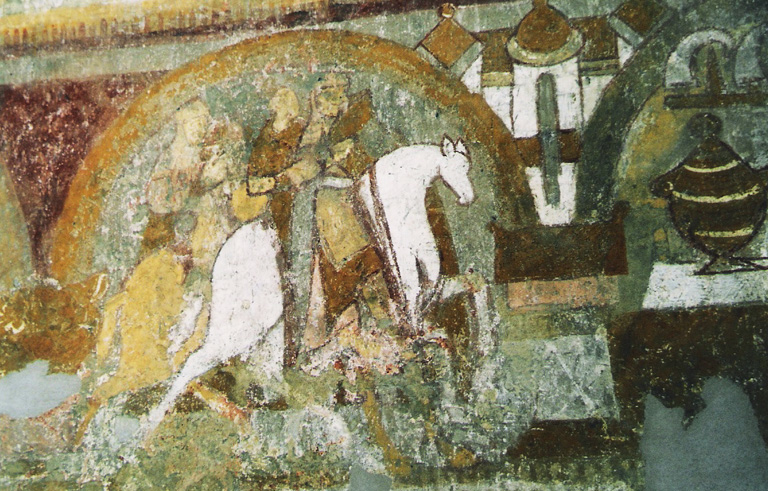
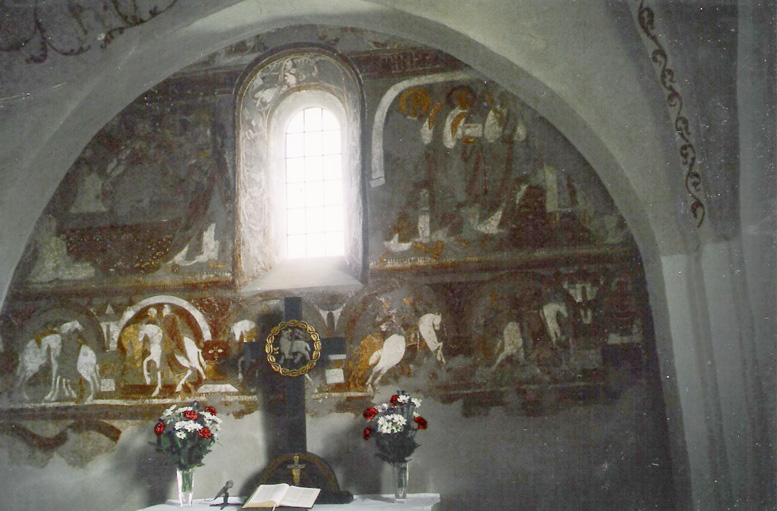
Skibet church, 'Rytterfrisen' (The Horsemen's Frieze') 1100s


(Above the Horsemen's frieze are two scenes from the New Testament, to the left Lazarus and to the right Christ and the disciples.)


During the ruling period of Valdemar Sejr and Valdemar the Great - between 1157 and 1241 - about 2000 stone churches were built inside the present borders of Denmark. (1700 old churches still exist.) The building activity was immense all over the country ; much influence and inspiration came from abroad, and some of it came from England. English master builders, stone masons and artists arrived - and they were responsible for some fine Anglo-Normannic inspired churches, especially in the north western part of Jutland.

One English artist might have travelled a little further down south - and he arrived to the location Skibet in the eastern part of Jutland, where a little stone church was built in the middle of the 1100s. Here he was possibly  the creator of some magnificent frescoes called 'Rytterfrisen' (The Horsemen's Frieze') , which is unprecedented in Denmark.


Skibet church. Two saddled horses and some horsemen riding slowly and with dignity to the north.


Skibet church. Some gallopping horsemen moving towards the jar, considered to be the key to the story. Behind is a city or a temple.

Hornslet Church, Aarhus


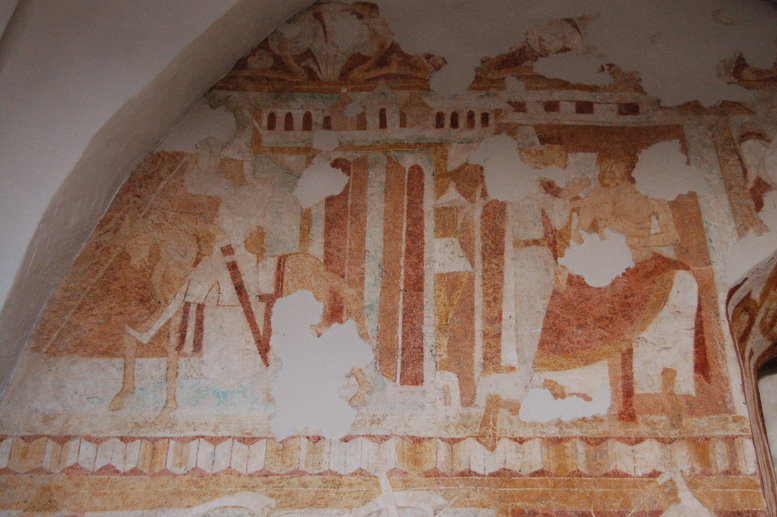
Hornslet church: A fully armed knight rides toward west, the crowned bedridden man recieves the Holy Communion from a cleric.

In Hornslet church north of Århus are frescoes from the first half of the 1200s, telling a similar story like in Skibet. It's a unique phenomenon that Jutland unlike the eastern part of Denmark is able to show those spectacular and dramatic scenes with horsemen.

The interpretation is open in both cases. Some have suggested that the story is from the colourful tale about the prophets - but both before and now it is believed that the frescoes are about the legend of the Holy Grail, which was known in Denmark already in the Viking period.


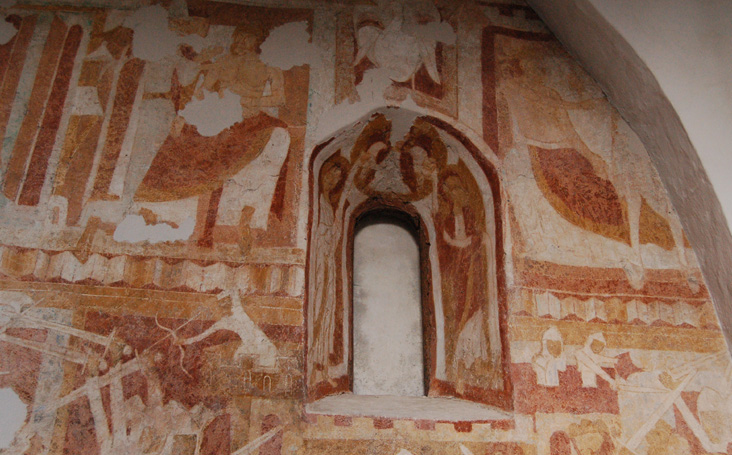
Hornslet church: A little angel in a medaillon above the window might represent the Grail with the blood of Christ, and the crowned man in the previous shown picture is the deadly sick king who can only survive in the virtue of the Holy Communion, and the knight to the left of the king is Percival riding out in search of the Grail. The war scene belov is one of the famous battle scenes from the legend's compulsory material.


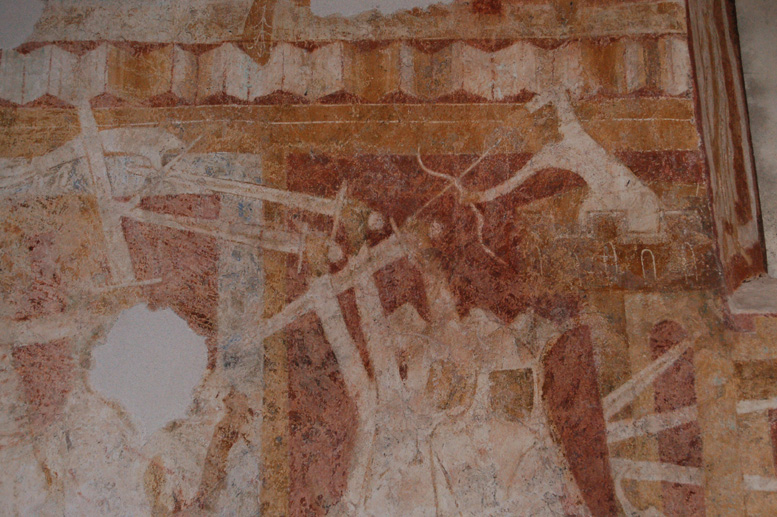
Hornslet church. A dramatic battle scene in front of a town wall or a castle. In one of the castle towers an archer is shooting an arrow with great power.


Hornslet church. A part of the battle scene.


What the fine English artist supposedly painted in a little newbuilt church in Jutland in the middle of the 1100s is now one of very few medieval representations of the Holy Grail on Danish ground.

photo Skibet church + Hornslet church 2003/2007: grethe bachmann 
Source:
Trap Danmark: Vejle amt
Gyldendal og Politikens Danmarkshistorie, bind 4
Gyldendals bog om Danmarks kirker.
Gyldendals bog om Danske kalkmalerier.

Sunday, March 18, 2012

Easter Customs in 16th Century's Scandinavia.

Pieter Bruegel the Elder: Netherlandish proverbs.
 
A Time of Change. 
Easter was not only a Christian celebration in the 16th century. Many customs were influenced by the early Middle Ages and before that, both by ancient Norse mythology and ancient pagant belief. It was not easy for the Catholic church fathers to handle or "rule" the Scandinavian people during Easter, considering all those various opinions and old customs. In some desolate districts of Norway the customs were still of an ancient origin and still very much alive, and in all of Scandinavia people still believed in witches and witchcraft. But when the reformation arrived in the middle of the century everything changed. This was the end of the Middle Ages. A time of change.

The Quiet Week. 
Ghirlandio: St. Jerome
Although the fasting-time was abandoned since the reformation, there were still old-fashioned people, who maintained the ancient customs around Lent - even people in the next generations who knew nothing or little about the Catholic period. But although people in general did not take it so seriously, it was very characteristic that nobody held a party, wedding or alike between Shrovetide and Easter. The last week before Easter was called "the quiet week",  and on Palm Sunday were some religious customs with inauguration of palm leaves or of flowering willow twigs. It was not easy to get hold of palm leaves in Scandinavia. But these customs disappeared quickly as soon as the Catholic church fathers  said good-bye after the reformation. The quietness and the gravity from before were more obviously seen in tne names of the Easter days: Palm Sunday, Blue Monday, White Tuesday, Ash Wednesday, Maundy Thursday.


Cabbage and Loke's Sleigh.
Loke
Contradictions met at Maunday Thursday. Folklore fought between light and darkness on this day. The bright sides of the day were first of all the power transferred to the only green plant which had survived winter, the cabbage. Nine cabbages cooked together protected against disease and other evils in the year to come, nine various cabbages or herbs, plucked and gathered in the morning and cooked together. The air had a healing power on that day. If the clothes were hang out in the air they would be freed from the moths, and the bedlinen would be freed from the fleas.  In Telemarken in Norway they had to do a little more work to free the bedlinen from the fleas, they had to plait three strings to help the god Loke's broken sleigh. Every Maundy Thursday Loke came with a load of fleas and since the load was heavy his sleigh broke, and if they did not assist him, they would not get rid of the intruders in their bedlinen the whole next year.


Malicious Witchcraft on Maundy Thursday. 
Medieval drawing.
Maundy Thursday was influenced by some sinister witchcraft. This day was similar to other wellknown witch-days - Valborg's Day and Midsummer's Day - and everyone who did not safeguard himself against the evil was higly exposed to danger. In a socalled "clerical law" from Christian II's time the magistrate ordered to closely watch all, who were suspected of witchcraft. But it was not easy to watch the elusive witches, when they in the dead of night on Maundy Thursday rode on a broomstick to their meeting-place. The safest precaution and protection against the witches was to fasten steel above the doors, put steel into the bed and with the cattle, and to spread axes and iron wedges upon the newly sown fields. Furthermore they had to remove the fourth wheel from the plough, so the witches, who planned to ride the plough, would fail. But it was impossible to keep oneself completely safe from the powerful and malicious witchcraft. A witch, Ingeborg Bogesdatter in Högalöff in Sweden, confessed in 1618  ( most probably under torture) that she had stolen a calf, put a bridle on it and rode above the forests, fields, mountains and waters to Blåkulla, where she took part in the witch-feast. Before her airborne journey she had been so sneaky to blow wind into her nightgown and made a skin in her own looks, whom she laid down beside her husband. Young witches did not need any mount or traffic tool. They had power enough by themselves to rise in the air and fly away.

Ringing the Bells, Finding the Witches.
woodcut 1700th century
The best way to avoid all this witchcraft was to ring the church bells. Still in the 19th century people rang the bells in Smaaland in Sweden each "Dimmelonsdag" ( "Ringing Wednesday") in the evening after sundown and the next morning, on Maundy Thursday, before sunrise. People knew that the witches wanted to whip the church, a very  dangerous witchcraft to the church and to everyone. So they wanted to ring down the Easter witches. There are many stories about this.  A Dean's servants rang the church bells, while three witches flew above the spire. They fell down, but changed skin and transformed into goats. The three goats run up into an old birch, but a man next to them cut one goat in the foot, and since then an old woman in the neighbourhood was limping, and no one doubted that she had been on her flight to the feast of the witches. In another case the downfallen witch transformed into a white sow. Three Easter witches, who had been rung down just before they had to whip the church, were found downside the church, quite naked. People were able to examine the witchcraft in their neighbourhood, if they used an egg, which had been laid by a hen on Maundy Thursday. It was best if this was the very first egg the hen had ever laid.  If they brought the egg with them to church in their pocket, this might be good enough, but the best way to discover the witchcraft was to look through the egg in the sunshine when they came to church. Then they would be able to see among the churchgoers exactly who was a witch and who had been out flying the night before.

Queen Elizabeth I and the Foot-Washing.
Hilliard: Elizabeth I
In England was celebrated a special act in the 1600s, which is still used in some Catholic countries. A number of poor people were gathered at the palace, and queen Elizabeth had to wash their feet. The cleaning was rather thorough, since everyone, before meeting the queen, was being washed by a washer woman, then by the subordinate of the charity-man and at last by the charity-man himself. When the gospel of the foot-washing had been read, the queen washed everyone's feet the fourth time, assisted by a noble lady. The humbleness of the queen increased with the years, this was indicated by the numbers of the poor which corresponded to the queens' age. 39 poor  people had their feet washed in 1572.  After having finished the washing, the queen kissed them, gave each one both money, clothes, food and drink and a towel and let them go at sunset.

Whipping, Weighing and Salt-cookies.  
After the sinister Maundy Thursday the Dark Good Friday came. (Danish: Langfredag). No one was allowed to be happy on that day, and the fasting and the self-torture reached a peak. In some places in Norway everyone had to be whipped with rods in the morning, no one had anything to eat until the evening, and they had to use all their strenght and torture themselves with overwhelming work. The conditions were just as strict in Denmark, the priest at court let his children summon into his study each Langfredag , where he flogged those poor little kids, so they could feel how awful the Saviour had suffered on Good Friday.  A reason for a punishment was, if someone did not pass the fasting-test. In many districts people had to be weighed, and if they had not lost weight after the Lent this indicated clearly that they had not respected the fasting - and they had to be punished. In some districts people knew how to prepare themselves for this test. On the first weighing before the Lent-period  they put sand in their stockings and pebbles in their pockets to get a better result and to avoid punishment on the second weighing. The fasting was also extended to the livestock. On Good Friday the cattle did not get their usual fodder, but only what was found in the forest and in the field, and humans had the humblest meal in the evening time, usually flour-porridge or eggs in a mustard sauce. In some districts they remembered how thirsty Christ were on that Friday, and before bed-time they had to eat three salt-cookies, which of course evoked an unbearable urge to drink water during the night.

Food-Blessing and Mass
Pieter Bruegel the Elder: Wheat Harvest.
Next day, Easter Saturday, the preparations for the happy time finally started. In days of the Catholicism the priest blessed the food and sowing seeds of the farmers, and this continued for a period after the reformation. The blessing still took place in 1566. People came with all kinds of food, rye, barly, oats; the priest blessed it and read a special prayer, a mass was held in the evening and the farmers were now sure that their food and corn were secure for the whole following year. But both the food-blessing and the mass were later prohibited by the bishop of Sjælland. (Zealand). People were now forced to be content by celebrating the Easter Saturday inside the walls of their own home with the old feast-dishes, sweet porridge and soft-boiled eggs.

Dancing Sun and Evil Smoke. 
di Paolo: Angels dancing in the Sun.
The Easter Sunday was entirely a happy festive. People were up and about from early morning to watch the sunrise, to see the sun play and dance with joy upon the sky.  Only in a few places some sad superstitions were connected to this Easter morning. In a Norwegian district the farm-people were afraid of lighting the fireplace, they believed that the smoke from the house meant they would be plagued by predators. They were later persuaded to forget their fear, but they were still cautious; instead they used nine kinds of wood and a wooden spoon, the ear of a pot, a broom and gunpowder and sulphur to light the fire. In this powerful way they intended to cleanse the chimney from the infection, which had been there since the night of Maundy Thursday, where the witches flew through the chimney. Even the smoke was infected. Everyone went out to see where the smoke went. If the smoke went towards the church, it was an omen that someone in the house was a coward and was soon to die.

Agnus Dei silver jewelry.

Easter Lamb and Agnus Dei.

Lam with cross, church North Jutland/gb
A Christian custom was the distribution of the socalled Easter lamb. In the beginning of the 16th century when the Catholic church was still the ruler, this distribution took place in the old-fashioned manner, the priest gave or sold after the mass on Saturday Evening the churchgoers some inaugurated Easter lambs made of  wax; they were considered to be some secret means against all evil. But their miraculous power made people wish to own them in a better material than wax and to carry them always. A custom evolved, where rich people wore an Easter lamb in silver or gold in a chain around the neck.  The jewelry in the chain was like a medal or a coin with the image of an Easter lamb. Jewelry like this was given the name Agnus Dei, and it was very popular both in Scandinavia and in Europe in general. But after the reformation the custom with the lambs were  just as unpopular as the other custom-rests from the Catholic period. The wax lambs disappeared together with the mass on Easter Saturday, or they were inaugurated secretly, until the custom went into oblivion. In Denmark most of the Agnus Dei-jewelry was probably lost during the next century. The silver and gold lambs were still worn openly, but the meaning was soon forgotten. The thirty-year war and the wars between Denmark and Sweden swept away all the old gold and silverware, and towards year 1700 there were only few Agnus Dei left. In the 19th century the old Easter lambs entered the market again, not in wax or as a jewelry, but as some kind of playtoy in sugar or cotton with an attached crossbanner.

Easter, Oster and Ostara
When people came home after the church service in the Easter-period,
Two devils with eggs, National Museum by Kornerup.
they spent their time with all kinds of fun. A special Easter pleasure was the  Easter eggs. They were like today, coloured eggs, usually red, blue, yellow, sometimes with inscriptions. They were used as gifts or in various plays.  The most common play was to let them roll down a hill. The players had to touch or crush the shell of the other down-rolling eggs. In Germany and England was also another play, where the eggs were hidden in "hare-nests". The use of Easter eggs is one of  the oldest known and most spread feast-customs. The blessing of food on Easter Saturday, which in Scandinavia was about both eggs, food in general and seeds, was in the southern countries only about eggs. In the Roman and Greek-Catholic church the Easter began with the enjoyment of eating the inaugurated Easter eggs. And Easter eggs were known from Scandinavia to Egypt,  from England to Persia and Siberia. The eggs were since time immemorial a symbol of the introvert and yet vigilant, fertile, emerging life, and it could as well be used as a sign of spring or resurrection. The English "Easter" and the German "Oster" both origin from the old Saxon word oster = to resurrect. But if it is referred to the resurrection only, then this is weakened by that the ancient Germans worshipped a goddess of spring named Ostara. Her name is connected to the East, to the dawn.

GB


Source: Dagligt liv i Norden det 16. århundrede, Årlige fester, Projekt Runeberg, 1914-1915. 

Saturday, August 28, 2010

Falconry in the Middle Ages


Gurre Castle Ruin, Zealand


Falconry , especially in medieval England.

In history no bird of prey has shared as close a relationship with humans as the falcon did during the Middle Ages, when the sport of falconry and hawking was an important part of life. It reigned as the most popular sport in England for more than four centuries. So important were falcons in England that the first laws aimed at protecting birds of prey were treated here. Perhaps no such stringent laws have ever been passed to protect a wild bird or animal.

Somehow wildlife conservation was born during the age of falconry. No one knows exactly where or when humans started using trained raptors to hunt for food, but a theory says that it probably came into existence by the nomads on the Asian steppes around 2000-1600 B.C., from where it spread east to China and west to Arabia, Persia and Europe.The first record of humans using birds of prey for hunting comes from an Assyrian bas-relief dated in the early part of the seventh century B.C. References to falconry in China are as early as 680 B.C., but one Japanese work states that falcons were used as gifts to Chinese princes during the Hsia dynasty, 206-220 B.C.

With the increasing trade falconry reached the Mediterranean about 400 A.D. Germanic tribes acquired the sport around the sixth century A.D., and by 875 A.D. it was practiced through western Europe and Saxon England.The first documented English falconer was the Saxon king of Kent, Ethelbert II (died 762), followed by Alfred the Great and Athelstan in the ninth century.
After the Norman conquest in 1066, new raptor species were introduced in England. The Normans restricted falconry to the upper classes, and peasants could be hanged for keeping hawks. Yeomen were allowed to use the short-winged hawks, like goshawks and sparrowhawks, to hunt for food, but only king and nobility were allowed to have the more noble long-winged falcons, like gyrfalcon, peregrine and merlin.


There are few written sources about falconry in the period before the Middle Ages, but already around year 1000 large amounts of art and literature began to emerge. Beyond being hunting birds the falcons were symbols of power, strength and superiority and found their place in coat of arms, banners and tapestries. The famous Bayeux tapestry is one of the best preserved contemporary sources. The first 10-15 meters of the embroidery is about a falcon hunt of Harold Godwinson's.

In the thirteenth century Frederick II of Hohenstaufen brought the sport to its highest state of respectability, when he wrote "The Art of Falconry". The book took over thirty years to complete, and as one of the first scientific works about birds placed him as one of the founders of ornithology. He introduced the Arabic practice of hooding falcons to keep them tranquil during training. His work also holds several pages of interesting instructions for dog trainers. The falcons often worked in conjunction with special trained hunting dogs, raised with the falcons since puppy hood. Frederick II's book is available for modern readers, newly edited and reprinted in 1969.

The position of falconer was usually handed down from father to son. In a royal household he was called Lord Falconer, sitting fourth from the king at table. He was responsible for capturing, training and caring for the hawks. He was a key number of the hunt, planning with the lord which birds to fly at which prey. He also rode to war with the lord, bringing the birds along to hunt for food.During the Hundred Year's War falcons accompanied their masters across the Channel to the battles of Grecy, Poitiers and Agincourt. When Edward III invaded France, he had thirty falconers with him. John of Gaunt often brought hunting parties to the Test Valley, and since it was due to the practice of ringing these birds, the huntings are documented in the Domesday Book.


Neither hawks or falcons are suitable house-pets because they have spectacular mode of excretion, they are tradionally kept on special perches standing in sand, the mews. Richard II let build the Royal Mews at Charing Cross in London, and the office of Master of the Mews is still extant.Falconry remained popular among royalty until the reign of George III. The Stuarts were particularly fond of the sport. Henry VIII was perhaps the most important falcon advocate since Frederick II. Mary, Queen of Scots, was an ardent fan of the merlins ("milady's falcon"), and Elizabeth, who liked the sport herself, occassionally let Mary out of the dungeon for short hawking excursions.

Falcons were so highly valued that they were worth more than their weight in gold. During one bloody crusade in the late fourteenth century, the Ottoman Sultan Beyazid captured the son of Philip the Bold, duke of Burgundy, and turned down Philip's offer of 200.000 gold ducats for ransom. Instead Beyazid wanted and was given something even more precious, twelve white gyrfalcons.

Falconry's popularity became a status symbol in medieval society, but it was a rather expensive pleasure. The birds required intricate housing and all kinds of accessories- and falconers were required to feed the birds a balanced diet on a daily basis. The average citizen kept more common birds like sparrowhawks and goshawks. According to the Boke of St. Albans of 1486, written by Dame Juliana Barnes, the prioress of Sopwell nunnery, there was a type of bird of prey for each class of feudal society. To keep a falcon that was above one's station was a felony, and the typical punishment was cutting off hands of people, who committed that crime.


People brought their pet falcon everywhere, perched on hand or wrist. Falcons were very popular among the clergy and were taken into religious services, especially nuns were rarely seen without their falcon on their wrist. Knights took their favourite birds to church so often that eventually rules were made to bar them. A few couples even got married with falcons on their fists. A lady was advised by her husband to take her bird everywhere with her so that it would become accustomed to people. Elements of the sport were found nearly everywhere. The Lisle Letters, published in six volumes by Muriel St. Claire Bryne, reveals how thoroughly falconry permeated various realities of life in the household of Lord and Lady Lisle.

In Shakespeare's works the reader will probably get a more distinct vision of falconry and the sporting pastimes of the aristocracy of that day than in any other way. To understand falconry and the falconer's words was an important part of the upbringing of young men and women, and it was often a necessity in order to understand the expressions in art and in some of Shakespeare's plays. In Shapespeare's time it was usual to go hunting in the afternoon, and when the falcon went up for the heron in a North Western wind, the falconer couldn't know the falcon from the heron, because he had the sun in his eyes. Therefore the words in Hamlet: " I am but mad north northwest, when the wind is southerly I know a hawk from a handsaw."

The Golden Age of falconry ended several centuries ago, due to the discovery of the firearms, but also because the feudal systems changed, and the forests were cleared for farmland.

Hobby


Borrowed words:
The word codger, used today to describe an elderly person, can be traced back to the falconry term, cadger, who carried a portable perch called a cadge for a falconer. Most cadgers were old falconers.
Callow, which is a nestling raptor whose feathers are still in the blood-quill stage, is now used to describe someone who is young or untested.
When raptors drink , it is called bowsing. A bird that drinks heavily is called a boozer, the term used to describe the same tendency in humans.

The falcon's maximum speed:
Speed is the falcon's forte. If birds of prey were airplanes, then the eagles, the buzzards, the kites would be the gliders, and the falcons would be the jets. Estimates of the maximum speed of a falcon dive are as fast as 273 miles an hour (440 km/h) based on analysis of motion-picture footage of a falcon in full vertical dive taken by the Naval Research Laboratory in England in WWII. Most biologists, however, estimate the falcon's maximum velocity at 150 to 200 miles an hour ( 240 to 320 km/h), which is still faster than any other animal on earth.


Koldinghus Castle, East Jutland

Falconry in the Middle Ages II
by grethe bachmann

"Their haufdu Hauka sina a oxlom" (They had hawks on their shoulders) Rolf Krakes Saga Chapter XL:
Rolf Krake (6th century) and his men went on a visit to his hostile stepfather king Adils in Uppsala, and the saga says: "They had hawks on their shoulders, and this was considered a great splendour, and king Rolf owned the hawk named Höjbrog."
Hakon Jarl had to pay a yearly tax to Harald Bluetooth (d.985) of 10 mark in gold and 60 hunting falcons for that part of Norway that was transferred to him, and on account of this tax Harald Bluetooth used to call Norway his Haukei (hawk- or falcon island.)
Canute the Holy had in 1085 a seal made, showing him on horseback with a falcon upon his hand, and after his death in 1086 his mortal remains were swept in a Byzantine silken carpet with motifs of birds of prey.
Hakon the Old of Norway (1204-1263) was the first northern king, who made present of falcons to foreign sovereigns, thus a considerable amount of goshawks, and later Icelandic falcons were sent from Norway and Iceland to England. In 1276 Edward I received eight grey and three white gyrfalcons from the king of Norway as a sign of peace.


In the 14th century at least five shipments of falcons were sent to the Emperor of Morocco, and negotations concerning similar shipments to Tripoli were conducted by the Danish king.The Renaissance king Christian IV gave his brother in law, James the First of England and Scotland 24 falcons every year.
Finding new birds was an important endeavour in the Middle Ages. Falcons from Scandinavia were considered especially good birds. The gyrfalcon came in colours from grey in Scandinavia, especially Norway, to a lighter shade in Iceland and to and almost white with black markings in Greenland. Falcons from Iceland and Greenland were sent to the Royal mews in Norway and Denmark, and from here they were sold to a medieval company in Lübeck in northern Germany and then shipped across the Alps to Venice and thence to Alexandria, Baghdad and Constantinople.
The Icelandic gyrfalcon was already in 1100-1220 years exported to the courts in Europe. The resources for bringing falcons home from Iceland were rather troublesome, and the men had to travel several hundred kilometres along primitive roads. Many falcons died during these long travels in spite of the best care. Furthermore there had to be enough food for the falcons upon the ships on the way home. An account shows that 10 falcons for a period of 3 months eat 200 kilo meat, which had to be of the finest and leanest quality. Some falcons (ab.12-20%) were rejected in the end ot the journey, if they did not please the royal falconer. Most Icelandic falcons were given to foreign courts, only a few were kept by the Danish and Norwegian falconry.
Falcons were also captured in the open moors of Valkenswaard, Holland, where each year millions of migrant birds would stop on their way south, followed by the falcons. All during the Middle Ages falcons were trapped and trained here for the nobility of Europe. In the fall, knights and falconers from the courts of every feudal lord and king would gather for lively medieval auctions, bidding against one another for the best of the birds captured that year.
There are two main categories of birds used in falconry, long winged falcons, which hunt birds, and short winged hawks, (accipiters), which hunt a range of prey, often focusing on rabbits. In falconry the birds were divided by the type of bird and by the way they were flown at the prey. While short wings could be flown in wooded country, the long winged falcons required large open tracts, where the falconer could follow the flight with ease. The general rule was that true falcons were "hawks of the lure" and accipiters were "hawks of the fist".
The term hawking was used when a hawk was used for the hunting, and even the broader term austringer was used for a falconer, who hunted with hawks. The term falconry was used strictly for hunting with falcons. Short wings (goshawk, sparrow hawk) were not flown to the lure, but encouraged to make long flights at a rabbit lure pulled along the ground and encouraged to fly from tree to tree as the falconer walked along. If the hunt was not successful the bird returned to its place on the falconer's glove and waited for a new opportunity.
One of the characteristics of a true falcon is to prey on birds in the open air. They circle hundreds of feet into the air, waiting for the prey to be flushed out by beaters or dogs. In falconry only the larger female bird was properly called the falcon. The male, which is up to one third smaller than the female, was the tiercel. A male hawk is also one third smaller than the female, but never called tiercel.
The long winged falcons were restricted to nobility, and the gyrfalcon was considered the ultimate status symbol of the medieval potentates. It makes its home in the Arctic, and it prefers to take its prey in a low ground hugging attack. The gyrfalcon is the largest and noblest of the falcons, it's similar to the peregrine, but heavier and harder to train.
Peregrine Falcon

The most highly evolved of the falcons is the peregrine. It is a large falcon, but unlike the gyrfalcon the peregrine takes almost all of its prey out of the sky. The peregrine was a favourite of falconers and the most frequently bird used for falconry. It was not only easily trained, but provided the most daring spectacle. It circles high overhead, waiting for the quarry to be flushed, then dive for it at high speeds. In locations where the main quarry was wild fowl, it was sometimes called "hawk of the river". The peregrine was found all over Europe.
The saker was the banner bird of Attila the Hun, it feeds only on small mammals, usually taking its prey near the ground. Sakers were trained in Arabia to go after gazelles. They were the bird of choice of Arab falconers. Their breeding grounds were in Eastern Europe and the Middle East.
The lanners were used predominantly in France and Spain during the Middle Ages.
Hobby

The hobby was considered the easiest falcon to train, it was mostly used for hunting larks. The merlin was "Milady's Falcon". It was considered the best flyer among the birds of prey and was sent after high flying skylarks. It circles up on a higher flying bird, until it is exhaused - and it doesn't mind chasing it through a tight flock of birds. Falconers recommended the kestrel for beginners, it was easy to train and handle and was used for hunting small birds like sparrows and larks.
Accipiters, (goshawks, sparrow hwawks) take birds too, but they do so in forests, where their short wings and long tails give them the ability to swerve through the branches, taking their prey by stealth and surprise. They waited upon the falconer's wrist or fist until the game was flushed, then were flown straight at the prey. They cannot fly as fast as the true falcons, but they can turn instantly and locate their quarry in dense vegetation.
The goshawk was considered the classic hunting bird, it was used for hunting pheasant, partridge, wild duck, hare and rabbit. Goshawk was everyman's hawk, as handy to the poacher as to the squire and required less skill than the peregrine. The austringer was not on horseback when hunting with goshawk. Its virtues were summed up in a nickname: kitchen-hawk. The French came to refer to goshawks as cuisiniers.
The female sparrow hawk was used for quail hunting.
The only difference between a trained and a wild falcon was that the falconer's bird had learned to accept the falconer as its helper. Falcons were taken from their nests as young birds and kept in mews or hawk houses. The falcon required much human contact and careful attention on daily basis, or else it would quickly grow wild an unreliable.
The falconer would feed the bird secretly, so it would not be aware that the food came from humans. The falcon was fed with its hood still on, until it ate without hesitation. Then gradually the hood was removed and the bird allowed to eat by candle light, as it slowly became accustomed to men, women, children and dogs.

Special devices aided the falconer. The falcons had small bells tied around their necks to help the falconer locate them, and they wore jesses, small leathered straps that hung loose, though they could later be attached to a leash. A leather hood covered the eyes of the bird to keep it calm.

Later the bird would be making long flights, and if it was absent at the regular feeding time, the falconer captured it back with nets. Training falcons required extreme patience and persistence, and the falconer was morally committed to keep his bird in good condition and to fly it regularly. Basically a hunting bird had to be tamed, or "manned". Raptors were not tamed in training, even birds bred for several generations in captivity were not tame in the way that social animals are.
The falconer was responsible for finding proper terrain with right wind conditions, plantations and proper quarry. When this was taken care of he was responsible for positioning himself, and if he had a dog, also the dog, in a way that left the bird in a position with the best chances possible of catching the quarry. Eventually the bird was taken into the field, where it was introduced to the lure, a padded weight with wings and with a long string attached. Food was tied to the lure and the falcon allowed to eat from it, until the bird associated the lure with food.
Birds were flown according to their weight and hunger. A fat bird might refuse to fly at all. The daily weighing of the bird was vital, and to ignore a bird's weight and condition was to lose it or kill it. The falconer manipulated the falcon's diet, so that the bird was in peak health, but just hungry enough to come to the falconer and the lure when called. A falconer must never take food away from the falcon. Once the bird killed its prey, the bird was taken from it with more food on the glove.
Before the hunting the bird was equipped with a hood, often decorated with tuft of feathers in the colours of the royal house. Hunting with falcons was usually done on horseback. The falconer wore his bird on his left glove hand. During the ride the falcon's breast had to be turned against the wind to prevent it from being restless. When the falconer saw the quarry, he threw the falcon up in the air, and if the bird caught eye of the game, it pursued it and went down on it in a vertical dive.
The horse was necessary for the falconer in order to move fast, and he had help from his dogs, who came to the falcon and its catch early. It all depended on the falcon itself, whether or not there would be any hunting. The falconer hurried to the spot and offered the falcon a piece of lean meat of partridge or something he knew his bird liked in change. It was essential that the falcon didn't feel cheated by the trade. If the bird found it was cheated it would fly away. Occassionally the falcon didn't start to eat the quarry, but awaited the approach of the falconer and the treasured morsel of lean meat.
Frederick II of Hohenstaufen said in his work about falconry that hunting for food put too great a burden on the falcon. He believed falconry was best practiced as an art, and he cautioned that a successful falconer could not be "indolent or careless, for this art requires much labor and much study". He advised the falconer to quiet a restless falcon with mouthfuls of pure cold water - after thouroughly having cleansed his mouth before the operation. Before Frederick II introduced the falcon hood, the birds' lower eyelids were stitched together with a fine silken thread, which was loosened gradually in the progress of the training.

The original purpose of falconry, using birds to capture quarry, was slowly replaced among the nobility by another purpose. The use of falconry was not a primary means of obtaining food for medieval citizens. Not even among nobility did falcons and hawks provide other than a small percent of meat. Falconry provided an opportunity for kings and lords to host other nobles for grand hunting parties. The kings of England and France, the Russian czars and the Holy Roman emperor all maintained extravagant falconry establishments. For the nobility falconry practiced on a magnificent scale became an essential element in establishing and maintaining personal and national prestige.
The patron of falconers St. Bavon is celebrated on October 1st. According to legend he was accused of stealing a white gyrfalcon, tried for the offence, and condemned to be executed. On the day and place of his execution the missing falcon suddenly appeared in the air and came down to land. St. Bavon's innocence, established by sign from heaven, caused him to be released immediately. He subsequently was regarded as the patron saint for falconers. He died in 659 and is buried in the cathedral in Gent.
Sources:Michael Tennesen: Flight of the Falcon, Edith Wenzel: Kunsten at jage med rovfugl, Bettina Buhl: Falkoneren og hans jagtfugl, Shawn E.Carroll: Ancient and Medieval Falconry


photo: grethe bachman & stig bachmann nielsen, Naturplan Foto
sketch: gb
Wednesday, August 11, 2010

Village Green/ Village Pond/ Gadekær


Open Air Museum, Hjerl Hede, Jutland

In England a Village Green is usually a common open area which is a part of the settlement. In Denmark the village green is not a green area, but a pond, the Danish name is gadekær. Once every village in Denmark had a gadekær - still most villages have one, and the interest for re-creating the pond as it once were in the good old days is growing.


Elsegårde gadekær near Ebeltoft, Mols, Jutland

Maybe the village pond was the earliest grounds of the village and the very first starting point from its birth. It was a common property and a part of the soul of the village. Through many centuries the village pond was important for the social life. It was a stamping ground. The blacksmith cooled his work there; vessels and barrels were put into water to become denser; the farmers washed their tools and wagon wheels, and the horses and cattle were watered; the children played by the village pond - and last but not least it was a water tank in case of fire.


Elsegårde gadekær, Mols, Jutland

When the farming grew mechanized the village pond was now only a water tank/fire pond. The broad flat banks of the old pond meant that it occupied a lot of space, but now it was changed into a deepened and smaller basin, from which it was easier to pump up water. In some villages the village pond later disappeared and in other villages it was neglected, but now there is a growing interest for re-creating a gadekær as it looked in the good old days.


Elsegårde gadekær, Mols, Jutland, Yellow Iris

A gadekær is usually protected area. It has a recreative importance for the community, but also a considerable nature function. The restored pond has to be as close to nature as possible. It is not allowed to set out fish in those small closed lakes/ponds, since this causes a uniform and poor flora and fauna. In some place in Denmark people set out Chinese grass carps in their village pond which was a complete mistake.


Elsegårde gadekær, Mols, Jutland

It is not indifferent which plants and fish are put out in a village pond. Besides being careful as to fish it is also necessary not to make the pond a feeding place for ducks. It is important to let the natural fauna and flora appear of itself. The surroundings have to be open to the south and to the west to give place for the sun. It is about obtaining clean clear water - and maybe also create a little place for people with tables and benches.

In a large lake-like village pond fish and ducks can live without causing a too heavy impact to the water quality .


Estruplund gadekær, East Jutland

photo 2004/2008: grethe bachmann

Sunday, April 26, 2009

Stubber Kloster, North Jutland
Benedictine Nuns in the Middle Ages

Stubber Klosterruin on the inlet at Stubbergård Sø

Upon an inlet in a small lake in North Jutland was built a nunnery for the Benedictine-order in the early Middle Ages. This was Stubber Kloster, mentioned for the first time in 1268 - but maybe already from 1150. In the Middle Ages the inlet was an island connected to the main land with a bridge. The building was a small four- winged plan from which is left a vaulted cellar, which was built in the 1400s together with a west wing. In the beginning of the 1800s a big part of Stubber Kloster burnt down and the last rests - except the west wing addition with the cellar - was demolished in 1870. The ruin has a beautiful situation at Stubbergård Sø . From Søgårde is a road to a Parking place. From here is a 2 km long nature trail down to the ruin on the east side of Stubbergård Sø.


In the Middle Ages the hills were forested, now they are grown with junipers

How was a nun's life in a Benedictine convent ? She took the monastic vow which meant that she promised to stay inside the walls of the convent, to live a life in poverty and chastity and to subject to the will of the prioress in unconditional obedience. In the convent all sisters were equal, they wore the same dress and shared the same conditions, they shared a dormitory with simple beds or had small sparsely furnished cells. They had dinner in a joint dining hall. Only the prioress had her own flat in one of the wings and was allowed to have guests at her table. If the private nuns had visitors, the conversation had to take place through a grated window.

The pious sisters had to spend their time praying, attending service and doing housework, under which they had to remain silent. Three times in 24 hours they gathered for a hymn of thanksgiving and prayers in the church. There were 2 daily masses, confessions every fourtnight and Communion at least once a month. The convent had its own priest. He might also be a prior who together with the prioress took care of the out-turned functions of the convent and administered the estates. The prioress could not herself attend meetings at the thing or do business on behalf of the convent. Later it was common practise to let a secular businessman function as a principal of the nunnery.


The nature trail goes between two small lakes to Stubber Kloster

Actually the nuns had to do all pursuits in the household, but the rough work was undoubtedly taken over by servants. The nuns came from the top of the social class, and they were probably not the least interested in cleaning and wash. Many nunneries in Europe were wellknown educational places, but there is no documentation for this in Denmark - the education was mostly of a religious kind in the convent. Many nuns worked as teachers for children, who were placed in the convent in order to be brought up. Much of the nuns' spare time went with fine needlework, magnificent embroidery with gold and silverthread with biblical scenes. And the Benedictine nuns still obeyed the rules of St. Benedict.

But as time went by the rules began to loosen. The prioress began to attend church-meetings, and the private nuns went in the streets of the town or in the country-roads, mostly in order to visit their families, but people were shocked. In 1447 the Danish king commanded that a building should be added to the convent in Aalborg in order to make the nuns remember their vows and shut them in to keep them from going out or have any other social convention than the one which the rule and the church allowed.


The nature trail

The vow about poverty was not kept in full either. The Danish Benedictine nuns were not without possessions. There are many examples that the nuns owned estates and gold, and they had both furs and silken clothes and jewelry. The record was held by a prioress in Easebourne in England who in the 1400s brought her convent almost on the verge of bankruptcy because of her luxurious social life - and she was instructed by the bishop to sell her furs in order to rectify the economy of the convent.

The ascetic life was relieved as time went by. Benedict's rule suggested that meat must not be eaten. This was changed into that meat of two-footed animals was allowed. But later the four-footed animals joined the queue; the findings of animal bones in Ringkloster's soil tells that the nuns had feasted on delicious pork. In a convent is a list of what food and clothes the prior in the end of the 1400s had to deliver to the nuns. Four barrels of beer every week, besides bread, barley, butter, herring, fish, pork, peas, beans, beef, porpoise-pork, onion, cheese, barley- and oat grain and salt and milk from 6 cows which were in the prior's stable, oil for the Lent, free cabbage-land and barley and oat for the geese.


As much as it was possible the nuns lived like other ladies of high rank; they had furs, linen in stead of rough underclothes, and they might wear jewelry. The life has been somewhat relieved, but in the middle of the 1400s a European reform movement demanded sinful nuns to follow the rules of Benedict, and some Johannes from Holstein was sent to the convents in Jutland. In Sebber and Gudum kloster he was received well by the nuns - and they were brought back to follow their original vows, but in the other Jutland convents they did not want to have anything to do with this Johannes - so they just sat still and said nothing and let the storm sweep out.

It was the aristocracy who made the convents rich, and it was the ladies of the aristocracy who lived in the convents. The old widows could achieve a safe and comfortable old age - but to the women wo came to the nunnery when children or quite young, the life in the convent could be terribly difficult and awful. The world outside was a closed land to them. An abbedisse Elisabeth in Bergen Convent at Rügen said that her brother had better marry her to the poorest knight of all than bury her alive in the nunnery in Bergen.


The ruin

At the reformation Stubber Kloster had an estate of 146 large and lesser farms and houses in 34 various parishes in Jutland. The convent owned several water-mills, seven forests, seven moors, seven green meadows, seven scores of ploughs - and they had the patronage-rights to seven churches. In 1538 were only 11 nuns left in Stubber Kloster.

Stubber Kloster

Stubbergård Sø

Source: Skalk 6, 1972; "Nonneliv - især i Jylland", Rikke og Olaf Olsen

photo 25 April 2009: grethe bachmann, Stubber Kloster, North Jutland