Showing posts with label plant. Show all posts

Tuesday, June 12, 2012

Mols Bjerge and mysteries and cattle and plants and Thunderbirds....


The landmark before we arrive at the Mols peninsula is the castle ruin of Kalø. The rest of the medieval castle is now only a small tower, the castle was broken down in the 1600s and the materials were brought to Copenhagen and used for a city-palace there. It's a lovely place to visit and it gives you a good walk around the castle on the small island, ( a good place to collect a herb like wormwood now) -  but we'll continue to Mols Bjerge. I have once told you about these socalled mountains. People who live in a mountain area will laugh their heads off, when they see our mountains like Mols Bjerge and Himmelbjerget! They believe we've got megalomania! At least we've got a strange sense of humour. At the south of the island Funen you'll see the Alps of Funen. Yes, the Alps! But it is a wonderful place with beautiful hills - and so is Mols Bjerge. 
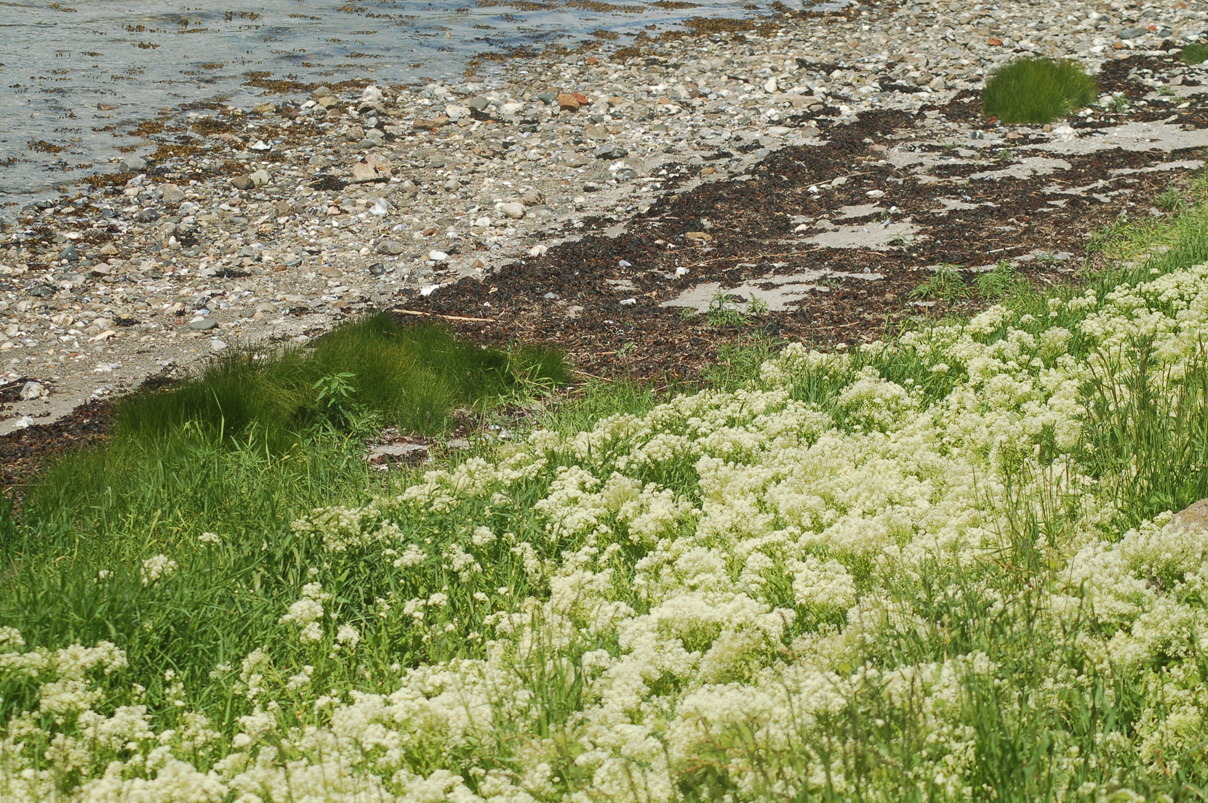
Hoary cress
A short pause by the beach  -  to breathe the fresh air - it's not a heat wave! It is cold today with some dusty rain , but maybe we'll not meet the predicted heavy rain until late afternoon. All along the shore upon a long low bank grow lots of Hoary cress, and it's actually an exotic plant in Denmark. It comes from the Mediterranean and the Middle East, but it has spread as a weed. The species might have survived in some places since the time of the sailing ships, or it has come to later with corn sacks. The Hoary cress has also spread along railroads, where it probably came during WWII and spread with transports of corn and food for the military.


I couldn't help "shoot" this bull who stood there looking yearningly across the road to his cattle friends. He was quite alone. Maybe he had behaved badly? The clouds are drifting fast across the sky making shadows upon the earth, an old windmill on the thill still stands there year after year when we pass by. 


Agri village and church


And here is the idyllic village I simply love with a church and a village pond and some fine houses and farms around the pond. A ghost story is connected to this church. Many have experienced this. A Norwegian family, parents and two teenage girls visited Denmark and came to Agri church on their way to the town Ebeltoft. They had enjoyed their tour in a lovely weather and took a break, drove up to the parking place at Agri church, went out to get some fresh air before driving on to Ebeltoft. It was ten in the evening and it was growing a little darker. They saw two figures emerge at the church, dressed in long dark robes, like monks, they talked and then disappeared around the corner of the tower. Another person came walking from the other side of the church, and when he passed the tower, the two figures jumped out and attacked him. The family watched paralysed, while he was beaten with heavy sticks - and while he lay on the ground, the two dark attackers bent over him and removed something from his clothes. The family discovered that the attack had taken place without a sound - in spite of the quiet evening and in spite of that they stood less than 100 meter from the dramatic scenery. They saw that the two attackers left their victim and almost melted together with the darkness on the other side of the church. The family finally came out of their paralysis - and they all run up to the victim on the ground. There was no trace of anything at all  - no victim, no blood, nothing.  "We just run to the car an drove all we could to our hotel in Ebeltoft", the mother told. "we almost did not talk about it, and the next days we kept a nervous eye on newspapers and TV-news, but we never saw or heard anything about a robbery at Agri church. We don't like to talk about it. I think we are all trying to forget it."       
In spite of several attempts no one have succeeded in finding out, if an attack like this has taken place by Agri church .. .  .


there were lots of scented chervil ....
A corner of Strandkær
Just before Agri we've passed the sign Nationalpark Mols Bjerge, and we'll now drive on a narrow gravel road up in the large hilly area. The hills have been cleared of some growth and now stand fine and round with trees and bushes and grazing cattle and horses. We reach Strandkær, the Mols Laboratory, owned by Naturhistorisk Museum in Århus - here is a large nature area in Mols bjerge. Researchers from Denmark and abroad come here to examine the special nature of the area. Here are two long and winding and sometimes steep paths (also for the public) "The Italian path" and the "Strandkærstien". They are worth a visit at all times of the year, although the Italian path can be dangerous in winter, either waterfilled or a place for ice skating! But we are here in summer, yes, it is summer, isn't it, and although it is a cold day and there are no butterflies to see, there are still many plants. This day we found the Sticky catchfly and the Common bugloss - and a plant I haven't noticed before, in Danish called Nikkende Limurt , the syllable Lim means glue, in English this herb is called the Nottingham catchfly.

Sticky catchfly
Sticky Catchfly/Tjærenellike is a very attractive plant with dark pink flowers on a tall stem, which is sticky just below each pair of leaves. The plant is said to increase the disease resistance of surrounding plants.If you pluck it, your fingers almost fasten in the tar-like paste on the stem, and if you look closely you'll see little dead and half-dead insects in the paste. The English name sticky catcfly is well-chosen. It is not a carnivorous plant though - on the contrary it has lots of nectar for bees and butterflies. In fact it is one of the best nectar plants in Denmark. On the other hand the plant wages war on the insects that try to steal the nectar, the so-called nectar robbers, fx ants. They empty the flowers of nectar without pollinating them , and insects on their way up fasten helplessly in the paste on the stem. Mother Nature is really smart.

Common bugloss
Common bugloss /Læge-oksetunge is an old medicinal herb and it was used against melancholia. It was also said to be cardiovascular and good against cough and healing wounds. The red colouring of the root was already in the Roman period used for makeup. Today the colour is used for dyeing cloth.
Nottingham catchfly
I've researched the Nottingham catchfly. (Danish: Nikkende Limurt). Wikipedia says that  the common name Nottingham Catchfly commemorates the former occurrence of Silene nutans on the walls of Nottingham castle, and the species was chosen to represent the unitary authority of Nottingham as its county flower. Despite this association, Nottingham Catchflies no longer occur in either the city of Nottingham or the wider county of Nottinghamshire. So much for that,  this herb is actually widespread in the world, and in North America it is called the Eurasian catchfly. The plant flowers during the night and produces a strong floral scent to attract its pollinators, which are mostly night-flying moths (well, then I don't need to look for a butterfly here!) 


Small Blue
But then we met a little butterfly, the only butterfly we saw that day, a little blue one of the Blues, it was the The Small Blue (Cupido minimus). It is found in both Europe and Asia,  it is known by its small size (wing span 18-24 mm).  It might sometimes be confused with the Holly Blue. In Denmark it is only seen in some limited areas in North and Mid Jutland and Funen and Zealand. Its habitat is dunes, banks with a thin earth layer and gravel pits. On the continent both larvae and pupae are tended by ants, but there is little evidence of this occurring in the UK. It is the smallest resident butterfly in Britain.

Galloway
The broom is in flower and there were flocks of brooms along the forest glades. There were also thousands and thousands of chervil sending out a fine summerly scent. The Strandkær center has got some livestock, the Galloways, which takes care of itself in a big field and forest area inside the Strandkær area. The Galloways are not curious. They do not come up to you to "have a little talk." The Galloway cattle is from southwest Scotland. It is the oldest British cattle race and the world's oldest hornless meat-cattlerace. It is supposed that the Galloway origins from the hornles cattle of the Scythians (year 485-425 bc). I think this is fantastic. Such an old race. The Galloway can survive in poor pastures, like heaths, and  the cows can raise their calves even under bad conditions. It's like the Highland cattle, they can also give birth and take care of their calves themselves, but there is a difference, the owners of the Highland cattle keep a close eye to their valuable Higlanders. I suppose the people at Strandkær also keep an eye on the Galloway after all! And of course the water supply is taken care of by humans in both cases. In Denmark the Galloway cattle is used for nature conservation. There are several types Galloway, also a miniature Galloway and a belted Galloway. And they are absolutely cute.
They are so calm these nice animals and they look friendly, but it is not advisable to enter the fence while they've got calves, naturellement!


Around the National Park's pastures and banks, sheep, goats, cows and horses are grazing. It is an important goal of preservation in Mols bjerge to keep the open landscapes, and  to reach this goal they use the animals for nature conservation, since the heath, the pastures and the meadows have come to by the human use of the areas. When the animals are grazing they contribute to keep the original look and character of the National park, because the various animals eat various plant species, which else would threaten to take the power. Cattle is well suited for nature conservation, they eat grass and do not care for bitter flowers with bitter taste like the buttercup, and they don't graze close to the cow dungs, where the plants growing there contribute to benefit the flowers and bees.

mixed race
The mixed lightbrown cattle is a special developed forest race, a cross between two Danish milk races and nine various meat-cattle races. This has created some tough animals, well suited for grazing on the nature inspired land all year. They have got the same properties as the Galloways at Strandkær. In several places graze milk goats and Gute-sheep, a tough Viking race with horn, they like to eat broom. In other places in Mols bjerge are horses, they are better when it is about eating the Wavy hair-grass, the most common grass in the open hills.

The National Park Mols Bjerge contains much more (link in English)


I love to visit Mols bjerge. There are so many various places to see, and it is difficult to choose sometimes what to see. I like to visit the archaological sites, like Poskær stenhus and the other dolmens, the beaches, the marinas, the forests and a town like Ebeltoft, which is the most idyllic town with a special little town-hall and old-fashioned gardens and a magnificent glass museum. And the pretty frigate Jutland in the harbour. Outside Ebeltoft the fantastic Safari park, Ree  Park, with cheetas and other exiting animals, living in good environments. And in Ebeltoft is also the film-institute, where many wellknown film-people were educated, like the instructors of Borgen and other wellknown TV-series.  Mols is a multicoloured place, like a painter's palette.   


dark clouds coming.........

But now the rain is coming, dark clouds are gathering, and we'll have to go home. It seems that we are always chasen home by rain. Well, we've just had some good hours in Mols bjerge, the Danish mountains! . See you later!

On our way home we saw some Thunderbirds. In the summer season are many veteran-car meetings at Mols and in this week-end the Thunderbirds. Maybe Ferrari next week!


Steve has just told me that they are Ford Mustangs and not Thunderbids!! 


Monday, August 01, 2011

Early Marsh Orchid/Kødfarvet Gøgeurt

Dactylorhiza incarnata


Early Marsh Orchid is an orchid with pink flowers, but  they can also be dark red or white.. It is about 25-50 cm tall and is blooming in June and well into July. Ita leaves at the base are almost always without spots. It varies much in looks, dependent on where it grows or its genetic inheritance. It also hybridizes with other related species or orchids. It is common in parts of Jutland and upon the Isles , but rare in the rest of Denmark. It grows in moors, in meadows, in dune hollows and on dry sections of beach meadows.

Variety: Pale Early Marsh Orchid (Dactylorhiza incarnata var. ochroleuca) has light yellow flowers. It is found in East Jutland and at Sjælland, but is very rare. It grows especially in fens with calcareous soil..

photo: grethe bachmann

Protection:

Early Marsh Orchid is listed. It must not be plucked, digged up or destroyed.

Most of its habitats are protected after § 3 i naturbeskyttelsesloven.
The species is also covered by CITES/Washington-konventionens liste II /bilag B.


Threats: 


  • Early Marsh Orchid is threatened by draining and cultivation.

    Nordens orkideer. Sven Nilsson og Bo Mossberg. Gyldendals grønne håndbøger. 1977.
  • Blomsternes Danmark. Jens Gregersen og Bernt Løjtnant. Side 110-113. Gyldendal 1999.
  • Gyldendals farveflora: Kirsten Tind. Gyldendal 2001

Monday, January 17, 2011

Soap Wort/Sæbeurt

Saponaria officinalis


Soap wort is native to Europe and the Middle East where its cleansing attributes have been utilized for centuries.The Latin name Saponaria means soap and refers to the content of saponines, which in connection to water lathers and achieves some cleansing properties. Other names are Bouncing Bet, Latherwort, Fuller's Herb, Sweet Betty. The name Bouncing Bet refers to the washerwoman's attributes being bounced around while  the soapwort's cleansing properties were applied to clothing. Its aromatic light pink star-shaped flowers remind about carnations. In Denmark the plant is feral from klostergardens and hospitals and grows by villages and ditches near cities. All parts of the plant can be used for making a soap like decoction but the roots have the highest concentration of saponine. 


Medicine and Soap:
The plant was used in the tratment of abdomunal diseases if the mercury treatment failed,decoction was used to wash itchy skin and to drink to treat breathing difficulties.In the Middle Ages the plant was used to calm down buzzing on the ears and chest pain. The plant is also known for killing toxines in the liver.
The crushed leaves of soapwort officinalis have been used as a soap since the Renaissance. The medieval fullers would use soapwort during the finishing process for cloth. The Syrians used it for washing wool products, while the Swiss used it to bathe their sheep before shearing. The early American settlers used it as a wash to counter poison ivy rash. 

Superstition:
The soap wort was once considered a gift of God to the humans.


Today:
Today soapwort is used as a cleansing means for delicate linen and silken. Museum conservators still use the soap made from its leaves and roots for claning the delicate fabrics - and it also makes a fine shampoo, which is recommended, thoughh it might irritate the eyes. Soapwort officinalis is also used in the food industry , especially in the making of halva, a sweet made using tahini and sugar and honey.

Warning. Caution is advisable.  Soap wort should not be taken internally. The high saponine content makes it mildly poisonous, and it can destroy the red blood cells. 


Source: Anemette Olesen, Danske Klosterurter, 2001.


photo Bølling sø 2008: grethe bachmann

Tuesday, September 14, 2010

Common Medlar/ Mispel


Mespilus germanica


Common Medlar, Botanical Gardens, Copenhagen

The Common Medlar is a large shrub or small tree, and the name of the fruit of this tree. Despite its Latin name, which means German or Germanic Medlar, it is indigenous to southwest Asia and also southeastern Europe, mostly the Black Sea coasts of modern Turkey. The common medlar was cultivated ab. 3000 years ago in the Caspian Sea Region. It was introduced to Greece around 700 BC and to Rome ab 200 BC. By the 17th and 18th century, however, it had been superseded by other fruits, and is very rarely cultivated today.

Common Medlar is one of the few fruit that becomes edible in winter, and an important tree for gardeners who wish to try to have fruit available all year round. There are several cultivars, which bears the largest fruit. Medlar can be grafted on to the rootstock of another species fx pear and apple. It thrives best in warm sun and mild winters. The five-petalled white flowers turn up in late spring, and the leaves turn a spectacular red in the fall. The reddish-brown fruit is a pome with wide-spreading sepals which makes the fruit look hollow. In the beginning the fruit is hard and acidic, but edible after frost or storage. The skin wrinkles and turns dark brown, and the inside reminds about apple sauce, both in flavour and consistency. In the medieval kitchen the fruit was used for jelly and marmelade.
Until recently, the Common Medlar was the only known species of medlar. However, in 1990 a new species was discovered in North America, now named Stern's Medlar (Mespilus canescens). The Loquat (Eriobotrya japonica) is also related, and sometimes called the "Japanese Medlar".
In medicine common medlar was used as a means against diarrhoea and dysentery. The wood was used in the same way as pear wood for carved work , letter types, figures, fine furniture etc. - and furthermore the medlar wood gave good charcoal. The leaves and branches were used for tanning.

Botanical Gardens Copenhagen

photo september 2008: grethe bachmann

Thursday, May 27, 2010

Viper's Buglos / Slangehoved

Echium vulgare


Viper's buglos is native to most of Europe and west and central Asia. This wildflower is found on disturbed dry soils, dunes, shingle, cliffs and open grassland. It is a good nectar plant, attracting lots of bees. On warm days the brilliant blue flowers are covered in honey bees and bumblebees.

Other names are Blue Devil, Blueweed, Thistle and Viper's Grass. The genus name echium comes from the Greek word Ekbis = viper. The viper part of the name may derive from the spotted stem said to recall marks on a snake, or an imagined resemblance between the flower-head and the head of a snake. Viper's buglos is an example of a wildflower that received a frightening name based simply on its looks. Some people thought that the plante created a hiding place for snakes or that the plant was guilty of other serpent-related qualities.

A red dye is obtained from the root.

Medicine.
Actually Viper's buglos was once considered to be a preventive and remedy for snake bites. Traditional the leaves of the plant were boiled and made into a tea which helped fevers and headaches or made into an infusion for nervous complaints.

photo June 2007: grethe bachmann, Jernhatten, Djursland

Sunday, May 23, 2010

Sticky Catchfly/ Tjærenellike

Lychnis viscaria


Sticky Catchfly/Tjærenellike is a very attractive plant with dark pink flowers on a tall stem, which is sticky just below each pair of leaves. The plant is said to increase the disease resistance of surrounding plants. Extract from it contains a relatively high amount of brassino-steroids, which have a proven positive effect on the growth of other plants. In Germany the extract is allowed for use as a 'plant strengthening substance.' Sticky catchfly is native to Europe, Asia and North America.

If you pluck it, your fingers almost fasten in the tar-like paste on the stem, and if you look closely you'll see little dead and half-dead insects in the paste. The English name sticky catcfly is well-chosen. It is not a carnivorous plant though - on the contrary it has lots of nectar for bees and butterflies. In fact it is one of the best nectar plants in Denmark. On the other hand the plant wages war on the insects that try to steal the nectar, the so-called nectar robbers, fx ants. They empty the flowers of nectar without pollinating them , and insects on their way up fasten helplessly in the paste on the stem. Mother Nature is really smart.


photo 250508: grethe bachmann, Stigsholm Sø, Mid Jutland

Monday, April 19, 2010

Anemone nemorosa


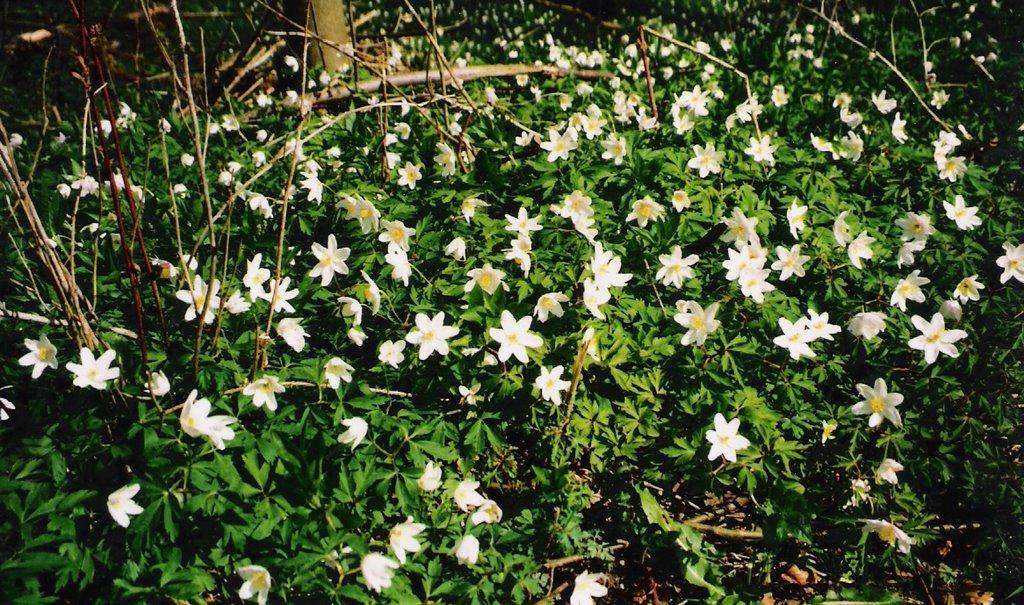
One of the first flowers of spring in the forest is the white anemone, spreading a lovely thick carpet of pure white flowers all over the forest floor, before the beeches come into leaf. The white anemone, Anemone nemorosa, is common in hardwoods. The name anemone origins from the Greek word anemos = wind. Denmark: Among many local names were feberurt (feverherb), spring lily and 'little white crow's feet'.The old herbalists called the Wood Anemone the Wood Crowfoot, because its leaves resemble in shape those of some species of Crowfoot. We also find it called Smell Fox. The specific name of nemorosa refers to its woodland habits.


In sunshine, the flower is expanded wide, but at the approach of night, it closes and droops its graceful head so that the dew may not settle on it and injure it. If rain threatens in the daytime, it does the same, receiving the drops upon its back, whence they trickle of harmlessly from the sepal tips. The way the sepals then fold over the mass of stamens and undeveloped seed-vessels in their centre has been likened to a tent, in which, as used fancifully to be said by country-folk, the fairies nestled for protection, having first pulled the curtains round them.


Folk medicine:
When the farmers in spring caught the sight of the first anemones, they eat at once three flowers as a protection against the dreaded cold fever (malaria) , and the flowers were also given to people, who already had this disease - and they were dried for use in winter. After having eaten the first three flowers , people had to say a magic verse and a prayer to God if he would protect them from the cold fever . White anemones crushed with egg white and salt were bound upon arteries against cold fever. Swelling feet had a bath in a decoction on white or blue anemone flowers. Only the flowers were used in folk medicine, since the juice from the plant was considered very poisonous. The plant was said to give the cattle bloody urine.Lineaeus says that cattle have been poisoned by eating it in the fresh state after having been underfed and kept on dry food during the winter, so that they were ready to browse on the first leaves they saw.


The Egyptians held the Anemone as the emblem of sickness, perhaps from the flush of colour upon the backs of the white sepals. The Chinese call it the 'Flower of Death.' In some European countries it is looked on by the peasants as a flower of ill-omen, though the reason of the superstition is obscure. The Romans plucked the first Anemones as a charm against fever, and in some remote districts this practice long survived, it being considered a certain cure to gather an Anemone saying, 'I gather this against all diseases,' and to tie it round the invalid's neck.
Greek legends say that Anemos, the Wind, sends his namesakes the Anemones, in the earliest spring days as the heralds of his coming. Pliny affirmed that they only open when the wind blows, hence their name of Windflower, and the unfolding of the blossoms in the rough, windy days of March has been the theme of many poets:
'Coy anemone that ne'er uncloses
Her lips until they're blown on by the wind.'
Culpepper also uses the word 'windflower.' In Greek mythology it sprang from the tears of Venus, as she wandered through the woodlands weeping for the death of Adonis -
'Where streams his blood there blushing springs a rose
And where a tear has dropped, a wind-flower blows.'


photo: grethe bachmann

Tuesday, March 23, 2010

Winter Aconite /Eranthis

Eranthis hyemalis

Winter aconite (Eranthis hyemalis) is one of the earliest bulbs to bloom in spring. This plant in the buttercup family (Ranunculaceae), native to Asia Minor and Europe, has small flowers that resemble tiny buttercups. The solitary, yellow cup-shaped flowers are surrounded by bright green bracts that look like a collar around the blossom. Eranthis is growing on forest floors and using the sunshine available below the canopy of trees before the leaves come out; the leaves die off when the shade from tree canopies becomes dense, or, in dry areas, when summer drought reduces water availability. They are popular ornamental plants grown for their winter or early spring flowering.

All parts of the plants are poisonous, though the very acrid taste makes poisoning a low risk.If you have small children or pets that are likely to dig in the garden you may not want winter aconite in your yard as the entire plant, but especially the tuber, is quite poisonous and may cause nausea, vomiting, colic attacks and visual disturbances.

This ground-hugging plant works well in rock gardens, flower beds and woodland gardens. The flowers first appear in the sunniest spots, just before the first snowdrops (Galanthus nivalis) begin to bloom. They can look charming together planted in the border or naturalized in the lawn. Winter aconite is good for naturalizing under trees and large shrubs. They combine nicely with hellebores and echo the flower color of Forsythia and witch hazel (Hamamelis). Because of their small size, they are best planted in groups.


When growing in conditions it likes, winter aconite reproduces easily and spreads readily to form large colonies – almost to the point of being invasive. Lift clumps while still green to keep under control, if desired, or when overcrowded. To propagate, divide the clumps after flowering or collect seeds to sow in the fall.

In Greek and Roman mythology, Medea tried to kill Theseus by poisoning him by putting aconite in his wine, in that culture thought to be the saliva of Cerberus, the three-headed dog who guarded the Underworld. Hercules dragged Cerberus up from the Underworld, while the dog turned his face away from the light, barking and depositing saliva along the path. The saliva hardened in the soil and produced its lethal poison in the plants that grew from the soil. Because it was formed and grew on hard stones, farmers called it 'aconite' (from the Greek akone, meaning 'whetstone').


Photo Forsthaven 2009/2010: grethe bachmann

Tuesday, March 02, 2010

Spring Snowflake/Dorothealilje

Leucojum vernum


The woods rejoic'd the day
Thro gentle showers, the laughing flowers
In double pride were gay.
Robert Burns

The snowflakes are native to central and southern Europe, but they have been introduced and have naturalized in many other areas. They have narrow, strap-like, dark green leaves. The flowers are small and bell-shaped, white with a green (or occasionally yellow) spot at the end of each tepal. They have a slight fragrance. It flowers one or two weeks later than the snowdrops, i.e., from mid-February to March, as soon as the snow melts in its wild habitat. The flowers remind about the snowdrop's flowers.

The Latin name for Spring Snowflake is Leucojum vernum. Leucojum comes from the Greek word leukos, meaning white and ion, meaning violet. In fact it has a pleasant scent reminiscing of violets. Vernum means spring blooming.

The Danish name Dorothealilje was given the flower from a young girl, Dorothea, who suffered martyrdom in the year 387 in Asia Minor. She was a Christian and wasn't able to marry a heathen who proposed to her. She turned him down and he killed her. Where her blood fell, the beautiful 'Dorothealilje' grew up. Another legend says that when Dorothea was killed, an Angel came from the sky with his arms full of Dorothea-lilies - and this made such an impression on the rejected suitor that he became a Christian himself. On February 6th is St. Dorotheas Day, and at this time of the year the flower was blooming in South Europe.

In the Birgittine convents this flower had a special significance and it was to be found in large amounts in their gardens. The Birgittine nuns brought the plant to the North, and it was probably introduced in Denmark shortly after 1416, when Maribo Convent was established by the Birgittiner nuns from Vadstena in Sweden.

Leucojum aestivum (Summer snowflake) has a wider natural range, taking in Europe (including the British Isles), southwest Asia and northern Iran, and growing in wetter habitats including damp woodland, riversides and swamps. Despite its common name it flowers from April to May, though later than the Spring Snowflake.

photo Mindeparken, Århus 120308: grethe bachmann.

Wednesday, February 10, 2010

Common Chicory/Almindelig Cikorie

Cichorium intybus


Common chicory (Cichorium intybus) is a bushperennial plant with blue, lavender, or occasionally white flowers.It grows as a wild plant on roadsides in its native Europe and in North America and Australia where it has become naturalized. Common chicory is also known as Blue Daisy, Blue Sailors, Coffee Weed, France endive etc. The cultivated forms are grown for their leaves , or for the roots , which are baked, ground, and used as a coffee substitute and additive. Some beer brewers use roasted chicory to add flavor to their stouts.

Chicory is also the common name in the US and in France for curly endive (Cichorium endivia). There is considerable confusion between Cichorium endivia and Cichorium intybus.

Culinary: Chicory was used as a salad plant since ancient times, first by the Egyptians, then by the Greeks and the Romans, and it was imported to Denmark by the monks; in Denmark is only found the imported medicinal herb Cichorium intybus, common chicory. Chicorium intybus is not common in Danish kitchen gardens, but it is considered an indispensable salad plant to Italy and France. The flowers are eatable and decorative in a salad with their fine blue colour. Shots of Common chicory, which has grown in darkness, are in Denmark sold in late autumn as Julesalat (Christmas salad).

Medicinal: Since ancient times chicory was used against liver, kidney and bilious diseases, dropsy, consumption, bubonic plague, gout, haemorrhoids, indigestion, melancholy and hypochondria. Already Plinius recommended it as a means against indigestion. A dekokt of the flowers was used as an eyewash.The medieval physician Henrik Smid recommended the herb to treat the eyebrows or else they could fall off. Chicory was also considered an aphrodisiac and used against poisoning.

Medicine today: Tea of flowers and dried leaves are good in stomach, liver and spleen problems and for haemorrhoids. Chicory root extract is high in inulin and used as a high-fiber dietary supplement. Dekokt of the herb is appetizing, good for the stomach and the bile.

Caution: If allergic to ragweed or other members of the Compositae family approach use of chickory with caution. In rare cases contact with the fresh plant can cause allergic skin reactions.

Coffee substitute: In the Napoleonic Era in France, chicory frequently appeared as either an adulterant in coffee or a coffee substitute; this practice also became common in the United States and the United Kingdom, in England (and Denmark) during the second world war and in Camp coffee, a coffee and chicory essence, which has been on sale since 1885. In the United States chicory root has long been used as a substitute for coffee in prisons.


Superstition: A young girl was sitting by the road, crying because her lover had disappeared, and where her tears fell, the chicory grew up. If a girl (Eastern Europe) had chicory in her boots and put the chicory in a pair of man's trousers under her pillow, she would see her husband-to- be. A legend tells about a girl ,who denied to give Christ something to drink, and as a punishment she had to stand by the road in the shape of a chicory. A variation of the legend: The pretty blue flowers of Chicory turn and follow the sun - and a German legend tells that Chicory is a transformed virgin, who was left by her boyfriend. She is now standing in the roadside looking for her lover, turning her head in order to look for him. The plant's German name wegwarte means 'she who waits by the road.' Chicory was believed to be able to open locked doors, according to European folklore.

Literature: The chicory flower is often seen as inspiration for the Romantic concept of the Blue flower. The chicory plant is one of the earliest cited in recorded literature. Horace mentions it in reference to his own diet, which he describes as very simple: "Me pascunt olivae, me cichorea, memalvae" ("As for me, olives, endives, and mallows provide sustenance")Lord Monboddo describes the plant in 1779 as the "chicoree", which the French cultivate as a pot herb.
Fodder: Chicory is well known for its toxicity to internal parasites. Studies indicate that ingestion of chicory by farm animals results in reduction of worm burdens,which has prompted its widespread use as a forage supplement. Research results from 2005 also showed that the taste and smell of boar disappears in the slaughtered pigs, if they had chicory in their fodder before slaughtering.

Source: Annemette Olesen, Danske Klosterurter, 2001

Snaps:
Use the root or the flowers, fresh or dried. Pour with neutral snaps and let it draw for some weeks. Filter and thin according to taste.

photo Gl. Rye August 2007: grethe bachmann

Wednesday, January 13, 2010

Bird's Foot Trefoil/Kællingetand

Lotus corniculatus


Lotus corniculatus, Bird's-Foot Trefoil is native to Eurasia and North Africa, but it grows in most of Europe and also in Denmark, where its Danish name Kællingetand means "Old Woman's Tooth". It is a perennial herbaceous plant, similar in appearance to some clovers. The name Bird's Foot Trefoil refers to the appearance of the seed pods on their stalk. It can survive fairly close grazing, trampling and mowing and is most often found in sandy soils. It flowers from June until September.It is also known in cultivation in North America as Birdfoot Deervetch. It has become an invasive species in some regions of North America and Australia.

The plant has many common English names in Britain, but they are now mostly out of use. The names were often connected with the yellow and orange colour of the flowers, fx "eggs and bacon" or "butter and eggs". A double flowered variety is grown as an ornamental plant. It is used in agriculture as a forage plant. In the beginning of the 1800s it was cultivated at a farm in Mid Jutland, but was given up and first cultivated again from the 1880s. The plant was mentioned in 1910 as the only one, which could replace the red clover, and in perennial grass fields it was indispensable. But many farmers did not acknowledge this.

The plant is an important nectar source for many insects and is also used as a larval food plant by many species opf lepidoptera such as Six-spot Burnet.

Fresh Birds Foot Trefoil contains cyanogenic glycosides and is thus poisonous to humans.

The plant is one of the few flowers in the language of flowers that has a negative connotation, symbolizing revenge or retribution.

In folk medicine Birds Foot was dried and put on snaps or in tea, this was used as a stomach medicine. The roots were used as a blood cleansing remedy.

The plant gives a fine yellow in yarn dyeing.

Source: Folk og Flora, Dansk Etnobotanik 3, V.J.Brøndegaard

photo Stigsholm Sø 24. May 2009: grethe bachmann

Sunday, January 10, 2010

Sainfoin /Esparsette

Onobrychis viciifolia

Høvblege, Møn , at calcareous soil.

Sainfoin is a very attractive wild flower with pinnate leaves and dense spikes of pretty pink flowers with darker veins. Onobrychis means "devoured by donkeys" from Ancient Greek ónos (donkey) and brýkein ("to eat greedily"), referring to sainfoin's good properties as a forage plant for large mammalian herbivores. Sainfoin is derived from Old French sain foin = healthy hay.

In northern European languages that have been less influenced by French the plants' name usually derives from esparceto, the Provencal term for the similar-looking and closely related sweetvetches (Hedysarum). Examples: Danish esparsette, Dutch esparcette, German sparsette, Russian espartset (Эспарцет) and Swedish esparsett.

Sainfoins are Eurasian perennial herbs of the legume family. About 150 species of sainfoins are presently known. The flora Europaea lists 23 species of Onobrychis; the main centre of diversity extends from Central Asia to Iran. Onobrychis viciifolia is naturalized throughout many countries in Europe and North american grasslands on calcareous soils. Sanfoins are mostly subtropical plants, but their range extends throughout Europe as far north as southern Sweden.These plants grow on grassland, agricultural land and wasteland.

These highly nutritious plants were an important forage for heavy working horses in agriculture, and are still an excellent source of nectar for honey production as well as pollen for bee food. Onobrychis species are used as food plants by the caterpillars of some Lepidoptera species.


Høvblege, Møn, a hillside with lots and lots of various flowers.

Sainfoin was probably from the middle of the 1700s cultivated in Denmark but it never had a large distribution. It was said that sainfoin when used as a fodder for the cattle increased the milk yield and made oxen fat, but horses must have it mixed with other fodder "or else they will grow too fat". It was tested as a fodder in several places with unsatisfying results - but then it was cultivated as an ornamental plant. Not until 1875 the sainfoin became popular and considered a good fodder for cattle in general, since it had a larger nutritional value than clover and lucerne. The milk gets bluish if the cows eat sainfoin.

The birth of Jesus in a humble stable has given ample opportunity for several legends. While the tired parents slept, Jesus was placed in a manger filled with sainfoin. When they awoke they were astonished to find that the dry hay had blossomed, and the baby was surrounded by its beautiful red flowers. Ever since sainfoin has been known as Holy Hay.

In George Orwell's "Coming Up for Air", travelling salesman George Bowling regularly reminisces about the smell of sainfoin in his father's seed shop in Lower Binfield.

photo
Høvblege, Møn June 2007: grethe bachmannn.

Monday, December 28, 2009

Agrimony/Agermåne

Agrimonia eupatoria


Agrimony is native for Denmark. It grows along roadsides, wasteland, hedges and banks. Its natural habitat is woods and fields, but it takes to cultivation easily. Both the yellow flowers and the notched leaves give off a faint characteristic lemony scent when crushed.

In Greek Agrimone means ' to heal the eyes' and the Greeks used the plant to treat ailments affecting the eyes. The Anglo Saxons used the plant for snake bites and treatment for wounds. It contains tannin and bitter substance plus ethereal oil. It was used for leather tanning and dyeing. The whole plant yields a yellow dye.

The medicinal use of Agrimony in Denmark goes probably back to the Viking period, since its fruits were found in the Oseberg ship. It was a common used medicinal plant in monastery gardens. Monks and physicians used it for many ailments: liver and gallblatter disease, inflammation of the urinary system, compress for wounds and other skin damage, and as gargling water for inflammation in mouth and throat.

Folkmedicine
In the 1400s: the seeds were eaten as a protection against various diseases, they seeds were cruched and mixed with honey and goat's milk rubbed against headache, the leaves were used in compresses against fever and lung diseases, the juice from the plant in stomach trouble , warts were rubbed with the plant crushed in vinegar, a "blue eye" was treated with agrimony and egg white, etc.
Christiern Pedersen in 1533: the plant juice mixed with destilled water from Rumex to drink against the plague, winedecoct against malaria, juice against snake bite.
Henrik Smid 1546: destilled water from the plant stops cough, good for patients with malaria, kill intestinal worms.
Simon Paulli 1648: the doctors gave a syrup or a decoct of agrimony for a blocked up liver, the plant mixed in a herbal extract against syphilis, cooked with the root of alant used for bathing frost-bites in hands and feet.

Agrimony was also used as a tea or mixed in herbal teas.

Dried agrimony hung in beer prevents it from getting sour. The plant was also used in fodder for sheep.


Today
Agrimony is not commonly used today, but has its place in traditional herbal medicine. It is frequently used in alternative medicine as a herbal mouthwash and a gargle ingredient and is applied externally in the form of a lotion to minor sores and ulcers.
Caution: this is an astringent herb, do not use if constipated. Do not use internally during pregnancy without discussing with your obstetrician.

Folklore
Witches used it in spells to dispel negative energies and to ward off hexes. Agrimony was said to cause deep sleep. When placed beneath a man's head this sleep would last until it was removed. This passage is from an old English medical manuscript:

'If it be leyd under mann's heed
He shal sleepyn as he were deed;
He shal never drede ne wakyn
Till fro under his heed it be takyn.'

It was also said that the Anglo Saxons included Agrimony in charms and dubious preparations of blood and pounded frogs.

Snaps
Dried spikes are poured over with a neutral snaps (in bottle or jar). Drawing time is about one week, then filter it and let it draw for some time. Thin your drink according to your taste.

Source: V.J. Brøndegaard, Folk og Flora, Dansk Etnobotanik 3, 1979
photo
: grethe bachmann

Saturday, December 12, 2009

Christmas Rose/Julerose


Christmas Rose/Julerose
Helleborus niger

Helleborus niger, commonly called Christmas rose or black hellebore, is an evergreen perennial flowering plant in the buttercup family, Ranunculaceae. It is poisonous.Although the flowers resemble wild roses, Christmas rose does not belong to the rose family.The name Christmas rose was given it in the Middle Ages because it flowered at Christmas time. The name niger is due to its black underground stalk.

The Helleborus niger has white, or occassionally pink flowers. In the wild, Helleborus niger grows in hilly terrain woodlands in middle and southern Europe. It is also found in the Alps and in the edge of the Appenines. The plant is a traditional cottage garden favourite, because it flowers in the depths of winter; large-flowered cultivars are available, as are pink-flowered and double-flowered selections. Helleborus niger contains ranunculin, which has an acid taste and can cause burning of the eyes, mouth and throat, oral ulceration, gastroenteritis and hematemesis.

Medicinal history: Its dried and grated root could make people sneeze, which supposedly cleared the brain, and the root was used in treating epilepsy, lack of balance and paralysis. the substance helleborin was used in heart diseases, weakness, melencholy, but caused by its poisonousness it is today only used in the homoeopathy or only obtained on prescription.

Superstition: In a French Catholic Christmas play from the Middle Ages are the three wise men/the three kings and a peasant girl Madelon. While the kings came with costy gifts for the Christ child, Madelon had none, and she cries, but an angel's wings touch the frozen ground, and a Christmas rose sprouts up . It was a Greek shepherd Melampos, who used the plant as a medicinal herb for the first time. He cured king Perseus' two daughters from their mental disturbances.The healing qualities could chase madness and evil spirits out from a human being; in the Middle Ages it was extended into general abilities of chasing evil spirits and sickness away. Also in the Middle Ages, people strewed the flowers on the floors of their homes to drive out evil influences. They blessed their animals with it and used it to ward off the power of witches. These same people believed, however, that witches employed the herb in their spells and that sorcerers tossed the powdered herb into the air around them to make themselves invisible. The Christmas rose was planted at the entrance of the house, and if an animal got sick, a piece of the plant was put into its ears.

A Maria-song: An old Christmas song from the 1500s, a Maria-song, was written when a monk was sent up to a prince in the mountains - and there in the prince's garden he was given a beautiful Christmas rose by a pretty young girl. The song is said to have been created on 24. December 1509, and the great church composer Michael Prætorius wrote the beautiful melody.(Dansk: En rose så jeg skyde)

photo Forsthaven 2009: grethe bachmann