A World of Colours
 |
| Elmelunde |
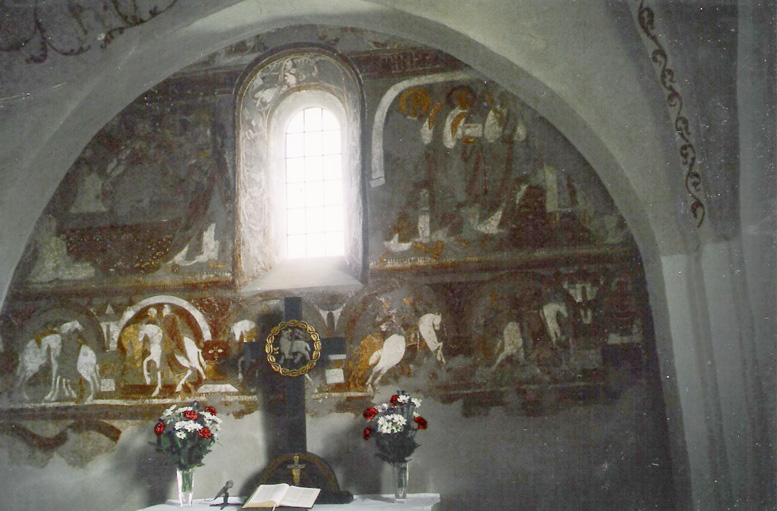
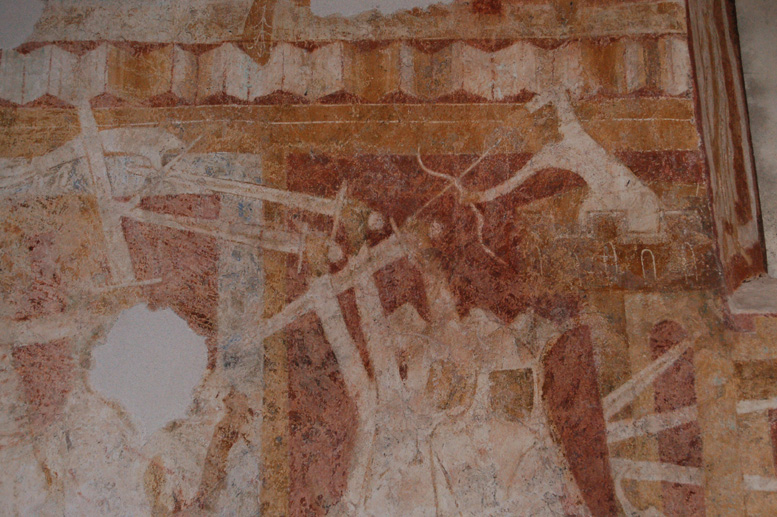
The walls and vaults of the Danish parish church were finely decorated with frescoe-paintings in the Middle Ages. Some frescoes are preserved, but many have disappeared or been washed over during time. What we still can see today tell us a story about how a church service was for a common church goer.While the vicar was preaching there was enough time to be entertained by the biblical or moral scenes of the frescoes - it was a medieval cartoon of horrifying scenes from hell or uplifting scenes from heaven. Many a church goer with a bad conscience have probably sweat with fear listening to the thundering voice of the priest and looking at the pictures of the devil torturing the condemned souls in the fires from hell. It was not just a calming experience to attend a church service in those days. But all Danes were Christians in the Middle Ages, and all were brought up in the same faith from birth and christening. The learning and traditions came from the Pope in Rome, from his delegate missionaries and priests. Those men were the educaters of people by speach and pictures - this meant that the history behind all biblical frescoes in the church were in advance known by all the viewers.
 |
| Elmelunde |
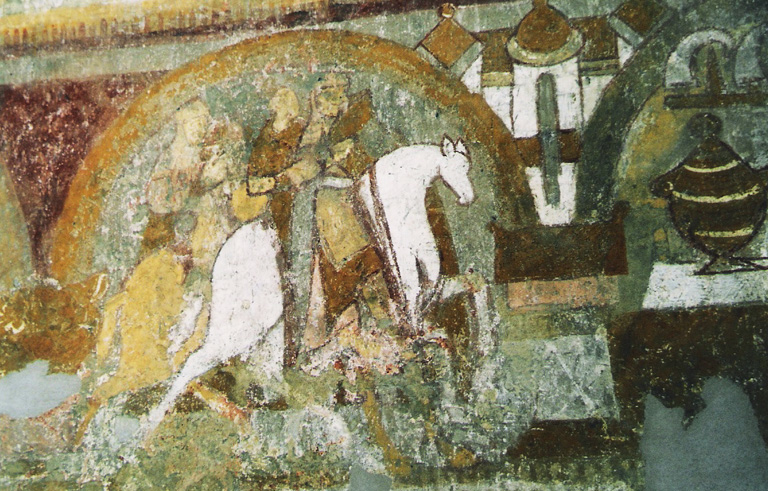
The medieval pictures were connnected to the Christian preaching. The motifs from the Bible followed a schedule decided by the alternate theology of the church. The religious ideas in the pictures were defined in advance, and no artist was allowed to change the tradition of motifs. The master of the workshop had a sketched or printed collection of models, and any original idea from the creating artist was banned.The colour scheme was strong in the Romanesque frescoes, yellow ochre, red ochre, black from crushed charcoal, white from chalk, cinnabar, red lead and green, made from copper or from the semi-precious stone malakit. The blue background colour was like darkblue velvet and came from the semi-precious stone lapis lazuli. The azurit was a light blue. The precious painted frescoes and sculptures must have looked divine in a dark world populated with common people dressed in brown and black wool. Only the highest and richest in the secular society and the top of clericals wore coloured clothes with gold and silver. The medieval fondness of colours was determined by small candles in the church and large candles upon the communion table when they lightened up the church room. The colours made the church-goer see and learn from the educational and devout pictures of the walls and the sculptures.
 |
| Keldby |
It was a demanding work to paint the Romanesque frescoe painting upon moist plaster, and it was probably done by experts from abroad with knowledge of the technology. The specialist frescoe- painters arrived probably together with the stone masons to Denmark in the rich early Romanesque period. The stone masons were to build the new stone churches all over the country to replace the old wooden churches, and the new churches had to be decorated. From about year 1000 till ab. 1200-1250 were most of all Danish parish churches built in stone.
In an attempt of copying the decoration of a church it was shown that a whole church might be painted from choir to tower and with both vault and walls in about 3 weeks. But this was made by a skilled group of painters with a master, who knew the graphic models and had his own ornaments and style.
 |
| Fanefjord |
Those frescoe-experts from abroad were eminent painters, and their pay must have been high. They came to the country with a quite new time-consuming technique. They used expensive materials like lapis lazuli and gold leaves for the relief haloes. The semi-precious stone lapis lazuli came from Afghanistan, and in the 1300s the fine blue quality was worth its weight in gold in Venice. It must have been extremely valuable in Denmark, but the Catholic church was rich, and it knew how to get more money from both the rich and the poor man. Of course it was a must to have splendid pictures of God upon his throne in all his glory and the symbols of the Evangelists and Virgin Mary with God's son and the most important motifs from the Holy Bible. The finest materials were necessary in order to represent these divine pictures. The golden haloes sparkled in the light from the candles upon the communion table, and the fine colours of the biblical and moral scenes caught the attention of the church goers. This was the colourful Middle Ages. But the scenes on the wall held some dark threats if the church-goer did not serve his church in the best way....
 |
| Fanefjord |
Not all pictures were sacred , some were unholy, immoral and offensive. The immoral motifs came from outside the religious universe. Maybe they were depicted in order to show the upturned world, the impious contra the divine. Other pictures were representations of proverbs. The immoral pictures were not found among the holy motifs and worship-pictures of the altar pieces. Some margin illustrations are often seen in the bottom of the vaults or as masks around the outlet holes.
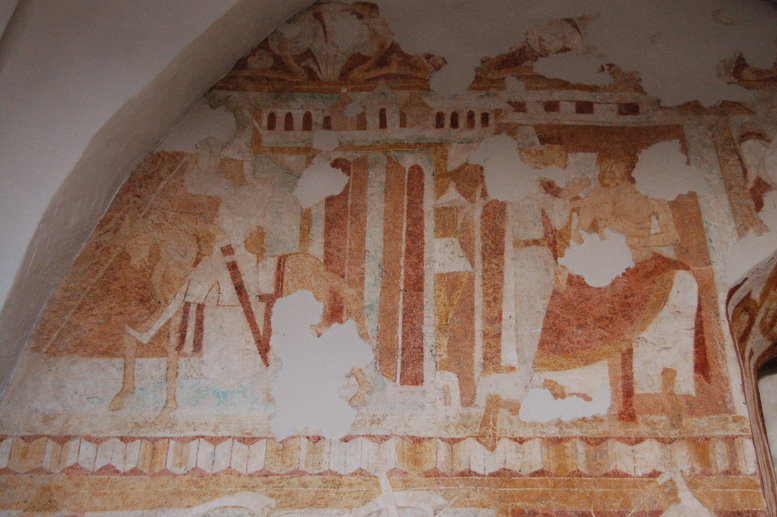
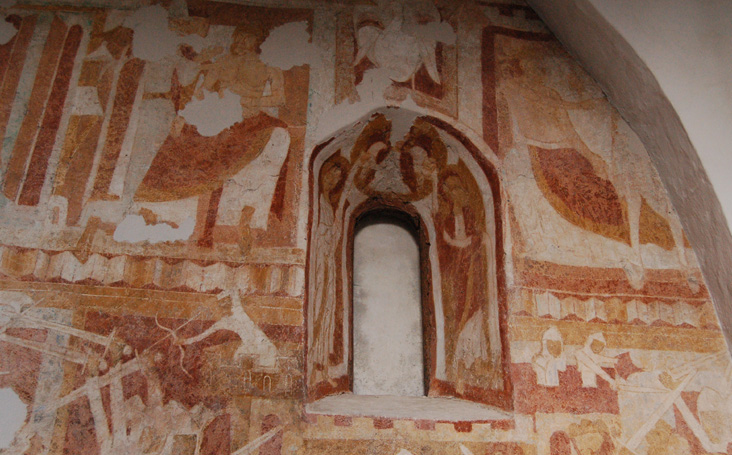
In the second half of the 1100s came a pause to the Romanesque frescoes. Tile churches were built with a modest amount of frescoes, there was only an ornamental decoration of the walls, but during the 1200s the rich frescoes came back, not only with biblical motifs but also with an ornamental world of flowers and trees and secular scenes. The Gothic painting technique used the white base as a piece of paper where the pictures were painted with lines and a few filled in colours. The colours were earth colours and green. The motifs in some churches show both moral stories and secular wedding scenes, pictures which were also used on frescoes in castles and manors. In rare cases were some of the frescoes signed.
 |
| Hyllested |
Behind all the pictures are other picture models and proposals. There are medieval examples of model
drawings in manuscripts for use in the workshops. Other pictures were copied after illustrations in de luxe binding Bibles or from other decorations. Those who ordered the work had chosen the picture programme from maybe the model book of the workshop. At Iceland is kept a unique model book from the second half of the 1300s, a collection of drawings as a use for painters, goldsmiths, embroiderers and carvers.
The stone sculptures in the Romanesque churches had spread rests of paint. Some baptismal fonts still hold rests of the original paint. Colour rests have been found on at least 225 Romanesque fonts. Many layers of paint have decorated the stone sculptures in the church during all times. The wooden sculpture of Madonna with the child was placed upon a side altar. She was decorated in polished gold upon a chalk base, with genuine gold leaves and polished with agat stone.
 |
| Fjenneslev |
A workshop named Finja worked in Skåne and at Zealand., fx in Fjenneslev church. Here is a frescoe of the son of the famous Skjalm Hvide, Asser Rig (+1150) and his wife, fru Inge. They hand over a little church (Fjenneslev) and a twisted gold ring to God's hand in the sky. Soderup church at Zealand was also decorated by the Finja workshop. In 1968 was uncovered a representation of the three kings, where all parts of the colour layers are preserved fragmentarily. The background is lapis lazuli, the skin colour is yellow ochre, the white dress has green shadows, the marbling is shown upon the pillars. A few characteristic upper layers depict the face-features - or else were only seen the oval face shape, when the frescoes showed under the wash-overs. The frescoes in Soderup bring a more trustworthy impression of the original colour strength of the Romanesque frescoe paintings than found normally.
 |
| Elmelunde |
 |
| Elmelunde |
A special workshop was the Elmelunde-workshop named after the church in Elmelunde, one of the churches with an eminent decoration of frescoes from the 1500s. A workshop like Elmelunde could be divided in a main workshop and some under workshops. Geographically were the Elmelunde workshops spread from Copenhagen to Skåne and to Djursland (Jutland) with Gjerrild and Hyllested church. The main workshop of Elmelunde was at Møn, Lolland-Falster and Skåne. 38 churches in this district were decorated, but not all frescoes are visible today. The geographical spread is best explained by that the painters sailed from place to place among the islands. It is known from Fanefjord church that a Netherland block print book Biblia pauperum was used as a proposal
The pictures and motifs a church-goer would meet in the large church at Fanefjord might be a clue to know the difference between the picture world of the Middle Ages contra our time. A church goer entered into the splendid world of the Catholic church. In the large two- naved room of Fanefjord church were frescoes painted by the Elmelunde
 |
| Fanefjord |
workshop upon all eight vaults,upon all walls and upon the four sides of all the supporting pillars. From the frescoe-parts brought to light today are motifs from both the Old and New testament. There were also illustrations upon the church textiles, upon the communion table's antepedium and on the chasubles of the priests. Textiles with embroidery like upon the cloth for the chalice and a little embroidered bag - the stole band of the priest and his shoes and gloves had embroidered pictures. Upon the holy vessels were goldsmith works with Christian pictures, like the candelabres upon the communion table. The choir cape of the priest was held together with a large broch with biblical motifs. A de luxe binding of the Bible was placed upon the communion table, this was often a goldsmith work with precious stones and a holy motif, maybe the Crucifixion. The clerics had fine illustrations in their liturgic holy books and music sheets which they used at the service. All these colourful and splendid things in the late medieval Fanefjord church had each their importance for the education of Christianity, for the knowledge about the saints, for the splendour around the mass, for the prayers and for the education in how to pray in order to obtain absolution and indulgence
 |
| Fanefjord |
photo Elmelunde, Fanefjord, Hyllested, Fjenneslev, Keldby: grethe bachmann.
The frescoes :
Elmelunde, Fanefjord (Møn) 1400-1500s, Keldby (Møn) 1275-1500s, Fjenneslev (Zealand) 1125-50, Hyllested (Jutland) 1475-1520.
Source: Middelalderens Danmark, Kultur og samfund fra trosskifte til reformation, Kirkernes Billeder, Ulla Haastrup, Gads Forlag, København 1999.

 An Italian lady made pasta in a beautiful Italian room which was actually a shop where you could buy pasta. In the Bologna way. Not with durum flour, but with light flour. I have sometimes made pasta in that way (Fettucine) and it tastes heavenly, much much better than the pasta you buy in the supermarket. Maybe I should make some pasta this week. Although this one is very rich. Lots of calories - la Grassa.