Welcome to a tour around Klitmøller and Thy!
Klitmøller is a town and an earlier landing place in Thy about 10 km southwest of Hanstholm and 17 km northwest of Thisted, with ab. 825 inhabitants, the number increases in the summer season with many guests in the holiday houses and on the camping sites. There is a varied range of shops and boutiques.
The town lies in the northwestern part of Jutland with the waters of Limfjorden to the east, the North Sea to the west, Hanstholm to the north and the National Park Thy to the south. Here is an experience of the great force of the North Sea, when the strong Atlantic swell from Iceland and the Faroes drifts against the coast. Here is fresh air, clean bathing water and large areas of virgin nature.
 The large reserve - the distance from where he walks and further into the area is much, much longer than you imagine, and the moist terrain makes a heavy walk.......
 a lake with no name in the dunes, here might be cranes, but they were out visiting somewhere that morning.....
If you drive north from Klitmøller, you arrive at the Hansted-Reserve, the largest nature reserve in Denmark. From 1. April till 15. July is here no access for the public because of the birds' breeding season. Inside a distance of 2 km are the prettiest dune plantations in the country and good possibilites for mushrooms experts and bikers. There are maps with informations about biking routes etc.
In 2007 was 244 km2 of the Thy-district appointed "Nationalpark Thy" - Denmark's first nationalpark. It stretches from a 12 km long belt along the North Sea coast from Hanstholm to the north and Agger Tange to the south. Here are the large dune-heaths and clean nutrient-poor lakes. The old fishing villages Klitmøller and Vorupør lie like small oases at the North Sea in the middle of the national park.
more info
nationalparkthy  The Cold HawaiiKlitmøller is famous for being a surfing paradise.
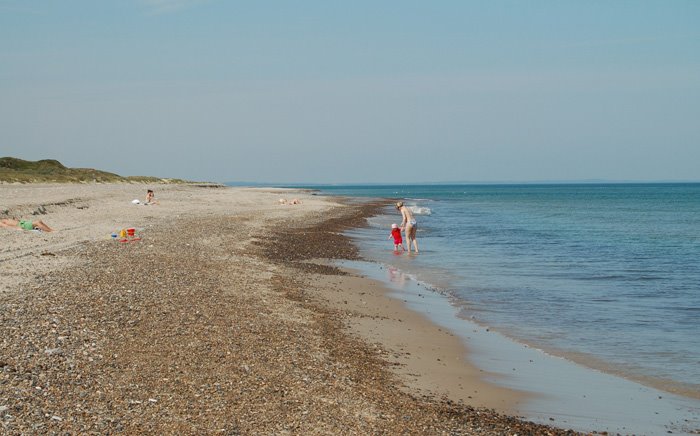
Klitmøller has a fine bathing beach and high white dunes. The western wind has formed small hollows in the sand creating lovely shelters on a sunny day. After special wind- and stream conditions you can find amber on the beach.
There are fine opportunities for bathing and surfing. The town is often mentioned as The Cold Hawaii, and it is especially in the discipline Waveperformance inside windsurfing and surfing that has exceptional conditions here. Klitmøller hosted the Danish masterships in waveperformance up through the 90s, EM in 1996 and WM in 1998. The relatively new sport kitesurfing has also attracted many practitioners from Denmark and abroad to Klitmøller with the strong wind and the large waves.
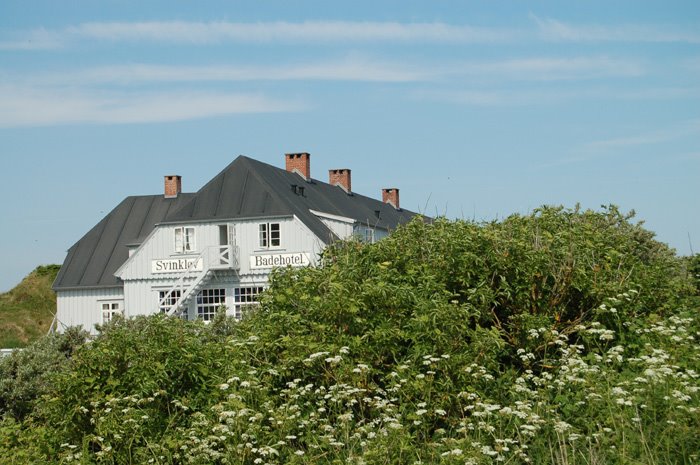
There are good overnight-possibilities, i.e. holiday houses, rooms and authorized camping sites, several restaurants, cafés and grillbars, mostly open in the summer season. Each year in the first week-end of June is the summer feast celebrated.


Earlier was Klitmøller a landing place for the coast fishing boats. The boats were pulled up and out with a winch. The landing place is still preserved and the fishing continues from small dinghys. Each day, when the weather allows it, the small boats come in with various fish, lobsters and crab's claws, the local delicatesse. For sports fishers are good opportunites for catching fish from the fishing cutters in Vorupør and Hanstholm or from the shelter-mole in Nørre Vorupør.

 Nors Sø, a fine area with osprey and lots of geese and other birds and a varied flora.
 The name Klitmøller origins from the 1600s, where 3 mills were placed close to the North Sea, surrounded by dunes. The mills were used for corn grinding, and the corn exported to Norway in special flat-bottomed boats, which could be drawn up on the sand. The boats came back with timber from Norway. At that time Klitmøller was the most important trading town in the area. Several boat captains grew immensely rich. Some of the success was caused by that Agger Tange was closed - it was impossible to sail into Limfjorden. This boat trade went on at several plaes along the north western coast of Jutland, but Klitmøller was the most important trading place. The town had its great period between 1600 and 1819, but it lost its central importance, when the North Sea broke through Agger Tange, making the passage free for sailing. The lifeboat station in Klitmøller was established in 1847 and abandoned in 1979. From 1852 till 1954 were 57 rescues and 543 people were saved.
In the sand dunes by town are i.e. lyme grass, heather, crowberry, sea holly and marsh-gentian, which is also found in the dune-heaths. Upon the heath breed i.e. the sandpiper and the crane. To the east are great coniferous plantations with two large lakes Vester Vandet Sø and Nors Sø.
new biking route
A photo collection from the area:
heather and honeysuckle (click to enlarge the small photos)


Lotus and bell heather with a red Admiral


Family at the beach and sweet gale


Kestrel and knotweed in a small lake with no name


Scabiosa and Peacock butterfly


Tømmerby church and a fishing village


chessboard Hillerslev church and forest after fire in dry summer


Common Blue and lovely horses


sea holly and small lake in the dunes


The nature in the nationalpark in Thy is so rich, and it is a joy just to take a walk there from one of the many parking places in the area. In many places are maps to inform people what is special exactly here as to flora and fauna, but also maps of biking and hiking routes etc.
Never give up without a fight!


It was exciting to see how the surfers fought the waves. I have never tried surfing, but it must be difficult just to get on the surfboard. This guy went on and on like the other surfers, and at last he succeeded in flying across the water. It looks so amazing - and it must be a wonderful feeling.

Hanstholm light tower
photos Thy August 2007: grethe bachmann


 T
T


