Showing posts with label flora. Show all posts

Monday, February 26, 2018

The Month of March - Daffodils and Birthstones

March is the first month of spring in the Northern Hemisphere (North America, Europe, Asia and part of Africa) and the first month of fall or autumn in the Southern Hemisphere (South America, part of Africa, and Oceania). Birthstones of March are Aquamarine and Bloodstone /Heliotrope.

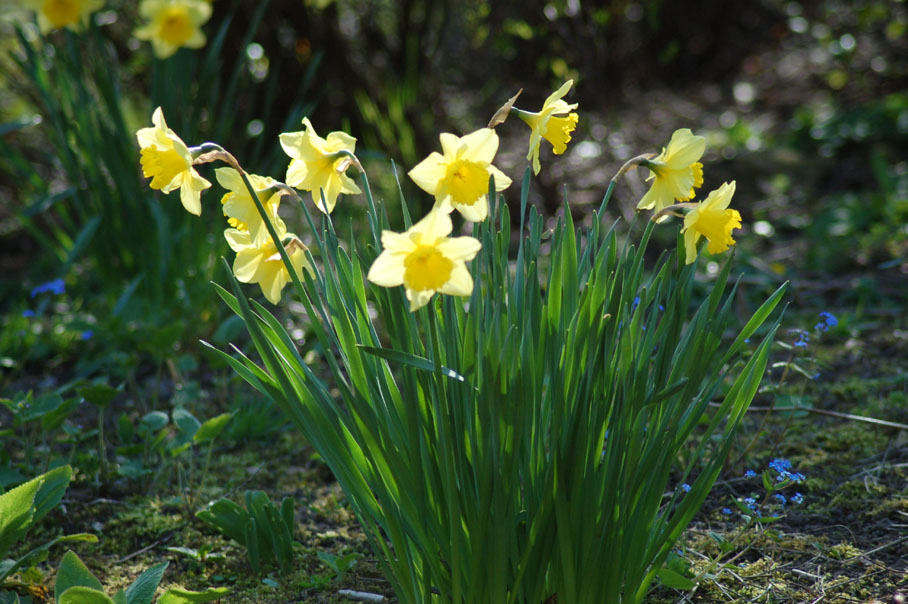
Flower emblem of March is Daffodil.  

Daffodils, Mindepark, Aarhus/GB
The Danish name Paaskelilje refers directly to Easter, and it is impossible to imagine a Danish Easter without bundles of those pretty yellow flowers as a decoration in the house together with the Easter eggs and all the other traditional Easter decorations. The name Narcissus is mostly connected to the legend about the youth in Greek mythology who became so obsessed by his own reflection that he kneeled and gazed into a pool of water until he fell into the water and drowned. The legend says further that the Narcissus plant first sprang from where he died. Narcissus is the botanic name and there are many variations. The common English name Daffodil is sometimes used for all varieties. The Narcissus was listed as a medicinal herb in 'De Medicina' by the physician Aulus Cornelius Celsus, who said that 'it was powerful to disperse whatever has collected in any part of the body'.


Birthstones of March:

  • Aquamarine/Beryl
    Aquamarine (from Latin: aqua marina = water of the sea/ referring to its sparkling ocean colour. It is a blue or cyan variety of beryl. The gem-gravel placer deposits of Sri Lanka contain aquamarine. The deep blue version of aquamarine is called maxixe. Maxixe is commonly found in the country of Madagascar. Its color fades to white when exposed to sunlight or is subjected to heat treatment, though the color returns with irradiation. Aquamarine is in several localities in USA, Brasil and in Africa. The largest aquamarine of gemstone quality ever mined was found in Marambaia, Minas Gerais, Brazil, in 1910. It weighed over 110 kg (240 lb), and its dimensions were 48.5 cm (19 in) long and 42 cm (17 in) in diameter. The largest cut aquamarine gem is the Dom Pedro aquamarine, now housed in the Smithsonians institutions National Museum of National History.

    Facetted Aquamarine, wikipedia.
    Aquamarine evokes the purity of crystalline waters, and the exhilaration and relaxation of the sea. It is calming, soothing, and cleansing, and inspires truth, trust and letting go. In ancient lore, Aquamarine was believed to be the treasure of mermaids, and was used by sailors as a talisman of good luck, fearlessness and protection. It was also considered a stone of eternal youth and happiness. Today it protects all who travel by, over, or near water, and opens the channels of clear and heartfelt communication.

    Art Deco  Aquamarine ring,1920s (Pinterest)
    Ancient seer considered it to be under the influence of the moon, an orb exerting very great magnetic influence. Present day supporters of crystal-gazing suggest that when using an Aquamarine to view coming events, do so when the moon is increasing. The magnetism of the moon on the included iron oxides will strengthen the stone's forecasting ability.Aquamarine embodies all things connected to the sea, as well as those things relating to Heaven reflected on the surface of the water. It becomes a mirror, reflecting itself indefinitely, making it possible to discover hidden meanings of reality. As a stone of symmetries, it is conducive for meditation and revelation, a stone of prophets, shamans, healers, and mystics. It also allows us to explore the darkest depths of our souls, face to face with ourselves, and with other


    Aquamarine is the blue variety of Beryl, though the Beryl family forms in other colors used as gems, such as green Emerald, yellow Heliodor and Golden Beryl, pink Morganite, Red Beryl or Bixbite, and the colorless variety, Goshenite.


    bloodstone/wikipedia
    The mineral aggregate Heliotrope,  also known as Bloodstone , is a variety of jasper or chalcedony. The "classic" bloodstone is green jasper (chalcedony) with red inclusions of hematite. The red inclusions are supposed to resemble spots of blood; hence the name "bloodstone". The name "heliotrope" derives from various ancient notions about the manner in which the mineral reflects light. Heliotrope was called "stone of Babylon" by Albert the Great and he referred to several magical properties, which were attributed to it from Late Antiquity. Pliny the Elder (1st century) mentioned first that the magicians used it as a stone of invisibility. Damigeron (4th century) wrote about its property to make rain, solar eclipse and its special virtue in divination and preserving health and youth. Heliotrope features as an invisibility stone in one of Boccacio's stpries in the Decameron and as a healing magic item in a musical comedy derived from it. Heliotrope is sometimes used in carved signet rings and is the traditional birthstone for March.

    In the Middle Ages, bloodstones were associated with the crucifixion of Christ. According to the legend, when Christ was crucified, blood dripped onto the green ground, and this red-green stone was formed.  Greeks and Romans wore Bloodstones during athletic games to increase their strength and endurance. They are most commonly sourced from India, but can also be found in places like Brazil, China and Australia. Bloodstone is a good birthday gift for someone who would value a reminder of their strength.

Thursday, September 14, 2017

European Birthwort/ Hjertebladet Slangerod

Aristolochia clematitis


European Birthwort 1885/ wikipedia
The (European) birthwort, (DK: Hjertebladet Slangerod)  is a twining herbaceous plant in the Aristolochiae family, which is native to Europe. The leaves are heart-shaped and the (carrion smelling) pale yellow flowers are tubular in form. The plant seeks light by ascending the stems of surrounding plants. It is connected to light-open habitats with dry and warm soil which has a high contents of nutrients and calcium. In Denmark it is cultivated in gardens and parks and is sometimes seen growing wild, especially at kloster sites and castle ruins. Autumn colour yellow-brown.


European birthwort/wikipedia
The name Aristolochia comes from the Greek word aristos which means best and lochia which means birth. The plant was known in the classical antiquity to start births . The Danish name slangerod refers to its use against snake bites.

Folk Medicine 
Birthwort was used in a decoct which was drunk as a sweat- and diuretic means; a decoct was also drunk against against jaundice and leaves and roots for healing wounds. The plant contains a substance which activated the white blood cells.  The root was stuck in the abdomen to promote birth.


Because of similarity to slangeurt (Polygonum bistorta) and corydalis (lærkespore) it is in early literature difficult to identify the botanic species.


Kloster garden(/ photo: GB
Harpestræng ab. 1300:
The physicians often distinguished between the drugs Aristolochia longa (DK: lang hulurt) and Aristolochia rotunda ( DK: rund hulurt) and Aristolochia clematitis (European birthwort/hjertebladet slangerod.)
A. rotunda: to drink with wine after poisonous bite; it drives out the afterbirth; to drink with water for cough; crushed as a cover on gouts; mixed with honey as a wound healing cover; to drink for fever; used as a smoking against insanity.

Christiern Pedersen 1533:
crushed plant to drink with wine or beer for breast pain; vinegar decoct as a cover for stomach pain; crushed root with wine or beer against malaria , to drink with wine after snake bite.
Henrik Smid 1546:
cooked with myrrha and pepper in wine for drink to drive out the afterbirth and all filthiness; wine decoct cleans and heals all internal wounds and broken lungs, liver and uterus; fresh crushed root used as cover drives out thorns, arrows etc. from wounds and heals it. A. rotunda to drink with wine against the plague, drives out sweat and urine and counteracts jaundice; crushed seeds with a drink against diarrhea.  Barbers used the root to heal and dry all runny wounds.
Simon Paulli 1648:
root to make the flesh grow after abscesses; the root is good for itching and scabies; decoct of leaves and roots for bathing mange and wounds on hands and feet. Some say the leaves should be smoked under newborn babies if they looked fragile and sick.

The rootstock of Aristolochia longa and Aristolochia rotunda were written into the Pharmacopoeia in 1772. 

Livestock: the plant was also used in diseases of the livestock: cattle, horse, swine, sheep and poultry.

Superstition 
The plant was revered by ancient healing book- authors who recommended it against snake bites.  Having a root in the pocket as an amulet against toothache.


European Birthwort/ wikipedia
Poisonous Plant:
It was formerly used as a medicinal plant, though it is poisonous , and is now occasionally found established outside of its native range as a relic of cultivation. It is now thought to be the cause of thousands of kidney failures in Romania, Bulgaria, Serbia, Bosnia and Herzegovina and Croatia where the plant is thought to be unintentionally consumed through contaminated flour. Urinary tract malignacies among those who have consumed the plant are also reported. The link between renal failure and aristolochid acid, which the plant contains, was discovered after a clinic for obesity in Belgium, some of the patients experienced kidney failure.


NB:
Because of its toxicity it must be warned to use the plant or parts of it as a natural medicine.

All parts of the plant are considered carcinogenic (kræftfremkaldende) and kidney damaging. 


Source:
Danske Klosterurter, Anemette Olesen, Aschehoug 2001. 
Brøndegaard, Dansk Etnobotanik, Folk og flora, bd. 3, 1978-80.


Thursday, June 09, 2016

European Honeysuckle (Woodbine) / Vild Kaprifolium (Gedeblad)


Lonicera periclymenum
The name after the genus Lonicera was given to the honeysuckle family by Carl Linneaeus (1707-78), the Swedish botanish, with honour of the German botanist Adam Loncer (1528-86). There are about 180 species of Lonicera. The Common honeysuckle (Danish: Vild Kaprifolie) has creamy white or yellowish flowers and red berries. The plant is usually pollinated by moths or long-tongued bees and develops bright red berries. Many of the species have sweetly-scented bell-shaped flowers that produce a sweet edible nectar. The powerful aroma attracts bees, moths, humming-bees and butterflies to its sweet nectar. Some lepidoptera species feed on honeysuckle. Some Loniceras have poisonous yellow or black berries.
Svinkløv Strand, North West Jutland photo: gb

woodbine on willow caused by Lonicera
Honeysuckle is a deciduous liana which together with ivory is the liana of the forest, twining around bushes and trees - but honeysuckle is in all its pretty variations popular in the garden for its sweet scent and it is great for covering fences and garden arches because of its fast growing - and it combines well with clematis. Other names for honeysuckle include woodbine, fairy trumpets, honeybind, trumpet flowers, goats leaf and sweet suckle. The old name woodbine describes the twisting binding nature of the honeysuckle through the hedgerows. 


Typical twining of Lonicera (wikipedia)
L. periclymenum is one of several honeysuckle species valued in the garden, for its ability to twine around other plants, or to cover unsightly walls or outbuildings; and for the intense fragrance of its profuse flowers in summer. It needs to be planted with its roots in the shade, and its flowering top in sun or light shade. Plants need to be chosen with care as they can grow to a substantial size. Growing to 7 m (23 ft) or more in height, it is a vigorous evergreen twining climber. It is found as far north as southern Norway and Sweden. In the UK it is one of two native honeysuckles, the other being Lonicera xylosteum It is often found in woodland or in hedgerows or scrubland.

The tough wood has been used for walking sticks and pipe stems. The charcoal was used for gun powder. The dried flowers are used for adding to pot-pourri, herb-pillows and floral waters. Scented cosmetics are made from the fresh flowers. The flowers can also be used in lemonade, decoration in desserts an pastry.

Lonicera on tree, wikipedia.
Honeysuckle (woodbine)  has been a valued part of Britain's ecology for centuries. It is mentioned by Shakespeare:
"I know a bank where the wild thyme blows,
Where oxclips and the nodding violet grows,
Quite over-canopied with luscious woodbine,
With sweet musk-roses and with eglantine
British rock band Dire Straits mentions Honeysuckle in the opening lines of their 1980 song " Expresso Love":
"She gets the sun in the daytime
Perfume in the dusk
And she comes out in the night time
With a honeysuckle musk"
The plant was voted the County flower of Warwickshire in 2002 following a poll by the wild plant conservation charity Plantlife.


Medicinal use in the Middle Ages:
red berries, Lonicera (wikipedia)
Culpeper stated that only the leaves of the honeysuckle were used medicinal to treat coughs, sore throat and for opening obstruction of the liver and spleen. Honeysuckle can be found in a Chinese herbal which is the earliest known existing pharmacopoeia written in AD 659. The Chinese used honeysuckle japonica as a cleanser and for removing poisons from the body.

Legend and Superstition
Honeysuckle has long been a symbol of fidelity and affection and there is much superstition attached to it. In Scotland it was believed that if honeysuckle grows around the entrance to the house it would prevent a witch from entering. It was also a promise of money. According to old superstition people had to put the first flower of a honeysuckle in the purse then it would never be empty -and if people brought the flower into their house then it would bring money to them.
There was also a promise to the garden people that if honeysuckle grew well in their garden they would be protected from evil.

In Victorian era there was a ban on young girls bringing honeysuckle into the house because it was believed to cause dreams that were far to risqué for their sensibilities.

photo 2008: grethe bachmann, Svinkløv, North Jutland
photo: wikipedia

Saturday, October 24, 2015

Fine-leaved Vetch / Langklaset Vikke


Fine-leaved Vetch / Langklaset Vikke


Vicia tenuifolia 


In Denmark: 
Fine-leaved Vetch / Langklaset Vikke is native and first of all registered in the Danish Isles  At Funen at Hindsholm, at Zealand along the coast of Storebælt, the inside of Isefjord and Roskildefjord and at the island Møn. (Jessen 1931)


Fine-leaved Vetch has still a main occurrence area in the northeast of Funen, Northwest Zealand, Stevns and East Møn. Also some sporadic discoveries in Jutland and at the island Falster. 
(Christiansen og Prehn 2009, Faurholdt 2006, Næsborg et al. 2001, Tranberg et al. 2002, 2003, 2005, 2007, 2009) and at Bornholm, where it was observed in 1985. (P. Wind pers.obs. 1985).

There are no informations about the population-development  of Fine-leaved Vetch/ Langklaset Vikke. The species is possibly vaguely declining .  It seems that it tolerates mowing in light-open facilities. (Næsborg et al 2001). It is able to spread secondary to culture-affected soil in edge of ditches, at railway slopes, in cultures with greenery and edges of roads. (Faurholdt 2006, Hansen, A. 1977, 1981, 1982, Lyshede 2004):

Fine-leaved Vetch /Langklaset Vikke is native to most of Europe and the northwestern part of Africa. The spread of the species reaches the Caucasus to the east and the central part of Asia. The northern limit of its distribution is the middle part of Sweden  (Hultén og Fries 1986) (.Christiansen og Prehn 2009, Faurholdt 2006, Hansen, A. 1977, 1979, 1981, 1982, Hansen, K. 1981, Hultén og Fries 1986, Jessen 1931, Lyshede 2004, Næsborg et al. 2001, Tranberg et al. 2002, 2003, 2005, 2007, 2009, Tutin et al. 1964-1980).


Source: Fagdatacenter, Biodiversitet og Terrestrisk Natur, for Den Danske Rødliste , Roskilde. 

 photo: grethe bachmann


View from the habitat Høvblege, (Møn) to the Baltic Sea.


Short summary  from Wikipedia
Vicia is a genus of about 140 species of flowering plants commonly known as vetches. It is in the legume family (Fabaceae). Member species are native to Europe, North America, South America, Asia and Africa. ( subfamily see Vicia, wikipedia) 
(...)
Fine-leaved Vetch is an established scrambling perennial, known only from Breadsall Cutting (SK3839). It was first discovered in 1979 and was still present in 1997. It is introduced to England from central and southern Europe as a grain contaminant.
A perennial herb occasionally found naturalised on grassy banks, verges and waste ground, especially by railways. It is often introduced as a contaminant of grain. Lowland.

photo: grethe bachmann 


Tuesday, October 06, 2015

Devil's Bit Scabious / Djævelsbid


Succisa pratensis


Devil's bit is common in Denmark, it grows especially in poor and sandy acidophilus with low pH, where it does well among grasses and other perennials and bushes. It is also found in bog-meadows and pastures, in moist heaths and calcareous fens. It is well suited  as a garden perennial for a "wild garden look"  - and is a valuable bee-plant since it is blooming from June into October. . 
It is the main foodplant of the Marsh Fritillary (Euphydryas aurinia), a priority species under the UK Biodiversity Action Plan (UKBAP). The butterfly lays its eggs in large batches and the caterpillars live as a group inside a conspicuous silken web. As both plant and invertebrates are rare, their survival relies on careful management of sites containing these species.

It is distributed throughout the British Isles, western and central Europe, extending eastwards into central Asia. It is absent from eastern Asia and North America.


The bluish or purple flowers are gathered in semicircular heads. The fruits are winged nuts which are spread by the wind. The root of the plant is a short, vertical or a little angled rootstock. Its unlobed leaves distinguish it from  Field Scabious  - and it is distinguished from Greater Knapweed by opposite pairs of leaves contrary to Geater Knapweed's alternate pairs.


Folklore 
The legend about its name is told in various tales. The short black root was in folk tales bitten off by the devil, angry at the plant's ability to cure these ailments, in anger against the Virgin Mary, or as part of some 'devilish plot'. The plant is easy to pull up, if you want to see the off-bitten root.Gerard tells us: "'The greater part of the root seemeth to be bitten away; old fantastick charmers report that the divel did bite it for envie, because it is an herbe that hath so many good vertues and it is so beneficial to mankinde". The legend referred to by Gerard tells how the devil found it in Paradise, but envying the good it might do to the human race, bit away a part of the root to destroy the plant, in spite of which it still flourishes, but with a stumped root. The legend seems to have been very widely spread, for the plant bears this name, not only in England but also on the Continent.


Folk Medicine

Devil's bit Scabious is an old medicinal herb, known since the 4th century. The plant is still used for its diaphoretic, demulcent and febrifuge properties, the whole herb being collected in September and dried. It makes a useful tea for coughs, fevers and internal inflammation. The remedy is generally given in combination with others, the infusion being given in wineglassful doses at frequent intervals.
Species of scabious were used to treat Scabies, and other afflictions of the skin including sores caused by the Bubonic plague.The word scabies comes from the Latin word for "scratch" (scabere).
The root was used against boils, coughs and eye-inflammations The crushed root was used as a cover on shingles. A wine decoction from root and flowers and destilled water was used against diseases.like breast abscesses, cough, and inward diseases. A decoction from the plant against clotted blood and plague.


Culpepper assigned it many uses, saying that the root boiled in wine and drunk was very powerful against the plague and all pestilential diseases, and fevers and poison and bites of venomous creatures, and that "it helpeth also all that are inwardly bruised or outwardly by falls or blows, dissolving the clotted blood,"' the herb or root bruised and outwardly applied, taking away black and blue marks on the skin. He considered "'the decoction of the herb very effectual as a gargle for swollen throat and tonsils, and that the root powdered and taken in drink expels worms."

The root was written into the Pharmacopoeia in 1772.

Livestock
A horse with worm was given decoction from the root. The plant is astringent and the vet used it for cleansing and healing wounds in the horse's hoof. A special cure was to hang the root around the horse's neck in order to heal keratitis = eye infection

Witchcraft
The root was part of a brandy-extraction for humans and livestock, who were being depraved by witchcraft. It was also used in other magic means against witchcraft in cattle, accidents during butter churning, for sick pigs etc. The root was given to horses if there was witchcraft in the stable.


Superstition
Together with other roots like asafoetida, coral stone and a magic formula it was put under the bed sheets against a broken marriage promise, caused by evil people.

Dyeing:
Decoction of the fresh herb dyes wool and yarn green, from the dried herb yellow. The root gives a yellow dye;  the leaves dye green, and they dye black with ferrous sulphate.

At the Faroe islands Devil's bit is used for dyeing green.


photo Tustrup, Djursland, August 2015: grethe bachmann
 Source: Brøndegaard, folk og flora, bd. 4 and Djævelsbid,wikipedia.

Sunday, October 04, 2015

Blackthorn / Slåen


Prunus spinosa

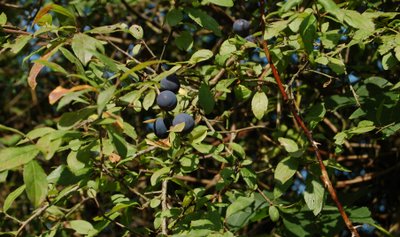
Blackthorn grows at cliffs, embankments along the beach, cleanings on edges of woodland, thicket and fences. It is extensively planted for hedging and a cover for game birds. Some forms are grown for ornament and flowers. The fruit is called sloe, which is similar to a small damson as plum suitable for preserves, but too tart to eat. The berries are best after the first night's frost, but if they are plucked before that period, they can either be pricked by a fork or put in the freezer for a few days. Sloe is used for juice, syrups, jams, jellies, liqueur, wine and snaps.

The foliage is sometimes eaten by larvaes of  Lepidoptera (like the Brown and the Black Hairstreak butterfly). The pocket plum gall is found on the fruit, where it results in an elongated and flattened gall, devoid of a stone.

In the 1700s and 1800s:
It was a common thing in the time after harvest and after the first nigh frost to gather sloe, scold them and eat them. Infusion gave a well-tasting and healthy juice, which people drunk together with porridge instead of milk. The berries cooked with syrup or sugar and fermented on a wooden barrel was popular as a porridge. Sloe-must was made by just pouring cooked water over the berries and let the infusion ferment for 3-4 weeks. Berries crushed with the kernels gave a juice with a spicy taste. After the first night of frost the farmers' wives plucked the sloe-berries in large baskets and made a fine red juice, which was hidden in a barrel until Christmas Evening. The clear light red juice drunk in wine glass and sweetened with sugar was a popular refreshing drink during summer. It tastes a little like red wine, bad red wine was despisingly called "sloe-juice". Beer cooked with the berries makes such a good taste that it is like old red wine. From the flowers were made aqvavit, and the berries were used to clear must. They bring a pleasant taste to beer and a pretty colour, but they can also improve apple-must during the fermentation.

Jam, Cheese and Tea.
The berries preserved with sugar and cinnamon gave jam for a winter salad or a steak sauce, after they had got frost they were put with honey in jars as a jam. In Vendsyssel (North Jutland) were sloe-berries used when preserving pumpkins. If the barch was used when making cheese the cheese wouldn't rotten. The new dried leaves were a good tea, also the dried flowers mixed with strawberry-leaves.


Sloe-Wine and Liqueur

In 1580 the vasal at Kronborg let gather 2-3 barrels of sloe, from which the king's cupbearer made sloe-wine for Frederik II. The wine made by chrushed berries and kernels was very intoxicating and was only served on special occassions. During WWII a wine firm in Odense (at Funen) advertised for sloe-berries. From the fruits are also made a liqueur.
 
Sloe-Gin
In rural Britain a so-called sloe-gin is made from the sloe. It is not a true gin but an infusion of vodka, gin, or neutral spirits with the fruit to produce a liqueur. In Navarre, Spain is a popular liqueur Patxacan made with sloe. Sloe is also excellent for a herbal snaps. From fermented sloes are made wine in Germany and other central European countries. Sloe is also good as jam and if preserved with vinegar, have a similar taste to the Japanese umeboshi.


Folk Medicine:
The juice of sloe was used for stomach pain - and the flowers drawn in warm beer was used for childrens' motions. It was also used to cure tooth-ache, pain in the eyes , blood poisoning, shingles and much more. Physician Christiern Pedersen 1533: crushed leaves and barch used on on shingles. Eyedrops from the pulverized barch in wine. Physician Simon Paulli 1648: berry-juice with beer for stomach problems. Children with constipation had the flowers in warm beer. Vinegar-decoct from the green medium barch was effective against toothache. The flowers in a healing morning drink , destilled water from the flowers for bronchitis, cleaning the body etc. A tea cleansed the blood and was laxative. The barch was used against malaria, the berries gave a healing drink against fevers, and mixed with cherries against diarrhoea. A milk decoct from flowers for a drink or a bath to remove freckles. The fruit juice for sores in the mouth or to rub upon swellings and against nosebleed. In 1772 flowers and fruit were entered into the pharmacopoeia.

Dye:
Unripe berries dye black, the juice of the ripe berries dye pale brown, while the dried berries make wool red. The barch gives with alun a red dye, unripe berries with iron vitriol give a dye like black ink. The unripe berries and the barch were used in tanning.


Other Use:
Blackthorn was recommended for hedges around gardens and fields, in Denmark this is much used especially at Funen. Many loads of cut blackthorn from the hedges were brought home as a fuel for the baking ovens. Before or in the killing season at the farms when sausages were made, the children gathered thorns from sloe, which in the evening were scraped clean , dried upon the oven and eventually burnt in the tips and then used as sausage-sticks; this was a tradition in most parts of the country  (DK) - and the sausage sticks were sold at the market. Boys also used the thorns as arrow-heads. From the wood were made music instruments, it was commonly used in turner-works and for mathematical instruments. From the tough wood were made walking sticks, hammer - and axen handles. During WWII gramophone needles were made from sloe thorns, they gave lesser needle-noise and lesser wear on the records than metal needles.

Blackthorn makes and excellent fire wood that burns slowly with a good heat and little smoke.

Straight blackthorn stems have traditionally been made into walking sticks or clubs (known in Ireland as a shillelagh). In the British Army, blackthorn sticks are carried by commissioned officers of the Royal Irish Regiment; the tradition also occurs in Irish regiments in some Commonwealth countries.

Ink: 
Shlomo yitzhaki, a Talmudist commentator of the High Middle Ages,  writes that the sap (or gum) of P. spinosa (or what he refers to as the prunellier) was used as an ingredient in the making of some inks used for manuscripts.

Fishing: 
A "sloe-thorn worm" used as fishing bait is mentioned in the 15th century work, The Treatyse of Fishing with an Angle, by Juliana Berners.The expression "sloe-eyed" for a person with dark eyes comes from the fruit, and is first attested in A.J.Wilson's novel Vashti.

Making snaps:
Put sloe berries in a glass or bottle with double amount alcohol. Filtration after 2-3 months. There is now a pretty dark red to violet essence, which can be thinned as you like. The berries can be used again together with the crushed stones in a new amount of alcohol to draw for a month or two, which gives a drink with a taste of almond. A sloe snaps gets better and better when stored. It is excellent for herring and cheese. Added honey makes it a snaps for desserts.


text and photo: grethe bachmann

Alder Buckthorn / Almindelig Tørst

  Rhamnus frangula


Rhamnus frangula is a bush, rarely a small tree, with a grey brown barch, oval leaves often pretty red in autumn, small whitish flowers which are hard to see, and small stone fruits, which change colour from green to red and black. It is common in light forests, mostly among oak and alder. The whole plant is poisonous. The bush can transfer kronrust, i.e. plant rust to oats. It has often been confused with bird cherry and alder.


Alder Buckthorn is also known as Arrowwood , Berry-bearing Alder, Black Alder, Black Aldertree, Black dogwood, Buckthorn , Glossy buckthorn. In spite of its name it has no thorns. It grows mostly on damp and peaty soil, near bogs, in marshes, damp moorland and open woodland. It may form part of the shrub layer in the Alderwoods of the fens and in open woodland. It is native of Europe, Central West Asia and North Africa.


NB: Barch and berries are poisonous to humans

Gunpowder
The buckthorn was of major military importance in the 15th-19th century as its wood provided the best quality charcoal for gunpowder manufacture. Both alder buckthorn and common buckthorn (Rhamnus cathartica) were used in fabrication of gunpowder, especially powder for hunting.

The long twigs were traditionally used to make arrows as well as butchers spikes and skewers. The coppiced branches have also been used for walking sticks as well as pea and bean sticks. Along with willow and split alder they have also found use for cane seating and basket work.


Dyeing:

The inner barch dye yellow like saffron, the berries are used for dyeing green in 1686, the barch dyes the wool yellow, the berries dye green, dried barch softened in beech ash lye gives the wool a madder-red colour, green berries make the wool yellow, ripe berries dye greyish, with salpeter blue, with vinegar violet and with bismuth green; if bricks were burnt together with the wood they grow bluish. The barch gives a bronze yellow dye, which after a handling with potash turns into a brick red.

Folk Medicine:
In the Middle Ages a juice was made which could drive out all kinds of bad fluids as well as all other filthiness from the bowels, but since the barch has a very drastic effect (  poisonous) the juice had to be added caraway, anise, cardamom or cinnamon. Juice from the inner yellow barch had a strong laxative effect; the barch cooked with butter or crushed with apples was put on scabies; tea from the innerbarch was used against rash, jaundice and ague(malaria).

The barch was stated in Dansk Farmakopé in 1772, the fresh barch and the fruits were used as an emetic, the dried 'frangulabark' was matured at least one year and was a part of mildly laxative medicines, added malt beer, liqueurs and other dietic drinks.

 NB: The barch and fruit were used as a purgative in the past, though their potentially dangerous violent action and side effects means they are now rarely used.


Bees and butterflies
The flowers are popular with bees and the plant is food plant for the brimstone butterfly.


Other Use: 
The berries were in 1775 mentioned as a means against some horse diseases. The leaves were said to be a good fodder for goats, and if the cows did eat them they gave much milk.(although it is also said that the cattle do not like to eat them because of the thorns). The smell of branches stuck into mole-passages drove away the vermins. The wood was used for inlaid works and shoemaker-pegs, the branches gave a good grip around beer jugs etc. In Vendsyssel (North Jutland) the branches were bound around vessels, and baskets were plaited from the split branches etc. The branches were baked in front of the oven to soften them and then straighten them out into walking sticks. Charcoal from this wood was the best for hunting powder, in 1895 a forest cultivation was recommended for this - from Mårum Skovdistrikt were sold logs and branches for the army's powder work in Frederiksværk.


Text and photo: grethe bachmann
Source: Folk og flora, Dansk Etnobotanik 3, V.J. Brøndegaard 1979.


Elder / Hyld

Sambucus nigra


Elder or elderberry is native to most of Europe, northwest Africa and southwest Asia. It is commonly named elder or elderberry, but has got many other names like Black elder, European elder/elderberry, Elder Bush etc. The Latin Sambucus is a Greek word for instrument, and nigra means black in Latin, black like the elder berries. It grows in a variety of conditions , it stands shadow, frost, salt and wind well. The leaves and the bark contain bitter substances, but not as much as the related red-berried elder. The whole elder bush except the flowers and the berries is poisonous.

The plant was possibly introduced to Denmark in prehistoric time. It is common all over the country, but grows especially at houses, in fences, edge of woods, as underwood etc. It has been in Denmark since Ertebøllekulturen, a Stone Age culture between 5000-3000 B.C.. About 300 years ago the elder grew in big numbers all over the Danish country, especially in villages, upon church yards, at fences, in cabbage gardens and in hop gardens etc.The ripe berries are very sought after by birds, and today the elder has spread by the help of birds up to the northern part of Sweden and in Norway up to the Polar circle.
.


Elderberry is an old medicinal plant. Also prehistoric people, the Egypts, the Greeks, the Romans used the elder as a medicinal plant. Dekokt from the flowers was supposed to be antipyretic and diaforetic, and the berries were used to relieve cold and flue. The leaves, flowers, branches, roots, bark, berries were used to heal many diseases like earache, headache, deafness, boils, indigestions, heart pain etc.


But also in the kitchen is elderberry good. The flowers are used in the popular elderberry-drink, and they taste well when dipped in a thin pastry, fried and sprinkled with sugar. The berries are used in juice and soups. They have a very high content of A- and C vitamin. Several things: tea from the dried flowers; wine and snaps of berries and flowers; put the berries in sugar and eat them like red-currants; the green berries in vinegar and sugar make fine capers. The flowers have also been used in perfume.


Mosquitoes.
If you rub elder-leaves against your skin it is said to keep mosquitos away, or if you carry a fresh branch or stand under an elder-bush! The berries should have the same effect, and you can use them as an insect repellant, if you like the colour purple!

The Garden:
Some gardeners use a strong elder extract as a means against plant diseases. It is considered effective especially against fungal diseases in fruit trees and  against aphids. It is also good as an addition in the compost heap and active  against caterpillars in seed plants. 


Poisonous substance:
All kinds of Sambucus contain a poisonous substance:Samburigin (cyanoglykocid) in leaves and in the unripe fruits. The druehyld is the most poisonous but its poisonous effect is limited to stomachache. In the past the sambucus was used  as a vomiting means . The seeds in all sambucus contain  a resin which gives dizziness and is diuretic , but the resin is destroyed by cooking.


The elder was called the Poor Man's Tree, the elder had no homestead - and yet it belonged everywhere.

Below material from V.J.Brøndegaards Danish work "Folk og Flora" bd. 4

Use of elder branches, wood, marrow:
The elder was the favourite tree of all foresters, it was used as hedgerows around the new-planted woods. In Jutland, especially in West Jutland elder was planted as hedgerows in the fields and around the dunghill in order to give shadow, so the sun did not dry out the power of the manure.
Branches were used for wicket sticks and for fuel. The wood was used to make spoons, shoe plugs pipe tubes, truncheons, spinning wheels, reels, looms, yarn reels, rules, meter rules, handles, fishing needles, and young shots were used for enemas. In Svendborg (Funen) was found a spoon from the 1200-1300s, made of elder wood.The wood gave good charcoal and from the ashes was made potash.
Furniture made of elder wood  did not get worm-eaten
People used a "blowing pipe", (made from a stick where the marrow was removed) to blow the fire in the morning on the embers in the fireplace.
The fodder for the bees was placed in an out-marrowed elder stick. Upon the island Agersø people smoked herring with green leaves of elder or ash. The marrow was also used for polishing optic lenses and for electrical experiments.

Use of elder berry, leaves, flowers:
The juice was commonly used, and no farmer's wife or house wife did not know how to cook the berries or have som house depot in case of need.
People went out in the countryside with baskets, gathering berries for sale, they were sold in shops and on market places for the juice making. (1875)  Upon Copenhagen's marketplace was in 1967 sold 160.380 kilo elderberries
From the berries was also made a snaps (1890).In july 1603 the Danish queen was delivered elder flowers, strawberries and red roses for having made akvavite.
Juice and sugar in snaps gave a  "redwine-toddy". Elder tea was made from dried flowers. Old people drank each night a cup of elder tea in order to keep themselves healthy. The tea was sweetened with syrup. It might be spiced with cinnamon, mint or yarrow. In winter season elder tea was often used instead of coffee (1880-90). The coffee was sweetened with elderberry syrup.
The flowers gave a spiced elder vine. Apples and pears get a taste like muscatelwine if they for some time have been placed among elder flowers.The fruits gave an elder wine and the seeds an oil (ab. 1800).
Elder-puré = cooked juice + honey on bread instead of butter (1809) . The berries were dried in the oven or in the sun and saved for elderberry soup. Young green leaves were used in cabbage soup and omelet (1920) Dried or sugar-cooked elderberries = currants. Green pickled berries were used as  capers. The flowers were baked in the panncakes.


Playthings:
Elder-guns: the marrow was removed or being burnt out with a thin iron stick so a piece of a branch made a pipe Small bullets made of paper, yarn, potatopieces, or marrow were pressed down with a loading-stick into the pipe in the opening.
Some boys made very long elder guns. A farmer at the island Fanø paid a boy 4 skilling to shoot against the priest while he was preaching in the church, but the boy hit the dove in the sounding board above his head instead.

Folk Medicine
Henrik Harpestræng ab. 1300: Elder gives vomit. Cooked leaves or oil from elder heal mange and blisters - open and clean wounds, ease earache.
1400s: bark and berries crushed with vinegar used as a cover for head pain, the juice from the seeds to drip in the ear against deafness and earache. Beer decoct from bark against constipation, the juice from the root against dropsy. 
Christian Pedersen 1533: destilled flower-water was a part of an advice against headache,  flowers or leaves cooked in beer for spleen disease, 
Henrik Smid 1546 the cooked berry juice was a good antidote and was used against inner swellings  and all poisonous fluids which came with the sweat. 
Simon Paulli 1648:  linen with destilled elder-water or a decoct of a red cow's milch to put upon the skin disease erysipelas (red skin). 

The elder bark, buds, flowers and berries were specified in the Pharmacopoeia  in 1772, the berries up till 1948.

The elder syrup was one of the farmers most popular universal means (except snaps) ( 1770).
Elder puré cooked with berry juice + honey works sudorific, dissolving, laxative etc.
No farmer must forget to have this medicin, which he can easily make himself. (1800)
Where someone has an elder and a beehive in the garden the doctor need not to come.
The elder was like a home pharmacy to the farmer.

The physician Th Bartolin 1616-80 adviced the pesasants to drink a decoct from  young elder leaves against dropsy..
The peasants drank ( 1798) the juice from the fresh root.
Oil mixed with elder in wine was used against fatigue.
Elder flowers were a part of a means against blatterstone (1720).
The bark eased all stomach ulcers.
Smoke from henbane-seeds was lead through an elder-stick to the bad tooth.
A spice-bag with dried elder flowers upon the cheek. 
Cure against malaria:
Elder tea with camphor drops..
The patient had to eat the first elder spring-shots of the year.
Tea from the flowers counteracts fever attacks.(1800)
Elder tea with egg yolk is a good sweating cure against fever diseases. 
Various diseases:
Elder tea with honey eases cough and pain in the breast.
People bathed running eyes with a milch decoct from the flowers.
Poultice against haemorroids ,  flowers soaked in vinegar against thick knees.
A balm of fresh flowers mixed in lard or vaseline bound upon scalding or burns (ab. 1800) - or upon chronic wounds. It was a good cure to bath pimples with elder-flower water added rum or brandy.
Tea from elder flowers mixed with lard was a fine beauty means in 1900.
Green elder leaves against swellings, abscesses, felon, (the upperside of the leaves draws out the inflammation, the underside heals the wound.) 
Adderbite:  bind elder leaves and mustard upon the bite.
A balm of the green middle bark cooked or fried with thick cream and rubbed or put upon open wounds or impetigo, throat-abscesses and excema on children's head, on their felon and ringworm
Smear oatmeal and goose-shit upon swelling after forgiftning. and with swine-lard upon bone-infection. A wise man blew through an elder stick upon ringworm


Livestock
Elder leaves were used against the horse-jaundice and elder tea against horse-hives. Elder syrup was used against cattle plague (1745) . A good cure was to bath the cow's teeth, mouth and tongue with tea of elder and camomile flower and sage, added honey and saltpeter (1750). Elder + butter healed wounds and fissures on the cow's udder.
Berry juice was the ingredience in a cake for sheep's cough (1632) . Dried and crushed berries with salt against the sheep's liver fluke and tea of elder leaves for lamb with tetanus.
Chicken could get sick by eating the green berries.

Vermits 
In most parts of Denmark people put the new leaves and/or the debarked branches down in the passages of the moles. The moles would flee because they didn't like the smell. (1800)
In harvest-time the farmer put a green elder branch on each corner of the barn in order to keep mice and rats away from the corn.
The crickets could not survive in a room  warmed up by elder wood (1761) - and the smoke from fresh leaves and branches upon a brazier drove them out. .
People put elder leaves in their  button-holes to keep away the mosquitoes. Concentrated elderwater was recommended for rubbing the skin against mosquitoes (1907).
Elder branches put by the entrance of the house drove away flies from house and stable. Leaves were spread upon the floor against bedbugs and put into the bed as a protection against pests. 
Elder juice mixed with lard = a balm which protected the horse against insects. The top of the branches were the part of a decoct which was used to bath the cattle against flies.
The elder was a popular bush by the living house because it kept away moths . Little bags with dried flowers put among the clothes could drive away moths. (1880)

Desinfection
Barrels and vessels which smelled moldy had to be rubbed with a handfull of fresh-plucked leaves from elder or blackcurrants. (1880)
If the milch in the summer-time got a bluestained surface the vessel had to be rubbed inside with green elder leaves.

Dyeing
Elder branches and leaves give a green/brown colour,especially for saddles. The bark dyes bismuth-treated wool bluegrey, the linen stained with alum and cooked with the berries and verdigris gets yellowbrown. The berry juice makes paper purple and snaps reddish or bloodred.

Omens

If an elder grows up by the house it means good luck.
If an elder is blooming twice in a year or in winter it is an omen that a death will happen in the owner's family
When the elder berries are ripening the chicken begin to drop their feathers.
If the elderflowers send out an extraordinary strong scent it  will be rain or thunder.
When the cat tears the elder tree it will be rain. 

Prophecies.
There are many alike prophecies about the elder.tree growing by a church. When it is so big that it is possible to bind a horse by the tree a king will arrrive upon a white horse. He will bind the horse by the elder tree and go into the church. Or:  Two kings will meet and bind their horses by the elder tree. They have come to  negotiate about peace.
King Magnus and his men are sleeping under the elder tree but if Denmark is in need they will wake up and come to rescue the country.

Legends and myths.
The elder is often gnarled and crippled. It was said that Judas Iscariot hang himself in the elder tree. Upon the elder grows the fungus Jew's ear (In Denmark called Judasøre)
An elder with branches like human fingers like the fingers of a murderer grew up from the grave of a  a murdered shepherdess in a village south of the town Tønder (Jutland).The tree was removed in 1930. An elder upon Helnæs (Funen) could not be removed. It grew up again. According to a legend a child was killed and buried here.There was supposedly a treasure under an elder by the village Tanderup (island Samsoe). People had seen light there in the night. East of the island Omø people can see a green elder on the bottom of the sea in clear weather.


Superstition:
A Jutland saying: "No man can live where the elder cannot grow."
It was a common belief that an elder must not be removed or destroyed. Then bad luck would really hit the family, but they could bring the bad luck to and end by wetting the stub with milch. This was done even as late as 1924 in a village at Zealand.
If  a man removed an elder without first having said a prayer he would have bad luck with his domestic animals. It was considered  a neccesity that an elder bush grew upon each giant grave hill. No one can say why but this rule was followed in many places all over the country. It was dangerous to remove it from the hill. After having removed an elder tree upon a giant grave hill in a village on Funen and brought it home as fuel, the owner's farm was harrassed by ghosts and his cattle died . So he brought the elder root back to the hill and planted it.
In a farm in North Jutland the chicken were bewitched and could not lay eggs. A wise man let cut two elder sticks which he marked in a certain way and placed as a cross under the roof of the hen house - This helped.
The farmer planted the elder outside the stable door and hoped thereby  to prevent the witches to reign inside.

Sickness placed inside the elder.
It was considered possible to place a sickness inside the tree by the help of a nail.. A wise man put in this way  the sickness of a boy (rakitis) into the elder tree. Still in 1885 were used warnings against coming close to a lonely placed elder tree, which might have been implanted with sickness.
"He who draws out the nail gets the disease". said people. This was still a belief in 1937 ( Schleswig).
Children who were playing near the elder were warned not to remove plugs from the tree.
A wise man from Funen  made a cut in a branch for each wort of a patient and rubbed blood from the patient into the cuts  In this way the man got rid of 37 worts.
People had to take care not to come close or damage certain elder trees since they risced to get the sickness which had been put into them. It was also dangerous just to urinate on the tree.
A wise woman in the village Asminderød lead the patient through an opening made of together-bound elder branches.

Gout
An advice from the superstition section: "Thursday evening after sunset, cut nail-pieces from hands and feet, rub them in a cloth from the patient's shirt and put them in a quill pen , which is stuck the same evening in a one year elder shot ,which is stuck into the earth where three field-borders meet, while saying the words: "Now my gout is buried and dead like God's son was buried without pain - (he crosses himself three times) - Amen!" This is a story from the town Kolding, Jutland.
A child with rakitis must stand in a digged hole under an elder while a wise woman treats him,  some of the out-digged soil is poured over his head. (Bakkebølle,Zealand).Or the child's clothes were put into the hole and milch from a darkred cow. poured over it. Next morning the child had to put on the clothes.

Toothache
An often mentioned advice against toothache was to cut the tooth into blood with a splint of elder and put the splint back under the bark. If the bark and the wood grew together the toothache would disappear, but it all had to happen in secrecy.
An elder in a wise wife's garden was still in the garden long after her death. No one dared to remove it in fear of getting a toothache or some other disease

Malaria:
Bark of elder and 8 other trees put on snaps, which is being hid under the elder-roots - but also been drunk.

The Elder people 
In the old days people believed that hyldefolk (the elder-people) lived at the foot of the elder bush. They called out for people in moonlit summer nights, and if you went to sleep under the elder, you would be "elder-shot", spellbound and mad. People also thought that the strong aroma of the elder could scare away trolls and other evil creatures. It was said that the goddess Freja lived in the elderberry bush; she protected people from evil, therefore it was necessary to care take care of the elder bush; if you cut down the elder outside your house without planting a new one, then all kinds of misfortune would hit you
People might get sick by felling an old elder which might grow upon the home of the underearth people (1798)
As far as the shadows of the elder reach is the home of the unearthly.
There were seen small pixies under an elder tree at Femø island  in 1860. The elder wife lived in giant hills or under the elder trees.The elder people spread sand and swept nicely around the elder tree in the garden by Ørslevkloster in North Jutland.
By an old elder the horses became frightened in the evening. In this place the Black Wife was seen.
People had great respect for an elder bush by a house near Roskilde: Strange sounds were heard from it and two creatures were seen nearby.
A sorcerer said: As long as the elder gives shadow to the bedchamber window there will not be born disfigured children in the house.
It was said that one could learn to do magic under an elder tree.


Elder Mother /Hyldemor
                                                                               In a German story from 1691 about heathen religion a priest from Åbenrå(Jutland)  told that he in his younger days (ab. 1670) often had seen people kneel and bare their heads and say a prayer with folded hands by the elder tree. They wanted to be allowed to fell "Madame Elder" and said: "Give me some of your wood, then I shall give you some of it back when it grows in the forest".
This precaution is known from many later records: People must not make furniture or tools from the elder,  the elder was Elder Mother's property. Before it was removed they had to promise to plant a new elder, and what had not been used from the elder had to be digged down under the new elder in order to reconcile it.
Below an elder people could be hit by the elder people ("elder shot", 1700) People said: " He has been under an elder" = he was mad or intoxicated. .
The peasants dared not cut the elder until they had asked for permission and then they spit three times as if they would drive away the evil trolls (1772).
In warm moonlit nights the spirit of the elder people cries on people and they must not answer for then the spirit would get power over them.
In 1757 it was told that people planted elder everywhere. This was a kind of heathen ancient rest of a religion. The almue worshipped the goddess Hikti (still in 1819). The Elder Mother is mentioned, she took revenge of all damage. It was told about a man who suddenly died that he had felled an elder. This was still a talk among people in Nyboder ( Copenhagen) in 1940.


In Denmark elder is named hyld, and the goddess Freja was later known as hyldemor.
H.C. Andersen wrote a lovely fairy tale "Hyldemor": (The Elder Tree Mother)


Summer Elder (Sambucus ebulus)
A young speciman of the common elder must not be mistaken for the close related summer elder which differs by having heavy, cringing rootstocks and almost white or light reddish flowers. Summer elder is also an old medicinal plant with healing qualities, but it requires accurate dosing in order to avoid poisonings. It is therefore not recommended for use.


text and photo: grethe bachmann