Showing posts with label snaps. Show all posts

Tuesday, August 01, 2017

Dill / Dild - a useful and pretty spice herb


Anethum graveolens


Dill is an annual herb in the celery family apiaceae, and it is the only species in the genus Anethum. Dill is widely grown in Eurasia where its leaves and seeds are used as a herb or spice for flavouring food. Dill is related to fennel and parsley and its leaves are very similar to fennel. The Danish name Dild comes from a Nordic word meaning pjalt (rag), which might indicate that the plant has a Nordic relation from origin, contrarily to all other spice- and kitchen herbs.

Dill originates from Central Asia and the plant grows wild in the Middle East. It was known in ancient Egypt, and from here it spread to Greece, Rome and the rest of Europe. Today dill is first of all used in northern, middle and eastern Europe while it used to a minimum in the Mediterranean.

Dill grows up to 40–60 cm with slender hollow stems and alternate, finely divided, softly delicate leaves.  The flowers are white to yellow, in small umbels. Fresh and dried dill leaves (sometimes called "dill weed" to distinguish it from dill seed) are widely used as herbs in Europe and Central Asia.

Culinary

Dill is a commonly cultivated spice herb and medical plant. It is a magnificent  culinary spice and also used in tea. The young fresh leaves are used in salads and fish dishes and as a ganiture. Later in summer the ripe dill umbels are used as a spice in fx cucumber pickling. Like caraway, the fernlike leaves of dill are aromatic and are used to flavor many foods such as gravlax (cured salmon) and other fish dishes, borscht and other soups, as well as pickles. Dill is best when used fresh as it loses its flavour rapidly if dried; however, freeze-dried dill leaves retain their flavor relatively well for a few months.

Dill seeds, having a flavor similar to caraway but also resembling that of fresh or dried dill weed, is used as a spice. Dill oil  is extracted from the leaves, stems and seeds of the plant. The oil from the seeds is distilled and used in the manufacturing of soaps.

In central and eastern Europe, Scandinavia, Baltic states, Russia and Finland dill is a popular culinary herb, used in the kitchen along with chives or parsley. Fresh, finely cut dill leaves are used as topping in soups, especially the hot red borscht and the cold borsht mixed with curds, kefir, yoghurt, or sour cream, which is served during hot summer weather and is called okroshka. It is also popular in summer to drink fermented milk (curds, kefir, yoghurt, or buttermilk) mixed with dill (and sometimes other herbs).In Scandinavia dill is a common spice/kitchen herb.


In the same way, prepared dill is used as a topping for boiled potatoes covered with fresh butter – especially in summer when there are so-called "new", or young, potatoes. The dill leaves can be mixed with butter, making a dill butter, which can serve the same purpose.


The etheric oil is used in the perfume industry and in some liqueors.

Folk Medicine


Dill was recommended for breastfeeding women, since it stimulates the milch production and secures that the baby will get a better sleep. Dill seeds were often used as a laxative, and dill-water was drunk against nausea, acid reflux, flatulence and other stomach trouble. Henrik Smid warns against the use of dill since it makes people lazy and incapable of sex.  If the flower umbels were hung up by the bed they worked somnolent. Dill in oil was said to be effective against ear ache - and it was recommended as the best means against hickups. The etheric oil has a driving and calming effect. Abscesses from the plague were rubbed with dill.

Dill Snaps

The dill seeds were written in the pharmacopoeia in 1772.

Medicine for livestock:
Dill was used as a prevention against rinderpest. Calves with tympania were given dill-tea. Dill was also used in diseases of the horse.


Superstition:
A young girl should wear dill, when walking in the woods. At her wedding the bride should have dill seeds in her shoes, and the groom should have dill seeds in his pocket. This would make a happy wedding. Valborg-evening 30/4 or Midsummernight 24/6 the cattle was given dill with garlic as a protection against witchcraft. If the dill plant was placed upon the brewing tub the beer was not bewitched. On Christmas night dill and honey were given the cows as a protection against witchcraft. 


History:

Dill has a long history and  is mentioned already ab. 1500 BC in the Egyptian papyrus-rolls . Dill was also used in the Roman Empire and is mentioned here in a collection of recipes Apicius from ca. year 400 BC. The Romans brought the plant with north - later it was also spread with the monks up to Scandinavia.


In Anglo Saxon England, as prescribed in Leechdoms, Wortcunning, and Starcraft of Early England (also called Læceboc, many of whose recipes were borrowed from Greek medicinal texts), dill was used in many traditional medicines, including those against jaundice, headache, boils, lack of appetite, stomach problems, nausea, liver problems, and many other ills. Dill seeds can also be used to prepare herbal tea. In ancient Greece fragrance was made from the leaves of dill. Also, athletes used to spread essence of dill all over their body, as muscle toner.


In 1967 were at the market of Copenhagen sold 1.125.375 bundles of dill.


images from wikipedia 

Source: Klosterurter, Krydderurter i haven, Køkkenurter, Brøndegaard: Folk og flora. 


Sunday, October 04, 2015

Blackthorn / Slåen


Prunus spinosa

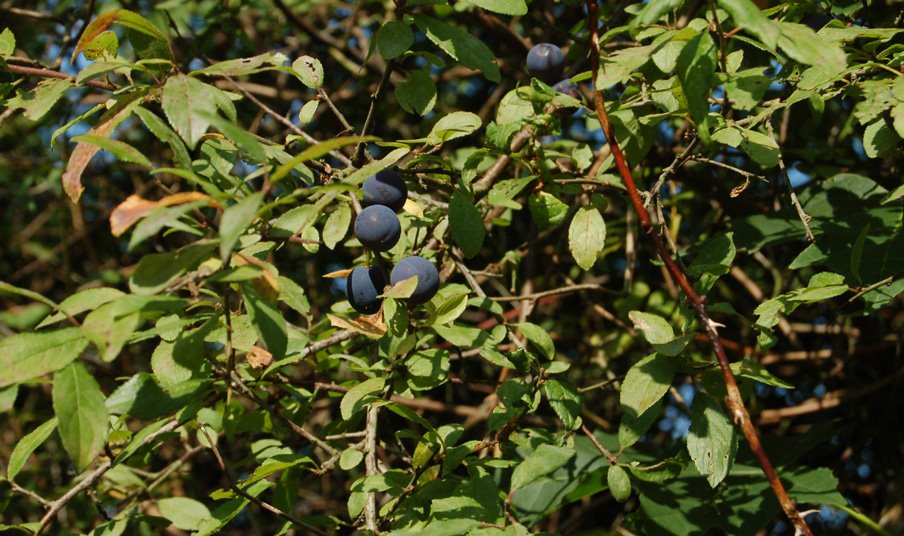
Blackthorn grows at cliffs, embankments along the beach, cleanings on edges of woodland, thicket and fences. It is extensively planted for hedging and a cover for game birds. Some forms are grown for ornament and flowers. The fruit is called sloe, which is similar to a small damson as plum suitable for preserves, but too tart to eat. The berries are best after the first night's frost, but if they are plucked before that period, they can either be pricked by a fork or put in the freezer for a few days. Sloe is used for juice, syrups, jams, jellies, liqueur, wine and snaps.

The foliage is sometimes eaten by larvaes of  Lepidoptera (like the Brown and the Black Hairstreak butterfly). The pocket plum gall is found on the fruit, where it results in an elongated and flattened gall, devoid of a stone.


In the 1700s and 1800s:
It was a common thing in the time after harvest and after the first nigh frost to gather sloe, scold them and eat them. Infusion gave a well-tasting and healthy juice, which people drunk together with porridge instead of milk. The berries cooked with syrup or sugar and fermented on a wooden barrel was popular as a porridge. Sloe-must was made by just pouring cooked water over the berries and let the infusion ferment for 3-4 weeks. Berries crushed with the kernels gave a juice with a spicy taste. After the first night of frost the farmers' wives plucked the sloe-berries in large baskets and made a fine red juice, which was hidden in a barrel until Christmas Evening. The clear light red juice drunk in wine glass and sweetened with sugar was a popular refreshing drink during summer. It tastes a little like red wine, bad red wine was despisingly called "sloe-juice". Beer cooked with the berries makes such a good taste that it is like old red wine. From the flowers were made aqvavit, and the berries were used to clear must. They bring a pleasant taste to beer and a pretty colour, but they can also improve apple-must during the fermentation.

Jam, Cheese and Tea.
The berries preserved with sugar and cinnamon gave jam for a winter salad or a steak sauce, after they had got frost they were put with honey in jars as a jam. In Vendsyssel (North Jutland) were sloe-berries used when preserving pumpkins. If the barch was used when making cheese the cheese wouldn't rotten. The new dried leaves were a good tea, also the dried flowers mixed with strawberry-leaves.


Sloe-Wine and Liqueur

In 1580 the vasal at Kronborg let gather 2-3 barrels of sloe, from which the king's cupbearer made sloe-wine for Frederik II. The wine made by chrushed berries and kernels was very intoxicating and was only served on special occassions. During WWII a wine firm in Odense (at Funen) advertised for sloe-berries. From the fruits are also made a liqueur.
 
Sloe-Gin
In rural Britain a so-called sloe-gin is made from the sloe. It is not a true gin but an infusion of vodka, gin, or neutral spirits with the fruit to produce a liqueur. In Navarre, Spain is a popular liqueur Patxacan made with sloe. Sloe is also excellent for a herbal snaps. From fermented sloes are made wine in Germany and other central European countries. Sloe is also good as jam and if preserved with vinegar, have a similar taste to the Japanese umeboshi.


Folk Medicine:
The juice of sloe was used for stomach pain - and the flowers drawn in warm beer was used for childrens' motions. It was also used to cure tooth-ache, pain in the eyes , blood poisoning, shingles and much more. Physician Christiern Pedersen 1533: crushed leaves and barch used on on shingles. Eyedrops from the pulverized barch in wine. Physician Simon Paulli 1648: berry-juice with beer for stomach problems. Children with constipation had the flowers in warm beer. Vinegar-decoct from the green medium barch was effective against toothache. The flowers in a healing morning drink , destilled water from the flowers for bronchitis, cleaning the body etc. A tea cleansed the blood and was laxative. The barch was used against malaria, the berries gave a healing drink against fevers, and mixed with cherries against diarrhoea. A milk decoct from flowers for a drink or a bath to remove freckles. The fruit juice for sores in the mouth or to rub upon swellings and against nosebleed. In 1772 flowers and fruit were entered into the pharmacopoeia.

Dye:
Unripe berries dye black, the juice of the ripe berries dye pale brown, while the dried berries make wool red. The barch gives with alun a red dye, unripe berries with iron vitriol give a dye like black ink. The unripe berries and the barch were used in tanning.


Other Use:
Blackthorn was recommended for hedges around gardens and fields, in Denmark this is much used especially at Funen. Many loads of cut blackthorn from the hedges were brought home as a fuel for the baking ovens. Before or in the killing season at the farms when sausages were made, the children gathered thorns from sloe, which in the evening were scraped clean , dried upon the oven and eventually burnt in the tips and then used as sausage-sticks; this was a tradition in most parts of the country  (DK) - and the sausage sticks were sold at the market. Boys also used the thorns as arrow-heads. From the wood were made music instruments, it was commonly used in turner-works and for mathematical instruments. From the tough wood were made walking sticks, hammer - and axen handles. During WWII gramophone needles were made from sloe thorns, they gave lesser needle-noise and lesser wear on the records than metal needles.

Blackthorn makes and excellent fire wood that burns slowly with a good heat and little smoke.

Straight blackthorn stems have traditionally been made into walking sticks or clubs (known in Ireland as a shillelagh). In the British Army, blackthorn sticks are carried by commissioned officers of the Royal Irish Regiment; the tradition also occurs in Irish regiments in some Commonwealth countries.

Ink: 
Shlomo yitzhaki, a Talmudist commentator of the High Middle Ages,  writes that the sap (or gum) of P. spinosa (or what he refers to as the prunellier) was used as an ingredient in the making of some inks used for manuscripts.

Fishing: 
A "sloe-thorn worm" used as fishing bait is mentioned in the 15th century work, The Treatyse of Fishing with an Angle, by Juliana Berners.The expression "sloe-eyed" for a person with dark eyes comes from the fruit, and is first attested in A.J.Wilson's novel Vashti.

Making snaps:
Put sloe berries in a glass or bottle with double amount alcohol. Filtration after 2-3 months. There is now a pretty dark red to violet essence, which can be thinned as you like. The berries can be used again together with the crushed stones in a new amount of alcohol to draw for a month or two, which gives a drink with a taste of almond. A sloe snaps gets better and better when stored. It is excellent for herring and cheese. Added honey makes it a snaps for desserts.


text and photo: grethe bachmann

Sct. John's Wort /Perikon


Hypericum perforatum


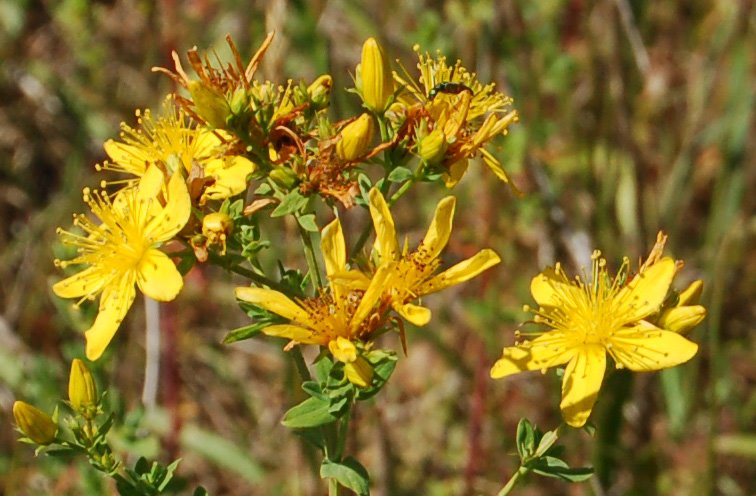
The lovely yellow St. John's wort is flowering in the summer fields now among white, blue, pink and other yellow flowering plants. It's got many different names, Man's Blood, Man's Power, Christ's Blooddrop, Sharon's Rose, Aron's Beard, Devil's Escape ( Fuga daemonum), Earth Hop, Lady's Herb and Snaps Herb.

Hypericum Snaps (Perikon snaps)The flower buds are the base for the famous Hypericum snaps. The fresh unopened flower buds without leaves are the best. Cover them with some neutral alcohol and let the snaps draw for a few days before filtering. The finished extract is dark red, like the colour of a precious ruby, and it has a wonderful taste, (when thinned of course)! It can be stored, and the red colour changes into brown along the way, but the taste is still fine. Dried or freezed flower buds are also okay for making a good snaps. There are many ways to mix and draw herbs in alcohol: an ancient recipe from folklore shows that people mixed fresh ginger with St. John's flowers in their snaps.


Folk Medicine: 
St. John's wort is a classical medicinal plant. In ancient times herbalists wrote about its use as a sedative and a treatment for malaria as well as a balm for wounds, bums and insect bites. The strong red colour inside the plant was considered to be blood-cleansing and being able to heal inside wounds like in the kidneys. Exterior damages like rheumatism were cured with tinctures, plasters, ointments and oils.

There is some scientific evidence that St. John's wort is useful for treating mild depressions. Today St. John's wort is used in alternative medicine as a means against mild depressions, but since it is known to cause photo-sensitivity it is advisable to take care. For exterior use St. John's wort is stimulating and healing for the skin. A St. John's wort oil on the base of flowers and sesame seeds is softening and make the skind supple.
NB: Every alternative medicinal use of any herb needs caution.

Legend and Superstition.There were many stories attached to St. John's wort. According to legend the plant grew up, where the blood hit the ground from John the Baptist's decapitated head, but the common name comes from the fact that it traditionally flowers by and is harvested on St. John's day, 24. June. Actually it flowers all summer.
The Devil had a role too in the legend. He was terribly irritated over this herb, because it created such great medicinal cures for the human beings - and he tried to destroy the plant by pricking holes in it with his pitchfork, but he didn't succeed in killing it. Both the Devil and all kinds of evil spirits were dominating in society then. People thought that insanity were evil demons helding the body captured, and they tried to drive them out with St. John's wort, from this the name 'The Devil's Escape.' On Midsummer's Night people burnt St. John's wort in order to drive away evil spirits from the family place.
Healing could be achieved with St. John's wort. People had to dig it up or pluck the flowers on Midsummer's Night, (St. John's Night) and if they wore the herb, then they became invulnerable. Even soldiers were assisted. If a soldier smeared his flintlock inside with the plant juice he would never miss the target.
By the ancient Norse St. John's wort was dedicated to the God Balder, and people were sure that it had magical powers and aroused a mad desire of love. The herb was also said to cure impotence and from this came the name 'Man's Power'. One of the other names 'Earth Hop' indicates that it was used as a spice in beer brewing.

Plant-dyeing : yellow and green shades can be extracted from St. John's wort

photo grethe bachmann

Tuesday, October 23, 2012

Sea Buckthorn/ Havtorn


Hippóphaë rhamnoídes


When you pluck the orange berries of sea-buckthorn here in October they are crushed easily and the bush bites you with little thorns. The sea buckthorn grows in the sandy soil in the tough wind and the sea fog on the western coast of Jutland, the fine and healty orange berries are very popular in the Nordic kitchen. It is   a little pearl among wildgrowing Danish fruitbushes, and it has got many names like the Danish sandtorn, strandpil, sandtidsel, ørkenbusk, klintepil or klintetidsel and the  English sandthorn, sallowthorn, or seaberry.


The common sea-buckthorn Hippóphaë rhamnoídes, is by far the most widespread of the species in the genus, with the ranges of its eight subspecies extending from the Atlantic coasts of Europe right across to northwestern China. In western Europe, it is largely confined to sea coasts where salt spray of the sea prevents other larger plants from out-competing it, but in central Asia it is more widespread in dry semi-desert sites where other plants cannot survive the dry conditions. In central Europe and Asia it also occurs as a subalpine shrub above tree line in mountains, and other sunny areas such as river banks. They are tolerant of salt in the air and soil, but demand full sunlight for good growth and do not tolerate shady conditions near larger trees. They typically grow in dry, sandy areas. In China the sea-buckthorn was used for production of medicine for more than 1200 years and it has been traced in Europe back to the 1500s. Plants were used primarily for medicine in Europe against diseases like fever and stomach pain.

Hippophae salicifolia ( willow-leaved sea-buckthorn) is restricted to the Himalaya, to the south of the common sea-buckthorn, growing at high altitudes in dry valleys; it differs from H. rhamnoides in having broader and greener leaves, and yellow berries. A wild variant occurs in the same area, but at even higher altitudes in the alpine zone.It is a low shrub not growing taller than 1 metre.


The Hippóphaë rhamnoídes /sea buckthorn grows in Denmark primarily upon banks and dunes at the sea since it needs sun and calcareous soil. The fruits are small orange berries, and contrary to many other fruits the berries sit on the plant even when ripe. This makes harvesting difficult, not at least because of the thorns.
The fruits are not easy to get hold of - and when you've finally got a hold they splash out among your fingers. There is a method:  put a cloth under the bush and shake the plant. Another method: cut some branches with many fruits and put them in the freezer for half an hour and the fruits can be beaten off.


The taste of the orange fruits is sourish, but after frost they are milder. During starvation periods the sea buckthorn was a valuable vitamin supplement for a poor family. In the old days people in the country eat a mix of milk, syrup and buchthorn.The berries give also a fine taste to a spice snaps, and they are fine in marmalade and porridge. Cremes and lotions are made from oil pressed from the kernel.

Glatved strand, Djursland, habitat for sea-buckthorn.


The bush is very hardy and thrives well in an infertile soil. This is possible because it has a coexistence with actinomyces fungi which in the root tubers are able to bind the free nitrogen from the air. This means that the bush can survive in clean sand. The flowers in April are very insignificant, and the plant needs both male and female flowers in order to make fruit. In September the bush shows lots of orange fruits. It is a grand sight and the fruits are very healty. The berries have an extremely high content of C-vitamin, in average 400 mg pr. 100 g. Compared to this it is recommended that an adult daily takes 75 mg C-vitamin, but the berries also contains other vitamins, A-, B-, E-, and P-vitamins.  And also antioxidants, Omega 7 fatty acids and dietary fibers.


fieldfare
The sea buckthorn is easy to recognize among the other plants in the landscape with its narrow silver shining leaves. If it gets much light it will become a very broad, dense, thorny bush, since sea buckthorn forms root suckers. It can fill large areas with an inaccessible thicket - and this is a paradise for the birds. The fruits are an important winter food ressource for some birds, notably fieldfares, but also pheasants eat them. Leaves are eaten by the larvaes of lepidoptera-species. The bush is useful in shelterbelts, game depots or as a slope protection in loose and sandy soil. 


In Denmark scientists have began to do experiments with the buckthorn as a medicine which might have a beneficial effect on stomach ulcer.


Folk Medicine:
wikipedia.
Different parts of sea-buckthorn have been used as traditional therapies for diseases. As no applications discussed in this section have been verified by science and sufficient clinical trial evidence, such knowledge remains mostly unreferenced outside of Asia and is communicated mainly from person to person, therefore falling into the category of folk medicine. Grown widely throughout its native China and other mainland regions of Asia, sea-buckthorn is an herbal remedy reputedly used over centuries to relieve cough, aid digestion, invigorate blood circulation and alleviate pain. Bark and leaves may be used for treating diarrhea and dermatological disorders. Berry oil, taken either orally or applied topically, may be used as a skin softener. For its hemostatic and anti-inflammatory effects, berry fruits are added to medications for pulmonary, gastrointestinal, cardiac, blood and metabolic disorders in Indian, Chinese and Tibetan medicines. Sea-buckthorn berry components have potential activity against cancer.
 
Diverse:
 Sea-buckthorn is distributed free of charge to Canadian prairie farmers by PFRA to be used in shelterbelts.
When the berries are pressed, the resulting sea-buckthorn juice separates into three layers: on top is a thick, orange cream; in the middle, a layer containing sea-buckthorn's characteristic high content of saturated and polyunsaturated fats, and the bottom layer is sediment and juice.
Sea-buckthorn fruit can be used to makepies, jams, lotions and liquors. The juice or pulp has other potential applications in foods or beverages In Mongolia, it is made into juice, with concentrates also available. In Finland, it is used as a nutritional ingredient in baby food.
To overcome high acidity, juice made by adding five-parts water to one-part sea-buckthorn and sweetened to taste, put through a blender and strained, is said to taste like orange or peach juice. 
Sea-buckthorn leaves, dried and shredded, can be made into teas.


Kilde: Louise Lundgren Berg, Professionshøjskolen Metropol ; Jens Thejsen,Jordbrugets uddannelsescenter; Wikipedia.


photo Glatved strand, Djursland September 2012/ fieldfare Horsens Nørrestrand January 2010 : grethe bachmann


Sunday, March 11, 2012

Sweet Flag/ Kalmus

 Acorus calamus


photo Gudensø: stig bachmann nielsen, naturplan.dk
In the foreground Kalmus and højt sødgræs (Glyceria) out in the water vandpileurt (Amphibious bistort).In the background bathing guests.

Acorus comes possibly from a Greek word meaning without, chore means pupil, referring to the medicinal use of the plant. The Danish name kalmus is Latin, and the same name is used in Germany and Sweden. The name kalmus origins from  the 1200s, from the older name calamus meaning tube or pipe.  Most used English name according to Liber herbarum is Sweet Flag. Other names: Calamus, beewort bitter pepper root, Myrtle Flag, Sweet Calamus, Sweet Myrtle, etc.

Kalmus has a thick white rootstock and sword-shaped 40-100 cm long leaves, the small flowers sit in a green bulb, "like little needle-houses". The whole plant has a strong spicy scent. It's found in Denmark in ponds by lakes and water streams. It is sometimes confused in non-botanic literature with German iris and reed. Kalmus likes to grow in water, best along water streams, but the plant can easily thrive in moist soil. It rarely produces flowers in Denmark, and it is reproduced by the outlets.

The species is said to be brought from Asia minor(Constantinople) in 1557 to Europe, where it reproduces only with loose rootstocks, but it was known in Europe long before as an imported droge (medicine) from India, and it might already have been brought from Baltikum in the Middle Ages to the Danish kloster- and castle gardens. In the 1600s it was both wildgrowing and plant in fish ponds. The roots were used for medicine, and descendants from kalmus have been found in several kloster- and castle ruins.


Cancer 
It has been discovered that the etherial parts of the plant can cause cancer, and the plant is prohibited for internal use in Denmark today.


Today's Use: 
The dried and pulverized root is now only used as a fixative in potpourris, since it holds on  to the scent of the other dried scent herbs. Internal use of kalmus was prohibited by den danske levnedsmiddelstyrelse in 1977.


 Folk medicine:
1300s: decoct as a drink for liver and bowl disease; boiled and put in a compress upon abscesses; cures old cough.
Henrik Smid 1546: pickled roots against stomach ache and coldfever (malaria); eaten in the morning for evil and poisonous smell - and it gives a fragrant breath; it is diuretic, it heals disease in blatter and kidneys, it crushes blatter stone and promotes menses.
Christiern Pedersen 1533: decoct to drink for heart trouble; the crushed root in wormwood-water as a drink against stomach diseases; pulverized kalmus together with the juice of mullein (kongelys) against haemorrhoids.
Simon Paulli 1648: The juice works as a diuretic, helps the spleen, "which is hard from evil mucoid and salten fluids", makes impure eyes clear; the roots pickled with honey and sugar is "an extremely wonderful and good healing for cold stomach and cold head", katarr and cold diseases; furthermore against cough and heart's distress and anxiety, bad breath is driven away, in times of plague it makes the air healthy; pulverized and drank in chervil-water to drive out the sweat in order "to loosen the blood which has gathered after blow and impact".

Medicine and Good Advice:  
The rhizome is a component in an appetizing vinegar-drink, (1600s); and it was very used in stomach tonics, put on snaps against colic and used to stimulate digestion; a decoct against stomach ache and a tea from the root to regulate the gastric acid. The droge (bought at pharmacy) was still used  in the 1900s against indigestion. If it was added to snaps together with the root of elecampane (alant) and angelic, then it became "the wise man's snaps" against heartburn, the root was also used against arthritis; together with the root of European birthwort (slangerod) and angelic in rum against chest disease (tuberculosis) and cough; a wise woman let her jaundice-patient drink snaps with kalmus root, and "it had to be drunk by a full moon".

The rootstock was noted in the pharmacopoeia in 1772, and its reputation as a highly invigorating and strengthening medicine caused a big sale of the droge. Det kongelige landhusholdningsselskab ( a union of farmer households) rewarded in 1814 a man, who had gathered 1251 pounds of kalmus- and angelic roots for the pharmacies, and in the late 1800s large amounts were gathered in the river Gudenå by Randers.


If it was very cold, people did chew a piece of kalmus root and sank the juice (1789);  the root was chewed against toothache - or the sore tooth was rinsed with a decoct of water and vinegar, the last drink was also used against scurvy, and the gums around loose teeth could be rubbed with pulverized kalmus root and china bark.

If people were afraid of being infected from patient visits, they chewed a piece of kalmus root; this promoted  a large portion of saliva, "therefore it is used as a means against infection". In 1800 it was said to be enough to walk with the root in the pocket. Kalmus was chewed against infection during "The Spanish Flu" in 1919-25.

Cattle and Horse.......
If the root is thrown into the water, the animals stay healthy. The kalmus root is included in a complex cure "from ancient times" against cattle diseases, and especially if the cattle is bewitched. If the cow is able to stand up in spring, kalmus root and pepper is put into a scratched wound; kalmus was used against abortion of the calf, used together with juniper or the root cooked with juniper and resin in beer. If the cow gave blue milk,  it was given kalmus and cumin in chalked water, and if the milk was without cream, the cow had a powder of kalmus and lovage root, mixed with slaked lime dissolved in water.

A horse who has "stepped over" = sprained the hoof joint, is bathed with a spirits-extraction of the root cut in  cubes, the extract is also poured over the bandage (ab. 1900). It was given for the pig's vomiting, and was the part of an advice against defects in geese. The veteranians used the root as a stomach and appetizing tonic.


Other use:
In order to protect the harvested corn and the heaps against mice and rats, fresh cut kalmus roots or leaves were placed upon the barn floor and/or between each layer of sheaf. It was recommended to plait a cornband of the leaves, since the mice could not cut them; the root or leaves could also be placed in rooms and spread on the floor against fleas, or put into the mattress to keep away the fleas. "Who did not sleep in kalmus root in the old days?" This plant was extremely popular as a bedstraw, and it was harvested in numbers and sold to the citizens. Kalmus mixed with carbamate (hjortetaksalt) was used to drive out ants. Many Jutlanders chewed the root instead of chewing tobacco.  "He's smelling of kalmus root, of smoked lard and fish",  is told in an old song. The children gathered the bittersweet rootstocks to chew them.

The hay bundles were tied with kalmus band, which could last for 10 years, reed mats made from the kalmus leaves had a strange smell. Sour beer would be welltasting, if kalmus root was put into the barrel, (1600s). The root was also used for smoking against bad smell in rooms.

Food and Drink:
A jam from the root is mentioned from the 1500s till the 1800s. It was often put into snaps as an extra taste and it was the part of many herbal snaps, stomach bitters and liqueurs.  (like Benedictine liqueur and chartreuse).

Superstition
If you put a piece of the root into a wash bowl or a water tank, it could rinse the water from toxic substances. The root was also used as a sacrifice to the gods.

Source: V. J. Brøndegaard, Folk og Flora, Dansk etnobotanik, Rosenkilde og Bagger, 1980; Anemette Olesen, Danske Klosterurter, Aschehoug  Dansk Forlag, 2001.
photo Gudensø: stig bachmann nielsen, naturplan.dk
photo and photo copy: grethe bachmann

From wikipedia: 
Use in other countries:
In Britain the plant was also cut for use as a sweet smelling floor covering for the packed earth floors of medieval dwellings and churches, and stacks of rushes have been used as the centrepiece of rushbearing ceremonies for many hundreds of years. It has also been used as a thatching material for English cottages.
In antiquity in the Orient and Egypt, the rhizome was thought to be a powerful aphrodisiac. In Europe Acorus calamus was often added to wine, and the root is also one of the possible ingredients of absinthe. Among the northern Native Americans, it is used both medicinally and as a stimulant. It is believed by some that calamus is a hallucinogen. This urban legend is based solely on two pages of a book written by Hoffer and Osmund entitled The Hallucinogens. To date there is no solid evidence of any hallucinogenic substances in calamus. Acorus calamus shows neuroprotective effect against stroke and chemically induced neurodegeneration in rat. Specifically, it has protective effect against acrylamide induced neurotoxicity.The essence from the rhizome is used as a flavor for pipe tobacco. When eaten in crystallized form, it is called "German ginger". It's also used in bitters.

Zephyrus and Chloris

The kalmus has long been a symbol of love. The name is associated with a Greek myth: Kalamos, son of the river-god Maeander, who loved the youth Karpos, of Zephyrus, (the West Wind) and Chloris (Spring). When Karpos drowned in a swimming race, Kalamos also drowned and was transformed into a reed, whose rustling in the wind was interpreted as a sigh of lamentation. The plant was a favorite of Henry David Thoreau,  (who called it "sweet flag"), and also of Walt Whitman, who added a section called the  "Calamus" poems, to the third edition of Leaves of Grass (1860). In the poems the calamus is used as a symbol of love, lust, and affection. The name Sweet Flag refers to its sweet scent (it has been used as a strewing herb) and the wavy edges of the leaves which are supposed to resemble a fluttering flag.  
                                                               GB

Sunday, January 29, 2012

Common Corn Cockle/ Almindelig Klinte

Flora and Fauna
Agrostemma githago

 
Common Corn Cockle, foto: stig bachmann nielsen, naturplan.dk


Common corn cockle is an example of that appeareance is deceptive. The beautiful flower reveals nothing about that the plant is a troublesome weed with poisonous seeds.  Agrostemma is a genus of annual plants in the Caryophyllaceae family, containing the species known as corncockles. Its best-known member is Agrostemma githago, the Common Corn Cockle, which is a native of Europe, where it is simply called "the Corncockle". The species is a weed of cereals and other crops, probably with a centre of origin in the eastern Mediterranean. Nowadays declining in its native range because of improved seed cleaning, it is found as a weed worldwide. In Denmark it was a common and very feared weed in rye and wheat, but it is now very rare and on its way to disappear from the flora.
 
The corncockle was probably let into Denmark with unclean seed corn (wheat) already in Stone Age, contemporary to the beginning of corn cultivation in the country. Capsules and seeds were found in Roman Iron Age sites. Since the 1300s the corncockle was often confused or mixed with Giftig Rajgræs (Poison Darnel). The corncockle is synonymous with weed and seed cleaning. It was a common farm work in early summer to weed the corncockle from the wheat. On 12. April 1631 king Christian IV writes to his vasal at Frederiksborg castle that the manager must let boys and girls weed corncockle from barley and put them in a basket on their arm. Many proverbs and sayings are about this weed.

Poisoning:
It was not possible to cleanse the corn enough;  the smallholders had to come and assist on the manors, separating the seeds with a sieve. The seeds were cooked in a wash boiler in the scullery into a poor, but usable pig fodder, and the farmers were afterwards sure that viable seeds did not return with the manure to the fields. Little pigs, chicken and other poultry were poisoned by the seeds. In a farm they gave 220 ducks a fodder from cleansed seeds stirred into water - the ducks all died.
 
Snaps:
"The seeds were damaging for the chest, but strong and useful for snaps". The corncockle gave much to the snaps, when it was burnt together with other corn,  although the snaps became more blue. The snapsburners sometimes paid more for rye mixed with corncockle; this gave a stronger and more intoxicating snaps, " which is known by everyone." If the rye harvest was much polluted with corncockle, it could not be sold as seed corn, but the flour was good for rye-bread. 

Wash:
People on the island Ærø cooked woolyarn clean in lye from finely grained corncockle seeds, which was also used in Jutland. Stockings and woolen cloth were soaked and washed in corncockle lye, which made them dazzling white. The lye was also good for the wash of coloured cotton.  The seeds were used for stamping and fulling woolen cloth. In 1870 they still washed with a lye of corncockle seeds and beech ashes.

Medicine:
Advice in old medical  books : the juice from green corncockle rubbed upon sick eyes; crushed corncockle plant mixed with sulphur, pigeon manure, flaxseed and vinegar as a compress upon leprosy;  crushed seeds boiled in beer or oil was a drink against ague; sundried seeds for cramp; corncockle flour and wormwood juice put upon the navel killed children's intestinal worms; if the root was held under the tongue it would stop nosebleed.

The corncockle seeds form a part of  a medicament against "negl i øjet" (nail in the eye) = keratitis in horses.

Food, Change, Harvest: 
The seeds were used to fake cumin; chopped leaves from young plants could be used in meat dishes together with vinegar. People thought that rye and wheat were changed into corncockle in bad soil and bad weather.  The rye had to be harvested, when the seed capsules were black and began to open; if they were open when the rye was being harvested, then it had only to be "aired" for a few days.

Source: Folk og Flora, Dansk Etnobotanik af V.J. Brøndegaard, Rosenkilde og Bagger, 1979.

photo: stig bachmann nielsen, naturplan.dk

Wednesday, November 23, 2011

Lady's Bedstraw /Gul Snerre

Flora and Fauna
Galium verum


Lady's Bedstraw has little yellow flowers, gathered in tufts at the top of the plant. A colony of Lady's Bedstraw reminds at a distance about a yellow carpet. The plant is common in a dry and sunny, grassy bottom, along roads, in sandy beach fields and in dunes. Lady's Bedstraw sends out a spicy, honey scent, which is especially strong before rain. Flowers in June-August.

Other names:  Cheese-rennet / Cheese-running / Maid's-hair / Our lady's bedstraw / Petty Mugget / True Bedstraw / Yellow Bedstraw / Yellow lady's bedstraw / Yellow spring bedstraw

Folk medicine:
Lady's Bedstraw was used in skin problems and stomach diseases and as a sweat-impelling means. It was also an effective means against viper bite and other poisoning. It worked against gouts, cramps, stones in the kidneys and it was easening epilepsy. Children's scabies was given an effective bath with Lady's Bedstraw. It has also been used to combat sleeplessness. A decoction is good as an addition to hot water to soothe the feet of a weary traveller. In Europe, people have placed a piece of the plant in their shoes for protection against blisters.


pasture with common sorrel, Lady's Bedstraw and Festuca rubra


Folklore:
Its common name probably derives from a Christian legend that claims it was part of the bedding used in the manger in which Jesus lay.  It was believed that virgin Mary had plucked it as a bedstraw for baby Jesus, because the flowers were soft as a blanket. Before Christianity the flower was considered sacred and dedicated to the goddes Freja (Frigg), who is the goddes of love, marriage and home. The plant has been used as stuffing in pillows and mattresses, particularly for women about to give birth, as it was believed to ensure a safe and easy childbirth. Frigg helped women give birth to children, and as Scandinavians used the plant Lady's Bedstraw (Galium verum) as a sedative, they called it Frigg's grass.

Bedstraws are used as food plants by the larvae of some Lepidoptera species.

Practical use:
In the past the dried plants were used to stuff mattresses, as the coumarin scent of the plants acts as a flea killer. But it was also hanged up in the rooms, partly as a decoration, because the yellow colour lasts long like an eternelle, and partly as a source of scent because of the spicy aroma. Lady's bedstraw was also used to spice beer. In Denmark, the plant (known locally as gul snerre) is traditionally used to infuse spirits, making the uniquely Danish drink bjæsk.


Cheese
The latin name Gallium derives from the Greek ‘gala‘ that means milk.  Lady’s Bedstraw is sometimes referred to as Cheese Rennet or Cheese Renning. This name corresponds to the common use of the plant as a milk curdler. The plant contains an enzyme suitable for this purpose.  What makes this plant especially useful in cheese production is that as well as curdling milk, it also colours the cheese a bright yellow.The flowers were used to coagulate milk in cheese manufacture, and in Gloucestershire to colour the cheese.


Plant dye:
Among the other common names used for the plant is Maid’s Hair. The yellow dye that can be obtained from the stems, leaves and flowering tips has been used as a hair dye. Although it has never been widely cultivated for this purpose, a red dye can also be produced from the roots and has been used for dyeing wool and other fabrics in places like the Western Isles.  The  flower top was used to dye yellow and olive green. Galium, or Ladys' straw, was used as a red dye during Anglo-Saxon times in England.


Snaps/ Bjæsk:
Use the flowers, it's best to use the buds just before flowering. They can be dried for later use, but not freezed. Put the flowers in a bottle, fill it with neutral snaps. Drawing time 1-2 days and not longer. After filter it has to be thinned. It's better when stored. The characteristic taste comes after storing it for a long time.


photo Vilsted Lake and Strandkær, Mols 2007, 2008:
grethe bachmann

Saturday, October 08, 2011

Herbal Snaps


Five good snaps

Some  are collectors of stamps, others of coins or books or tin  soldiers, and some are collectors of herbal snaps. They have a whole regiment of bottles with fine etiquettes, telling which herb is in the snaps - and when it was added to it. They are often members of a snaps-guild,  (Brændevinslaug) - and they take their hobby very seriously. The gathering of herbs, the knowledge about the plants in nature and how to make a fine herbal snaps is important.  And the drink must not be swilled down - no, a glass of herbal snaps has to be enjoyed at a special occassion, it is not a means of intoxication. They take care of their bottle regiment!

The snaps, known in Denmark as Brændevin, was once the simple drink of the peasants. It has to be taken into consideration that drinking water was rather bad at that time. Brændevin means Burnt Wine or Burning Wine. It was also used as a  medicine, both internal and external. Just 50 years ago were in some Danish farms a bottle with a bitter snaps in the house. It was used in occurring diseases. This snaps, called a Bitter, was made by the oldest members of the family, who Sunday morning sneaked out to gather herbs on the church dike. They had to do it in secret.

Strange things were added to the drink. Tales about snaps with wall-flower, crisp rusks, oak fern, dead man's bones, peony, feet of a bittern, spleen from a fole, red oak shots, white vitriol, great mullein, moose-hooves, capon-water, tobacco, swallow stones, agate, unicorn. This must be the so-called unicorn powder.  In ancient folk medicine it was sold by wise women - and pharmacies, probably something they crushed from common animal bones.


The name Aqua vitae is mentioned already in writings by the Moorish alchymists.  The snaps was common in Sweden in 1500, and in the last half of the 1600s in all of Scandinavia among peasants, commoners and nobility. Aqua vitae, or the akvavit, was considered an eminent medicine because of its stimulating effects.
Asger Jorn: Dead drunk Danes
The snaps spread fast caused by its wonderful qualities, and people drank too much. They took a snaps or two in the morning and before meals , and king Frederik II had to issue an open royal letter in 1593 to the Danish Thing that the meetings had to begin early in the morning before people were dead drunk. Christian IV had an Aqua vitae regia with 23 various plant drugs and pulverized pearls. It was recommended for use on the morning after a booze. He had also a recipe from the astronomer Tycho Brahe's sister on Elixyr Thycons, a bitter akvavit, which among other things contained aloe, root of angelica and juniper oil. This snaps was effective against plague and epidemics. So they said.

In the 1840s there was a  strange custom among men in some places in the country. After a funeral  they gathered at the death-house for a guild, called ligdrikkeri (body-drinking). The men played cards and smoke tobacco and drank snaps. At such an evening they smoke about 1 pound of tobacco and drank 10 jars of snaps. 

Up till present the snaps was given to the cow and the wife when they had respectively calved and given birth. The cow even got bread and salt herring too.


Today the snaps is enjoyed cold, but once people used to heat it on the stove.

How to gather herbs:
Flyndersø, Sweet gale in spring
Gather roots in the autumn or early spring, while they still hold the reserves. Throw away the rotten parts and cut off the fine roots. Wash the roots or brush them clean with a dry, stiff brush. The large roots has to be split before drying. Gather stalks, leaves and flowers in clear, dry weather, best in the morning, when the dew has left the grass. Some have to be plucked as soon as the leaves have sprung, before the flowers arrive - others as soon as the flowers have opened (Wormwood and Sct. John's Wort). The plants must be free of dust, when they are gathered, since it is impossible to cleanse them later. Take the seed, when it is ripe and before it begins to dry - before it falls off by itself. The wild plants are better and more spicy than the culitvated plants, except for angelica and possibly wormwood.

How to dry the herbs:
Drying the herbs has to be in a shadowy, airy place - in the summer fx on a warm loft. Spread the plants on paper, like old newspapers. If the weather is moist or the plants are difficult to dry, they can be put in the oven at last to prevent them from going mouldy.  The drying has to be done as quickly as possible and finished as quickly as possible. Comminute the dried plants, (the drugs): cut into pieces, if they are tough, or pound in a pestle; keep them in bottles or boxes, but best not for more than a year. They must be looked after for mould and insect attacks, which often reveals itself by cobwebs in the drugs.

How to draw the herbs:
The effective flavourings are drawn from comminuted plant-parts by the help of neutral snaps or Vodka. The drawing time for herbs is usually 8 days in bottles, 3/4 filled, shake a couple of times a day. Filter the herbs, keep the tincture in a cold, dark place. It has to be clear with the smell and scent of the herbs and contain all the effective substances.


Five good herbal snaps:
Wormwood (Danish: Malurt)
Sweet Gale, Bog Myrtle (Danish: Porse)
Sct. John's Wort (Danish: Perikon)
Yarrow (Danish: Røllike)
Walnut (Danish:Valnød)


Kaløvig
The Wormwood Snaps: 
Malurt snaps
The Sea Wormwood grows along beaches and in beach meadows and is easy to gather. Some call a wormwood snaps "the king of snaps", but if it draws too long then it gives a bitter substance. Drawing time 10-12 hours. Store for a year, but it is probably consumed before that since it is so good. Dry the herb about a week before drawing, but it can also be used fresh.Take the first light green shots in spring. Avoid the flowers, they might give a bitter taste, although some use both leaves and flowers. Flowers in August-September.  This snaps is first light green then dark green and at last brown. When you thin the essence it changes colour.


Kalø, Sea Wormwood
History and Legend:
Wormwood was used already more than 3.000 years ago in Egypt and Greece. Since the Middle Ages it was used as a spice in beer, since people thought it was able to prevent intoxication. It was also recommended for seasickness and much more. According to a legend wormwood was the favourite flower of the godddes Artemis, who chose it when she was mourning her husband's death. Absinthium means abstaining from, referring to Artemis who was the goddess of chastity. Another legend says that wormwood grew up in the traces of the snake, when it was leaving the Garden of Eden.


Folklore:
People hang branches of wormwood upon walls and doors of their house to keep away all evil, although the practical use was not forgotten. Wormwood was used against moths. The moth larvaes were partly almost extinct when small branches of wormwood were placed among the woolen clothes.


Today:
It is a brilliant herb for snaps, but it is also used extracted in water to help the kitchen herbs against insect attacks, and the branches can be put under the cabbage, when it has grown big. The scent of the herb keeps away unwanted insects. Branches keep fleas away from the basket of the dog and cat. The dried stalks among clothes and linen keep away the moths. The bitter taste of the snaps keeps the stomach in order. Wormwood has a lot of good qualities like many other herbs.


NB:
It is not advisable to drink too much wormwood snaps. The substance absinthin can cause nerve- damages, which shows itself by dizzyness and cramps.  The bitter substance is used as a flavouring of vermouth and absinth. It is prohibited today to sell absinth in its original strenght of 68 %.


The Sweet Gale, Myrica Gale, Bog Myrtle Snaps
Porse Snaps

Moor by Aqua Silkeborg
Sweet gale, Aqua by Silkeborg
The Sweet gale/Myrica gale/Bog myrtle  has a strong aromatic scent;  flowers in April-May, grows in heaths and moors. It is common in Jutland where it is called porse, but rare in other places of Denmark. A couple of branches, (both fresh and dried can be used), are enough for a bottle of neutral snaps; drawing time 5-8 days, then filter and store for 3-5 months. Thin the essence with neutral snaps. You can use both the flowers or ratkins for making the snaps.The first leaves of spring gives a fine lightgreen snaps. 


The wax coating on the fruit of several porse species, known as Bayberry wax, was used traditionally to make candles. It was used for that purpose in the novel The Swiss Family Robinson. The foliage of Myrica gale is a traditional insect repellent used by campers to keep biting insects out of tents. Several species are also grown as an ornamental plant in the garden. The fruit of Myrica gale are an economically important crop in China. It is also a traditional ingrediense in Royal Wedding bouquets and in various perfumes and as a condiment.


Sweet gale in spring
The Vikings used Sweet gale/Myrica gale as a spice in beer. In northwestern Europe it was much used in a mixture called gruit as a flavouring for beer from the Middle Ages to the 16th century, but it fell into disuse after hops had become widely available. In modern times, some brewers have revisited this historic technique. Danish brewery Thisted Bryghus produces Porse Guld, a strong beer flavoured with the plant. A brewing company in Canada produces 'Bog Water', a seasonal strong ale made with sweet gale. In Denmark and Sweden, the plant is commonly used to prepare home-flavoured snaps. This special flavouring is also produced commercially. (Porse Snaps).

It is a favorite food of beavers, and low beaver dams can be found where sweet gale is present. The ponds thus formed are often completely submerged at high tide but retain water at low tide and provide deep enough water to provide a refuge for fish, including juvenile salmon where the water is too deep for predation by wading birds. Thus the presence of Sweet Gale can enhance salmon recruitment.

NB: Myrica gale is listed as an abortifacient and, therefore, should not be consumed by women who are, or might be, pregnant. 

Sct. John's Wort Snaps 
Perikon snaps 

The Sct John's Wort is a common plant in Denmark, it flowers in July-August. For snaps use the fresh flower buds, drawing time 3-4 days, then filter. It gives a ruby red snaps with a spicy taste, good for the lunch table.
It is one of those snaps which get better when thinned. It can be used at once or stored.

The Sct John's Wort has got many names: Man's Blood, Man's Power, Christ's Blood, Sharon's Rose, Aron's Beard etc. -  and Snaps Wort.  It has an old Danish byname jordhumle (= earth-hop), which refers to that the plant was used as a spice in beer. 

The Latin Hypericum comes from Greek hyper = on and erike = heather. Perforatum refers to the oilglands, which look like the leaves were perforated with small needles. Because of the red colour in the leaves people considered the plant to be blood-cleansing . It was used in oilments and oils. The oil was used to rub on body in rheumatisn and fever. Today the pericum-medicine is used to treat light depressions.

Folklore:
If a weapon was rubbed with Sct John's Wort, you couldnt get hit, and if you had lumbago the plant would help healing it. The Devil was irritated over the healing powers of the plant, and he pierced it without killing it. Sct.John's Wort has to be plucked or digged up on Midnight's Eve. According to legend the plant came from John the Baptist's severed head, where the blood hit the ground. Sct Johns Wort grew up there. In the ancient North it was dedicated to the god Balder. People used it in witchcraft and to awake passionate love. The herb was considered to work against impotence.

NB: Too much intake of Sct. John's Wort makes the skin sensitive to sunlight.  (photo-sensitivity)

The Yarrow Snaps
Røllikesnaps


Flower field by the sea with yarrow,  Mols
A common plant in fields, meadows and along roads.  Flowers in July-September. Use the newly sprung flowers , 1 dl for a bottle of neutral snaps,  drawing time a few days,  then filter. Store 2-3 months. The essence has to be thinned with snaps. Yarrow snaps is a fine red snaps, good for herring.

Legendary names:
The name Achillea is after the hero Acchilleus, who used the plant to heal the wounds of his soldiers. He was invulnerable except for his Achilles-sinews. Other names: common yarrow, gordaldo, nosebleed plant, old man's pepper, devil's nettle, sanguinary, milfoil, soldier's woundwort, thousand-leaf (as its binomial name affirms), and thousand-seal. The English name yarrow conmes from the Saxon (Old English) word gearwe which is related to both the Dutch word gerw and the old High German word garawa.

History:
Yarrow was one herb identified at Shanidar IV, a Neanderthal flower burial of northern Iraq, dated c.60,000BCE along with a number of other medicinal herbs.Stories about yarrow feature in traditional Chinese culture. For example, it is said that it grows around the grave of Confucius.Yarrow also featured in British folk customs and beliefs. Yarrow was one of the herbs put in Saxon amulets. These amulets were for protection from everything from blindness to barking dogs. In the Middle Ages, yarrow was part of a herbal mixture known as gruit used in the flavouring of beer prior to the use of hop. (like sweet gale). The yarrow was used against fever, stomach ulcer and other inflammation diseases - and to wash hair in order to prevent hair loss. In the 1700s it was used in the kitchen -  and in cosmetics to smooth out wrinkles

pink yarrow
Today:
Yarrow is used in herbal tea and as a spice on snaps. The styptic effect of the plant is documented. Yarrow is also used in cleansing lotions for greased skin and in dandruff-shampoos. The juice can prevent cracked skin and is used in face masks.  The flowers and leaves are used in making some liquors and bitters. Several cavity-nesting birds, like the common starling use yarrow to line their nests. In the manga and anime series Bleach, the insignia for the Eleventh Division is the Yarrow; the meaning behind it is Fight.

NB: In rare cases, yarrow can cause severe allergic skin rashes; prolonged use can increase the skin's photosensitivity. This can be triggered initially when wet skin comes into contact with cut grass and yarrow together. Pregnant women should avoid intake of yarrow.


The Walnut Snaps
Valnøddesnaps


Walnut tree, Mindeparken
Last but not least. The Walnut snaps. When it is good it is much like a brandy. It is perfect for a Christmas snaps. Use the green fruits. Cut them in quarters and cover them in neutral snaps. Drawing time at least 3 months, or 1/2 year. Soon after having covered the fruits the essence will be absolutely black, but don't despair, the snaps will be a beautiful dark brown, a golden walnut brown at last. After filter thin x 6. A walnut snaps gets better when stored,  it can be kept in store for 7 years or more. This is a noble snaps!

green walnuts
There are several opinions about how long this snaps has to be stored. Some say that the snaps can be enjoyed at Christmas Eve for a late cup of coffee, others that it is a real sacrilege to drink the noble drops before they have been stored at least one year; the extremes are of the opinion that it is not a walnut snaps until it is 7 years old. Tastes differ!


History:
The name derives from German wal and Old English wealnuth, literally meaning foreign nut. The walnut was introduced to west and north Europe very early in Roman times or earlier. It is cultivated extensively in some countries for its high quality nuts, eaten both fresh and pressed for their richly flavoured oil. The walnut oil is used in special oil colours and in fine soaps. The wood is used for furniture and rifle butts.


The Walnut was so valued by the Romans, both as yielding a furniture wood and as a fruit-bearing tree, that they probably introduced it both into Germany and into Britain; but it is not a native of Italy. Its original home seems to have been the north of Persia. In Skopelos, a Greek island in the Aegaean Sea, a local legend says that who plants a walnut tree will die when the tree can see the sea. In Flandern a proverb says that when the tree is big the planter will be dead.

Walnut tree, Mindeparken
There is much medicinal information about the walnut on the net, but I'll only mention one thing: Compared to certain unnamed nuts, walnuts (especially in their raw form) contain the highest total level of  antioxidants, including both free antioxidants and antioxidants bound to fiber. An essence of the leaves is used to protect horses and cattle against mosquitos and stable flies.  

NB: Horses should not eat walnut leaves, they can give them a hoof disease. 


Sources: 
Holger M. Rasmussen og Johannes Larsen, Brændevinsgrisen,  2002; M.T. Hortulanus 131 kryddersnapse efter gamle opskrifter, 1985.


All photos: grethe bachmann
except photocopies of Asger Jorn painting, Unicorn, green walnuts, glass, jar, snaps collection .